Mangaluru: Verbal clash erupts over ‘cattle’ at ‘peace and harmony’ meet

[email protected] (CD Network)
January 9, 2016

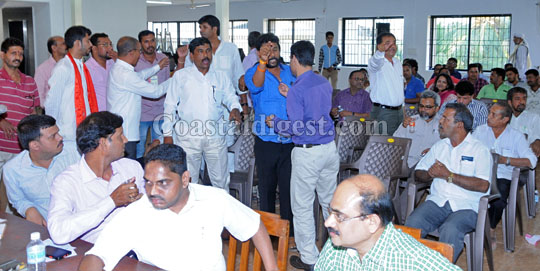
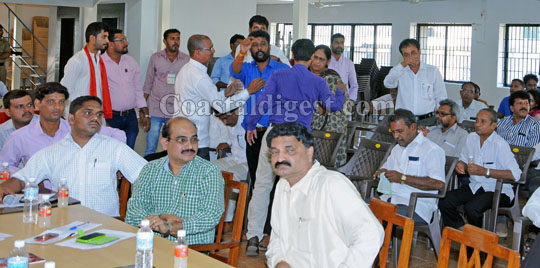
Mangaluru, Jan 9: A mild tension erupted at a ‘peace and harmony’ meet organised by Karnataka Journalists Union in association with Dakshina Kannada district administration at SCDCC auditorium in the city on Saturday.

kpsA 4

However, the situation did not go out of control thanks to the presence of senior police officers in the ‘Shanti Sauharda Adalat’ which attracted several prominent leaders from different religions and communities. A few leaders of saffron fringe groups also took part in the meeting.

The tension erupted when Congress leader Mithun Rai slammed immoral policing against couples and vigilante attacks during cattle transportations. Unable to bear Mr Rai’s comments Bajrang Dal leader began to counter him. This led to a verbal clash between the two for some time.

In another instance, a few leaders of saffron fringe groups alleged Dakshina Kannada deputy commissioner AB Ibrahim of perusing double standard and showing soft corner towards one particular community. Mr Ibrahim rubbished the claims and warned them against making baseless and communal allegations.

Also Read: Shanti Souharda Adalat: Religious leaders stress on peace, brotherhood

kpsA 3

Comments

oswald lobo
 - 
Sunday, 10 Jan 2016

i think beef should be banned, we can't afford to eat meat now its cost is rs 180 from rs 60 to 70. and also we can't get full beef meat even if we pay rs 180. it is also highly cholesterol. better beef should be banned.
like other states. beef stallers take adwantage of this matter there will be no more clashes or communal violence against cow slaughter. jai ho

Munnabhai
 - 
Sunday, 10 Jan 2016

Rowdy Mithun Rai is a repeat offender. He is aiming for MLA seat in the next election. He want to become Hero for minorities to get their votes. But minorities need to know, he is running Haram business (Amazon Pub) in front for SDM college and recently in news for beating innocents.

ummar
 - 
Saturday, 9 Jan 2016

NEED TO DUMP THIS SHARAN PUMPLE IN PUMPLE GARBAGE ,

USELESS GUY HE IS Y MEDIA FOCUS ON HIM ...... LEAVE HIM LET HIM GO TO HELL

Ayman hassan
 - 
Saturday, 9 Jan 2016

My humble request to all the officers of mangalore pls dump sharan borewell after no need any peace meeting in mangalofe arrest him & put goonda act on him

Add new comment

  • Coastaldigest.com reserves the right to delete or block any comments.
  • Coastaldigset.com is not responsible for its readers’ comments.
  • Comments that are abusive, incendiary or irrelevant are strictly prohibited.
  • Please use a genuine email ID and provide your name to avoid reject.
News Network
April 27,2020

New Delhi, Apr 27: Indian prime minister Narendra Modi has said the monthlong ongoing lockdown has yielded positive results and that the country has managed to save “thousands of lives”.

Modi, who had a videoconference with various heads of the states on Monday, said the impact of the coronavirus, however, will remain visible in the coming months, according to a press statement released by his office. On the issue of getting back Indians who are overseas, the Prime Minister said that this has to be done keeping in mind the fact that they don’t get inconvenienced and their families are not under any risk.

During the meeting with state heads, Modi advocated for social distancing of at least 6 feet and the use of face masks as a rapid response to tackle COVID-19.

He said that states should put their efforts of converting hotspots, or red zones, into “orange and thereafter green zones”.

India last week eased the lockdown by allowing shops to reopen and manufacturing and farming activities to resume in rural areas to help millions of poor, daily-wage earners. But the economic costs of the nationwide lockdown continue to mount in a country of 1.3 billion people.

Modi, who put India under a strict lockdown on March 25, did not say if the lockdown restrictions will extend after May 3.

India has confirmed over 27,000 cases of the coronavirus, including 872 deaths.

Comments

Add new comment

  • Coastaldigest.com reserves the right to delete or block any comments.
  • Coastaldigset.com is not responsible for its readers’ comments.
  • Comments that are abusive, incendiary or irrelevant are strictly prohibited.
  • Please use a genuine email ID and provide your name to avoid reject.
News Network
June 23,2020

Bengaluru, Jun 23: Police have nabbed two foreign nationals who were drawing money from ATMs of various banks by using fake ATM cards after collecting details of the card including code while customers used to withdraw money.

Police on Tuesday said that the arrested were identified as Felix Kisiibo (25), Present address Kogilu, Yelahanka, Bengaluru Native address BUGOBERO Village, Khabutoola sub-county, Manafwa District, Uganda and Khairun Abbdulla (32), Present address Kogilu, Yelahanka, Bengaluru Native address House Uzini Zanzibar, Mkele urban, Tanzania.

The duo by inserting Skirmish machine into ATM used to collect details of ATM cardholders, balance and code and then by using fake ATM cards used to withdraw the money without the knowledge of customers.

Comments

Add new comment

  • Coastaldigest.com reserves the right to delete or block any comments.
  • Coastaldigset.com is not responsible for its readers’ comments.
  • Comments that are abusive, incendiary or irrelevant are strictly prohibited.
  • Please use a genuine email ID and provide your name to avoid reject.
Agencies
May 8,2020

Washington D.C., May 8: The prime time for brain development in a child's life is the first year, where the infant spends most of the time asleep. It is the time when neural connections form and sensory memories are encoded.

However, when sleep is disrupted, as occurs more often among children with autism, brain development may be affected, too.

New research led by the University of Washington finds that sleep problems in a baby's first 12 months may not only precede an autism diagnosis but also may be associated with altered growth trajectory in a key part of the brain, the hippocampus.

The study, which was published in the American Journal of Psychiatry, researchers report that in a sample of more than 400 taken of 6- to 12-month-old infants, those who were later diagnosed with autism were more likely to have had difficulty falling asleep.

It also states that this sleep difficulty was associated with altered growth trajectories in the hippocampus.

"The hippocampus is critical for learning and memory, and changes in the size of the hippocampus have been associated with poor sleep in adults and older children.

As many as 80 per cent of the children with autism spectrum disorder have sleep problems," said Annette Estes, director of the UW Autism Center and senior author of the study.

"In our clinical experience, parents have a lot of concerns about their children's sleep, and in our work on early autism intervention, we observed that sleep problems were holding children and families back," added Estes, who is also a UW professor of speech and hearing sciences.

"It could be that altered sleep is part-and-parcel of autism for some children. One clue is that behavioural interventions to improve sleep don't work for all children with autism, even when their parents are doing everything just right. This suggests that there may be a biological component to sleep problems for some children with autism," said Estes.

To consider links among sleep, brain development, and autism, researchers at the IBIS Network looked at MRI scans of 432 infants, surveyed parents about sleep patterns, and measured cognitive functioning using a standardized assessment.

At the outset of the study, infants were classified according to their risk for developing autism: Those who were at higher risk of developing autism -- about two-thirds of the study sample -- had an older sibling who had already been diagnosed.

Infant siblings of children with autism have a 20 per cent chance of developing autism spectrum disorder -- a much higher risk than children in the general population.

In the current study, 127 of the 432 infants were identified as "low risk" at the time the MRI scans were taken because they had no family history of autism.

They later evaluated all the participants at 24 months of age to determine whether they had developed autism. Of the roughly 300 children originally considered "high familial risk," 71 were diagnosed with autism spectrum disorder at that age.

Problems with sleep were more common among the infants later diagnosed with an autism spectrum disorder, as were larger hippocampi. No other subcortical brain structures were affected, including the amygdala, which is responsible for certain emotions and aspects of memory, or the thalamus, a signal transmitter from the spinal cord to the cerebral cortex.

The authors note that while parents reported more sleep difficulties among infants who developed autism compared to those who did not, the differences were very subtle and only observed when looking at group averages across hundreds of infants.

Sleep patterns in the first years of life change rapidly as infants transition from sleeping around the clock to a more adult-like sleep/wake cycle. Until further research is completed, Estes said, it is not possible to interpret challenges with sleep as an early sign of increased risk for autism.


Comments

Add new comment

  • Coastaldigest.com reserves the right to delete or block any comments.
  • Coastaldigset.com is not responsible for its readers’ comments.
  • Comments that are abusive, incendiary or irrelevant are strictly prohibited.
  • Please use a genuine email ID and provide your name to avoid reject.