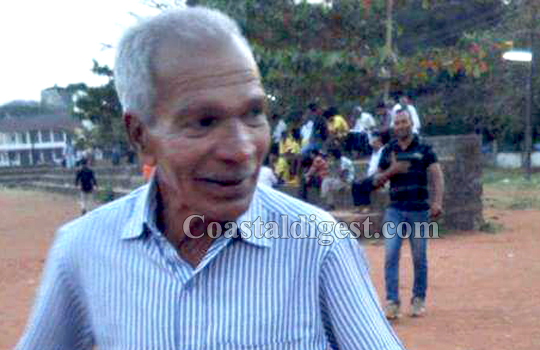
Mangaluru: Veteran football player, coach TA Rahman passes away

[email protected] (CD Network)
November 20, 2016

Mangaluru, Nov 20: T A Rahman, a veteran football player and coach, who had played in several national level tournaments, passed away here on Sunday. He was 74.

ta rahman

Rahman, who was also a banker, breathed his last at a private hospital where he had been admitted following old age ailments.

In 1960s he was a popular player in Mumbai, where he was working for a nationalised bank. He had represented Maharashtra state team in 1964 in the Santhosh Trophy.

He is survived by four daughters and two sons. Originally, he hailed from Town Compound in Bunder in the city. In recent years he was residing in Babbukatte near Thokkottu.

Expressing condolences to the sad demise of the footballer, D M Aslam, president, of Dakshina Kannada district football association, said that late Rahman had popularised the game of football in coastal Karnataka.

“He was a senior adviser of the football association. He was also an excellent football coach and trained many youngsters and students,” he said.

Comments

Roshan zaheer
 - 
Tuesday, 22 Nov 2016

Inna lillahi wa inna ilaihi rajioon
May Allah grant him jannatul firdous
He was famous for his corner shorts (like gugli, or curved corner shots)
He was my coach also
We miss him

Saleem
 - 
Monday, 21 Nov 2016

Inna lillahi wa inna ilahirajioon. Allahumma yaghfirlahu wa yarhamhu.

Shahul
 - 
Sunday, 20 Nov 2016

May allah bless highest place in Jannah and forgive his sins and accept his good deeds. Aameen

We lost a great sport personality.

Mohammad Irfan
 - 
Sunday, 20 Nov 2016

Inna lillaahi wa inna ilaihi rajioon.. May allah give him magfirath..

Mohammad Irfan
 - 
Sunday, 20 Nov 2016

Inna lillahi wa inna ilaihi rajioon.. May allah give him magfirath..

Mohammed Fayaz
 - 
Sunday, 20 Nov 2016

Sir T Abdur Rahman a well known football player cum coach in Mangalore city. Undoubtedly we have lost a great sports person as well as a soft hearted person. May Allah grant him jannah and forgive his sins..Ameen

Abdul
 - 
Sunday, 20 Nov 2016

Innalillahi vayinna ilaihi raajivoon., Allahummagfirlahu warhamhu...

Asif
 - 
Sunday, 20 Nov 2016

Inna Lillahi Wa Inna Ilaihi Rajioon...

Anwar kandak
 - 
Sunday, 20 Nov 2016

We lost a advisor for new generation for football in mangalore whom cannot compare or replace him.
We pray for his magifirath

Prof.M.Abubake…
 - 
Sunday, 20 Nov 2016

Inna lillahi wa inna ilaihi raajihoon. Allahummghfiralahu warhamhoo wahfu anhu yaa Rabbal AAlameen. ameen.

Add new comment

  • Coastaldigest.com reserves the right to delete or block any comments.
  • Coastaldigset.com is not responsible for its readers’ comments.
  • Comments that are abusive, incendiary or irrelevant are strictly prohibited.
  • Please use a genuine email ID and provide your name to avoid reject.
News Network
July 19,2020

Bengaluru, Jul 19: Karnataka Chief Minister B S Yediyurappa convened a meeting with Private Medical College Hospitals on Saturday to assess COVID-19 management and directed them to provide 50 per cent of the beds, as promised, with effect from Sunday.

The chief minister said that private medical college hospitals need to cooperate as there is a sharp rise in COVID-10 cases in the city. He further said that it has come to the notice of the government that some institutes are denying treatment of COVID-19 as well as non-COVID patients.

The chief minister expressed his concerns over media reports stating several people died as they didn't get timely treatment due to denial from the hospitals. He said that Bengaluru should continue to lead the country as a role model in COVID-19 management.

During previous meetings, private medical colleges had agreed upon providing around 4,500 beds, which would make the total beds available in government and private medical colleges 6,500.

The chief minister expressed dismay over some colleges not providing the number of beds as promised and also about certain lacunae which were noticed by ministers during their visit.
During this emergency situation, we should show humanity. COVID and non-COVID patients shall not be denied treatment and the balance in healthcare system shall be maintained, he advised.

He assured them of all support, including providing doctors and nurses if need be.
The private medical colleges had assured to provide 50 per cent of beds and some colleges offered 80 per cent of the beds for COVID treatment.

Nodal officers have already been appointed to monitor the availability of beds in these medical colleges.

It was decided to issue a notice to Vaidehi Medical College for their absence in the meeting.

Comments

Add new comment

  • Coastaldigest.com reserves the right to delete or block any comments.
  • Coastaldigset.com is not responsible for its readers’ comments.
  • Comments that are abusive, incendiary or irrelevant are strictly prohibited.
  • Please use a genuine email ID and provide your name to avoid reject.
News Network
April 2,2020

The current physical distancing guidelines provided by the World Health Organisation (WHO) and by the US Centers for Disease Control and Prevention (CDC) may not be adequate to curb the coronavirus spread, according to a research which says the gas cloud from a cough or sneeze may help virus particles travel up to 8 metres. The research, published in the Journal of the American Medical Association, noted that the the current guidelines issued by the WHO and CDC are based on outdated models from the 1930s of how gas clouds from a cough, sneeze, or exhalation spread.

Study author, MIT associate professor Lydia Bourouiba, warned that droplets of all sizes can travel 23 to 27 feet, or 7-8 metres, carrying the pathogen.

According to Bourouiba, the current guidelines are based on "arbitrary" assumptions of droplet size, "overly simplified", and "may limit the effectiveness of the proposed interventions" against the deadly pandemic.

 She explained that the old guidelines assume droplets to be one of two categories, small or large, taking short-range semi-ballistic trajectories when a person exhales, coughs, or sneezes.

However based on more recent discoveries, the MIT scientist said, sneezes and coughs are made of a puff cloud that carries ambient air, transporting within it clusters of droplets of a wide range of sizes.

Bourouiba warned that this puff cloud, with ambient air entrapped in it, can offer the droplets moisture and warmth that can prevent it from evaporation in the outer environment.

"The locally moist and warm atmosphere within the turbulent gas cloud allows the contained droplets to evade evaporation for much longer than occurs with isolated droplets," she said.

"Under these conditions, the lifetime of a droplet could be considerably extended by a factor of up to 1000, from a fraction of a second to minutes," the researcher explained in the study.

The MIT scientist, who has researched the dynamics of coughs and sneezes for years, added that these droplets settle along the trajectory of a cough or sneeze contaminating surfaces, with their residues staying suspended in the air for hours.

"Even when maximum containment policies were enforced, the rapid international spread of COVID-19 suggests that using arbitrary droplet size cutoffs may not accurately reflect what actually occurs with respiratory emissions, possibly contributing to the ineffectiveness of some procedures used to limit the spread of respiratory disease," Bourouiba wrote in the study


Comments

Add new comment

  • Coastaldigest.com reserves the right to delete or block any comments.
  • Coastaldigset.com is not responsible for its readers’ comments.
  • Comments that are abusive, incendiary or irrelevant are strictly prohibited.
  • Please use a genuine email ID and provide your name to avoid reject.
Wafa Sultana
April 4,2020

Over the last couple of days when the world was occupied with unifying efforts to fight the deadly Covid19 pandemic, sections of Indian media provided viewers a familiar scapegoat – the Indian Muslims – who are often stereotyped as a community being constantly at loggerheads with the citizenry and the State. Biased media channels were quick to resort to blaming the entire Muslim community for the spread of the disease in the country, thanks to an ill-timed Tablighi Jamaat gathering at its international headquarters in Delhi’s Nizamuddin. Unsurprisingly, the opprobrium was also marked by a sudden spike in WhatsApp forwards of videos with people wearing skullcaps licking spoons and performing Sufi breathing rituals, suggesting some sort of wild conspiracy on the part of the community to spread the virus.  Some media channels were quick to formulate, hypothesize and provide loose definitions of a newly discovered form of Jihad i.e. ‘Corona Jihad ’ thereby vilifying the Islamic faith and its followers.

While the investigation on the culpability of the organizers of the Nizamuddin event is still ongoing, there is enough information to suggest that the meeting was held before any lockdown was in force, and the problem began when there was no way of getting people out once the curfew was announced. Be that as it may, there is little doubt that organizing a meet of such a scale when there is a global pandemic smacks of gross misjudgment, and definitely the organizers should be held accountable if laws or public orders were defied. Attendees who attempt to defy quarantine measures must be dealt with strictly. However, what is alarming is that the focus and narrative have now shifted from the unfortunate event at Nizamuddin to the Tablighi Jamaat itself.

For those not familiar with the Tablighi Jamaat, the organization was founded in 1926 in Mewat by scholar Maulana Mohammad Ilyas. The Jamaat’s main objective was to get Muslim youth to learn and practice pristine Islam shorn of external influences. This is achieved through individuals dedicating time for moral and spiritual upliftment secluded from the rest of the world for a brief period of time. There is no formal membership process. More senior and experienced participants typically travel from one mosque to other delivering talks on religious topics, inviting local youth to attend and then volunteer for a spiritual retreat for a fixed number of days to a mosque in a nearby town or village to present the message to their co-religionists. Contrary to ongoing Islamophobic rhetoric, the movement does not actively proselytize. The focus is rather on getting Muslims to learn the teachings and practices of Islam.  This grassroots India-based movement has now grown to almost all countries with substantial Muslim populations. Its annual meets, or ‘ijtemas’ are among the largest Islamic congregations in the world after the annual Haj. One of the reasons for its popularity and wide network in the subcontinent and wordwide is the fact that it has eschewed the need for scholarly intervention, focusing on peer learning of fundamental beliefs and practice rather than high-falutin ideological debates. The Tablighi Jamaat also distinguishes itself from other Islamic movements through its strictly apolitical nature, with a focus on individual self-improvement rather than political mobilization. Hardships and difficulty in the world are expected to be face through ‘sabr’ (patience) and ‘dua’ (supplication),  than through quest for political power or influence. In terms of ideology, it is very much based on mainstream Sunni Islamic principles derived from the Deobandi school.

So, why is all this background important in the current context? While biased media entities have expectedly brought out their Islamophobic paraphernalia out for full display, more neutral commentators have tried to paint the Tablighi Jamaat as a fringe group and have tried to distance it from 'mainstream Muslims'. While the intent is no doubt innocent, this is a trap we must not fall into. This narrative, unfortunately, is also gaining ground due to apathy some Muslims have for the group, accusing it of being “disconnected from the realities of the world”. Unlike other Muslim organizations and movements, the Tablighi Jamat, by virtue of its political indifference, does not boast of high-profile advocates and savvy spokespersons who can defend it in mainstream or social media.  The use of adjectives such as 'outdated' and 'orthodox' by liberal columnists to describe the Jamaat feeds into the malignant attempt to change the narrative from the control of the spread of the pandemic due to the Nizamuddin gathering to 'raison d'etre' of the organization itself.

A large mainstream religious group like the Tablighi Jamaat with nearly a hundred-year history, normally considered to be peaceful, apolitical and minding its own business is now suddenly being villainized owing to unfortunate circumstances. Biased media reactions filled with disgust and hate seem to feed the Indian public conscience with a danngerous misconception - to be a nominal Muslim is okay but being a practicing one is not.  For those committed to the truth and fighting the spread of Islamophobia, the temptation to throw the entire Tablighi Jamaat under the bus must be resisted.

The writer is a lawyer and research scholar at Qatar University. Her research interests include Islamic law and politics.

Comments

zahoorahmed
 - 
Saturday, 4 Apr 2020

great article! provides a great perspective on tableeg jamat

Add new comment

  • Coastaldigest.com reserves the right to delete or block any comments.
  • Coastaldigset.com is not responsible for its readers’ comments.
  • Comments that are abusive, incendiary or irrelevant are strictly prohibited.
  • Please use a genuine email ID and provide your name to avoid reject.