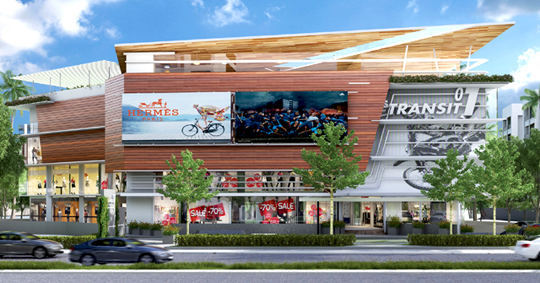
Mangaluru's first theme-based mall 'Transit One' set for launch

[email protected] (Business Desk)
March 5, 2016

Mangaluru: Ecologic Habitats is all set to launch Transit One, first of the Transit series of innovative theme-based malls, with the foundation stone laying ceremony on Friday November 20 at 5.30 pm in Thokkkottu.
transitone1

This was revealed by P S Mohammed, managing director, Ecologic Habitats at a press meet here on Thursday November 19.

The Mangaluru-based real estate development firm 'Ecologic Habitats' is all set to revolutionize the idea of traveling on the Indian highways with the concept of transit oriented development. Transit- one is strategically located on NH-66, Thokottu, the southern gateway to Mangaluru city.

Addressing the press meet, P S Mohammed said, "The idea is to maximize the shopping access to public and private transport along this busy freeway that connects Kerala to Mangaluru, Goa, Mumbai and so on. Transit One also caters to the Thokottu region, a fast growing suburb with numerous educational institutes and IT firms. The tagline 'Stop. Recharge. Restart' sums up the transit situated on 40 cents of land with 50,000 sq ft area of plush shopping experience. It addresses the need of the hour for towns like Thokottu, which otherwise would have to depend on nearby Mangaluru city to meet their routine shopping and recreational requirements.

"Transit One offers a wide range of products right from affordable mini boutique stores to large drive in supermarkets, restaurants, food courts, social clubs, thus catering to all sections of the society. The external facade also has a large electronic display screen where one can showcase their ideas and brands. Promoters of the project envision Transit One to be a 'Small world of large happiness'," he added.

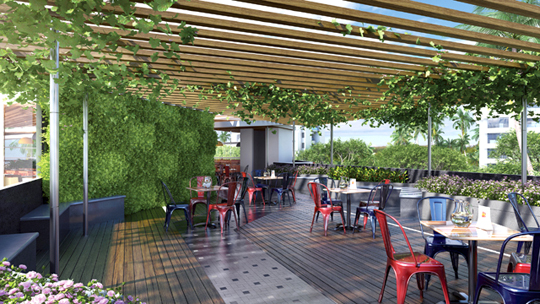
"The visitors step into the level 1 by strolling across the external landscaped plaza, where they are welcomed by their favourite branded stores. Level 2 is the urban fashionista's delight where a wide range of trendy apparel accessories catch your eye. Level 3 is what the Ecologic says is the modem version of the 'Old Indian Bazaar', where the local entrepreneurial spirit is at full display at the smaller boutique stores. Level 4 offers an extensive variety of culinary options with the perfect ambience," he explained.

"Ecologic Habitats boasts of raking in the services of the best in industry to design and implement the project. Well-landscaped environs is what we believe is at the core of our product portfolio. Services of a leading Bengaluru-based landscape architect has been sought to breathe in green into the entire shopping experience. At Ecologic Habitats it is our commitment to add value to all our buildings by breathing green into them. We aspire to partner with a like-minded set of discernible clientele, so that it can add value to their investments by consistently delivering products that inspire," P S Mohammed said.

Kareem, director and Pradeep Hegde, associate, Ecologic Habitats were present at the press meet.

transitone2

transitone3

Comments

priyanka
 - 
Sunday, 6 Mar 2016

this will be a different mall comparing to others. all the best ecological habitats.

aharkul
 - 
Saturday, 5 Mar 2016

I think this is the first one in Mangaluru. Lucky Mangalureans. I am very far from Mangaluru. In Sha Allah When I come to Mangaluru I will visit there and taste the things in every level.

Madhu
 - 
Saturday, 5 Mar 2016

wow wonderful looking very nice.

Add new comment

  • Coastaldigest.com reserves the right to delete or block any comments.
  • Coastaldigset.com is not responsible for its readers’ comments.
  • Comments that are abusive, incendiary or irrelevant are strictly prohibited.
  • Please use a genuine email ID and provide your name to avoid reject.
News Network
January 25,2020

Bengaluru, Jan 25: The Karnataka government would hold a Global Investors' Meet (GIM 2020) in Bengaluru from November 3-5 to showcase the southern state's ecosystem for attracting investments from the world over, an official said on Friday.

"Our Chief Minister B.S. Yediyurappa held the first road show on the GIM at the 50th World Economic Forum (WEF) annual meeting, being held at Davos in Switzerland and invited global firms to participate in the 3-day event for investment opportunities," additional secretary P. Ravikumar told IANS.

At a curtain-raiser on "Invest Karnataka 2020" on Thursday, the BJP Chief Minister said the theme of the GIM would be "Innovate Now. Growth Forever" as the state had one of the best natural and human resources for investing in manufacturing, services and agriculture sectors and creating jobs.

"About 100 entrepreneurs, businessmen and heads of global firms participated in the roadshow to assess the state's industrial policies, incentives, infrastructure, tax system and its ease of doing business for investment potential," Ravikumar said.

Among the participants at the event were Swiss-India parliamentary group president Niklaus-Samuel Gugger, Uber Chief Executive Dara Khosrowshahi, General Electric (GE) executive William Cowan and heads of Gemini Corporation, Coca Cola, SAP Labs, Swiss Re and Mitsubishi Heavy Industries.

"Khosrowshahi discussed Uber's expansion plans in Bengaluru and assured the Chief Minister of investing more in the state. Cowen expressed interest in the development of healthcare, renewable energy and power distribution across the state through partnership with the state government," the official noted.

The US-based transnational firm (GE) has a large presence in Bengaluru with one its largest engineering and technology centres and two production plants.

"A Coca Cola executive told Yediyurappa that the soft beverage firm would initially invest $25 million in its plants in the state and enhance it to $200 million to benefit farmers and rural people with access to clean drinking water in their villages," Ravikumar said.

The Chief Minister also sought to know the investment or expansion plans of global firms present in the state, especially Bengaluru and assured their heads of the state support in creating hundreds of jobs and wealth.

About 100 members of the Indian delegation to the WEF, led by Union Commerce and Industries Minister Piyush Goyal, Confederation of Indian Industry (CII) director-general Chandrajit Bannerjee, Bharat Forge chairman Baba Kalyani, Kirloskar Systems Managing Director Vikram Kirloskar, also participated in the state's GIM roadshow.

State Industries Minister Jagdish Shettar, chief secretary T. M. Vijaya Bhaskar, additional chief secretary E.V. Ramana Reddy and industrial department principal secretary Gurav Gupta also attended the state event.

"Emiriti Lulu Group chairman M.A. Yusuf Ali discussed plans to invest $300 million (Rs 2,160 crore) in logistics, hospitality and health/wellness sectors across the state with Yediyurappa," said Ravikumar.

Ali, an NRI (non-resident Indian) migrated to the United Arab Emirates (UAE) from Kerala two decades ago and founded the Lulu Group at Abu Dhabi to operate a chain of hypermarkets and retail firms since 2000.

"The Chief Minister assured Ali of speedy approvals and incentives for investing in the state, with ease of doing business," the official said in an e-mail to IANS from the Swiss town.

Asserting that his proactive government would work overtime to facilitate global investments in the southern state, Yediyurappa said he was committed to create more jobs across sectors.

Dassault Systems executive Florene Verzelen told the chief minister about her company's plans to set up centres of excellence in smart manufacturing and smart cities in the southern state.

"The centres will train and equip the youth with skilled jobs in large corporations the world over," Ravikumar reiterated.

Yediyurappa apprised US aerospace behemoth Lockheed Martin executive Richard Ambrose of the ecosystem for aerospace and defence industry in the state, especially Bengaluru.

"I will soon visit Bengaluru to explore the possibilities of investing more in Karnataka and taking up research and development work," said Ambrose on the occasion.

A delegation from global automotive component maker Denso also called on the chief minister and interacted with the state delegation.

The Japanese firm has an excellence and research centre in New Delhi and a manufacturing unit at Nelamangala on the outskirts of Bengaluru.

Denso executive Hiroyuki Wakabasyi said he would visit Bengaluru soon to explore further investments in the state.

"Arcelor Mittal chairman Laxmi Mittal also met the chief minister and discussed his company's investment plans in the state," the official added.

Mittal backed out of setting up a steel plant in the state's northern region over a decade ago due to delays in acquiring land and mandatory approvals.

Drug maker Novo Nordisk chief executive Lars Fruergaard expressed readiness to work with the state government in taking up educative and awareness programmes for diabetic patients.

Comments

Add new comment

  • Coastaldigest.com reserves the right to delete or block any comments.
  • Coastaldigset.com is not responsible for its readers’ comments.
  • Comments that are abusive, incendiary or irrelevant are strictly prohibited.
  • Please use a genuine email ID and provide your name to avoid reject.
News Network
February 4,2020

Bengaluru, Feb 4: Taking the state government to task, the Karnataka High Court on Monday opined there was a need to rehabilitate or compensate migrant workers whose homes in Tubarahalli and Kundalahalli were demolished by a BBMP engineer last month.

On January 19, the Bruhat Bengaluru Mahanagara Palike (BBMP) assistant executive engineer at Marathahalli had taken up a demolition drive stating that the migrant workers residing in the area were “illegal Bangladeshis”.

A division bench led by Chief Justice Abhay S Oka was hearing a petition by the People’s Union for Civil Liberties which contended that the evacuation of the workers was illegal. Stressing the need for relief, the court directed the state government to come clean on its stance and adjourned the hearing to February 10.

Advocate General Prabhuling K Navadgi submitted that the Union government had issued a circular last year to ascertain the presence of illegal Bangaladesh migrants. “On the basis of this circular, the BBMP officials had written a letter to Marathahalli police sub-inspector on January 18. Based on this letter, the residents in huts were evicted in a civilised manner,” he stated.

The bench, however, differed with the submission. “Who identified them as Bangladeshis before the eviction? Which is the competent authority to do so? Which police officer took up the inquiry?” the bench questioned.

The court also asked whether the government would take up similar eviction drives against illegal buildings of the rich. It also expressed displeasure over the action taken against the BBMP engineer.

“Instead of sending him home, you say you have transferred him. We can’t be mute spectators,” the bench said.

The court did not mince words as it castigated the authorities for failing to act judiciously. “The police and the BBMP are blaming each other. Your action appears to be dangerous. Going by the state of things, it seems that everything is not in order,” it said.

Comments

Add new comment

  • Coastaldigest.com reserves the right to delete or block any comments.
  • Coastaldigset.com is not responsible for its readers’ comments.
  • Comments that are abusive, incendiary or irrelevant are strictly prohibited.
  • Please use a genuine email ID and provide your name to avoid reject.
Ram Puniyani
February 4,2020

As democracy is seeping in slowly all over the world, there is an organization which is monitoring the degree of democracy in the individual countries, The Economist Intelligence Unit. As such in each country there are diverse factors which on one hand work to deepen it, while others weaken it. Overall there is a march from theoretical democracy to substantive one. The substantive democracy will herald not just the formal equality, freedom and community feeling in the country but will be founded on the substantive quality of these values. In India while the introduction of modern education, transport, communication laid the backdrop of beginning of the process, the direction towards deepening of the process begins with Mahatma Gandhi when he led the non-cooperation movement in 1920, in which average people participated. The movement of freedom for India went on to become the ‘greatest ever mass movement’ in the World.

The approval and standards for democracy were enshrined in Indian Constitution, which begins ‘We the people of India’, and was adopted on 26th January 1950. With this Constitution and the policies adopted by Nehru the process of democratization started seeping further, the dreaded Emergency in 1975, which was lifted later restored democratic freedoms in some degree. This process of democratisation is facing an opposition since the decade of 1990s after the launch of Ram Temple agitation, and has seen the further erosion with BJP led Government coming to power in 2014. The state has been proactively attacking civil liberties, pluralism and participative political culture with democracy becoming flawed in a serious way. And this is what got reflected in the slipping of India by ten places, to 51st, in 2019. On the index of democracy India slipped down from the score of 7.23 to 6.90. The impact of sectarian BJP politics is writ on the state of the nation, country.

Ironically this lowering of score has come at a time when the popular protests, the deepening of democracy has been given a boost and is picking up with the Shaheen Bagh protests. The protest which began in Shaheen Bagh, Delhi in the backdrop of this Government getting the Citizenship amendment Bill getting converted into an act and mercilessly attacking the students of Jamia Milia Islamia, Aligarh Muslim University along with high handed approach in Jamia Nagar and neighbouring areas.  From 15th December 2019, the laudable protest is on.

It is interesting to note that the lead in this protest has been taken by the Muslim women, from the Burqa-Hijab clad to ‘not looking Muslim’ women and was joined by students and youth from all the communities, and later by the people from all the communities. Interestingly this time around this Muslim women initiated protest has contrast from all the protests which earlier had begun by Muslims. The protests opposing Shah Bano Judgment, the protests opposing entry of women in Haji Ali, the protests opposing the Government move to abolish triple Talaq. So far the maulanas from top were initiating the protests, with beard and skull cap dominating the marches and protests. The protests were by and large for protecting Sharia, Islam and were restricted to Muslim community participating.

This time around while Narendra Modi pronounced that ‘protesters can be identified by their clothes’, those who can be identified by their external appearance are greatly outnumbered by all those identified or not identified by their appearance.

The protests are not to save Islam or any other religion but to protect Indian Constitution. The slogans are structured around ‘Defence of democracy and Indian Constitution’. The theme slogans are not Allahu Akbar’ or Nara-E-Tadbeer’ but around preamble of Indian Constitution. The lead songs have come to be Faiz Ahmad Faiz’s ‘Hum Dekhenge’, a protest against Zia Ul Haq’s attempts to crush democracy in the name of religion. Another leading protest song is from Varun Grover, ‘Tanashah Aayenge…Hum Kagaz nahin Dikhayenge’, a call to civil disobedience against the CAA-NRC exercise and characterising the dictatorial nature of the current ruling regime.

While BJP was telling us that primary problem of Muslim women is Triple talaq, the Muslim women led movements has articulated that primary problem is the very threat to Muslim community. All other communities, cutting across religious lines, those below poverty line, those landless and shelter less people also see that if the citizenship of Muslims can be threatened because of lack of some papers, they will be not far behind in the victimization process being unleashed by this Government.

While CAA-NRC has acted as the precipitating factor, the policies of Modi regime, starting from failure to fulfil the tall promises of bringing back black money, the cruel impact of demonetisation, the rising process of commodities, the rising unemployment, the divisive policies of the ruling dispensation are the base on which these protest movements are standing. The spread of the protest movement, spontaneous but having similar message is remarkable. Shaheen Bagh is no more just a physical space; it’s a symbol of resistance against the divisive policies, against the policies which are increasing the sufferings of poor workers, the farmers and the average sections of society.

What is clear is that as identity issues, emotive issues like Ram Temple, Cow Beef, Love Jihad and Ghar Wapasi aimed to divide the society, Shaheen Bagh is uniting the society like never before. The democratisation process which faced erosion is getting a boost through people coming together around the Preamble of Indian Constitution, singing of Jan Gan Man, waving of tricolour and upholding the national icons like Gandhi, Bhagat Singh, Ambedkar and Maulana Azad. One can feel the sentiments which built India; one can see the courage of people to protect what India’s freedom movement and Indian Constitution gave them.

Surely the communal forces are spreading canards and falsehood against the protests. As such these protests which is a solid foundation of our democracy. The spontaneity of the movement is a strength which needs to be channelized to uphold Indian Constitution and democratic ethos of our beloved country.

Comments

Add new comment

  • Coastaldigest.com reserves the right to delete or block any comments.
  • Coastaldigset.com is not responsible for its readers’ comments.
  • Comments that are abusive, incendiary or irrelevant are strictly prohibited.
  • Please use a genuine email ID and provide your name to avoid reject.