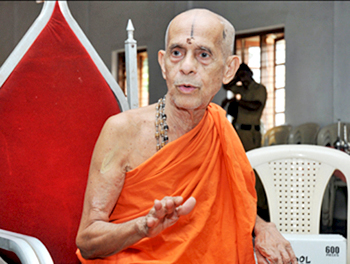
‘Many Hindus eat beef’: Pejawar seer refuses to withdraw statement

CD Network
June 30, 2017

Udupi, Jun 30: Sri Vishwesha Teertha Swamiji, the chief pontiff of Paryaya Pejawar Mutt has brushed aside the demand of fringe groups like Sri Ram Sena that he should apologize for revealing the fact that many Hindus also consume beef in India.pejawar

Several Hindutva hardliners including SRS chief Pramod Muthalik had slammed the senior pontiff and asked him to withdraw his statement which exposed the double standard of communal outfits that use beef as a pretext to target Muslims.

Replying to queries of media persons here on Thursday, the seer once again justified his decision to host iftar party for Muslims and allow them to offer namaz at the dining complex of the Krishna Mutt.

He also recalled an instance wherein leaders of Hindu community had reportedly reached an agreement with their Muslim counterparts to allow Muslims to offer namaz once in a week in the proposed Ram temple in Ayodhya when VP Singh was the prime minister of India.

The seer re-iterated that allowing Muslims to offer namaz cannot be an insult to Hindus or Hindu religion. Instead, it creates a positive opinion about Hindus among the followers of other faiths, he said.

Comments

Mohammed
 - 
Wednesday, 5 Jul 2017

Good for her. She has an amazing voice.
@Ahmd It would be nice if you keep your God stuff for yourself.

Pease
 - 
Wednesday, 5 Jul 2017

He is rowdy sheeter... no need of publicity....

Add new comment

  • Coastaldigest.com reserves the right to delete or block any comments.
  • Coastaldigset.com is not responsible for its readers’ comments.
  • Comments that are abusive, incendiary or irrelevant are strictly prohibited.
  • Please use a genuine email ID and provide your name to avoid reject.
coastaldigest.com news network
May 5,2020

The Department of Preuniversity Education, Karnataka has declared the board exams or pre university I exam results. To get results online, the students need to log on to result.bspucpa.com and have to provide their registration number and date of birth. 
Apart from the online portal, the students will get the results via mail or SMS.

“The results of the first year Pre-University Examinations will be announced on May 5. The results will be sent directly to students. Hence, colleges will not be displaying the results,” said S Suresh Kumar, Primary and Secondary Education Minister. 

The pre-university course of PUC is a two-year course including class 11 and class 12 called PUC I and PUC II. It is based on PUC score that candidates can get admission to varsities.

Earlier, the Karnataka PUC 1 result was to be announced on March 27 which was postponed and hence the revised dates are announced now.

The board exam results have been put on halt due to the nation-wide lockdown imposed after the coronavirus pandemic gripped India. As of May 3, the number of people infected by the coronavirus in India had crossed over 40,000.

The HRD Minister Ramesh Pokhriyal Nishank had in a meeting asked state and central boards to resume their evaluation process and declare the results to curb any further delay in the academic cycle. The academic cycle has been delayed by over a month due to the coronavirus. Now, the colleges will start by September instead of July.

Comments

Add new comment

  • Coastaldigest.com reserves the right to delete or block any comments.
  • Coastaldigset.com is not responsible for its readers’ comments.
  • Comments that are abusive, incendiary or irrelevant are strictly prohibited.
  • Please use a genuine email ID and provide your name to avoid reject.
News Network
June 28,2020

Udupi, Jun 28: The Padubidri police have booked cases against two patients of Novel Coronavirus for not revealing their primary contacts and hiding their travel history.

According to DHO Sudhirchandra Sooda, two siblings from Hejamadi in Padubidri had tested positive for COVID-19 recently. After shifting to the hospital, when the officials asked them about their primary contacts and travel history, the patients furnished false information.

When the officials collected information from various sources, they realised that the duo had travelled to Bantwal, Kasargod, Ullal and other places in Dakshina Kannada, said Dr Sooda. Hence, the district administration decided to file cases against them, he added.

Comments

Add new comment

  • Coastaldigest.com reserves the right to delete or block any comments.
  • Coastaldigset.com is not responsible for its readers’ comments.
  • Comments that are abusive, incendiary or irrelevant are strictly prohibited.
  • Please use a genuine email ID and provide your name to avoid reject.
Media Release
February 14,2020

Veteran journalist P. Sainath has said that the nation is in a crisis. And this crisis is not limited to just the rural area. It has become a national crisis at various areas such as agriculture, education, economy, job creation etc.

He was delivering the endowment lecture on the topic ‘Indian democracy at the post-liberalization and post-truth era’ at Media Manthan 2020 organized by the PG department of journalism and mass communication at St Aloysius College (Autonomous). 

Mr Sainath said that the many policies adopted in the 90s led to India becoming unusually unequal. Referring to the speech Ambedkar had made at the Constituent Assembly while handing over the draft of the Constitution, Mr Sainath said, “Ambedkar had warned about the weakness of Indian democracy that liberty without equality allows the supremacy of a few over the multitude. Liberty, equality and fraternity must be kept together as we cannot have one without the other.” 

Mr Sainath stated that the agrarian crisis was no longer about the loss of productivity, employment or about farmer suicide; it was a societal, civilizational crisis. Commenting on the lopsided policies such as cow-slaughter ban, he explained how cow slaughter ban had adversely affected many industries due to their interdependency. While Muslims who slaughtered cows were rendered helpless, the cattle traders who were mostly OBCs lost their earnings as the cattle prices crashed. An important industry like Kolhapur sandals industry in Maharashtra went bankrupt as a result of the cow slaughter ban in Maharashtra. He said the policymakers had no idea how the rural industries were interconnected. Demonetisation too devastated the rural economy as 98 percent of rural transactions happen through cash. 

Mr Sainath also spoke about the crisis of inequality which affects the Dalits and the Adivasis far more than anyone else as 90 percent of the rural households take home less than Rs 10,000/- per month. “Women are yet another group whose labour is never counted in the gross domestic product. Women and girls globally do unpaid work which amounts to about 12.5 billion working hours per year. Monetarily speaking, this is worth 10.8 trillion dollars,” Mr Sainath added. 

Speaking about the crisis of jobs Mr Sainath said that major companies were laying off employees just to create more profits for the investors and the adoption of artificial intelligence in the industry would further destroy millions of jobs.

Rector of St Aloysius College Institutions Fr Dionysius Vaz SJ, Principal Dr (Fr) Praveen Martis SJ, HOD of Journalism and Mass Communication department Dr (Fr) Melwyn Pinto SJ were present.

‘Veerappan and Vijay Mallya’s business models are interesting!’

Addressing the gathering during his endowment lecture on Friday, Mr Sainath made an interesting comment on the so called ‘revenue model’. “Whenever I visit IIMs and IITs for lectures on my PARI project, the students there ask me what my revenue model for my project is. I tell them that I do not have a revenue model. In fact, journalism does not begin with a revenue model. Gandhiji, Ambedkar, Bhagat Singh were all great journalists. But they did not have a revenue model,” Mr Sainath said.

On a lighter note, he said that the best revenue model that he liked was that of forest brigand Veerappan and liquor baron Vijay Mallya. “Veerappan ruled the forest for forty years and from the top ministers to the villagers he could dictate terms and liver royally. Similarly, Mallya’s revenue model was to steal the banks and run away abroad and live like a king,” Mr Sainath added.

Journalism is not and can never be a business. It is a calling, he opined. While newspaper can be a business, television can be a business, journalism per se cannot be reduced to a business. “Unfortunately today, journalists are recruited on a contract basis and they have no bargaining power; and there are no unions to fight for their cause. Hence, they are at the mercy of the corporate media houses for their survival and are made to write stories that cannot be called journalism,” Mr Sainath said.

Answering a question as to the pressures he faced as a journalist, he said that external pressures from the government or others could be very well handled. It is the internal pressures from once own media house that journalists find it difficult to manage.


 

Comments

Add new comment

  • Coastaldigest.com reserves the right to delete or block any comments.
  • Coastaldigset.com is not responsible for its readers’ comments.
  • Comments that are abusive, incendiary or irrelevant are strictly prohibited.
  • Please use a genuine email ID and provide your name to avoid reject.