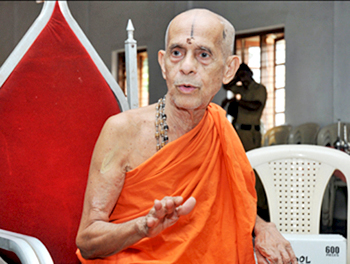
‘Many Hindus eat beef’: Pejawar seer refuses to withdraw statement

CD Network
June 30, 2017

Udupi, Jun 30: Sri Vishwesha Teertha Swamiji, the chief pontiff of Paryaya Pejawar Mutt has brushed aside the demand of fringe groups like Sri Ram Sena that he should apologize for revealing the fact that many Hindus also consume beef in India.pejawar

Several Hindutva hardliners including SRS chief Pramod Muthalik had slammed the senior pontiff and asked him to withdraw his statement which exposed the double standard of communal outfits that use beef as a pretext to target Muslims.

Replying to queries of media persons here on Thursday, the seer once again justified his decision to host iftar party for Muslims and allow them to offer namaz at the dining complex of the Krishna Mutt.

He also recalled an instance wherein leaders of Hindu community had reportedly reached an agreement with their Muslim counterparts to allow Muslims to offer namaz once in a week in the proposed Ram temple in Ayodhya when VP Singh was the prime minister of India.

The seer re-iterated that allowing Muslims to offer namaz cannot be an insult to Hindus or Hindu religion. Instead, it creates a positive opinion about Hindus among the followers of other faiths, he said.

Comments

Mohammed
 - 
Wednesday, 5 Jul 2017

Good for her. She has an amazing voice.
@Ahmd It would be nice if you keep your God stuff for yourself.

Pease
 - 
Wednesday, 5 Jul 2017

He is rowdy sheeter... no need of publicity....

Add new comment

  • Coastaldigest.com reserves the right to delete or block any comments.
  • Coastaldigset.com is not responsible for its readers’ comments.
  • Comments that are abusive, incendiary or irrelevant are strictly prohibited.
  • Please use a genuine email ID and provide your name to avoid reject.
News Network
July 4,2020

Bengaluru: The Secondary School Leaving Certificate (SSLC) examinations in Karnataka concluded on Friday with an overall average of about 98 per cent attendance amid the coronavirus scare. Chief Minister B S Yediyurappa congratulated the lakhs of students who appeared for the crucial exercise braving the coronavirus pandemic situation.

An average of about 98 per cent of 8.5 lakh odd enrolled students took the exams which began on June 25, after the government stuck to its decision to go ahead with them despite rising coronavirus cases but laid down a string of safety measures, including face masks and maintaining distancing by seating only one student a bench.

Examinations for all main subjects had been completed and alternative subjects such as music would take place on Saturday, Education department officials said.

"I heartily congratulate students who faced the examination even during the coronavirus pandemic," Mr Yediyurappa tweeted.

Expressing happiness over the successful completion of the examination, he greeted state Primary and Secondary Education Minister S Suresh Kumar, officers and employees of education department, health department, police and transport personnel.

"The exam is a proof that anything can be made possible if all the government departments work in tandem," Mr Kumar tweeted.

Later addressing a press conference, he said on Friday 98.10 per cent attendance was recorded compared to 98.76 for the same paper last year.

"Credit goes to children. First day, parents were scared and students were sceptical and there was a big challenge before us. But the children appearing for the exam instilled confidence. They came with masks, sanitisers and were careful about maintaining social distancing. Our children have set an example for others to follow," Mr Kumar said.

Lauding the students, parents and the government staff who made the exam possible ignoring the virus scare, Medical Education Minister Dr K Sudhakar said Karnataka has set an example by successfully conducting the examination.

The Karnataka Secondary Education Examination Board, which conducted the examination, faced various challenges. While protecting students from coronavirus infection was the top priority, transportation, security and convincing the parents to allow their children to take up the exam were the other factors it encountered.

According to sources in the department, the education officers had directed authorities of all the schools to call the parents and students to make sure that they appear for the examinations.

The Central Board of Secondary Education (CBSE) and boards of various neighbouring states either gave general promotion or decided to give marks to the students based on their performance in the earlier tests conducted by the schools.

The exams were conducted at a time when there was a sudden spurt in coronavirus cases in Karnataka, especially Bengaluru. Expressing apprehension, former chief minister and JD(S) leader H D Kumaraswamy had appealed to the government to postpone the examination but the government went ahead with its decision.

Comments

Add new comment

  • Coastaldigest.com reserves the right to delete or block any comments.
  • Coastaldigset.com is not responsible for its readers’ comments.
  • Comments that are abusive, incendiary or irrelevant are strictly prohibited.
  • Please use a genuine email ID and provide your name to avoid reject.
Agencies
July 5,2020

The deadly coronavirus that entered India while there was still nip in the air has beaten rising mercury, humid conditions, unique Indian genome and has entered monsoon season with more potency as fresh cases are only breaking all records in the country.

India recorded a single-day spike of record 24,850 new coronavirus cases on Sunday, taking its total tally to 6.73 lakh corona-positive cases.

Top Indian microbiologists were hopeful in March that after the 21-day lockdown, as summer approaches, the rise in temperature would play an important role in preventing the drastic spread of COVID-19 virus in India.

Several virologists hinted that by June this year, the impact of COVID-19 would be less than what it appeared in March-April.

The claims have fallen flat as the virus is mutating fast, becoming more potent than ever.

According to experts, the novel coronavirus is a new virus whose seasonality and response to hot humid weather was never fully understood.

"The theory was based on the fact that high temperatures can kill the virus as in sterilisation techniques used in healthcare. But these are controlled environment conditions. There are many other factors besides temperature, humidity which influence the transmission rate among humans," Dr Anu Gupta, Head, Microbiologist and Infection Control, Fortis Escorts Heart Institute, told IANS.

There is no built-up immunity to COVID-19 in humans.

"Also, asymptomatic people might be passing it to many others unknowingly. New viruses tend not to follow the seasonal trend in their first year," Gupta emphasized.

Globally, as several countries are now experiencing hot weather, the World Health Organization (WHO) reported a record hike in the number of coronavirus cases, with the total rising by 2,12,326 in 24 hours in the highest single-day increase since COVID-19 broke out.

So far over 11 million people worldwide have tested positive for the disease which has led to over 5,25,000 deaths, according to data from Johns Hopkins University. The US remained the worst-hit country with over 28 lakh cases, followed by Brazil with 15.8 lakh.

According to Sandeep Nayar, Senior Consultant and HOD, Respiratory Medicine, Allergy & Sleep Disorders, BLK Super Speciality Hospital in New Delhi, whether temperature plays a role in COVID-19 infection is highly debated.

One school of thought said in the tropical regions of South Asia, the virus might not thrive longer.

"On the other hand, another school of thought has found that novel Coronavirus can survive in a hot and humid environment and tropical climate does not make a difference to the virus. According to them, this is what distinguishes the novel coronavirus from other common viruses, which usually wane in hot weather," stressed Nayar.

Not much has been studied in the past and no definite treatment or vaccine is available to date.

"Every day, new properties and manifestation of the disease come up. As of now, the only way to prevent this monster is by taking appropriate precautions. Hand hygiene, social distancing, cough etiquette and face masks definitely reduce spread of COVID-19 infection," Nayar told IANS.

Not just top Indian health experts, even Indian-American scientists had this theory in mind that sunshine and summer may ebb the spread of the coronavirus.

Ravi Godse, Director of Discharge Planning, UPMC Shadyside Pennsylvania in the US told IANS in April: "In the summer, the humidity can go up as well, meaning more water drops in the air. If the air is saturated with water and somebody sneezes virus droplets into such air, it is likely that the droplets will fall to the ground quicker, making them less infectious. So the short answer is yes, summer/sunshine could be bettera.

According to Dr Puneet Khanna, Head of Respiratory Medicine and Pulmonology, Manipal Hospital, Delhi, COVID-19 death rates are not too different in tropical countries but since the disease affected them late it was yet to show its peak in these areas.

"The virus can survive well in hot and humid countries and this is proven now," he stressed.

Comments

Add new comment

  • Coastaldigest.com reserves the right to delete or block any comments.
  • Coastaldigset.com is not responsible for its readers’ comments.
  • Comments that are abusive, incendiary or irrelevant are strictly prohibited.
  • Please use a genuine email ID and provide your name to avoid reject.
News Network
July 8,2020

Bengaluru, Jul 8: The expert committee constituted by the Karnataka government to look into imparting online education in the wake of the COVID-19 lockdown submitted its report on Tuesday to the Minister for Primary and Secondary Education, S Suresh Kumar.

Amid growing pressure by educational institutions to allow them to run online classes for the students, the government set up the committee headed by noted educationist M K Sridhar.

The Minister told reporters that some schools wanted to run online classes, including for LKG and UKG students. It had also come to the government's notice that schools were reportedly charging hefty fees in the name of online teaching, he added.

"To address the concerns of parents, schools, and the future of the children, the committee was formed,"Kumar said. He further said that the government would study the recommendations and hold discussions with officials and various stakeholders before arriving at a decision.

The Education Department said that the committee, in its report, titled "Continuation of Learning in School Education of Karnataka: Guidelines During COVID-19 Pandemic for Technology Enabled Education and Beyond", has recommended teaching online or by using printed material. The committee suggested that children in the age group of three to six be taught online by way of story-telling, rhymes and games strictly in the presence of parents thrice a week just for one session a day For students from class one to three, it advised two periods a day and three days a week for online teaching.

Students from class three to five would have classes five days a week and two classes for 30 minutes a day. For students from class six to eight, there could be three classes a day for a duration of 30 minutes to 45 minutes each, while for students of class nine and 10 there would be four sessions a day between 30 and 45 minutes each.

The committee also suggested usage of Doordarshan and Akashwani for the government school children. Suresh Kumar said there were a few petitions filed in the Karnataka High Court regarding online teaching to the children.

Comments

Add new comment

  • Coastaldigest.com reserves the right to delete or block any comments.
  • Coastaldigset.com is not responsible for its readers’ comments.
  • Comments that are abusive, incendiary or irrelevant are strictly prohibited.
  • Please use a genuine email ID and provide your name to avoid reject.