Massive fire breaks out at Ajman residential building

March 29, 2016

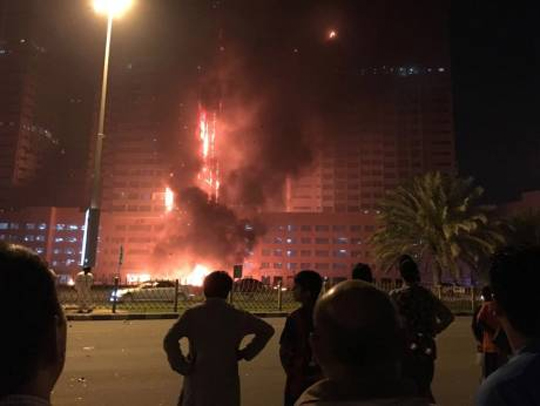
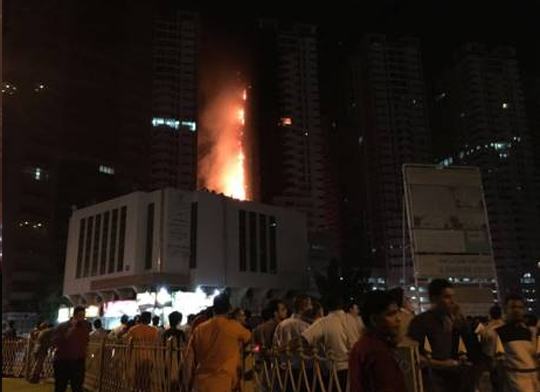
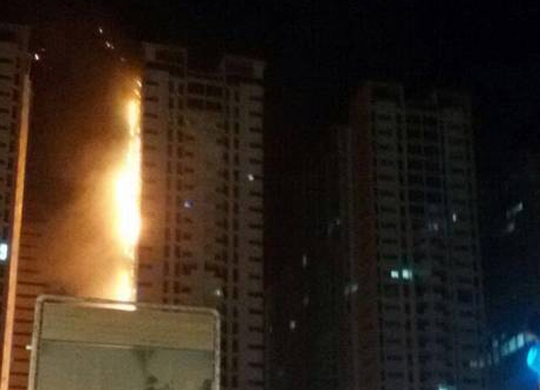
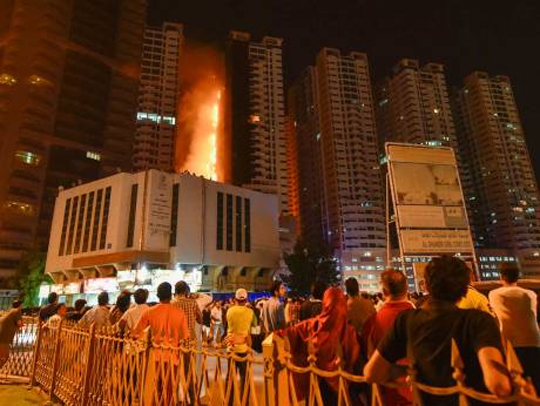
Ajman, Mar 29: A huge fire gutted at least two buildings in the Ajman One residential cluster of 12 towers close to the border with Sharjah on Monday night. Fire mainly damaged tower 1.
ajmanfire1

Brigadier Shaikh Sultan Bin Abdullah Al Nuaimi, Commander-in-Chief of Ajman Police, said five people sustained minor injuries and they were treated at the site. A pregnant woman was rushed to Shaikh Khalifa Hospital as she suffered from dyspnea.

Ajman Civil Defence tweeted early Tuesday morning that although the fire had been controlled, the cooling process was underway.

The operations room had received a call about the fire at 9.45pm. Civil Defence, rescue and ambulance teams rushed to the scene. Traffic on roads leading to the area had come to a virtual halt.

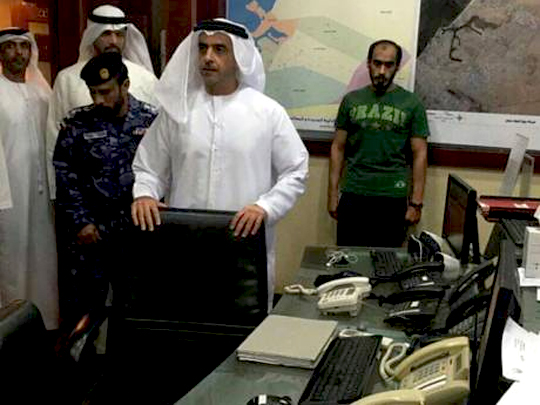
Lieutenant General Shaikh Saif Bin Zayed Al Nahyan, Deputy Prime Minister and Minister of Interior, rushed to Ajman to follow-up on the details of the firefighting operations, through the Command and Control Center at Ajman Central Operations Room at the Directorate General of Civil Defense in Ajman.

Bismillah, a Pakistani tenant of tower 8 in the complex said her three children rushed down 19 floors to safety. Tenants gathered around the complex as the buildings burned. "We are all very distraught. We have lost everything," she said.

Several units battled the huge blaze well into the night.

Flames are seen raging while the area has been cordoned off leading to huge traffic jam Ajman and Sharjah. Fire fighters were busy putting out the fire until late into the night.

“My flat is completed gutted,” said another resident while wiping away tears. "I have lost everything including my documents and I have no place to stay.”

Tower 6 was gutted by midnight as the inferno continue to rage through the building.

It didn't appear to spread to any other building after tearing through tower 8, 7, and 6.

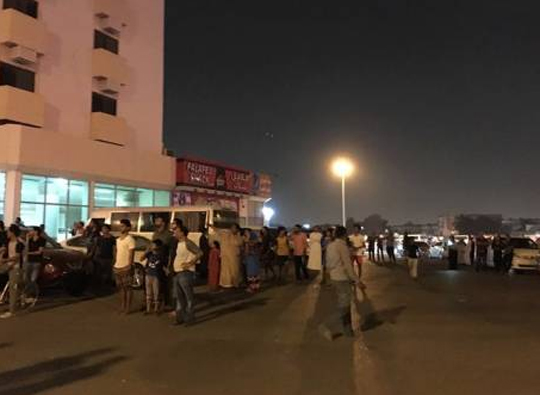
Many tenants were in tears as the building burned. Huge crowds that gathered to watch the incident dispersed somewhat after midnight but many people continued to take pictures and videos.

"All I have left are the clothes on my back, " said an Indian tenant of tower 6, who lived on floor 22.

"My colleague is coming to pick me up. I am too disturbed to make sense of it all."

Buildings in the complex apparently untouched by the fire were empty as tenants had been evacuated.

"I am waiting to see if I will be let back in. Otherwise I will have to sleep on the beach tonight," said Katerina, a tower 3 tenant from Ukraine.

"I can't believe how quickly all this happened last. I saw the fire from my window and as a precaution grabbed my documents and left the building. It was not a huge fire then."

Fire trucks, police and ambulance units remained on the site. Police kept pushing forward the cordoned area away from the complex as fiery debris rained down.

People stood watching the flames well into the night.
ajmanfire6

ajmanfire2

ajmanfire3

ajmanfire4

ajmanfire5

Comments

Ahmed
 - 
Tuesday, 29 Mar 2016

sorry some correction....It should be abula hab Not abu thalib

Add new comment

  • Coastaldigest.com reserves the right to delete or block any comments.
  • Coastaldigset.com is not responsible for its readers’ comments.
  • Comments that are abusive, incendiary or irrelevant are strictly prohibited.
  • Please use a genuine email ID and provide your name to avoid reject.
Agencies
February 6,2020

Even more than three years after demonetisation and all-out efforts to make most transactions through electronic, cash is still king, as it thrives in a digital India, said fintech start-up Paytm founder Vijay Sekhar Sharma.

"While cashless economy is not possible in India, less cash economy will be in the future. Less cash is the only solution, not the elimination of cash," Sharma told IANS in an interview after unveiling an all-in-one payment gateway on Tuesday.

Asserting that it would take 5-10 years for India to make the transition to digital payments from the traditional mode of cash, Sharma, 41, said the e-payment industry benefitted more from the November 8, 2016 note ban and withdrawal of old Rs 1,000 and Rs 500 denominations.

"I think it (demonetisation) helped the industry despite lack of specific help. But the world has changed since then. It is about the scale of distribution of merchants that is what is propelling digital payments," said Sharma.

Most of the cash not only came back into circulation, but also remains as the mode of payment for the majority due to its convenience for the people used to such transactions.

Expounding Paytm's zero service charge, Sharma said the strategy is sustainable as it leads to acquiring more customers and merchants, enabling newer business opportunities.

Paytm also does not levy a service charge to small merchants for its payments services, unlike organised players like Uber.

"Though there is a monetisation model, the merchants who are small shopkeepers, become our financial services customers as they open a bank account, which is profitable."

Paytm secured a Payments Bank license from the Reserve Bank of India to offer a savings bank account, Rupay debit card and money transfer services.

"We are banking on payment services acquiring customers and merchants who avail banking, lending, insurance, wealth and software services like billing software and business ledger software services eventually," Sharma noted.

The mobile first bank services include zero balance and zero digital transaction charge accounts.

"Basically, payments, cloud, commerce and financial services are a cohort we follow. So, payments is our customer as well as merchant acquisition. If it breaks even, we are happy because other line items make more money, he affirmed.

Noting that in a market like India, one cannot price services at a premium unlike in a developed country like the US, the billionaire businessman said a consumer in a developing country would not be able to afford such a hefty charge.

Forbes ranked Sharma as India's youngest billionaire in 2017, with a net worth of $2.1 billion.

While several countries operate on the model of higher service charges, Sharma said newer business models have to be discovered in India, as customer lifecycle value is accounted for more stages than in other nations.

Asked about an upscale retailer like Zara not giving a wallet payment option during its recent end of season sale in Bengaluru, Sharma said Paytm was addressing such hiccups with its all-in-one payment solutions.

"It's an opportunity, because if the retailer has our all-in-one point of sale machine, where in they enter the amount, it shows both the Quick Response code (QR) and card payment options," he observed.

Sharma compared older swiping payment machine to feature phones and modern ones to feature-rich smartphones.

"If you notice, they look like feature phones and the modern day card machine is more a smartphone like. You can add the smatphone components, which can add the features," reiterated Sharma.

Though Paytm's all-in-one QR point of sale machine integrates the billing system, its chief executive said it was not ideal to have an independent QR feature.

Paytm has 16 million strong merchant user base, which Sharma aims to raise to 26 million base in the next one year.

Sharma has launched in this tech city an all-in-one payment gateway and Paytm Business Payments solution, which enable digital payments through multiple methods for small and medium enterprises (SMEs) and an Android point of sale machine.

With the new gateway solution, collecting digital payments through multiple methods can be achieved seamlessly while Paytm Business Payments solution enables automated vendor payments, including employee salaries and customer refunds among others.

The One97 Communications-owned Paytm aims to help SMEs streamline and digitise their business activities using its new solutions, which enhance the overall efficiency of both accepting and making payments.

Paytm has a data bank of over 200 million saved cards and bank accounts, a feature which enables partner apps to shorten transaction times and propel faster conversions while using the all-in-one payment gateway.

Complementing the two solutions, Sharma also launched an all-in-one Android point of sale machine, which can accept payments through all forms such as cards, wallets, UPI apps and even cash.

The device has a QR code that supports all contact and contactless payments, coming with integrated billing software customized solutions for different sectors such as catering, ticketing, parking and others.

The handheld Android device is equipped with an in-built printer, scanner and can also generate bills.

Valued at $16 billion, Paytm is not alone in the fiercely competitive Indian fintech space where a dozen players like PhonePe, MobiKwik, Kotak 811 and deep pocketed international giants Google Pay and Amazon Pay are in the fray.

Comments

Add new comment

  • Coastaldigest.com reserves the right to delete or block any comments.
  • Coastaldigset.com is not responsible for its readers’ comments.
  • Comments that are abusive, incendiary or irrelevant are strictly prohibited.
  • Please use a genuine email ID and provide your name to avoid reject.
coastaldigest.com web desk
June 27,2020

New Delhi, June 27: The Prime Minister Narendra Modi-led union government of India is not ready to stop all imports from aggressive China in spite of mount calls to boycott Chinese products in India.

The Centre is reportedly considering to stop only non-essential imports from the neighbouring country.

However, the Inward shipment in sectors such as automobiles, pharmaceuticals, certain electronics and others will continue until a domestic alternative is found.

“India will gradually move towards import substitution. It will not happen overnight. In the meantime, attention has to be paid on production and job creation. We cannot throttle our industry. There are certain absolutely essential imports. Needless to say, those will keep going,” official sources said.

Sources said that both the government and the industry are in the process of identifying products that can be domestically manufactured in the medium term. There are certain chemicals, automotive components, handicrafts, cosmetics, agriculture items and certain consumer electronics, which can be manufactured domestically in the short to medium term. The government is doing all it can to raise the capacity of domestic industries.

However, there are certain other imports in the automobile and the pharmaceutical sectors which cannot be done away within the short to medium term. Their domestic production at the moment may not be that cost-effective.

The six-crore strong traders’ body CAIT has been at the forefront of such a demand and has launched a campaign to celebrate Indian Diwali this year with a total absence of Chinese goods.

“Ease of doing business, capital availability at lower rates and globally competitive logistics and energy costs are some of the prerequisites that the government should look into to ensure the growth of the domestic auto component industry,” according to Automotive Component Manufacturers Association of India (ACMA) Director General Vinnie Mehta.

Maruti Suzuki Chairman R C Bhargava said, “People who are boycotting Chinese goods have to remember that in some cases it may lead to their being asked to pay more for the same product."

Meanwhile, domestic rating agency Acuite Ratings & Research has analysed the current import portfolio from China and found 40 sub-sectors have the potential to lower their import dependency on China. These sectors contribute to $33.6 billion worth of imports from China and about 25% of these imports can be substituted by local manufacturing without any significant additional investments.

Comments

Add new comment

  • Coastaldigest.com reserves the right to delete or block any comments.
  • Coastaldigset.com is not responsible for its readers’ comments.
  • Comments that are abusive, incendiary or irrelevant are strictly prohibited.
  • Please use a genuine email ID and provide your name to avoid reject.
News Network
April 28,2020

Bengaluru, Apr 28: With fresh guidelines on the COVID-19 lockdown expected soon, Karnataka Chief Minister B S Yediyurappa on Monday chaired a meeting with key ministers, officials and Deputy Commissioners of districts and discussed about re-starting economic activities in the state, as he took stock about of the pandemic.

"At the video conference with DCs, CM took stock of COVID-19 situation and measures taken to control its spread. Discussions also happened regarding starting of certain economic activities in parts of the state," official sources said. The state government would take any decision in this regard after the Centre issues fresh guidelines or directives, they said, without elaborating.

The meeting came hours after Prime Minister Narendra Modi held a video conferencing with Chief Ministers to discuss the situation arising due to COVID-19 in the country, which is under lockdown since March 25 to contain the pandemic. Only nine chief ministers spoke in the virtual meeting with the Prime Minister and Yediyurappa did not get an opportunity.

A senior Minister, who attended the meeting told PTI, necessary directions regarding the lockdown after May 3, they were likely to come in a couple of days.

"Most of the Chief Ministers wanted the lockdown to continue to contain the spread.... nothing concrete emerged, but we expect the necessary directions will follow in couple of days. This is what we expect after seeing what has happened as a followup to three to four such video conferences in the past," he said.

The Minister said the larger opinion was that the current measures should continue and interstate or inter-district movement should not be allowed. Regarding movement within the districts that are green zone, some decision may be taken soon, he said, adding the Prime Minister also asked states to concentrate on reforms, aimed at attracting investments in the days to come.

Comments

Add new comment

  • Coastaldigest.com reserves the right to delete or block any comments.
  • Coastaldigset.com is not responsible for its readers’ comments.
  • Comments that are abusive, incendiary or irrelevant are strictly prohibited.
  • Please use a genuine email ID and provide your name to avoid reject.