



MCC, giant industries to repair Suratkal-Kana-MRPL road jointly

[email protected] (CD Network)
October 18, 2016

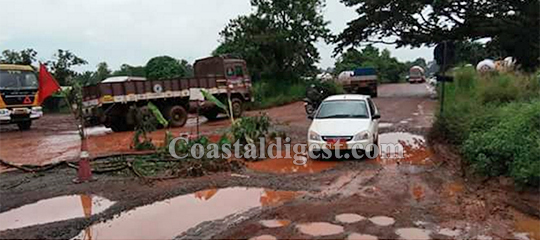
Mangaluru, Oct 18: The Mangaluru City Corporation and the giant industries that operate heavy bullet tankers on Suratkal-Kana-MRPL Road have finally reached an accord to repair 4.5 km long stretch.
mcc

In a meeting convened by Dakshina Kannada MP Nalin Kumar Kateel on Monday, Mangaluru Mayor Harinath, MRPL officials and some councillors agreed in principle to repair the road first with funds drawn from the share of major industries using the road and also from the civic body.

Mr Kateel convened the meeting two days after Mr Harinath wrote to Prime Minister Narendra Modi to direct MRPL to repair the road using its corporate social responsibility fund.

The Mayor later said that it was decided to hold another round of meeting on Friday by inviting more stakeholders using the particular road which is in pathetic condition.

The Mayor said that the MP promised that officials of HPCL, BASF and other industries using the road would be invited to Friday's meeting and their share of fund would be decided there.

The officials who participated in Monday's meeting estimated that it might require about Rs. 1.50 crore to repair the road now.

The Mayor said that if the same road was to be concreted, it might require Rs. 45 crore. Some in the meeting suggested that after concreting the road, toll could be collected from the users. No decision has been taken yet.

It may be recalled here that, the Mayor on October 4 had threatened of sitting in dharna in front of MRPL if the company did not start repair work within 20 days. He blamed the company for the bad condition of the road.

Also Read:

Stop drama and fix Suratkal- Kana road: Residents tell MCC, MRPL

Sorry, no money to repair Suratkal-Kana road: MRPL replies to MCC

Your giant vehicles spoiled Suratkal- Kana road; repair it now: Mayor to MRPL

Comments

Rakshith
 - 
Tuesday, 18 Oct 2016

Good job Mayor..atleast u r able to make our MP awake...what about MLA?..now he will jump into picutre to take credit..

Add new comment

  • Coastaldigest.com reserves the right to delete or block any comments.
  • Coastaldigset.com is not responsible for its readers’ comments.
  • Comments that are abusive, incendiary or irrelevant are strictly prohibited.
  • Please use a genuine email ID and provide your name to avoid reject.
News Network
July 6,2020

Bengaluru, Jul 6: As COVID-19 cases continue to surge in Karnataka, more than 20 police stations were sealed in Bengaluru after many policemen tested positive for novel coronavirus.

"Since the last few weeks, the number of COVID-19 cases in the police department has increased as many of the policemen have tested positive, so that's the reason why the police have taken a decision to close police stations," Bengaluru Commissioner of police Bhaskar Rao said.

He added, "However, people can lodge their complaints and other issues can be solved in help desks launched outside premises of the police station. Most of the areas where positive cases found in the police station are been sealed down for the safety of the people and sanitised them."

However, some of the police stations would be functional from outside the premises.

Commercial Street, Cottonpete, Chickepete, KG Halli traffic police station are among the few stations closed due to scare of the coronavirus spread after some policemen tested positive in particular stations.

Rao further said that the traffic police, civil police along with home guards have been given safety gloves, face masks, and sanitizers along with face covers by the department of police.

According to the Union Health Ministry, 23,474 COVID-19 cases have been reported in the state, as of Monday.

Comments

Add new comment

  • Coastaldigest.com reserves the right to delete or block any comments.
  • Coastaldigset.com is not responsible for its readers’ comments.
  • Comments that are abusive, incendiary or irrelevant are strictly prohibited.
  • Please use a genuine email ID and provide your name to avoid reject.
News Network
April 11,2020

Bengaluru, Apr 11: Former prime minister H D Deve Gowda claimed the lockdown decision was taken in 'haste' without forethought because of which farmers and the working class were 'suffering' and suggested measures to mitigate the impact. The state government should have consulted experienced citizens, officials, progressive farmers, farmer organisations and wholesale traders about the pros and cons before lockdown, he said in a letter to Chief Minister B S Yediyurappa, while highlighting that 61 per cent of the state's population depended on agriculture.

Because of the "hasty decision taken without any preparations", farmers of the country and the state are facing financial distress," he said in the April 9 letter, a copy of which was released to media here on Friday. The JD(S) patriarch suggested taking up some measures, including ensuring no restrictions on agriculture activities, procurement of horticulture produce at a fair price, relaxing export curbs on it, to provide relief to farmers, agriculture labourers, and daily wage workers.

On Sunday, Gowda had said he has assured Prime Minister Narendra Modi of his support in the nation's battle against COVID-19 pandemic when the latter called him to discuss the situation. In his letter to the chief minister, Gowda said: "...the lockdown implemented to control the spread of coronavirus has led our farmers into despair and put their lives into a burning fire.

This lockdown looks like a decision taken at haste without proper thinking and forethought for our farmers, agriculture labourers, and daily wage workers." He said the lockdown decision was taken after remaining 'quite' for about two months since the first corona infection was reported in the country on January 30. Among the suggestions made by the former prime minister include, procurement of horticulture produce at a fair price like in the case of milk from villages by the government through related organisations like Karnataka Horticulture Federation, HOPCOMS among others.

As horticulture produce was perishable, there should be no restriction on its procurement, transportation and marketing; all processing related activities of horticulture produce should be given relaxation from the lockdown, he said. Gowda also called for relaxation on exports for horticulture produce and its processed items. There should be no restriction on agriculture activities; a national grid has to be set up for marketing of horticulture produce, he said.

If such measures were not taken up immediately, the government will have to pay compensation to farmers for losses. Lack of remedial measures would lead to a shortage of supply, leading to rebellion from the people and may result in farmers' suicides and bringing about a situation that might be more grave than coroanvirus, he said.

Comments

Add new comment

  • Coastaldigest.com reserves the right to delete or block any comments.
  • Coastaldigset.com is not responsible for its readers’ comments.
  • Comments that are abusive, incendiary or irrelevant are strictly prohibited.
  • Please use a genuine email ID and provide your name to avoid reject.
News Network
February 28,2020

Bengaluru, Feb 28: Historian S. Shettar, 85, breathed his last early on February 28 in Bengaluru. He was suffering from respiratory problems and was hospitalised for over a week.

Shettar was known for his multi-disciplinary work, encompassing linguistics, epigraphy, anthropology, the study of religions and art history. He had extensively worked on the Jain practice of ritual death in Karnataka and Asoka edicts. He had studied and compiled early edicts in Kannada and worked extensively on the growth of Kannada language down the ages.

Born in 1935 at Hampasagara, Ballari district, he went on to study at Cambridge University and started his career as a Professor of History at Karnatak University, Dharwad, his alma mater. He later headed the National Museum Institute of the History of Art, Conservation and Museology in 1978 and Indian Council for Historical Research in 1996. He was also a visiting professor at the National Institute of Advanced Studies, Bengaluru.

He was a bilingual historian who wrote in English for most of his career, but started writing in Kannada in later years. In the last two decades, he developed a keen interest in linguistics and wrote multiple books on classical Kannada and Prakrit. His 2007 book “Shangam Tamilagam” is considered a seminal work in the study of the early period of Dravidian languages. It won him Bhasha Samman from Central Sahitya Akademi. He later wrote two works on Halegannada, classical Kannada. His most recent work was “Prakrita Jagadvalaya” in 2018.

Comments

Add new comment

  • Coastaldigest.com reserves the right to delete or block any comments.
  • Coastaldigset.com is not responsible for its readers’ comments.
  • Comments that are abusive, incendiary or irrelevant are strictly prohibited.
  • Please use a genuine email ID and provide your name to avoid reject.