Meet Ayesha Aziz, India's youngest pilot who secured license at 16!

[email protected] (Anjali Bisaria, IndiaTimes)
May 10, 2016

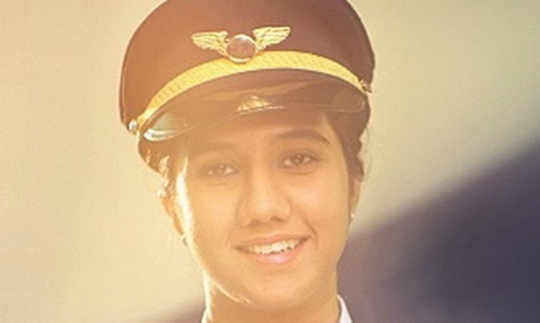
May 10: Ayesha Aziz was all of 16 when she got licensed as a pilot. The girl, who dreamt of flying planes when she grew up, got her wish fulfilled and how! At 20, the young achiever feels proud to have become the country's youngest pilot!

ayesha 3

Ayesha always wanted to do something challenging and unconventional. "More than being India's youngest pilot, I am happy for having accomplished my childhood goal," said Ayesha, as reported by The New Indian Express.

A resident of Mumbai, Ayesha's love for flying took root whenever she visited her native place, Kashmir. The twice-a-year trips to the valley made Ayesha more determined to become a pilot when she grew up.

"While I would enjoy take-off and landing of the plane, my brother would be scared and always sleep during the flight," chimed Ayesha.

The lucky girl also got the chance to visit NASA and meet John McBride. But her favourite moment was when she met her "second greatest inspiration" - astronaut Sunita Williams.

"I met her when she came to Worli in 2013 or 2014. I shared my experiences with her. I told her about the activities I participated in NASA like scuba diving, moon walk and bunny walk which an astronaut should know," she said.

Ayesha joined a flying school after she passed high school. She took ground lessons and passed five viva sessions. And as soon as she turned 16, she was awarded her student pilot license in November 2013. However, due to financial constraints, her training in commercial flying got delayed.

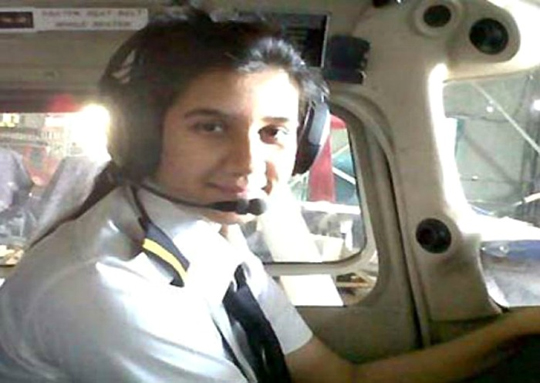
She currently pilots single engine Cessna 152 and Cessna172.

At the Bombay Flying Club, Ayesha is one of the only 4 girls studying B.Sc. third year in Aviation. But this doesn't pull her down and once she completes 80 hours of the total 200 hours of flying, Ayesha will finally gain her commercial pilot licence.

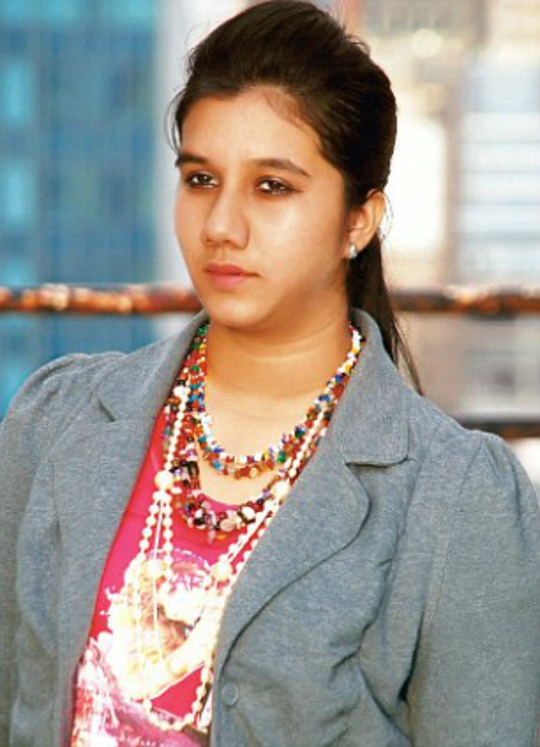
Apart from flying, Ayesha has done several photo shoots for a magazine and even done an ad commercial for Whisper.

Women like Ayesha Aziz and Saara Hameed Ahmed (India's first Muslim woman pilot) are showing what it is to chase their dreams with ardent fervour and not bow down to the pressures that usually force women to abandon theirs.

Ayesha, you are an inspiration to girls everywhere. May you soar to new heights in life!

ayesha 1

ayesha 2

ayesha 4

Comments

Nasir KK
 - 
Tuesday, 10 May 2016

Ayesha., you are the inspiration to girls everywhere. may you soar to new heights in life...all the best.

Add new comment

  • Coastaldigest.com reserves the right to delete or block any comments.
  • Coastaldigset.com is not responsible for its readers’ comments.
  • Comments that are abusive, incendiary or irrelevant are strictly prohibited.
  • Please use a genuine email ID and provide your name to avoid reject.
News Network
February 4,2020

Bengaluru, Feb 4: Congress leader and former minister U T Khader today demanded an “objective” probe by an IAS officer into the sedition case the police have booked against a school in Bidar for a play students staged on the controversial Citizenship (Amendment) Act.

On January 26, the Shaheen Primary and High School was charged by the Bidar New Town police with sedition on January 26. This was based on a complaint by an Akhila Bharatiya Vidyarthi Parishat (ABVP) worker who claimed that the play staged by the students on January 21 “insulted” Prime Minister Narendra Modi.

On January 30, the police arrested Nazbunnisa, the mother of an 11-year-old student and Fareeda Begum, a head-teacher in the school.

“This shows how today in India and in Karnataka, the BJP is looking to suppress the voices of people. Sedition cases have no value anymore,” UT Khader told a news conference.

“When a complaint on sedition is filed, action must be taken after obtaining legal opinion. But today, a written complaint by any BJP worker is enough to brand someone as anti-national. Even schoolchildren aren’t spared,” Khader said.

“An IAS officer should be appointed to objectively probe this. If something is found, then the police can continue the investigation,” Khader said. “But the government should pressurize the police. We’ve seen what happened in Mangaluru,” he said, referring to the police shootout that killed two people during an anti-CAA protest. “I know it’s difficult for officials to resist political pressure, but a line must be drawn. All officials must come together and send the government a message, that they will not be bogged down to pressure that’s against societal interests,” he added.

Khader said he lacked faith in the BJP government. “That’s because the BJP tends to give election tickets to those who plant bombs,” Khader said, citing the example of terror-accused Bhopal MP Pragya Thakur. “Even the Aditya Rao case (Mangaluru airport bomb planter)...we don’t know what’s happening. They just want to hush it up,” Khader charged.

Comments

Add new comment

  • Coastaldigest.com reserves the right to delete or block any comments.
  • Coastaldigset.com is not responsible for its readers’ comments.
  • Comments that are abusive, incendiary or irrelevant are strictly prohibited.
  • Please use a genuine email ID and provide your name to avoid reject.
News Network
July 22,2020

Bengaluru, July 22: Complete lockdown on Sundays and daily night curfew would continue across Karnataka to contain the coronavirus spread, a top officia.

"Though lockdown will be lifted from 5 am on Wednesday across the state, night curfew will continue daily from 9 pm to 5 am to restrict movement of people and vehicles. Total lockdown on Sundays will also continue on July 26 and August 2," said state Chief Secretary T.M. Vijaya Bhaskar in an order here.

The order to unlock Bengaluru and four other districts - Dakshina Kannada, Dharwad, Kalaburagi and Kodagu, which have been under 7-9 day lockdown since March 14 night came after Chief Minister B.S. Yediyurappa declared that lockdowns would not be re-imposed across the state hereafter.

Besides restrictions in containment areas to control the virus spread, the order banned reopening of gyms and prevented use of benches in parks by walkers or joggers.

"All vegetable and fruit markets in cities and towns across the state will be shifted to the suburbs or outskirts to decongest them and prevent crowding," said the order in Kannada.

Wearing mask, sanitising hands and maintaining social distancing will be strictly enforced and violators will be fined.

Suburban train and metro services will continue to remain shut till further orders.

Select long-distance express trains will continue to operate as per the standard operating procedure given by the Union Ministry of Home Affairs on May 30.

"State-run and private buses in cities and on intra-state and inter-state routes will operate with limited number of passengers to ensure physical distancing. All buses will be sanitized and fumigated after every trip," said the order.

Schools, colleges, cinema theatres, multiplexes will remain shut to prevent crowding and violation of social distancing.

Ban on religious functions and mass gatherings will also continue.

Comments

Add new comment

  • Coastaldigest.com reserves the right to delete or block any comments.
  • Coastaldigset.com is not responsible for its readers’ comments.
  • Comments that are abusive, incendiary or irrelevant are strictly prohibited.
  • Please use a genuine email ID and provide your name to avoid reject.
Ram Puniyani
February 4,2020

As democracy is seeping in slowly all over the world, there is an organization which is monitoring the degree of democracy in the individual countries, The Economist Intelligence Unit. As such in each country there are diverse factors which on one hand work to deepen it, while others weaken it. Overall there is a march from theoretical democracy to substantive one. The substantive democracy will herald not just the formal equality, freedom and community feeling in the country but will be founded on the substantive quality of these values. In India while the introduction of modern education, transport, communication laid the backdrop of beginning of the process, the direction towards deepening of the process begins with Mahatma Gandhi when he led the non-cooperation movement in 1920, in which average people participated. The movement of freedom for India went on to become the ‘greatest ever mass movement’ in the World.

The approval and standards for democracy were enshrined in Indian Constitution, which begins ‘We the people of India’, and was adopted on 26th January 1950. With this Constitution and the policies adopted by Nehru the process of democratization started seeping further, the dreaded Emergency in 1975, which was lifted later restored democratic freedoms in some degree. This process of democratisation is facing an opposition since the decade of 1990s after the launch of Ram Temple agitation, and has seen the further erosion with BJP led Government coming to power in 2014. The state has been proactively attacking civil liberties, pluralism and participative political culture with democracy becoming flawed in a serious way. And this is what got reflected in the slipping of India by ten places, to 51st, in 2019. On the index of democracy India slipped down from the score of 7.23 to 6.90. The impact of sectarian BJP politics is writ on the state of the nation, country.

Ironically this lowering of score has come at a time when the popular protests, the deepening of democracy has been given a boost and is picking up with the Shaheen Bagh protests. The protest which began in Shaheen Bagh, Delhi in the backdrop of this Government getting the Citizenship amendment Bill getting converted into an act and mercilessly attacking the students of Jamia Milia Islamia, Aligarh Muslim University along with high handed approach in Jamia Nagar and neighbouring areas.  From 15th December 2019, the laudable protest is on.

It is interesting to note that the lead in this protest has been taken by the Muslim women, from the Burqa-Hijab clad to ‘not looking Muslim’ women and was joined by students and youth from all the communities, and later by the people from all the communities. Interestingly this time around this Muslim women initiated protest has contrast from all the protests which earlier had begun by Muslims. The protests opposing Shah Bano Judgment, the protests opposing entry of women in Haji Ali, the protests opposing the Government move to abolish triple Talaq. So far the maulanas from top were initiating the protests, with beard and skull cap dominating the marches and protests. The protests were by and large for protecting Sharia, Islam and were restricted to Muslim community participating.

This time around while Narendra Modi pronounced that ‘protesters can be identified by their clothes’, those who can be identified by their external appearance are greatly outnumbered by all those identified or not identified by their appearance.

The protests are not to save Islam or any other religion but to protect Indian Constitution. The slogans are structured around ‘Defence of democracy and Indian Constitution’. The theme slogans are not Allahu Akbar’ or Nara-E-Tadbeer’ but around preamble of Indian Constitution. The lead songs have come to be Faiz Ahmad Faiz’s ‘Hum Dekhenge’, a protest against Zia Ul Haq’s attempts to crush democracy in the name of religion. Another leading protest song is from Varun Grover, ‘Tanashah Aayenge…Hum Kagaz nahin Dikhayenge’, a call to civil disobedience against the CAA-NRC exercise and characterising the dictatorial nature of the current ruling regime.

While BJP was telling us that primary problem of Muslim women is Triple talaq, the Muslim women led movements has articulated that primary problem is the very threat to Muslim community. All other communities, cutting across religious lines, those below poverty line, those landless and shelter less people also see that if the citizenship of Muslims can be threatened because of lack of some papers, they will be not far behind in the victimization process being unleashed by this Government.

While CAA-NRC has acted as the precipitating factor, the policies of Modi regime, starting from failure to fulfil the tall promises of bringing back black money, the cruel impact of demonetisation, the rising process of commodities, the rising unemployment, the divisive policies of the ruling dispensation are the base on which these protest movements are standing. The spread of the protest movement, spontaneous but having similar message is remarkable. Shaheen Bagh is no more just a physical space; it’s a symbol of resistance against the divisive policies, against the policies which are increasing the sufferings of poor workers, the farmers and the average sections of society.

What is clear is that as identity issues, emotive issues like Ram Temple, Cow Beef, Love Jihad and Ghar Wapasi aimed to divide the society, Shaheen Bagh is uniting the society like never before. The democratisation process which faced erosion is getting a boost through people coming together around the Preamble of Indian Constitution, singing of Jan Gan Man, waving of tricolour and upholding the national icons like Gandhi, Bhagat Singh, Ambedkar and Maulana Azad. One can feel the sentiments which built India; one can see the courage of people to protect what India’s freedom movement and Indian Constitution gave them.

Surely the communal forces are spreading canards and falsehood against the protests. As such these protests which is a solid foundation of our democracy. The spontaneity of the movement is a strength which needs to be channelized to uphold Indian Constitution and democratic ethos of our beloved country.


Comments

Add new comment

  • Coastaldigest.com reserves the right to delete or block any comments.
  • Coastaldigset.com is not responsible for its readers’ comments.
  • Comments that are abusive, incendiary or irrelevant are strictly prohibited.
  • Please use a genuine email ID and provide your name to avoid reject.