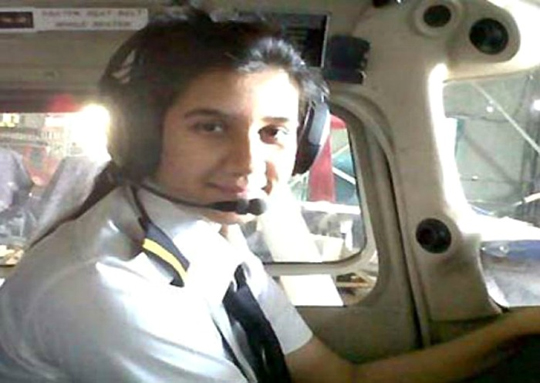
Meet Ayesha Aziz, India's youngest pilot who secured license at 16!

[email protected] (Anjali Bisaria, IndiaTimes)
May 10, 2016

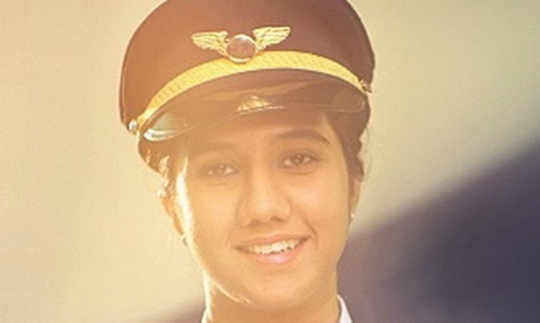
May 10: Ayesha Aziz was all of 16 when she got licensed as a pilot. The girl, who dreamt of flying planes when she grew up, got her wish fulfilled and how! At 20, the young achiever feels proud to have become the country's youngest pilot!
ayesha 3

Ayesha always wanted to do something challenging and unconventional. "More than being India's youngest pilot, I am happy for having accomplished my childhood goal," said Ayesha, as reported by The New Indian Express.

A resident of Mumbai, Ayesha's love for flying took root whenever she visited her native place, Kashmir. The twice-a-year trips to the valley made Ayesha more determined to become a pilot when she grew up.

"While I would enjoy take-off and landing of the plane, my brother would be scared and always sleep during the flight," chimed Ayesha.

The lucky girl also got the chance to visit NASA and meet John McBride. But her favourite moment was when she met her "second greatest inspiration" - astronaut Sunita Williams.

"I met her when she came to Worli in 2013 or 2014. I shared my experiences with her. I told her about the activities I participated in NASA like scuba diving, moon walk and bunny walk which an astronaut should know," she said.

Ayesha joined a flying school after she passed high school. She took ground lessons and passed five viva sessions. And as soon as she turned 16, she was awarded her student pilot license in November 2013. However, due to financial constraints, her training in commercial flying got delayed.

She currently pilots single engine Cessna 152 and Cessna172.

At the Bombay Flying Club, Ayesha is one of the only 4 girls studying B.Sc. third year in Aviation. But this doesn't pull her down and once she completes 80 hours of the total 200 hours of flying, Ayesha will finally gain her commercial pilot licence.

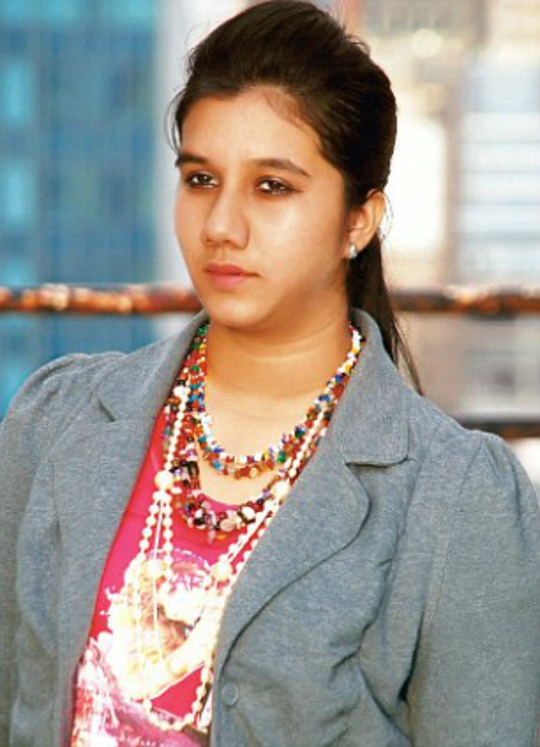
Apart from flying, Ayesha has done several photo shoots for a magazine and even done an ad commercial for Whisper.

Women like Ayesha Aziz and Saara Hameed Ahmed (India's first Muslim woman pilot) are showing what it is to chase their dreams with ardent fervour and not bow down to the pressures that usually force women to abandon theirs.

Ayesha, you are an inspiration to girls everywhere. May you soar to new heights in life!
ayesha 1

ayesha 2

ayesha 4

Comments

Nasir KK
 - 
Tuesday, 10 May 2016

Ayesha., you are the inspiration to girls everywhere. may you soar to new heights in life...all the best.

Add new comment

  • Coastaldigest.com reserves the right to delete or block any comments.
  • Coastaldigset.com is not responsible for its readers’ comments.
  • Comments that are abusive, incendiary or irrelevant are strictly prohibited.
  • Please use a genuine email ID and provide your name to avoid reject.
Wafa Sultana
April 4,2020

Over the last couple of days when the world was occupied with unifying efforts to fight the deadly Covid19 pandemic, sections of Indian media provided viewers a familiar scapegoat – the Indian Muslims – who are often stereotyped as a community being constantly at loggerheads with the citizenry and the State. Biased media channels were quick to resort to blaming the entire Muslim community for the spread of the disease in the country, thanks to an ill-timed Tablighi Jamaat gathering at its international headquarters in Delhi’s Nizamuddin. Unsurprisingly, the opprobrium was also marked by a sudden spike in WhatsApp forwards of videos with people wearing skullcaps licking spoons and performing Sufi breathing rituals, suggesting some sort of wild conspiracy on the part of the community to spread the virus.  Some media channels were quick to formulate, hypothesize and provide loose definitions of a newly discovered form of Jihad i.e. ‘Corona Jihad ’ thereby vilifying the Islamic faith and its followers.

While the investigation on the culpability of the organizers of the Nizamuddin event is still ongoing, there is enough information to suggest that the meeting was held before any lockdown was in force, and the problem began when there was no way of getting people out once the curfew was announced. Be that as it may, there is little doubt that organizing a meet of such a scale when there is a global pandemic smacks of gross misjudgment, and definitely the organizers should be held accountable if laws or public orders were defied. Attendees who attempt to defy quarantine measures must be dealt with strictly. However, what is alarming is that the focus and narrative have now shifted from the unfortunate event at Nizamuddin to the Tablighi Jamaat itself.

For those not familiar with the Tablighi Jamaat, the organization was founded in 1926 in Mewat by scholar Maulana Mohammad Ilyas. The Jamaat’s main objective was to get Muslim youth to learn and practice pristine Islam shorn of external influences. This is achieved through individuals dedicating time for moral and spiritual upliftment secluded from the rest of the world for a brief period of time. There is no formal membership process. More senior and experienced participants typically travel from one mosque to other delivering talks on religious topics, inviting local youth to attend and then volunteer for a spiritual retreat for a fixed number of days to a mosque in a nearby town or village to present the message to their co-religionists. Contrary to ongoing Islamophobic rhetoric, the movement does not actively proselytize. The focus is rather on getting Muslims to learn the teachings and practices of Islam.  This grassroots India-based movement has now grown to almost all countries with substantial Muslim populations. Its annual meets, or ‘ijtemas’ are among the largest Islamic congregations in the world after the annual Haj. One of the reasons for its popularity and wide network in the subcontinent and wordwide is the fact that it has eschewed the need for scholarly intervention, focusing on peer learning of fundamental beliefs and practice rather than high-falutin ideological debates. The Tablighi Jamaat also distinguishes itself from other Islamic movements through its strictly apolitical nature, with a focus on individual self-improvement rather than political mobilization. Hardships and difficulty in the world are expected to be face through ‘sabr’ (patience) and ‘dua’ (supplication),  than through quest for political power or influence. In terms of ideology, it is very much based on mainstream Sunni Islamic principles derived from the Deobandi school.

So, why is all this background important in the current context? While biased media entities have expectedly brought out their Islamophobic paraphernalia out for full display, more neutral commentators have tried to paint the Tablighi Jamaat as a fringe group and have tried to distance it from 'mainstream Muslims'. While the intent is no doubt innocent, this is a trap we must not fall into. This narrative, unfortunately, is also gaining ground due to apathy some Muslims have for the group, accusing it of being “disconnected from the realities of the world”. Unlike other Muslim organizations and movements, the Tablighi Jamat, by virtue of its political indifference, does not boast of high-profile advocates and savvy spokespersons who can defend it in mainstream or social media.  The use of adjectives such as 'outdated' and 'orthodox' by liberal columnists to describe the Jamaat feeds into the malignant attempt to change the narrative from the control of the spread of the pandemic due to the Nizamuddin gathering to 'raison d'etre' of the organization itself.

A large mainstream religious group like the Tablighi Jamaat with nearly a hundred-year history, normally considered to be peaceful, apolitical and minding its own business is now suddenly being villainized owing to unfortunate circumstances. Biased media reactions filled with disgust and hate seem to feed the Indian public conscience with a danngerous misconception - to be a nominal Muslim is okay but being a practicing one is not.  For those committed to the truth and fighting the spread of Islamophobia, the temptation to throw the entire Tablighi Jamaat under the bus must be resisted.

The writer is a lawyer and research scholar at Qatar University. Her research interests include Islamic law and politics.

Comments

zahoorahmed
 - 
Saturday, 4 Apr 2020

great article! provides a great perspective on tableeg jamat

Add new comment

  • Coastaldigest.com reserves the right to delete or block any comments.
  • Coastaldigset.com is not responsible for its readers’ comments.
  • Comments that are abusive, incendiary or irrelevant are strictly prohibited.
  • Please use a genuine email ID and provide your name to avoid reject.
News Network
June 2,2020

Bengaluru, Jun 2:  With easing of COVID-19 lockdown curbs, the Karnataka excise department has accorded permission for fresh brewing or production of beer and to sell it in microbreweries as takeaways.

"Permission is hereby accorded to microbreweries for fresh brewing/production and sale of beer as takeaway in glass, ceramic or stainless steel container (up to 2 litre) till 30-06-2020, or until further orders, whichever is earlier," the Excise Commissioner in a letter dated June 1 to Deputy Excise Commissioners of all districts said.

The opening and closing hours of the microbreweries shall be from 9 am to 9 pm, it said, adding that all other conditions as laid down will remain unaltered.

Earlier, in a letter dated May 12, the Excise Commissioner had "conditionally" granted permission for microbreweries to sell their beer stock as takeaway on experimental basis for the period from May 14 to June 30 or until exhaustion of existing beer stock, whichever is earlier.

It had called for measures like social distancing, cleanliness, usage of masks and sanitizers, among others, and had said, microbreweries situated in containment zones are not allowed to function.

Comments

Add new comment

  • Coastaldigest.com reserves the right to delete or block any comments.
  • Coastaldigset.com is not responsible for its readers’ comments.
  • Comments that are abusive, incendiary or irrelevant are strictly prohibited.
  • Please use a genuine email ID and provide your name to avoid reject.
News Network
February 24,2020

Bengaluru, Feb 24: Raising questions about the situation in Kashmir, senior Congress leader and former Karnataka chief minister Sidddaramaiah on Monday asked the BJP heading the union government to prove 'normalcy' by hosting US President Donald Trump's event in the valley.

If @BJP4India feels Kashmir has returned to Normalcy, & If @BJP4India feels that there is no govt orchestrated violence. Now is the time to prove the same by hosting @realDonaldTrump's event at Kashmir, Siddaramaiah tweeted.

Amid concerns raised by opposition parties, the government has said efforts have been made to restore normalcy in Jammu and Kashmir which faced months of restrictions after its special status under Article 370 was scrapped in August last year.

Siddaramaiah, who is Leader of Opposition in Karnataka Assembly, in another tweet hit out at Prime Minister Narendra Modi on the long wall built near the airport in Ahmedabad allegedly to block the view of a slum, ahead of Trump's visit.

It is time for @realDonaldTrump to get inspired from @narendramodi. Inspiration to build decorative walls to hide not so decorative life!! he tweeted. The opposition Congress in Gujarat had accused the BJP- ruled civic body in Ahmedabad of building the 500-meter long wall to block the view of a slum colony. Refuting the allegations, AMC officials had said the construction of the wall, around four feet in height, was approved much before Trump's Gujarat visit was finalised.

Trump, accompanied by First Lady Melania Trump and a high-level delegation, arrived in Ahmedabad around noon on Monday for a little less than a 36-hour-long trip.

Comments

Add new comment

  • Coastaldigest.com reserves the right to delete or block any comments.
  • Coastaldigset.com is not responsible for its readers’ comments.
  • Comments that are abusive, incendiary or irrelevant are strictly prohibited.
  • Please use a genuine email ID and provide your name to avoid reject.