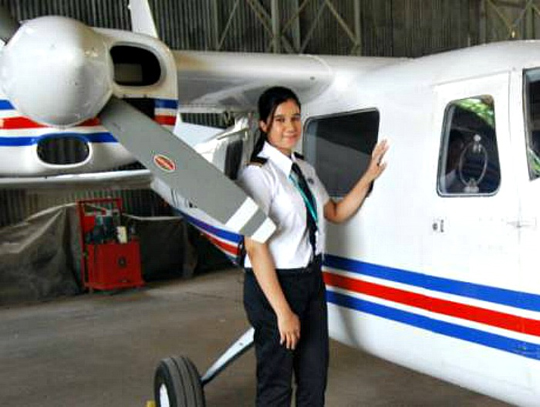
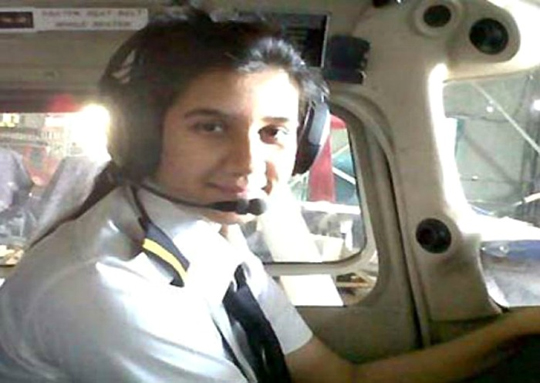
Meet Ayesha Aziz, India's youngest pilot who secured license at 16!

[email protected] (Anjali Bisaria, IndiaTimes)
May 10, 2016

May 10: Ayesha Aziz was all of 16 when she got licensed as a pilot. The girl, who dreamt of flying planes when she grew up, got her wish fulfilled and how! At 20, the young achiever feels proud to have become the country's youngest pilot!
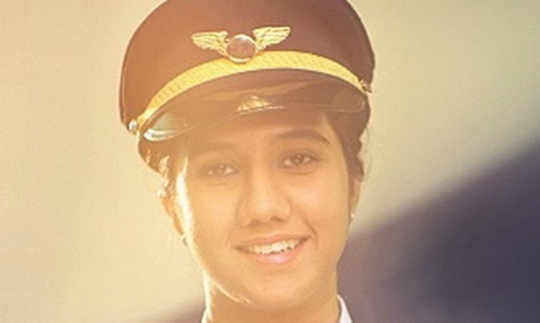
ayesha 3

Ayesha always wanted to do something challenging and unconventional. "More than being India's youngest pilot, I am happy for having accomplished my childhood goal," said Ayesha, as reported by The New Indian Express.

A resident of Mumbai, Ayesha's love for flying took root whenever she visited her native place, Kashmir. The twice-a-year trips to the valley made Ayesha more determined to become a pilot when she grew up.

"While I would enjoy take-off and landing of the plane, my brother would be scared and always sleep during the flight," chimed Ayesha.

The lucky girl also got the chance to visit NASA and meet John McBride. But her favourite moment was when she met her "second greatest inspiration" - astronaut Sunita Williams.

"I met her when she came to Worli in 2013 or 2014. I shared my experiences with her. I told her about the activities I participated in NASA like scuba diving, moon walk and bunny walk which an astronaut should know," she said.

Ayesha joined a flying school after she passed high school. She took ground lessons and passed five viva sessions. And as soon as she turned 16, she was awarded her student pilot license in November 2013. However, due to financial constraints, her training in commercial flying got delayed.

She currently pilots single engine Cessna 152 and Cessna172.

At the Bombay Flying Club, Ayesha is one of the only 4 girls studying B.Sc. third year in Aviation. But this doesn't pull her down and once she completes 80 hours of the total 200 hours of flying, Ayesha will finally gain her commercial pilot licence.

Apart from flying, Ayesha has done several photo shoots for a magazine and even done an ad commercial for Whisper.

Women like Ayesha Aziz and Saara Hameed Ahmed (India's first Muslim woman pilot) are showing what it is to chase their dreams with ardent fervour and not bow down to the pressures that usually force women to abandon theirs.

Ayesha, you are an inspiration to girls everywhere. May you soar to new heights in life!

ayesha 1

ayesha 2

ayesha 4

Comments

Nasir KK
 - 
Tuesday, 10 May 2016

Ayesha., you are the inspiration to girls everywhere. may you soar to new heights in life...all the best.

Add new comment

  • Coastaldigest.com reserves the right to delete or block any comments.
  • Coastaldigset.com is not responsible for its readers’ comments.
  • Comments that are abusive, incendiary or irrelevant are strictly prohibited.
  • Please use a genuine email ID and provide your name to avoid reject.
Agencies
May 8,2020

Washington D.C., May 8: The prime time for brain development in a child's life is the first year, where the infant spends most of the time asleep. It is the time when neural connections form and sensory memories are encoded.

However, when sleep is disrupted, as occurs more often among children with autism, brain development may be affected, too.

New research led by the University of Washington finds that sleep problems in a baby's first 12 months may not only precede an autism diagnosis but also may be associated with altered growth trajectory in a key part of the brain, the hippocampus.

The study, which was published in the American Journal of Psychiatry, researchers report that in a sample of more than 400 taken of 6- to 12-month-old infants, those who were later diagnosed with autism were more likely to have had difficulty falling asleep.

It also states that this sleep difficulty was associated with altered growth trajectories in the hippocampus.

"The hippocampus is critical for learning and memory, and changes in the size of the hippocampus have been associated with poor sleep in adults and older children.

As many as 80 per cent of the children with autism spectrum disorder have sleep problems," said Annette Estes, director of the UW Autism Center and senior author of the study.

"In our clinical experience, parents have a lot of concerns about their children's sleep, and in our work on early autism intervention, we observed that sleep problems were holding children and families back," added Estes, who is also a UW professor of speech and hearing sciences.

"It could be that altered sleep is part-and-parcel of autism for some children. One clue is that behavioural interventions to improve sleep don't work for all children with autism, even when their parents are doing everything just right. This suggests that there may be a biological component to sleep problems for some children with autism," said Estes.

To consider links among sleep, brain development, and autism, researchers at the IBIS Network looked at MRI scans of 432 infants, surveyed parents about sleep patterns, and measured cognitive functioning using a standardized assessment.

At the outset of the study, infants were classified according to their risk for developing autism: Those who were at higher risk of developing autism -- about two-thirds of the study sample -- had an older sibling who had already been diagnosed.

Infant siblings of children with autism have a 20 per cent chance of developing autism spectrum disorder -- a much higher risk than children in the general population.

In the current study, 127 of the 432 infants were identified as "low risk" at the time the MRI scans were taken because they had no family history of autism.

They later evaluated all the participants at 24 months of age to determine whether they had developed autism. Of the roughly 300 children originally considered "high familial risk," 71 were diagnosed with autism spectrum disorder at that age.

Problems with sleep were more common among the infants later diagnosed with an autism spectrum disorder, as were larger hippocampi. No other subcortical brain structures were affected, including the amygdala, which is responsible for certain emotions and aspects of memory, or the thalamus, a signal transmitter from the spinal cord to the cerebral cortex.

The authors note that while parents reported more sleep difficulties among infants who developed autism compared to those who did not, the differences were very subtle and only observed when looking at group averages across hundreds of infants.

Sleep patterns in the first years of life change rapidly as infants transition from sleeping around the clock to a more adult-like sleep/wake cycle. Until further research is completed, Estes said, it is not possible to interpret challenges with sleep as an early sign of increased risk for autism.

Comments

Add new comment

  • Coastaldigest.com reserves the right to delete or block any comments.
  • Coastaldigset.com is not responsible for its readers’ comments.
  • Comments that are abusive, incendiary or irrelevant are strictly prohibited.
  • Please use a genuine email ID and provide your name to avoid reject.
News Network
May 21,2020

Mangaluru, May 21: The Supreme Court has awarded Rs 7.64 crore compensation to the next of kin of a man who was killed in a crash-landing of Air India Express Flight 812 from Dubai in Mangalore on May 22, 2010. The accident killed 158 out of 166 passengers on board.

The family of the 45-year-old Mahendra Kodkany, which include his wife, daughter and son, were earlier granted Rs 7.35 crore as compensation by National Consumer Disputes Redressal Commission (NCDRC). This compensation will now get enhanced after adding 9 per cent interest per annum (on the amount yet to be paid), to be paid by Air India.

Kodkany was the regional director for the Middle East for a UAE-based company. The aircraft overshot the runway and went down a hillside and burst into flames.

A bench comprising Justices D.Y. Chandrachud and Ajay Rastogi said: "The total amount payable on account of the aforesaid heads works out to Rs 7,64,29,437. Interest at the rate of nine per cent per annum shall be paid on the same basis as has been awarded by the NCDRC. The balance, if any, that remains due and payable to the complainants, after giving due credit for the amount which has already been paid, shall be paid within a period of two months."

The apex court noted that in a claim for compensation arising out of the death of an employee, the income has to be assessed on the basis of the entitlement of the employee. The top court said: "We are unable to accept the reasons which weighed with the NCDRC in making a deduction of AED (UAE currency) 30,000 from the total CTC. Similarly, and for the same reason, we are unable to accept the submission of Air India that the transport allowance should be excluded. The bifurcation of the salary into diverse heads may be made by the employer for a variety of reasons."

The top court observed that the deceased was evidently, a confirmed employee of his employer. "We have come to the conclusion that thirty per cent should be allowed on account of future prospects", added the court.

The top court noted that if the amount which has been paid by Air India is in excess of the payable under the present judgement, "we direct under Article 142 of the Constitution (discretionary powers) that the excess shall not be recoverable from the claimants," said the court.

Comments

A.Rahman
 - 
Friday, 22 May 2020

First of all  A Salute To Lawyer One Who Handled This Case Against Carriers Mismanagement Wrong Action.


Sure this is the second victory for the lawyer against arriers mismanagement.


Over all it is the sign  of a profesional ; qualified  eligble  lawyers efforts and right decision from a capable knowlegable judge. Suit case operating lawyers cannot handle such specilized cases.

They lawyer may handled rest of the vicitms cases or he not. But for his siincere efforts for the past ten years delcares whatn he  is. Am personally met him and  witnessed his court appearance  hope and wish him all the best and success .


Add new comment

  • Coastaldigest.com reserves the right to delete or block any comments.
  • Coastaldigset.com is not responsible for its readers’ comments.
  • Comments that are abusive, incendiary or irrelevant are strictly prohibited.
  • Please use a genuine email ID and provide your name to avoid reject.
News Network
April 3,2020

Mangaluru, Apr 3: The Dakshina Kannada district administration’s decision to ban use of private vehicles, excluding permitted categories, from Friday for effective implementation of lockdown, began showing results since morning itself.

Mangaluru City Traffic Police and Dakshina Kannada district police erected several pickets at vantage places on arterial roads to check those moving without a valid reason. Several two-wheelers were seized during the checking while a few car drivers were let off with a strict warning.

Assistant Commissioner of Police (Traffic), M Manjunatha Shetty, who was supervising a picket at Hampankatta, said that movement of private vehicles has drastically reduced in the city.

Comments

Add new comment

  • Coastaldigest.com reserves the right to delete or block any comments.
  • Coastaldigset.com is not responsible for its readers’ comments.
  • Comments that are abusive, incendiary or irrelevant are strictly prohibited.
  • Please use a genuine email ID and provide your name to avoid reject.