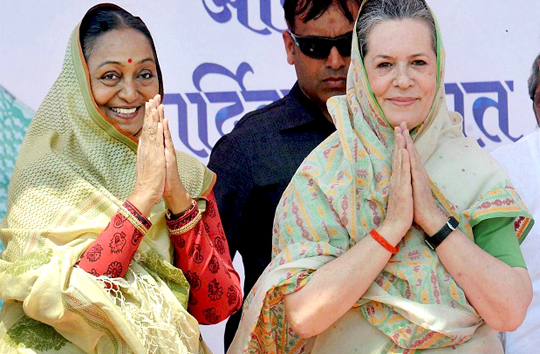
Meira Kumar files nomination, Sonia Gandhi calls it battle of ideologies, principles

Agencies
June 28, 2017

New Delhi, Jun 28: Moments after opposition candidate Meira Kumar filed her nomination for the Presidential Election, Congress president Sonia Gandhi on Wednesday said the July 17 polls were a battle of ideology, truth, and principles for them.

MeiraKumar

She further vowed to fight this “battle”.

"For us, it's a battle of ideology, principles and truth and we will fight it," said Gandhi.

Her comments came moments after Meira Kumar filed her nomination.

Gandhi is one of Kumar's proposers in one set of nomination papers, sources said.

Opposition leaders, including from the Congress and Left, along with Meira Kumar assembled at Parliament's Gate Number 1 and later left for the Lok Sabha Secretary General's chamber to file the nomination.

Besides Gandhi, former prime minister Manmohan Singh, Congress president Sonia Gandhi, NCP chief Sharad Pawar, BSP leader Satish Chandra Mishra, CPI-M general secretary Sitaram Yechury, CPI leader D Raja and TMC leader Derek O'Brien accompanied Meira Kumar.

RJD Chief Lalu Prasad Yadav was not present.

Before reaching Parliament, Meira Kumar visited Raj Ghat and Samta Sthal, the memorial of Mahatma Gandhi and her father Babu Jagjivan Ram respectively.

Punjab Chief Minister Amarinder Singh, Puducherry Chief Minister V Narayanasamy and Karnataka Chief Minister Siddaramaiah were also present.

Meira Kumar is pitted against NDA candidate Ram Nath Kovind.

Congress vice president Rahul Gandhi, who is abroad on a vacation, said Kumar represents the values that bind the country and its people.

"Against the ideology of divisiveness she represents the values that bind us as a nation and people. Proud to have Meira Kumar ji as our candidate," he tweeted.

Comments

Add new comment

  • Coastaldigest.com reserves the right to delete or block any comments.
  • Coastaldigset.com is not responsible for its readers’ comments.
  • Comments that are abusive, incendiary or irrelevant are strictly prohibited.
  • Please use a genuine email ID and provide your name to avoid reject.
News Network
March 16,2020

New Delhi, Mar 16: Reliance Group Chairman Anil Ambani has been summoned by the ED in connection with its money laundering probe against Yes Bank promoter Rana Kapoor and others, officials said on Monday.

They said Ambani was asked to depose at the Enforcement Directorate office in Mumbai on Monday as his group companies are among the big entities whose loans went bad after borrowing from the crisis-hit bank.

The officials said Ambani, 60, has sought exemption from appearance on some personal grounds and he may be issued a new date.

Ambani's group companies are stated to have taken loans of about Rs 12,800 crore from the bank that turned NPAs.

Finance Minister Nirmala Sitharaman had said in a March 6 press conference that the Anil Ambani Group, Essel, ILFS, DHFL and Vodafone were among the stressed corporates Yes Bank had exposure to.

Officials said promoters of all the big companies who had taken large loans from the beleaguered bank which later turned bad are being summoned for questioning in the case to take investigation forward.

Ambani's statement will be recorded under the Prevention of Money Laundering Act (PMLA) upon deposition, they said.

Kapoor, 62, is at present in ED custody after he was arrested by the central probe agency early this month.

The ED has accused Kapoor, his family members and others of laundering "proceeds of crime" worth Rs 4,300 crore by receiving alleged kickbacks in lieu of extending big loans through their bank that later turned NPA.

Comments

Add new comment

  • Coastaldigest.com reserves the right to delete or block any comments.
  • Coastaldigset.com is not responsible for its readers’ comments.
  • Comments that are abusive, incendiary or irrelevant are strictly prohibited.
  • Please use a genuine email ID and provide your name to avoid reject.
Agencies
June 29,2020

From March through May, around 1 crore migrant workers fled India’s megacities, afraid to be unemployed, hungry and far from family during the world’s biggest anti-Covid-19 lockdown.

Now, as Asia’s third-largest economy slowly reopens, the effects of that massive relocation are rippling across the country. Urban industries don’t have enough workers to get back to capacity, and rural states worry that without the flow of remittances from the city, already poor families will be even worse off -- and a bigger strain on state coffers.

Meanwhile, migrant workers aren’t expected to return to the cities as long as the virus is spreading and work is uncertain. States are rolling out stimulus programs, but India’s economy is hurtling for its first contraction in more than 40 years, and without enough jobs, a volatile political climate gets more so.

“This will be a huge economic shock, especially for households of short-term, cyclical migrants, who tend to come from vulnerable, poor and low-caste and tribal backgrounds,” said Varun Aggarwal, a founder of India Migration Now, a research and advocacy group based in Mumbai.

In the first 15 days of India’s lockdown, domestic remittances dropped by 90%, according to Rishi Gupta, chief executive officer of Mumbai-based Fino Paytech Ltd., which operates the country’s biggest payments bank.

By the end of May, remittances were back to around 1750 rupees ($23), about half the pre-Covid average. Gupta’s not sure how soon it’ll fully recover. “Migrants are in no hurry to come back,” Gupta said. “They’re saying that they’re not thinking of going back at all.”

If workers stay in their home states long term, policymakers will have more than remittances to worry about. If consumption falls and the new surplus of labor drives wages down, Agarwal said, “there will also be a second-order shock to the local economy. Overall, not looking good.”

India announced a $277 billion stimulus package in May and followed it up with a $7 billion program aimed at creating jobs for 125 days for migrants in villages across 116 districts. Separately, local authorities are also looking for solutions.

Officials in Bihar have identified 2,500 acres of land that could be made available to investors, said Sushil Modi, deputy chief minister of Bihar, a state in east India. “We can use this crisis as an opportunity to speed up reforms,” he said.

The investors haven’t materialised yet, and in the meanwhile, state governments are relying on the national cash-for-work program that guarantees 100 days worth of wages per household.

Skilled workers don’t want to do manual labor offered through the program, and even if they did, says Amitabh Kundu of RIS, many think of it as beneath their station. “There will be an increase in social tensions,” he predicts. “Caste may again start playing a role. It’s absolute chaos.”

For skilled workers, initiatives vary:

* Uttar Pradesh, which received 3.2 million people, is compiling lists of skilled workers who need employment and trying to place them with local manufacturing and real estate industry associations. So far, the government says, it’s placed 300,000 people with construction and real estate firms.

* Bihar has placed returners in state-run infrastructure projects and hired others to stitch uniforms and make furniture for government-run schools, even as they waited in quarantine centres, said Pratyay Amrit, head of the state’s disaster management department.

* The eastern state of Odisha announced an urban wage employment program aimed at putting as many as 450,000 day labourers to work through September. Some 25,000 people have been employed, so far, under the scheme, G. Mathivathanan, principal secretary for housing and urban development said.

Attracting Investments

It’s not clear any of this will be enough to make a dent, says Ravi Srivastava, professor at New Delhi-based Institute of Human Development, adding that the states don’t have much of a track record on economic development.

“It was the failure of these states to improve governance and put development plans in place that led to the out-migration in the first place,” he said.

But officials and workers’ rights advocates see opportunity. Uttar Pradesh has established liaisons to encourage companies from the US, Japan and South Korea to establish manufacturing in the state. There and in Madhya Pradesh and Rajasthan, the government has made labour laws more friendly to employers, making it easier to hire and fire workers.

Modi, the minister from Bihar, said the migration may also give workers--historically a disenfranchised group--new power, particularly as urban centres struggle. “The way industries treated workers during the lockdown -- didn’t pay them, the living conditions were poor -- now these industries will realize the value of this force,” Modi said.

“In the days to come, labour will emerge as a force that can’t be ignored anymore,” he added. “That’s the new normal. We will work out how to ensure dignity, rights to our people who are going to work in other states.”

Bihar is due for elections by November, a vote that could be an early test of the mass migration’s political consequences. The state is currently governed by a coalition that includes Prime Minister Narendra Modi’s Bharatiya Janata Party. Amitabh Kundu, a fellow at the Research and Information System for Developing Countries, a New Delhi-based government think-tank, said migrant workers are likely to be angry voters.

“Chief ministers are telling these migrants that they will not have to go back for work,” he said. “But their capacity to do something miraculous in the next four to five months is doubtful. If they can retain even one-fourth of the migrants, I would call it a success.”


Comments

Add new comment

  • Coastaldigest.com reserves the right to delete or block any comments.
  • Coastaldigset.com is not responsible for its readers’ comments.
  • Comments that are abusive, incendiary or irrelevant are strictly prohibited.
  • Please use a genuine email ID and provide your name to avoid reject.
Agencies
February 4,2020

New Delhi, Feb 4: Saying the matter had been adjourned many times and it will have to hear it someday, the Supreme Court on Tuesday fixed April 14 for hearing a plea by Zakia Jafri, wife of slain MP Ehsan Jafri, challenging the SIT's clean chit to then Gujarat chief minister Narendra Modi in the 2002 riots.

A bench comprising Justices A M Khanwilkar and Dinesh Maheshwari posted the matter for hearing in April after Zakia's counsel sought an adjournment and urged the court to post it after the Holi vacation.

When advocate Aparna Bhat, appearing for Zakia, told the court that the issue in the matter is contentious, the bench said, "It has been adjourned so many times, whatever it is, we will have to hear it someday. Take one date and make sure you all are available." Zakia had filed a petition in the apex court in 2018 challenging the Gujarat High Court's October 5, 2017 order rejecting her plea against the decision of the Special Investigation Team.

Ehsan Jafri was among the 68 people killed at Gulberg Society on February 28, 2002, a day after the S-6 Coach of the Sabarmati Express was burnt at Godhra killing 59 people and triggering riots in Gujarat.

On February 8, 2012, the SIT filed a closure report giving a clean chit to Modi and 63 others, including senior government officials, saying there was "no prosecutable evidence" against them.

Comments

Althaf
 - 
Tuesday, 4 Feb 2020

No use.. will Supreme court gives justice??? 

Add new comment

  • Coastaldigest.com reserves the right to delete or block any comments.
  • Coastaldigset.com is not responsible for its readers’ comments.
  • Comments that are abusive, incendiary or irrelevant are strictly prohibited.
  • Please use a genuine email ID and provide your name to avoid reject.