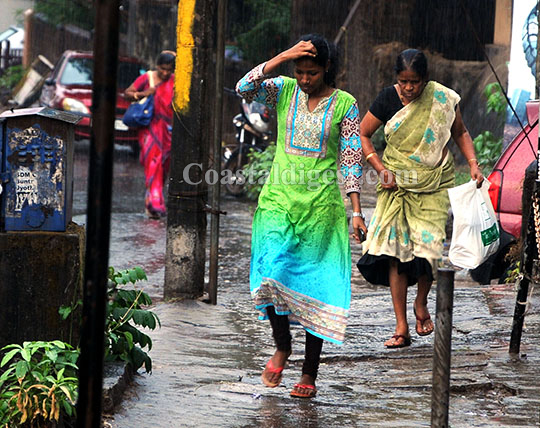
Mercury dips as pre-monsoon rain finally lashes Mangaluru; will it continue?

[email protected] (By Pavithra Prakash | CD Network)
May 11, 2016

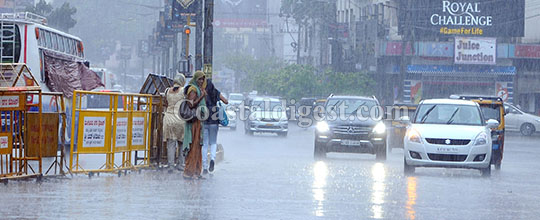
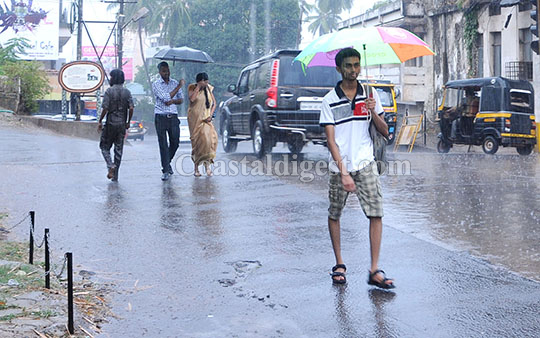
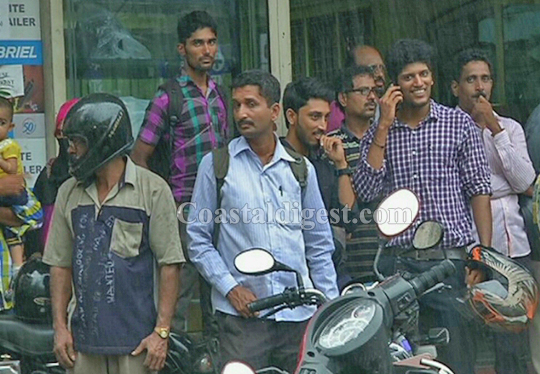
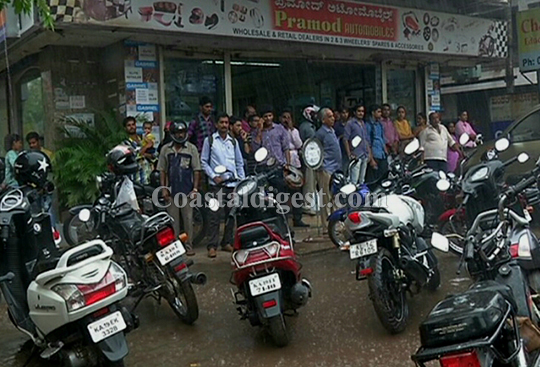
Mangaluru, May 11: Giving respite to people from summer heat, the pre-monsoon rains lashed the coastal city of Mangaluru and other parts of Dakshina Kannada district on Wednesday evening.
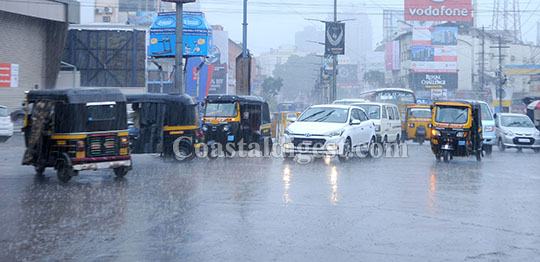
Rain 1

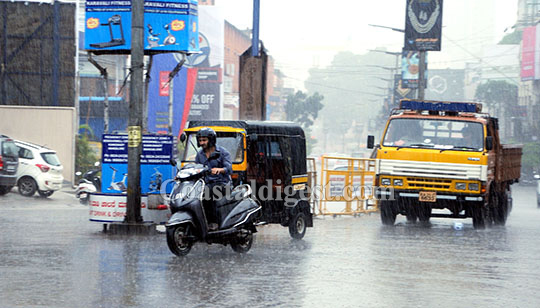
It was relatively a cloudy day since morning and moderate to heavy rains occurred after 5 p.m. in the city. The entire city was drenched by 6.30 p.m.

Roads in low lying areas including Derebail, Yeyyadi, Jeppinamogaru were flooded for some time. Mercury plummeted by more than five degree C during day hours giving respite from the heat.

However, this rain is not likely to address the water scarcity of Mangaluru immediately unless it continues to pour and increases the water level at Thumbe vented dam.

Due to lack of pre-monsoon rains most of the rivers in Dakshina Kannada and Udupi districts including Nethravati, Phalguni (Gurupura), Nandini, Swarna, Varahi, Sharavati, Aghanashini, and Kali, have almost dried up and groundwater level depleted considerably.

The region used to get normal pre-monsoon showers of up to 60 mm between January and April, but this year it got just 8 mm rainfall — a deficit of 87 per cent.

While groundwater has considerably depleted in the coastal region, farmers, with no other recourse, have become hapless to witness dying crops, including arecanut and coconut plantations.

Rain 2

Rain 3

Rain 4

Rain 5

Rain 6

rainS 1

rainS 2

rainS 3

rainS 4

rainS 5

Rain 7

Comments

UMMAR
 - 
Thursday, 12 May 2016

NICE TO SEE RAIN IN MANGALORE

Rikaz
 - 
Wednesday, 11 May 2016

Keep praying Allah....he is merciful and beneficent....

Add new comment

  • Coastaldigest.com reserves the right to delete or block any comments.
  • Coastaldigset.com is not responsible for its readers’ comments.
  • Comments that are abusive, incendiary or irrelevant are strictly prohibited.
  • Please use a genuine email ID and provide your name to avoid reject.
News Network
March 28,2020

Bengaluru, Mar 28: Sun Tsu, in 'The Art of War' speaks of a skilful general who can subdue his enemy without any fighting. This constitutes the ultimate triumph which is referred to as stratagem. Today, we would need one such when we are faced with the '21-day corona challenge' for India.
Nearly four weeks back, Dr Jyothsna Rao, Dr Gururaj Rao and I sat across the OPD in the afternoon at HCG Bengaluru discussing our ongoing cancer immunology research. While on this topic, we drifted into the discussion on the coronavirus. During this engaging discussion, we wondered the similarity of the enigma between the virus and cancer. I paused to ask Dr Jyothsna and Dr Guru - how we wish we could do something against this virus.
Dr Jyothsna is a PhD from NCBS and had worked under Dr Ralph Steinman, physician and researcher from Rockefeller University, who won the Nobel Prize for his discovery of the dendritic cell and its role in adaptive immunity in 2011. Dr Gururaj is a molecular and cell biologist who did his PhD at the Chapel Hill, University of North Carolina and is the Director of iCrest.
Jyothsna while hearing our perplexing conversation on the covid intervened, "Yes, surely. I think we should take a break from cancer and focus on the innate and adaptive immunity role in COVID-19."
Thus began this sincere attempt to relook the human immune system from the eyes of the COVID-19.
We have 10 types of immune cells at the least which are widely dispersed in millions across the body. When our body is invaded by a foreign organism (bacteria, fungi or virus), these cells work with each other to destroy the invader.
Now, the question is - how do the immune cells talk to each other? They use small-molecule substances called cytokines (cyto means cells; kine means movement). There are many cytokines that are involved in work on the immune system. The most relevant for viruses are interferons.
Interferons (IFN) as the name reflects have an ability to interfere with the viral activity and stop their multiplication. These specialised signal proteins are released by our cells in response to a viral attack to forewarn other cells. They help build the antiviral proteins within the cells to kill the virus as it tries to invade the new cells.
Historically, interferons are a group of cytokines known to be potent antiviral agents against viruses and a hallmark cytokine induced by the host upon viral infections. Interferons possess unique immunoregulatory activities and are signature cytokines released by (TH1) T immune cells, which are crucial in viral infections.
As the outbreak of COVID-19 grapples us, an urgent need for finding strategies to combat the virus is growing. Coronaviruses (CoVs) are a group of RNA viruses. In patients infected with coronavirus, it was indicated that the activation of the IFN does not occur until 48 hours post-infection. Thus the delayed IFN-related antiviral response by the healthy cells leads to coronavirus evade the immune response.
Numerous studies have presented the success in defeating CoVs by the direct administration of IFNs. In a combination as a concoction, it was shown to synergistically inhibit the virus replication in vitro.
Moreover, it is understood that the earlier induction of IFNs in children although they have a less developed immune system could be the reason behind the children being least affected.
The key to success in reducing the disease fatality might be the stimulation of the immune responses to trigger IFN production at the very early stages of the disease, which might be done through the administration of IFN. Despite the evidence for the efficacy of IFNs in treating CoV-induced infections, the proper dosing and ideal timing for such interventions needs to be verified in clinical trials.
For the later stages of the diseases in advance stages where patients are on ventilator and have developed respiratory distress, we propose to utilise the mesenchymal cells derived from donor bone marrow that have been known to treat acute respiratory syndrome. Mesenchymal cells are known to possess anti-inflammatory activity and thus used often in autoimmune diseases.
With this scientific background, we have activated T cells from healthy donors, in a cGMP facility at iCrest - HCG hospital with an enriched cocktail of cytokines rich in Interferons. Injections of this cocktail we believe will result in a surge of cytokines in the body of the infected person and will boost his ability to fight the virus in the early phases. We are in the initial phases of this study and hope to be ready in the coming weeks with meaningful data on its potential utility.
Currently, it awaits government approvals (Union and state) and we have applied to central drugs authority for their initial evaluation and further directions.
As my Guru often expounded the philosophy of 'Seva' - the goal of education is knowledge, the end goal of knowledge is service. In this attempt to serve our fellow humans at this brink of unprecedented crisis, medical fraternity stands with you and promises to do our best for your safety.
We assure to exhaust every bit of our spirit in this fight against coronavirus. We have lost the sight of shores and travelled thus far, but that is the mandatory first step to cross the ocean. Are we going to succeed in this battle, is something only time will answer. 

Comments

Add new comment

  • Coastaldigest.com reserves the right to delete or block any comments.
  • Coastaldigset.com is not responsible for its readers’ comments.
  • Comments that are abusive, incendiary or irrelevant are strictly prohibited.
  • Please use a genuine email ID and provide your name to avoid reject.
Agencies
July 25,2020

New Delhi, Jul 25: Nearly a year after Cafe Coffee Day founder V.G. Siddhartha's death, the probe committee appointed by the Board of Coffee Day Enterprises Ltd (CDEL) has given a virtual clean chit to private equity investors and the Income Tax Department who were named in his last letter.
The investigation report noted that Siddhartha may have felt "aversive behavioural stimulus" due to persistent reminders from the PE investors and other lenders.

"However, such reminders and follow-ups by the PE investors and lenders are not something which are beyond normal industry practices and we believe that PE investors were acting as per accepted legal and business norms," said that report.

It further said that the investigators were not provided with any documentary evidence to show any "advertent or inadvertent harassment" from the Income Tax Department.

It however, said that the financial records suggest a serious liquidity crunch which may have arisen due to the attachment of Mindtree shares by the IT Department.

Further, the probe revealed that MACEL, a private firm of Siddhartha, owes Rs 2,693 crore to Coffee Day Enterprises, which the report says, "needs to be addressed".

The Cafe Coffee Day founder's body was fished out of the Netravathi river in Karnataka by a group of fishermen on July 31 last year, a day after he went missing.

His last note raised several questions about the role of investors, and tax officials.

He had written: "Tremendous pressure from other lenders lead to me succumbing to the situation. There was a lot of harassment from the previous DG Income Tax in the form of attaching our shares on two separate occasions to block our Mindtree deal and then taking possession of our Coffee Day shares, although the revised returns have been filed by us. This was very unfair and has led to a serious liquidity crunch."

The massive shock to the industry and the country also led the government to assure that tax officials would not harass businessmen and the situation would improve.

Comments

Add new comment

  • Coastaldigest.com reserves the right to delete or block any comments.
  • Coastaldigset.com is not responsible for its readers’ comments.
  • Comments that are abusive, incendiary or irrelevant are strictly prohibited.
  • Please use a genuine email ID and provide your name to avoid reject.
News Network
April 7,2020

Mangaluru, Apr 7: The virology lab set up in Wenlock Hospital here to test COVID-19 samples will start functioning from Tuesday, Karnataka District in-charge Minister Kota Srinivas Poojary said.

In his tweeter Mr Poojary said “After receiving approval from the Indian Council of Medical Research (ICMR) and National Institute of Virology (NIV), the Virology Research and Diagnostic Laboratory set up at district Wenlock will start operating from April 7. The samples for COVID-19 will be tested in the district itself. I thank the state government for helping us set up the lab.”

The new Lab becomes the 10th government lab for testing COVID-19 samples in the state.

Comments

Add new comment

  • Coastaldigest.com reserves the right to delete or block any comments.
  • Coastaldigset.com is not responsible for its readers’ comments.
  • Comments that are abusive, incendiary or irrelevant are strictly prohibited.
  • Please use a genuine email ID and provide your name to avoid reject.