Mercury dips as pre-monsoon rain finally lashes Mangaluru; will it continue?

[email protected] (By Pavithra Prakash | CD Network)
May 11, 2016

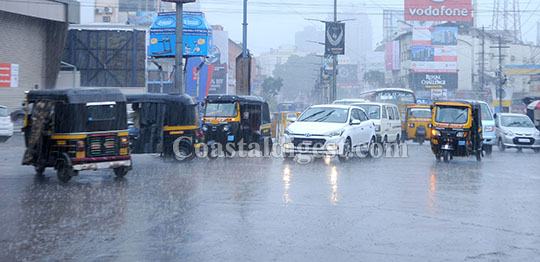
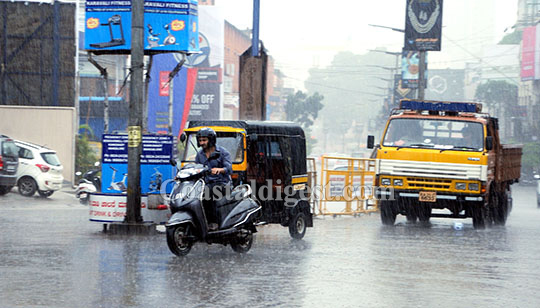
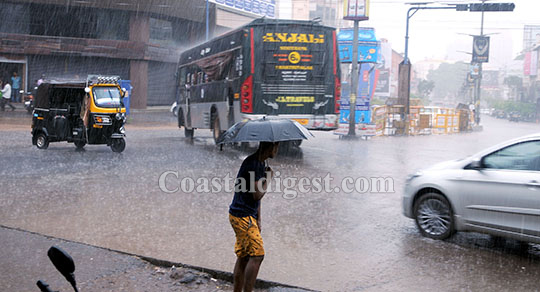
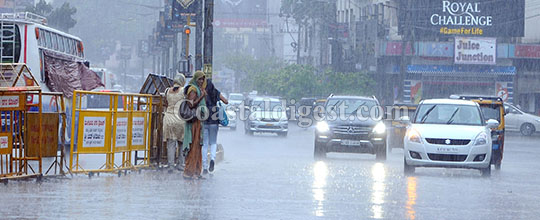
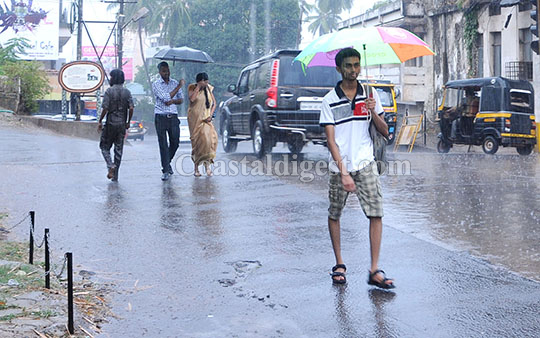
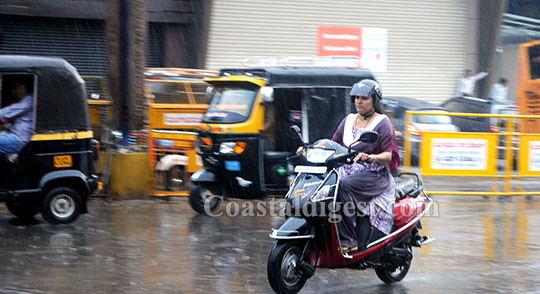
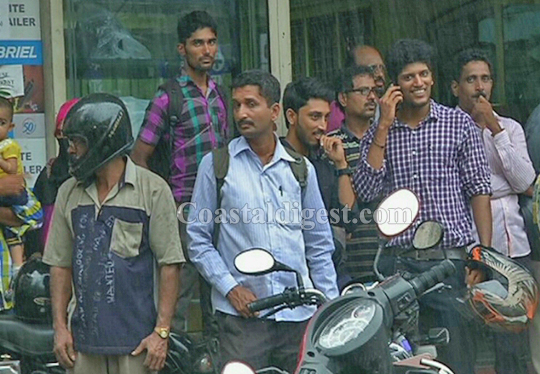
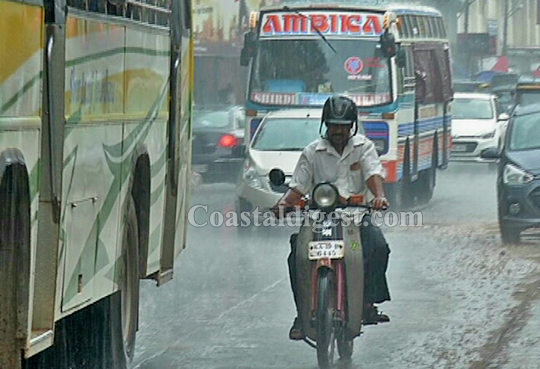
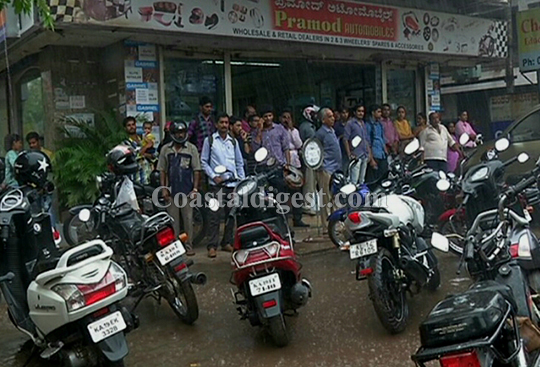
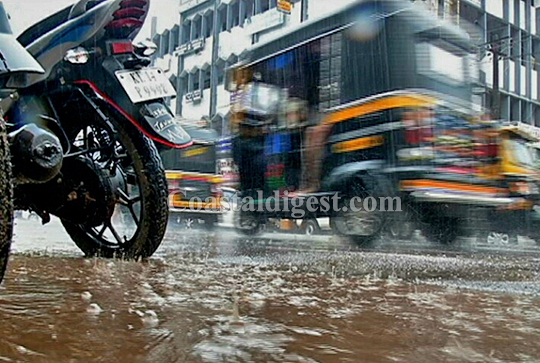
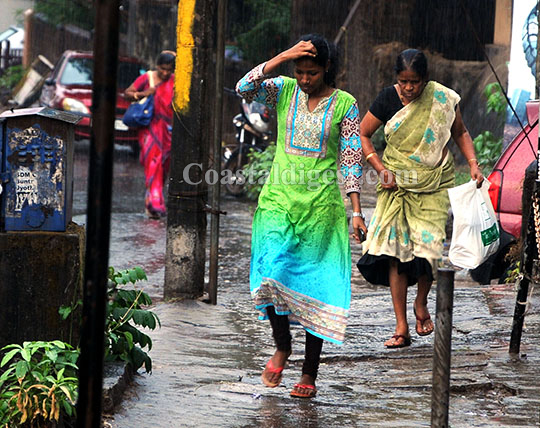
Mangaluru, May 11: Giving respite to people from summer heat, the pre-monsoon rains lashed the coastal city of Mangaluru and other parts of Dakshina Kannada district on Wednesday evening.

Rain 1

It was relatively a cloudy day since morning and moderate to heavy rains occurred after 5 p.m. in the city. The entire city was drenched by 6.30 p.m.

Roads in low lying areas including Derebail, Yeyyadi, Jeppinamogaru were flooded for some time. Mercury plummeted by more than five degree C during day hours giving respite from the heat.

However, this rain is not likely to address the water scarcity of Mangaluru immediately unless it continues to pour and increases the water level at Thumbe vented dam.

Due to lack of pre-monsoon rains most of the rivers in Dakshina Kannada and Udupi districts including Nethravati, Phalguni (Gurupura), Nandini, Swarna, Varahi, Sharavati, Aghanashini, and Kali, have almost dried up and groundwater level depleted considerably.

The region used to get normal pre-monsoon showers of up to 60 mm between January and April, but this year it got just 8 mm rainfall — a deficit of 87 per cent.

While groundwater has considerably depleted in the coastal region, farmers, with no other recourse, have become hapless to witness dying crops, including arecanut and coconut plantations.

Rain 2

Rain 3

Rain 4

Rain 5

Rain 6

rainS 1

rainS 2

rainS 3

rainS 4

rainS 5

Rain 7

Comments

UMMAR
 - 
Thursday, 12 May 2016

NICE TO SEE RAIN IN MANGALORE

Rikaz
 - 
Wednesday, 11 May 2016

Keep praying Allah....he is merciful and beneficent....

Add new comment

  • Coastaldigest.com reserves the right to delete or block any comments.
  • Coastaldigset.com is not responsible for its readers’ comments.
  • Comments that are abusive, incendiary or irrelevant are strictly prohibited.
  • Please use a genuine email ID and provide your name to avoid reject.
News Network
March 26,2020

New Delhi, Mar 26: While the humans are on lockdown and spending time with their families, animals are free and without any fear roaming around on the otherwise busy roads. From Malabar civets to large Indian bisons, animals are enjoying this time.

Indian Forest Officer Susanta Nanda recently shared a video with the caption, "Indian bison( the gaur) goes for a street walk. The largest extant Bovine, is native to South and Southeast Asia. It can be very aggressive. Rare to see in markets."

The 8-second video shows the large animal freely walking in the market area of Chikmagalur district, Karnataka, while the few onlookers on the road get aside and watch the Bison with utmost amazement.

The videos of animals having a gala time on the roads have become common. After the video was posted online, it became a hit. The clip garnered over 3.1k views and over 100 retweets.

Twitter is amazed at the video. Have a look at the comments.

One user wrote, "Oh! We should vacate this place for them. Guess humans have stayed for too long."

Another Twitter user wrote, "That’s one thing people would follow social distancing with!"

Comments

Add new comment

  • Coastaldigest.com reserves the right to delete or block any comments.
  • Coastaldigset.com is not responsible for its readers’ comments.
  • Comments that are abusive, incendiary or irrelevant are strictly prohibited.
  • Please use a genuine email ID and provide your name to avoid reject.
News Network
August 6,2020

Bengaluru, Aug 6: No private hospital in Karnataka can turn away a patient without attending to him or her, irrespective of the Coronavirus status, an official has said.

"Private medical establishments shall not deny treatment and admission to any patient approaching the establishment irrespective of the fact that such patient may or may not be suffering from Covid-19," an official from the state Health and Family Welfare Department said on Wednesday.

Likewise, no private hospital can insist on a patient for a Covid-19 test report, said the official invoking the Disaster Management Act.

"The establishments also cannot insist for Covid test report," he said, directing all private hospitals to strictly abide by their responsibilities.

According to the department, it is the duty of every private hospital to provide first aid and take lifesaving steps when any patient approaches it.

"It is the duty of every private medical establishment to provide first aid and take lifesaving measures to stabilise the patient," he said.

The department also invoked statutes from Karnataka Medical Establishments Act 2017, under sections 11 and 11 (A) to drive home the message.

The directives assume significance at a time when several cases of private hospitals denying admissions and fleecing patients across the state have emerged.

"It has been noticed that some of the private hospitals are refusing treatment and admission to emergency patients, causing distress and this has resulted in complications, leading to death in certain cases," said the official.

The district authorities have been directed to take action on the erring hospitals as the department reiterated the responsibilities of private medical establishments.

Comments

Add new comment

  • Coastaldigest.com reserves the right to delete or block any comments.
  • Coastaldigset.com is not responsible for its readers’ comments.
  • Comments that are abusive, incendiary or irrelevant are strictly prohibited.
  • Please use a genuine email ID and provide your name to avoid reject.
DHNS
January 2,2020

Jan 2: A year after 12,000 acres of forests in Bandipur went up in smoke, the Karnataka Forest Department is gearing up for the summer even as the Forest Survey of India (FSI) has cautioned that 22.78 lakh acres (9,222 sq km) or about 20% of the green cover spread across three districts in the central part of the state is fire-prone.

The FSI studied forest fire incidents across the country between 2004-05 and 2017 before coming up with state-specific inputs.

According to the 13-year observation, Karnataka has 7,352 “fire points” or areas measuring 5 km X 5 km with frequent fire incidents.

Though the number is lower compared to states like Maharashtra, Madhya Pradesh and Odisha with over 20,000 points, the sheer spread of the fire-prone area itself is a challenge for the Karnataka Forest Department.

According to data, about three lakh acres (1,199.9 sq km) of forest area is very highly fire prone with 26 to 52 fire incidents in 13 years. This is followed by 7.6 lakh acres (3,067 sq km) of “highly fire prone” areas with an average of one to two incidents every year.

Almost all of the “red alert” areas are concentrated in Uttara Kannada, Chikkmagaluru, Shivamogga and Chamarajanagar districts. As temperature rises at the end of January, so does the risk of forest fires, requiring officials to be on vigil till the end of summer.

After an investigation into the Bandipur blaze revealed that faulty fire lines and poor supervision were the reason for the spread of the fire, the department has come up with a multi-pronged approach to prevent similar incidents this year.

“After the Bandipur incident, we have created a fire cell and a standard operating procedure (SOP) which everyone has to follow. Firstly, a fire management plan is prepared and approved by a competent authority.

The SOP has well defined firelines which have to be executed by December-end and burning must be completed by January 15,”  Principal Chief Conservator of Forests (Head of Forest Force) Punati Sridhar told DH.

He said that to ensure its strict implementation, GPS readings of firelines are to be submitted for random verification.

“All the required equipment from fire jackets to shoes, gloves, backpack sprayers and tractors mounted with 2,000-5,000 litre tanks with high pressure pumps will be deployed at vantage points,” he said.

In addition, the department’s fire cell works in collaboration with the Karnataka State Remote Sensing Applications Centre (KSRSAC) to give fire alerts within half and hour of an area catching fire and detected by satellites.

“Earlier, the gap used to be four hours by when the fire would have spread beyond control. Now, with reduced time gap, it would be easier to control fire early,” he added.


Comments

Add new comment

  • Coastaldigest.com reserves the right to delete or block any comments.
  • Coastaldigset.com is not responsible for its readers’ comments.
  • Comments that are abusive, incendiary or irrelevant are strictly prohibited.
  • Please use a genuine email ID and provide your name to avoid reject.