Mercury dips as pre-monsoon rain finally lashes Mangaluru; will it continue?

[email protected] (By Pavithra Prakash | CD Network)
May 11, 2016

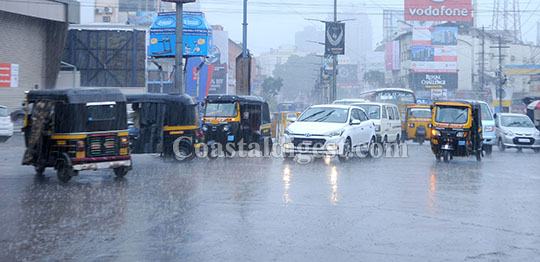
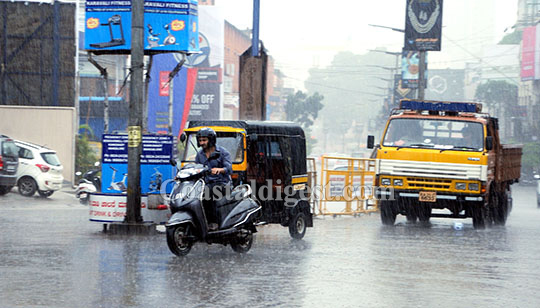
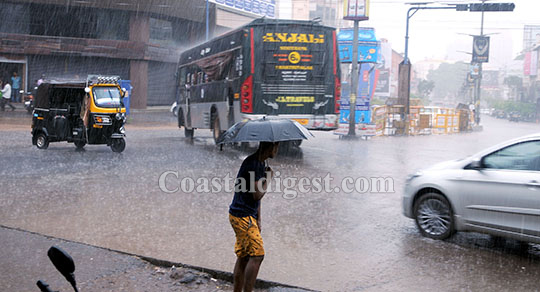
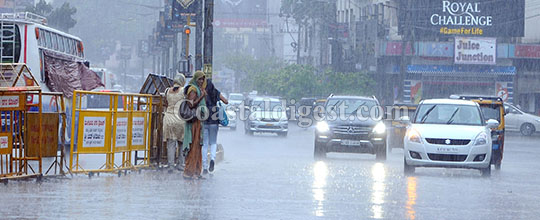
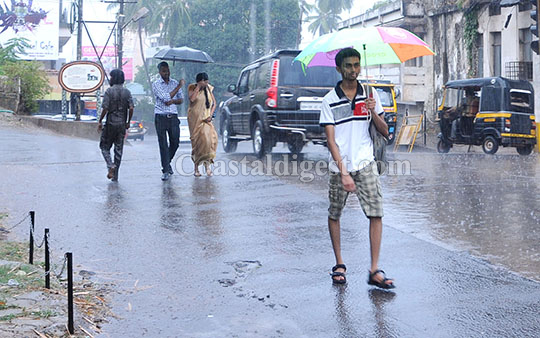
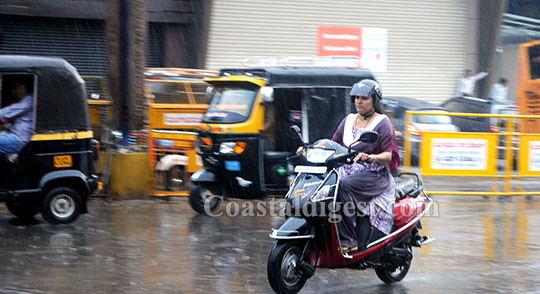
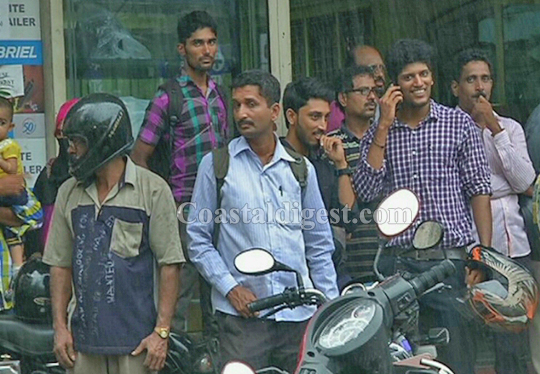
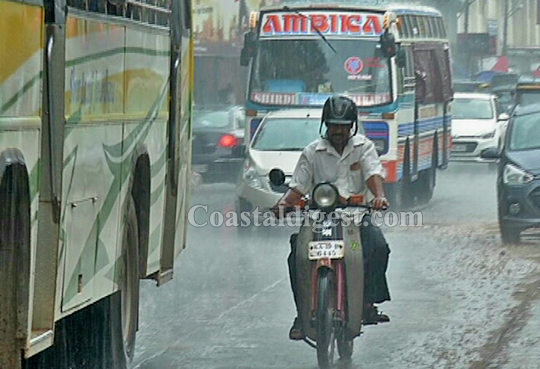
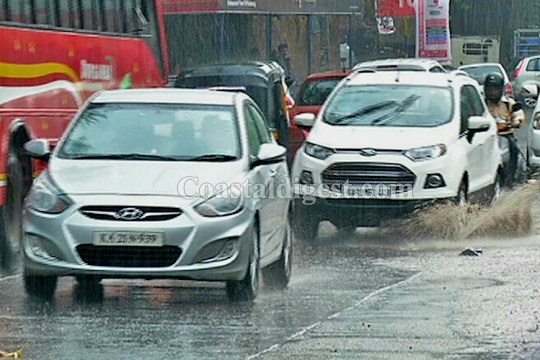
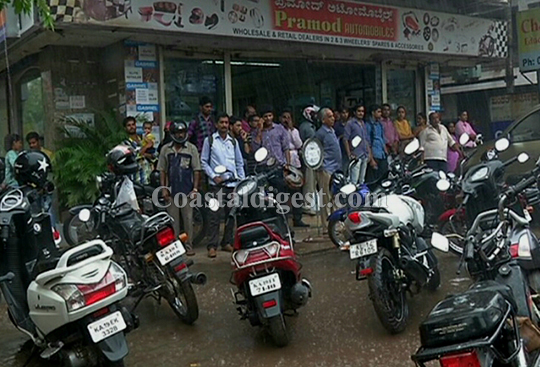
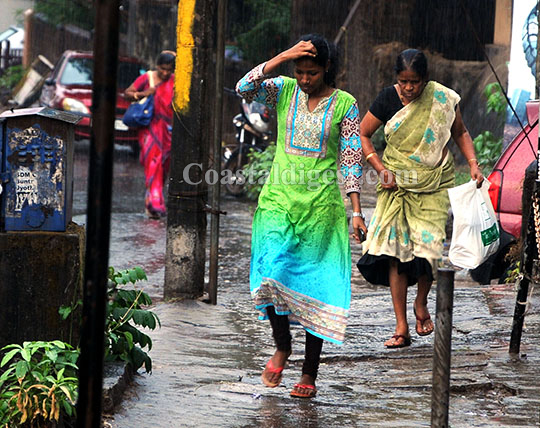
Mangaluru, May 11: Giving respite to people from summer heat, the pre-monsoon rains lashed the coastal city of Mangaluru and other parts of Dakshina Kannada district on Wednesday evening.

Rain 1

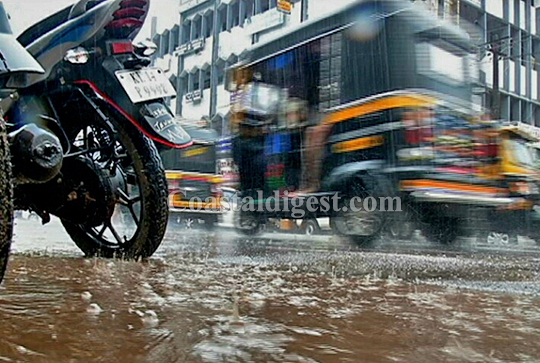
It was relatively a cloudy day since morning and moderate to heavy rains occurred after 5 p.m. in the city. The entire city was drenched by 6.30 p.m.

Roads in low lying areas including Derebail, Yeyyadi, Jeppinamogaru were flooded for some time. Mercury plummeted by more than five degree C during day hours giving respite from the heat.

However, this rain is not likely to address the water scarcity of Mangaluru immediately unless it continues to pour and increases the water level at Thumbe vented dam.

Due to lack of pre-monsoon rains most of the rivers in Dakshina Kannada and Udupi districts including Nethravati, Phalguni (Gurupura), Nandini, Swarna, Varahi, Sharavati, Aghanashini, and Kali, have almost dried up and groundwater level depleted considerably.

The region used to get normal pre-monsoon showers of up to 60 mm between January and April, but this year it got just 8 mm rainfall — a deficit of 87 per cent.

While groundwater has considerably depleted in the coastal region, farmers, with no other recourse, have become hapless to witness dying crops, including arecanut and coconut plantations.

Rain 2

Rain 3

Rain 4

Rain 5

Rain 6

rainS 1

rainS 2

rainS 3

rainS 4

rainS 5

Rain 7

Comments

UMMAR
 - 
Thursday, 12 May 2016

NICE TO SEE RAIN IN MANGALORE

Rikaz
 - 
Wednesday, 11 May 2016

Keep praying Allah....he is merciful and beneficent....

Add new comment

  • Coastaldigest.com reserves the right to delete or block any comments.
  • Coastaldigset.com is not responsible for its readers’ comments.
  • Comments that are abusive, incendiary or irrelevant are strictly prohibited.
  • Please use a genuine email ID and provide your name to avoid reject.
Media Release
February 14,2020

Veteran journalist P. Sainath has said that the nation is in a crisis. And this crisis is not limited to just the rural area. It has become a national crisis at various areas such as agriculture, education, economy, job creation etc.

He was delivering the endowment lecture on the topic ‘Indian democracy at the post-liberalization and post-truth era’ at Media Manthan 2020 organized by the PG department of journalism and mass communication at St Aloysius College (Autonomous). 

Mr Sainath said that the many policies adopted in the 90s led to India becoming unusually unequal. Referring to the speech Ambedkar had made at the Constituent Assembly while handing over the draft of the Constitution, Mr Sainath said, “Ambedkar had warned about the weakness of Indian democracy that liberty without equality allows the supremacy of a few over the multitude. Liberty, equality and fraternity must be kept together as we cannot have one without the other.” 

Mr Sainath stated that the agrarian crisis was no longer about the loss of productivity, employment or about farmer suicide; it was a societal, civilizational crisis. Commenting on the lopsided policies such as cow-slaughter ban, he explained how cow slaughter ban had adversely affected many industries due to their interdependency. While Muslims who slaughtered cows were rendered helpless, the cattle traders who were mostly OBCs lost their earnings as the cattle prices crashed. An important industry like Kolhapur sandals industry in Maharashtra went bankrupt as a result of the cow slaughter ban in Maharashtra. He said the policymakers had no idea how the rural industries were interconnected. Demonetisation too devastated the rural economy as 98 percent of rural transactions happen through cash. 

Mr Sainath also spoke about the crisis of inequality which affects the Dalits and the Adivasis far more than anyone else as 90 percent of the rural households take home less than Rs 10,000/- per month. “Women are yet another group whose labour is never counted in the gross domestic product. Women and girls globally do unpaid work which amounts to about 12.5 billion working hours per year. Monetarily speaking, this is worth 10.8 trillion dollars,” Mr Sainath added. 

Speaking about the crisis of jobs Mr Sainath said that major companies were laying off employees just to create more profits for the investors and the adoption of artificial intelligence in the industry would further destroy millions of jobs.

Rector of St Aloysius College Institutions Fr Dionysius Vaz SJ, Principal Dr (Fr) Praveen Martis SJ, HOD of Journalism and Mass Communication department Dr (Fr) Melwyn Pinto SJ were present.

‘Veerappan and Vijay Mallya’s business models are interesting!’

Addressing the gathering during his endowment lecture on Friday, Mr Sainath made an interesting comment on the so called ‘revenue model’. “Whenever I visit IIMs and IITs for lectures on my PARI project, the students there ask me what my revenue model for my project is. I tell them that I do not have a revenue model. In fact, journalism does not begin with a revenue model. Gandhiji, Ambedkar, Bhagat Singh were all great journalists. But they did not have a revenue model,” Mr Sainath said.

On a lighter note, he said that the best revenue model that he liked was that of forest brigand Veerappan and liquor baron Vijay Mallya. “Veerappan ruled the forest for forty years and from the top ministers to the villagers he could dictate terms and liver royally. Similarly, Mallya’s revenue model was to steal the banks and run away abroad and live like a king,” Mr Sainath added.

Journalism is not and can never be a business. It is a calling, he opined. While newspaper can be a business, television can be a business, journalism per se cannot be reduced to a business. “Unfortunately today, journalists are recruited on a contract basis and they have no bargaining power; and there are no unions to fight for their cause. Hence, they are at the mercy of the corporate media houses for their survival and are made to write stories that cannot be called journalism,” Mr Sainath said.

Answering a question as to the pressures he faced as a journalist, he said that external pressures from the government or others could be very well handled. It is the internal pressures from once own media house that journalists find it difficult to manage.


 

Comments

Add new comment

  • Coastaldigest.com reserves the right to delete or block any comments.
  • Coastaldigset.com is not responsible for its readers’ comments.
  • Comments that are abusive, incendiary or irrelevant are strictly prohibited.
  • Please use a genuine email ID and provide your name to avoid reject.
coastaldigest.com news network
May 31,2020

Mangaluru, May 31:  Even as the worst locust attack on India in recent years raised concerns over its impact on crops, swarms of locusts have triggered panic in Karnataka’s Dakshina Kannada too. 

Farmers in the coastal district were taken aback when they found the swarms of locusts, which they feared as the arrival of desert locusts in the region.

According to reports, Renjalady village under the limits of Nuji Baltila Gramp Panchayats in Kadaba taluk and Shirlalu village in Belthangady taluk witnessed locust attacks in last couple of days. 

“Locust swarms were seen in many areas. We have also alerted agriculture department. Already insects have destroyed crops of many farmers,” said a farmer in Shirlalu village.  

Joint director of Dakshina Kannada district agriculture department MC Seetha confirmed that officials have received information from villagers about the locust scare and entemologists have already visited the place to collect more information.

Not Desert Locusts?

“We contacted entemologists and forwarded the pictures that farmers sent to us. Looking at the picture, entemologists have opined that it may be calotropis locust or colour grasshopper. Desert locusts usually arrive in lakhs,” said Ms Seetha. Desert locusts that are destroying crops in other parts of India may not come to Dakshina Kannada, she added.

Comments

Add new comment

  • Coastaldigest.com reserves the right to delete or block any comments.
  • Coastaldigset.com is not responsible for its readers’ comments.
  • Comments that are abusive, incendiary or irrelevant are strictly prohibited.
  • Please use a genuine email ID and provide your name to avoid reject.
News Network
May 24,2020

Bengaluru, May 24:The first 'Sunday curfew' imposed by the Karnataka government to try and contain the spread of COVID-19 got underway in the state today, with people by and large adhering to norms, roads wearing a deserted look and almost no vehicular traffic, barring essential services.

With barricades being up across most roads in the state, people ventured out only to purchase groceries, vegetabes and medicines.

Instances of violation of Sunday curfew lockdown norms were reported in COVID-19 hotspots of Shivajinagar and Rayapura in Bengaluru and Nelamangala and Devanahalli.

Temples, malls, bars, eateries and small food joints remained shut throughout state.

In most parts of the state buses, autorickshaws and cabs did not ply.

In Bengaluru, the ever bustling Majestic area, which houses the central city bus stand, inter-city bus stand, Metro Railway Station and the City Railway Station, did not see any activity as buses did not ply and all shops were shut, police said.

Reports from Mysuru, Tumakuru, Kolar, Mangaluru, Udupi and other towns across the state said there were no lockdown violations.

Amid the rigid curfew marriages were conducted in a simple manner in various parts of the state like Gollarahatti and Yashwanthapura in Bengaluru and also in Davangere.

Families of the brides and grooms invited only a few people for the event, adhered to social distancing norms and wore masks.

In Gollarahatti, the event organisers cleaned the road, after which the invitees, who were hardly 25 to 30 in number, sat down to have a feast.

The Karnataka government had eased restrictions during Lockdown 4 for start of economic activities like city buses, inter-district bus service, intrastate train services, opening of shops and markets.

However, the government had made it clear that there will be 'Janata Curfew' every Sunday during which only essential services would be permitted.

Comments

Add new comment

  • Coastaldigest.com reserves the right to delete or block any comments.
  • Coastaldigset.com is not responsible for its readers’ comments.
  • Comments that are abusive, incendiary or irrelevant are strictly prohibited.
  • Please use a genuine email ID and provide your name to avoid reject.