


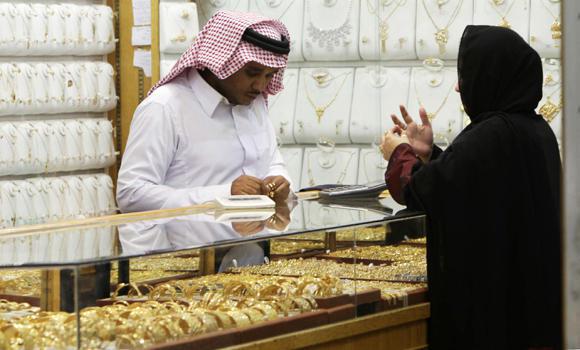
Rising gold prices threaten some factories with closure

August 12, 2013

Rising_gold_pricesJeddah, Aug 12: The rising prices of gold during the past two weeks caused stagnation in the Saudi market, and pushed gold merchants to activate sales because factories didn’t halt their production, according to the National Committee for Precious Metals.

The price of the precious metal has registered the second weekly decline, while the dollar has recovered from its lowest value since seven weeks ago.

Speculation about the US Federal Reserve to reduce the bonds purchase program with a value of $85 billion a month was triggered by the low price of gold, which reached its lowest levels this week.

“Gold merchants didn’t lose because of the declining world prices, because most of them deal with gold as physical balance, and most merchants have sufficient gold accounts,” said Ahmad Al-Sharif, member of the National Committee for Precious Metals.

Gold prices declined by 0.2 percent, to $1,308 per ounce, and the market is about to close at 0.25 percent. Delayed US gold contracts, which will be delivered in December declined by $2, to $1,307.90 per ounce.

Silver prices stabilized at $20.19 per ounce, while platinum gained 0.1 percent to $1,488 per ounce. Palladium rose 0.1 percent to $736.97 per ounce.

Meanwhile, the National Committee for Precious Metals is attempting to ferret out illegal gold sellers, which had controlled as much as one-quarter of the gold market.

“Workshops have been organized, which held unknown names in the gold trade, or operated from places that didn’t have defined headquarters contained products with ambiguous origins were combated,” said Al-Sharif. “We are working on a mechanism to combat violating workshops, and educate consumers and merchants who deal with such workshops. We advise merchants, and gold market clients to buy gold from approved individuals.”

He pointed to the existence of “workshops alien to the market” that had a large share before prices rose, which control 25 percent of the market.

“After the rising prices a large number of these workshops sold their stocks and changed their activities because they were illegal dealers,” he said. “After strict controls and the correction of labor status these violating workshops will be eliminated, because most of them are illegal workers who practice their business in un licensed areas.”

“At the present time, and because of the strict control of the Passport Department and the Ministry of Labor, these workshops have 10 percent of the market share,” he said.

Comments

Add new comment

  • Coastaldigest.com reserves the right to delete or block any comments.
  • Coastaldigset.com is not responsible for its readers’ comments.
  • Comments that are abusive, incendiary or irrelevant are strictly prohibited.
  • Please use a genuine email ID and provide your name to avoid reject.
News Network
March 28,2020

Mar 28: Just hours after Prime Minister Narendra Modi spoke to the Abu Dhabi crown prince on the Coronavirus Pandemic, India “thanked the UAE authorities for accommodating the 19 Indian nationals who were stuck at Dubai airport for past several days”.

The Indian mission in Dubai tweeted, “They got stranded due to various restrictions to deal with Covid-19 pandemic. Hotel rooms have been given to them inside the airport. Our Consulate had been in constant touch with the Indian nationals and UAE and Indian authorities. We had also provided some financial help to enable our stranded passengers to buy food. The situation was tough due to the pandemic situation.”

During their conversation last evening, Abu Dhabi crown prince Sheikh Mohammed Bin Zayed Al Nahyan had “assured Prime Minister Narendra Modi about the welfare of the over two million Indians living in UAE and contributing to its economy”. PM Modi “thanked the Crown Prince for his personal attention to the health and safety of Indian expatriates in the present situation”.    

A statement issued late on Thursday night by the MEA said, “The two leaders exchanged information and views on the ongoing COVID-19 pandemic, the situation in their respective countries, as well as the steps being taken by their Governments. They agreed that the next few weeks would be crucial to control the spread of the virus, and required concerted and coordinated efforts by all countries. In this context, they appreciated the organisation of a Virtual Summit among G20 Leaders earlier in the day, to discuss the pandemic.

Both leaders emphasised the importance they attach to the strength and richness of the bilateral relationship. They agreed to maintain regular consultations between their officials in the present situation, particularly to ensure continuity of logistical supply lines.”

Comments

Add new comment

  • Coastaldigest.com reserves the right to delete or block any comments.
  • Coastaldigset.com is not responsible for its readers’ comments.
  • Comments that are abusive, incendiary or irrelevant are strictly prohibited.
  • Please use a genuine email ID and provide your name to avoid reject.
News Network
July 18,2020

Dubai, July 18: An NRI student who passed away in Dubai shortly after shortly after attempting his Central Board of Secondary Education (CBSE) Grade 12 papers in March, has scored an impressive 91.4 per cent on his board examinations, including 100 in his media studies paper.

Ahmed Ziyad, a student of GEMS Our Own Indian School in Al Qouz, Dubai, died on March 19, suffered a heart condition called Hypertrophic cardiomyopathy (HCM) that stopped him from being active in sporting activities.

Ziyad's parents, teachers, and classmates remember him as a very ambitious pupil, who wanted to launch his own business and achieve great things in his life. His board results are - mass media studies 100, Marketing 97, English 84, Entrepreneurship 82, and Home Science 94.
 
Ziyad's father, Shanavaz Manangath, a real estate professional who has been a resident of Dubai for over two decades said, "Six months ago, he had collapsed while playing with his friends. Since there was an irregularity in his heartbeat, he could not take part in any strenuous activities." He added, "Ziyad had just started playing with his friends on March 19 when he suddenly collapsed and died shortly after. My family has not been able to overcome his loss."

Unable to hold back his tears, an emotional Manangath said Ziyad wanted to do his BBA and launch his own business, "He was very ambitious. Honestly, I haven't looked into his board exam results, but, I know he had studied very hard for the exams."

Comments

Add new comment

  • Coastaldigest.com reserves the right to delete or block any comments.
  • Coastaldigset.com is not responsible for its readers’ comments.
  • Comments that are abusive, incendiary or irrelevant are strictly prohibited.
  • Please use a genuine email ID and provide your name to avoid reject.
News Network
July 23,2020

Beirut, Jul 23: The pandemic will exact a heavy toll on Arab countries, causing an economic contraction of 5.7% this year, pushing millions into poverty and compounding the suffering of those affected by armed conflict, a U.N. report said Thursday.

The U.N.'s Economic and Social Commission for Western Asia expects some Arab economies to shrink by up to 13%, amounting to an overall loss for the region of $152 billion.

Another 14.3 million people are expected to be pushed into poverty, raising the total number to 115 million — a quarter of the total Arab population, it said. More than 55 million people in the region relied on humanitarian aid before the COVID-19 crisis, including 26 million who were forcibly displaced.

Arab countries moved quickly to contain the virus in March by imposing stay-at-home orders, restricting travel and banning large gatherings, including religious pilgrimages.

Arab countries as a whole have reported more than 830,000 cases and at least 14,717 deaths. That equates to an infection rate of 1.9 per 1,000 people and 17.6 deaths per 1,000 cases, less than half the global average of 42.6 deaths, according to the U.N.

But the restrictions exacted a heavy economic toll, and authorities have been forced to ease them in recent weeks. That has led to a surge in cases in some countries, including Lebanon, Iraq and the Palestinian territories.

Wealthy Gulf countries were hit by the pandemic at a time of low oil prices, putting added strain on already overstretched budgets. Middle-income countries like Jordan and Egypt have seen tourism vanish overnight and a drop in remittances from citizens working abroad.

War-torn Libya and Syria have thus far reported relatively small outbreaks. But in Yemen, where five years of civil war had already generated the world's worst humanitarian crisis, the virus is running rampant in the government-controlled south while rebels in the north conceal its toll.

Rola Dashti, the head of the U.N. commission, said Arab countries need to “turn this crisis into an opportunity” and address longstanding issues, including weak public institutions, economic inequality and over-reliance on fossil fuels.

“We need to invest in survival, survival of people and survival of businesses,” she said.

Comments

Add new comment

  • Coastaldigest.com reserves the right to delete or block any comments.
  • Coastaldigset.com is not responsible for its readers’ comments.
  • Comments that are abusive, incendiary or irrelevant are strictly prohibited.
  • Please use a genuine email ID and provide your name to avoid reject.