


Rising gold prices threaten some factories with closure

August 12, 2013

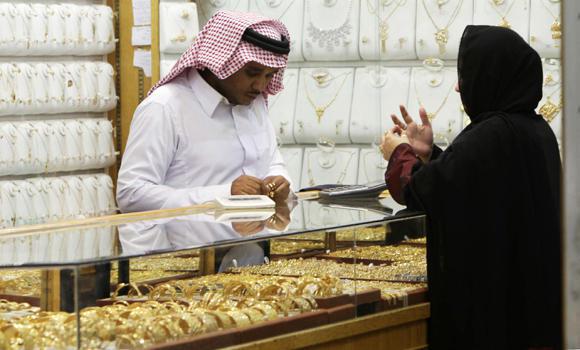
Rising_gold_pricesJeddah, Aug 12: The rising prices of gold during the past two weeks caused stagnation in the Saudi market, and pushed gold merchants to activate sales because factories didn’t halt their production, according to the National Committee for Precious Metals.

The price of the precious metal has registered the second weekly decline, while the dollar has recovered from its lowest value since seven weeks ago.

Speculation about the US Federal Reserve to reduce the bonds purchase program with a value of $85 billion a month was triggered by the low price of gold, which reached its lowest levels this week.

“Gold merchants didn’t lose because of the declining world prices, because most of them deal with gold as physical balance, and most merchants have sufficient gold accounts,” said Ahmad Al-Sharif, member of the National Committee for Precious Metals.

Gold prices declined by 0.2 percent, to $1,308 per ounce, and the market is about to close at 0.25 percent. Delayed US gold contracts, which will be delivered in December declined by $2, to $1,307.90 per ounce.

Silver prices stabilized at $20.19 per ounce, while platinum gained 0.1 percent to $1,488 per ounce. Palladium rose 0.1 percent to $736.97 per ounce.

Meanwhile, the National Committee for Precious Metals is attempting to ferret out illegal gold sellers, which had controlled as much as one-quarter of the gold market.

“Workshops have been organized, which held unknown names in the gold trade, or operated from places that didn’t have defined headquarters contained products with ambiguous origins were combated,” said Al-Sharif. “We are working on a mechanism to combat violating workshops, and educate consumers and merchants who deal with such workshops. We advise merchants, and gold market clients to buy gold from approved individuals.”

He pointed to the existence of “workshops alien to the market” that had a large share before prices rose, which control 25 percent of the market.

“After the rising prices a large number of these workshops sold their stocks and changed their activities because they were illegal dealers,” he said. “After strict controls and the correction of labor status these violating workshops will be eliminated, because most of them are illegal workers who practice their business in un licensed areas.”

“At the present time, and because of the strict control of the Passport Department and the Ministry of Labor, these workshops have 10 percent of the market share,” he said.

Comments

Add new comment

  • Coastaldigest.com reserves the right to delete or block any comments.
  • Coastaldigset.com is not responsible for its readers’ comments.
  • Comments that are abusive, incendiary or irrelevant are strictly prohibited.
  • Please use a genuine email ID and provide your name to avoid reject.
News Network
April 20,2020

Apr 20: Eight Indians, including two engineers, have died due to the novel coronavirus in Saudi Arabia, according to a media report on Sunday.

Mohammed Aslam Khan, an electrical engineer in Makkah, and Azmatullah Khan, an engineer at the Makkah Haram power station, have died due to the COVID-19, Saudi Gazette reported.

Aslam Khan, aged 51, who hailed from Meerut in Uttar Pradesh, was admitted to King Faisal Hospital, Makkah on April 3, following worsening of his condition after being infected with fever and throat pain.

He had been on ventilator for more than two weeks and breathed his last on Saturday night, the paper said.

Khan is survived by wife and a daughter and a son. His wife and children are under self-imposed home quarantine.

Azmatullah Khan, from Telangana, died of coronavirus on Friday.

Mujeeb Pukkottoor, a prominent Indian social worker and general secretary of Makkah chapter of Kerala Muslim Cultural Center, told the paper that the body of Khan was buried in Makkah on Sunday.

Khan, aged 65, had been working with Saudi Binladin Group for the last 32 years.

Fakre Alam, an employee at the Haram Project of Saudi Binladin Group in Makkah, died on Sunday due to infection, the paper said.

Barkt Ali Abdullatif Fakir, an electrical technician working in Medina, also died of coronavirus, it said.

According to the Saudi Ministry of Health’s daily report published on April 14, the number of coronavirus infected cases among workers of Saudi Binladin Group in various parts of the Kingdom stood at 117, and these included 70 cases in Makkah.

The first two Indian fatalities were reported from Medina and Riyadh earlier this month with the death of Shebnaz Pala Kandiyil (29) and Safvan Nadamal (41), both from Kerala.

Mohammed Sadiq, from Hyderabad, working in Jeddah and Suleman Sayyid Junaid (Maharashtra) are other Indians who died due to COVID-19 in the Gulf kingdom, the paper said.

Shebnaz from Panoor in Kannoor district died on April 3 and his body was buried in Medina on April 7. He came back to the Kingdom March 3 after his marriage in January.

Safvan, a taxi driver from Chemmad in Malappuram district, died on April 2 and was buried in Riyadh on April 8.

Comments

Add new comment

  • Coastaldigest.com reserves the right to delete or block any comments.
  • Coastaldigset.com is not responsible for its readers’ comments.
  • Comments that are abusive, incendiary or irrelevant are strictly prohibited.
  • Please use a genuine email ID and provide your name to avoid reject.
News Network
January 12,2020

Dubai, Jan 12: Saudi Arabian oil giant Aramco announced Sunday that its initial public offering raised a record $29.4 billion, a figure higher than previously announced, after the company used a so-called "greenshoe option" to sell millions more shares to meet investor demand.

The company said that the sale of an additional 450 million shares took place during the initial public offering process.

The oil and gas company, which is majority owned by the state, began publicly trading on the local Saudi Tadawul exchange on December 11. It hit hit upwards of $10 a share on the second day of trading. This gave Aramco a market capitalization of $2 trillion, making it comfortably the world's most valuable company.

Aramco's additional sales mean the company has publicly floated 1.7% of its shares. It's IPO, even before the added sales, was the world's largest ever.

The shares sold in the over-allotment option "had been allocated to investors during the book-building process and therefore, no additional shares are being offered into the market today," Aramco said.

Company shares traded down on Sunday, dipping to around 34.7 riyals, or $9.25 a share, amid heightened tensions in the Persian Gulf between Iran and the United States. Aramco was a target of rising tensions over the summer when a missile and drone attack, which Saudi Arabia and the US blame on Iran, temporarily halved its production.

Sunday's trading figures value Aramco at $1.85 trillion, still well ahead of Apple, the second largest company in the world after Aramco, but below the $2 trillion mark sought by Crown Prince Mohammed bin Salman.

Comments

Add new comment

  • Coastaldigest.com reserves the right to delete or block any comments.
  • Coastaldigset.com is not responsible for its readers’ comments.
  • Comments that are abusive, incendiary or irrelevant are strictly prohibited.
  • Please use a genuine email ID and provide your name to avoid reject.
News Network
January 16,2020

Dubai, Jan 16: The UAE Ministry of Climate Change and Environment on Wednesday announced that it has banned the import of birds, some eggs and meat products from Hungary and Slovakia.

The ministry said the decision was taken following a notification from the World Organization for Animal Health (OIE) on the outbreak of a highly pathogenic strain of bird flu, H5N2, in the two countries.

Accordingly, the ministry has banned "the import of all species of domestic and wild live birds, ornamental birds, chicks, hatching eggs, meats and meat products and non-heat-treated wastes from Hungary and Slovakia".

It has also regulated the import of poultry meat and non-heat-treated products, requiring a health certificate for the export of meat and meat products from the two countries to release consignments into the UAE.

A health certificate will be needed for the import of eggs, the ministry added.

However, thermally-treated poultry products (meat and eggs) have been cleared for import from all parts of Hungary and Slovakia.

Kaltham Ali Kayaf, Acting Director, Animal Development & Health Department at the ministry, said: "These measures reiterate the ministry's keenness in achieving its strategic objectives including enhancing bio-security levels and eliminating pathogens before they enter the country. In doing so, the ministry prevents the bird flu virus and related risks and impacts on the country's poultry health and safety, in addition to protecting public health and well-being."

Comments

Add new comment

  • Coastaldigest.com reserves the right to delete or block any comments.
  • Coastaldigset.com is not responsible for its readers’ comments.
  • Comments that are abusive, incendiary or irrelevant are strictly prohibited.
  • Please use a genuine email ID and provide your name to avoid reject.