


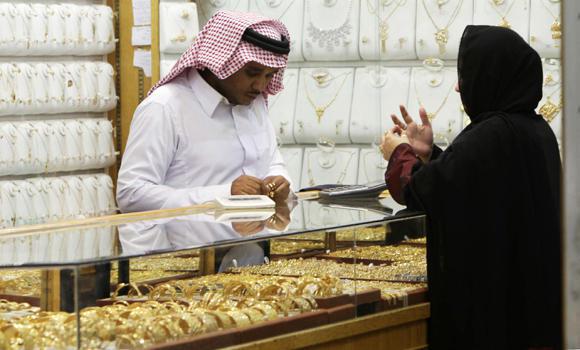
Rising gold prices threaten some factories with closure

August 12, 2013

Rising_gold_pricesJeddah, Aug 12: The rising prices of gold during the past two weeks caused stagnation in the Saudi market, and pushed gold merchants to activate sales because factories didn’t halt their production, according to the National Committee for Precious Metals.

The price of the precious metal has registered the second weekly decline, while the dollar has recovered from its lowest value since seven weeks ago.

Speculation about the US Federal Reserve to reduce the bonds purchase program with a value of $85 billion a month was triggered by the low price of gold, which reached its lowest levels this week.

“Gold merchants didn’t lose because of the declining world prices, because most of them deal with gold as physical balance, and most merchants have sufficient gold accounts,” said Ahmad Al-Sharif, member of the National Committee for Precious Metals.

Gold prices declined by 0.2 percent, to $1,308 per ounce, and the market is about to close at 0.25 percent. Delayed US gold contracts, which will be delivered in December declined by $2, to $1,307.90 per ounce.

Silver prices stabilized at $20.19 per ounce, while platinum gained 0.1 percent to $1,488 per ounce. Palladium rose 0.1 percent to $736.97 per ounce.

Meanwhile, the National Committee for Precious Metals is attempting to ferret out illegal gold sellers, which had controlled as much as one-quarter of the gold market.

“Workshops have been organized, which held unknown names in the gold trade, or operated from places that didn’t have defined headquarters contained products with ambiguous origins were combated,” said Al-Sharif. “We are working on a mechanism to combat violating workshops, and educate consumers and merchants who deal with such workshops. We advise merchants, and gold market clients to buy gold from approved individuals.”

He pointed to the existence of “workshops alien to the market” that had a large share before prices rose, which control 25 percent of the market.

“After the rising prices a large number of these workshops sold their stocks and changed their activities because they were illegal dealers,” he said. “After strict controls and the correction of labor status these violating workshops will be eliminated, because most of them are illegal workers who practice their business in un licensed areas.”

“At the present time, and because of the strict control of the Passport Department and the Ministry of Labor, these workshops have 10 percent of the market share,” he said.

Comments

Add new comment

  • Coastaldigest.com reserves the right to delete or block any comments.
  • Coastaldigset.com is not responsible for its readers’ comments.
  • Comments that are abusive, incendiary or irrelevant are strictly prohibited.
  • Please use a genuine email ID and provide your name to avoid reject.
Agencies
August 2,2020

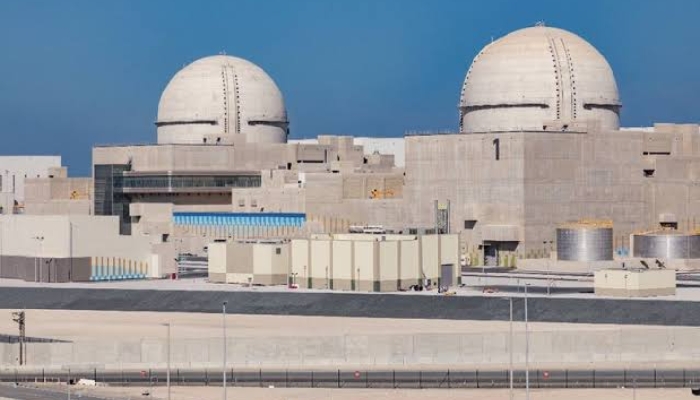
Dubai, Aug 2: The United Arab Emirates (UAE) announced on Saturday that it has started operations in the first of four reactors at the Barakah nuclear power station - the first nuclear power plant in the Arab world.

Emirates Nuclear Energy Corporation (ENEC), which is building and operating the plant with Korea Electric Power Corporation (KEPCO) said in a press release that its subsidiary Nawah Energy Company "has successfully started up Unit 1 of the Barakah Nuclear Energy Plant, located in the Al Dhafrah Region of Abu Dhabi".

That signals that Unit 1, which had fuel rods loaded in March, has achieved "criticality" - a sustained fission chain reaction.

"The start-up of Unit 1 marks the first time that the reactor safely produces heat, which is used to create steam, turning a turbine to generate electricity," said ENEC.

Barakah, which was originally scheduled to open in 2017, has been dogged by delays and is billions of dollars over budget. It has also raised myriad concerns among nuclear energy veterans who are concerned about the potential risks Barakah could visit upon the Arabian Peninsula, from an environmental catastrophe to a nuclear arms race.

Paul Dorfman, an honorary senior research fellow at the Energy Institute, University College London and founder and chair of the Nuclear Consulting Group, has criticised the Barakah reactors' "cheap and cheerful" design that he says cuts corners on safety.

Dorfman authored a report (PDF) last year detailing key safety features Barakah's reactors lack, such as a "core catcher" to literally stop the core of a reactor from breaching the containment building in the event of a meltdown. The reactors are also missing so-called Generation III Defence-In-Depth reinforcements to the containment building to shield against a radiological release resulting from a missile or fighter jet attack.

Both of these engineering features are standard on new reactors built in Europe, says Dorfman.

There have been at least 13 aerial attacks on nuclear facilities in the Middle East - more than any other region on earth.

The vulnerability of critical infrastructure in the Arabian Peninsula was further laid bare last year after Saudi Arabia's oil facilities at Abqaiq and Khurais were attacked by 18 drones and seven cruise missiles - an assault that temporarily knocked out more than half of the kingdom's oil production.

On Saturday, Dorfman reiterated his concern that there is no regional protocol in place to determine liability should an accident or incident at Barakah result in radioactive contamination spreading from the UAE to its neighbours. 

"Given Barakah has started up, because of all the well-rehearsed nuclear safety and security problems, it may be critically important that the Gulf states collectively evolve a Nuclear Accident Liability Convention, so that if anything does go wrong, victim states may have some sort of redress," Dorfman told Al Jazeera. 

The UAE has substantial oil and gas reserves, but it has made huge investments in developing alternative energy sources, including nuclear and solar.

Experts though have questioned why the UAE - which is bathed in sunlight and wind - has pushed ahead with nuclear energy - a far more expensive and riskier option than renewable energy sources.

When the UAE first announced Barakah in 2009, nuclear power was cheaper than solar and wind. But by 2012 - when the Emirates started breaking ground to build the reactors - solar and wind costs had plummeted dramatically.

Between 2009 and 2019, utility-scale average solar photovoltaic costs fell 89 percent and wind fell 43 percent, while nuclear jumped 26 percent, according to an analysis by the financial advisory and asset manager Lazard.

There are also concerns about the potential for Barakah to foment nuclear proliferation in the Middle East - a region rife with geopolitical fault lines and well-documented history of nuclear secrecy.

The UAE has sought to distance itself from the region's bad behaviour by agreeing not to enrich its own uranium or reprocess spent fuel. It has also signed up to the United Nation's nuclear watchdog's Additional Protocol, significantly enhancing inspection capabilities, and secured a 123 Agreement with the United States that allows bilateral civilian nuclear cooperation.

Comments

Add new comment

  • Coastaldigest.com reserves the right to delete or block any comments.
  • Coastaldigset.com is not responsible for its readers’ comments.
  • Comments that are abusive, incendiary or irrelevant are strictly prohibited.
  • Please use a genuine email ID and provide your name to avoid reject.
News Network
March 18,2020

Riyadh, Mar 18: Private-sector businesses in Saudi Arabia on Wednesday were ordered to introduce enforced remote working for all employees for 15 days in an attempt to prevent the spread of the coronavirus.

Businesses that require staff to be physically present to ensure they continue to operate — including those in vital or sensitive sectors such as electricity, water and communications — must reduce the number of workers in their offices to the bare minimum. This can be no more than 40 percent of the total number of staff.

In such cases precautionary measures set by the Ministry of Health must be followed. At offices, and staff accommodation, with more than 50 workers, an area at the entrance must be provided where temperatures can be taken and symptoms checked.

Employers must also set up a mechanism for workers to report any symptoms, such as high temperature, coughing or shortness of breath, or contact they have had with infected individuals or people who recently returned from other countries without following proper Ministry of Health quarantine procedures.

Inside offices, a safe amount of space between employees must be maintained at all times. In addition, all health clubs and nurseries provided by employers must close.

Pregnant women and new mothers, people suffering from respiratory diseases, those with immune-system problems or chronic conditions, cancer patients and employees above the age of 55 are to be given 14 days compulsory paid leave, which will not be deducted from their annual entitlement.

Businesses that are excluded from the new measures include pharmacies and supermarkets, and their suppliers. Private-sector organizations that provide services to government agencies must contact them before suspending workplace attendance. Any other business that considers it impossible to operate with only 40 percent of staff in the workplace must submit an exemption request to the authority that supervises it.

Comments

Add new comment

  • Coastaldigest.com reserves the right to delete or block any comments.
  • Coastaldigset.com is not responsible for its readers’ comments.
  • Comments that are abusive, incendiary or irrelevant are strictly prohibited.
  • Please use a genuine email ID and provide your name to avoid reject.
News Network
July 10,2020

Dubai, Jul 10: Saudi Minister of Culture Prince Badr bin Abdullah bin Farhan has appointed Dina Amin as CEO of the Visual Arts Commission.

She will take the lead in implementing the ministry’s vision and directions in promoting and developing visual arts in the Kingdom and empowering practitioners in the field.

Amin is a leading Saudi specialist in visual arts and the international contemporary art field. She gained a bachelor’s degree in art history and architecture from Wellesley College, in the US, and also attended a collaborative program in architecture at Massachusetts Institute of Technology.

During her career, spanning more than two decades, she has held senior positions in prominent international arts companies, including most recently Phillips, a global auction house for art, design, watches, jewels, and more.

She has also worked at Christie’s, one of the world’s most famous auction houses, employed in senior roles at the company’s international offices including New York, Dubai, and London.

The Visual Arts Commission is one of 11 new cultural bodies recently launched by the Ministry of Culture in line with the Saudi Vision 2030 reform plan to manage the empowerment and development of the Kingdom’s cultural sector. The commission will be responsible for managing and developing the visual arts sector to help achieve the ministry’s goals.

Comments

Add new comment

  • Coastaldigest.com reserves the right to delete or block any comments.
  • Coastaldigset.com is not responsible for its readers’ comments.
  • Comments that are abusive, incendiary or irrelevant are strictly prohibited.
  • Please use a genuine email ID and provide your name to avoid reject.