


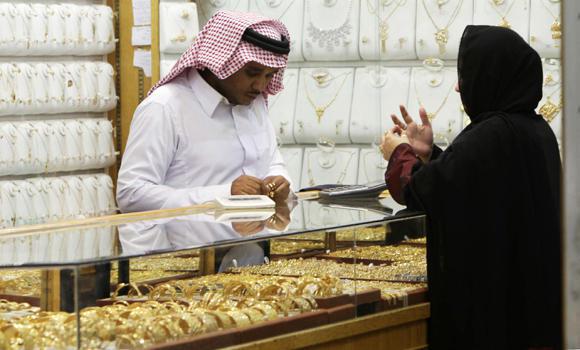
Rising gold prices threaten some factories with closure

August 12, 2013

Rising_gold_pricesJeddah, Aug 12: The rising prices of gold during the past two weeks caused stagnation in the Saudi market, and pushed gold merchants to activate sales because factories didn’t halt their production, according to the National Committee for Precious Metals.

The price of the precious metal has registered the second weekly decline, while the dollar has recovered from its lowest value since seven weeks ago.

Speculation about the US Federal Reserve to reduce the bonds purchase program with a value of $85 billion a month was triggered by the low price of gold, which reached its lowest levels this week.

“Gold merchants didn’t lose because of the declining world prices, because most of them deal with gold as physical balance, and most merchants have sufficient gold accounts,” said Ahmad Al-Sharif, member of the National Committee for Precious Metals.

Gold prices declined by 0.2 percent, to $1,308 per ounce, and the market is about to close at 0.25 percent. Delayed US gold contracts, which will be delivered in December declined by $2, to $1,307.90 per ounce.

Silver prices stabilized at $20.19 per ounce, while platinum gained 0.1 percent to $1,488 per ounce. Palladium rose 0.1 percent to $736.97 per ounce.

Meanwhile, the National Committee for Precious Metals is attempting to ferret out illegal gold sellers, which had controlled as much as one-quarter of the gold market.

“Workshops have been organized, which held unknown names in the gold trade, or operated from places that didn’t have defined headquarters contained products with ambiguous origins were combated,” said Al-Sharif. “We are working on a mechanism to combat violating workshops, and educate consumers and merchants who deal with such workshops. We advise merchants, and gold market clients to buy gold from approved individuals.”

He pointed to the existence of “workshops alien to the market” that had a large share before prices rose, which control 25 percent of the market.

“After the rising prices a large number of these workshops sold their stocks and changed their activities because they were illegal dealers,” he said. “After strict controls and the correction of labor status these violating workshops will be eliminated, because most of them are illegal workers who practice their business in un licensed areas.”

“At the present time, and because of the strict control of the Passport Department and the Ministry of Labor, these workshops have 10 percent of the market share,” he said.

Comments

Add new comment

  • Coastaldigest.com reserves the right to delete or block any comments.
  • Coastaldigset.com is not responsible for its readers’ comments.
  • Comments that are abusive, incendiary or irrelevant are strictly prohibited.
  • Please use a genuine email ID and provide your name to avoid reject.
coastaldigest.com news network
May 24,2020

Abu Dhabi: A senior Hindi teacher at Sunrise School in Abu Dhabi has died of coronavirus, it has been confirmed. Anil Kumar, 50, passed away on Sunday morning, May 24.

The sad and shocking demise of Mr Kumar, a senior Hindi teacher of Sunrise School on May 24, has left the entire Sunrise family in a pall of gloom, read a statement.

“The management, administrators, other faculty members, students and the school as a whole is struck with intense sorrow and is speechless.

“The bond that he had developed over the years, just as how we have with each faculty, makes the loss unbearable. The entire SEPS family is shaken and finds it hard to come to terms with this most saddening news.

“Anil Kumar was a very inspiring teacher. He always brought a creative aspect to the classes he handled and would make it an enjoyable class to attend to. Mr. Anil Kumar had a great way of motivating his students to do their best, and pushed them to be the best they could be. He was a great strength and support to the Department of Hindi, always willing to scaffold and mentor students and teachers. He was a very approachable man, warm and friendly at heart and that is something I will truly miss about Mr. Anil.

“Mr Anil Kumar has left behind his wife and two children. Mrs. Rajini, his wife is also a member of the school family. She is a faculty of the maths department. Our prayers and sincere condolences to each and every one of the family. May God give the strength to endure and face this most challenging phase of their life.”

It is learnt Mr Kumar fell ill with COVID-19 and had been in hospital since May 7.

Comments

Add new comment

  • Coastaldigest.com reserves the right to delete or block any comments.
  • Coastaldigset.com is not responsible for its readers’ comments.
  • Comments that are abusive, incendiary or irrelevant are strictly prohibited.
  • Please use a genuine email ID and provide your name to avoid reject.
News Network
July 23,2020

Beirut, Jul 23: The pandemic will exact a heavy toll on Arab countries, causing an economic contraction of 5.7% this year, pushing millions into poverty and compounding the suffering of those affected by armed conflict, a U.N. report said Thursday.

The U.N.'s Economic and Social Commission for Western Asia expects some Arab economies to shrink by up to 13%, amounting to an overall loss for the region of $152 billion.

Another 14.3 million people are expected to be pushed into poverty, raising the total number to 115 million — a quarter of the total Arab population, it said. More than 55 million people in the region relied on humanitarian aid before the COVID-19 crisis, including 26 million who were forcibly displaced.

Arab countries moved quickly to contain the virus in March by imposing stay-at-home orders, restricting travel and banning large gatherings, including religious pilgrimages.

Arab countries as a whole have reported more than 830,000 cases and at least 14,717 deaths. That equates to an infection rate of 1.9 per 1,000 people and 17.6 deaths per 1,000 cases, less than half the global average of 42.6 deaths, according to the U.N.

But the restrictions exacted a heavy economic toll, and authorities have been forced to ease them in recent weeks. That has led to a surge in cases in some countries, including Lebanon, Iraq and the Palestinian territories.

Wealthy Gulf countries were hit by the pandemic at a time of low oil prices, putting added strain on already overstretched budgets. Middle-income countries like Jordan and Egypt have seen tourism vanish overnight and a drop in remittances from citizens working abroad.

War-torn Libya and Syria have thus far reported relatively small outbreaks. But in Yemen, where five years of civil war had already generated the world's worst humanitarian crisis, the virus is running rampant in the government-controlled south while rebels in the north conceal its toll.

Rola Dashti, the head of the U.N. commission, said Arab countries need to “turn this crisis into an opportunity” and address longstanding issues, including weak public institutions, economic inequality and over-reliance on fossil fuels.

“We need to invest in survival, survival of people and survival of businesses,” she said.

Comments

Add new comment

  • Coastaldigest.com reserves the right to delete or block any comments.
  • Coastaldigset.com is not responsible for its readers’ comments.
  • Comments that are abusive, incendiary or irrelevant are strictly prohibited.
  • Please use a genuine email ID and provide your name to avoid reject.
KT
May 18,2020

May 18: As the UAE authorities have asked all residents to avoid gatherings, it is clear that - for the first time - it's going to be a #StayHome Eid. But experts say that although it will be different, the celebration will be just as meaningful.

It is important to remember that the Eid prayer can be performed at home either individually or with family members under the sane roof, said Dr Mohammed Eyada Ayoub Alkobaisi, a Grand Mufti with the Islamic Affairs and Charitable Activities Department in Dubai.

Dr Alkobaisi said this prayer is a highly recommended Sunnah or practice urged by the Prophet Muhammad (Peace be upon him).

"Eid Prayer must be performed openly, unless we are prevented for an acceptable reason, such as fear for self, wellbeing, property, etc." Under the current circumstances, prayers can be offered from home, he said.

But what the faithful will likely miss is listening to the khutbah or the sermon of Eid with a crowd. The sight of people pouring out into the streets and coming together for prayer and worship would not be unfolding this time.

Dr Sheikh Mohamed Ashmawy, an Islamic researcher, said that in this time of Covid, doing away with several Eid traditions would be necessary for everyone's safety.

"The ban is is line with the ongoing preventive measures to curb the spread of Covid-19," he said.

However, it doesn't mean people can't celebrate and exchange heartfelt greetings, he added.

"We can greet each other remotely on the phone or via social media networks."

Islamic researcher Sheikh Mohamed Wasfi said audio-visual smart apps have made communication much easier, even bringing people closer than before.

"Of course, families and friends wish to hug, shake hands and see each other personally, but this will be a big risk these days," he said.

Sheikh Asadullah Del Mohamed, an imam, reminded that banquets, parties and visits are discouraged to avoid crowds and gathering.

Recently, 30 people from two families tested positive for the virus after breaking social distancing rules and holding a gathering.

Faithful's sentiments

Ibrahim Abdelkader, an Egyptian auditor, said that while it would be sad to spend Eid Al Fitr at home, he understood that it is for everyone's safety.

"Better to stay home than be sorry," said Ahmad Jamil, a Syrian resident.

Rashid Saeed, an Emirati national, said people are advised to just check on each other by phone or video and voice call apps.

"While Eid prayers is banned in congregation, it's not acceptable at all for some people to carelessly gather and exchange visits," he said.

Abdullah Al Saleh, an Emirati national, said he and all his relatives used to gather for breakfast after the Eid prayer - but this time, they are ready to do it in their own homes.

Mohamed Ibrahim, another Emirati, said he would surely miss seeing his kids happily prancing around with their new clothes and enjoying the outdoors like every year.

"But, I agree as it is for their health, safety and wellbeing," he said.

THINGS TO REMEMBER IN CELEBRATING EID THIS YEAR

>Perform the Eid prayer at home, individually or with family members living with you

>Exchange greetings with loved ones and friends via phone calls or online

>No hugs

>No handshakes

>No gatherings

>No visits to other homes

Comments

Add new comment

  • Coastaldigest.com reserves the right to delete or block any comments.
  • Coastaldigset.com is not responsible for its readers’ comments.
  • Comments that are abusive, incendiary or irrelevant are strictly prohibited.
  • Please use a genuine email ID and provide your name to avoid reject.