Minister donates blood as Blood Helpline-Karnataka celebrates anniversary

coastaldigest.com news network
August 6, 2017

Mangaluru, Aug 6: The first anniversary celebration of Blood Helpline-Karnataka was celebrated on Sunday at Forum Fiza Mall, Mangaluru. 

Inaugurating the event, Food and Civil Supplies Minister U T Khader said that donating and arranging blood in emergency is one of the greatest deeds. 

He congratulated the young enthusiastic team of Blood Helpline that arranges the blood during emergency requirements in coastal district and other parts of the state.

Prof. Pattabhirama Somayaji spoke as chief guest and distributed identity cards among blood donors.

On the same occasion, B A Mohammed Ali Kammaradi, Harekala Hajabba and social activist Ravoof were felicitated.

President Iftikar Krishnapura presided over the programme. MLAs Mohiuddin Bava, J R Lobo, Mustafa Addoor Demmele, Khatheeb Abdul Azeer Darimi, A H Naushad Haji were present among others. 

A blood donation camp was also hosted as part of the anniversary celebration. Minister Khader also donated blood.

Comments

Navaz Thokur- …
 - 
Sunday, 6 Aug 2017

Masha Allah.  Salute to your selfless efforts BHL team. May Almighty Allah bless you all with good health and strength to serve the society in more better way

Add new comment

  • Coastaldigest.com reserves the right to delete or block any comments.
  • Coastaldigset.com is not responsible for its readers’ comments.
  • Comments that are abusive, incendiary or irrelevant are strictly prohibited.
  • Please use a genuine email ID and provide your name to avoid reject.
Media Release
February 14,2020

Veteran journalist P. Sainath has said that the nation is in a crisis. And this crisis is not limited to just the rural area. It has become a national crisis at various areas such as agriculture, education, economy, job creation etc.

He was delivering the endowment lecture on the topic ‘Indian democracy at the post-liberalization and post-truth era’ at Media Manthan 2020 organized by the PG department of journalism and mass communication at St Aloysius College (Autonomous). 

Mr Sainath said that the many policies adopted in the 90s led to India becoming unusually unequal. Referring to the speech Ambedkar had made at the Constituent Assembly while handing over the draft of the Constitution, Mr Sainath said, “Ambedkar had warned about the weakness of Indian democracy that liberty without equality allows the supremacy of a few over the multitude. Liberty, equality and fraternity must be kept together as we cannot have one without the other.” 

Mr Sainath stated that the agrarian crisis was no longer about the loss of productivity, employment or about farmer suicide; it was a societal, civilizational crisis. Commenting on the lopsided policies such as cow-slaughter ban, he explained how cow slaughter ban had adversely affected many industries due to their interdependency. While Muslims who slaughtered cows were rendered helpless, the cattle traders who were mostly OBCs lost their earnings as the cattle prices crashed. An important industry like Kolhapur sandals industry in Maharashtra went bankrupt as a result of the cow slaughter ban in Maharashtra. He said the policymakers had no idea how the rural industries were interconnected. Demonetisation too devastated the rural economy as 98 percent of rural transactions happen through cash. 

Mr Sainath also spoke about the crisis of inequality which affects the Dalits and the Adivasis far more than anyone else as 90 percent of the rural households take home less than Rs 10,000/- per month. “Women are yet another group whose labour is never counted in the gross domestic product. Women and girls globally do unpaid work which amounts to about 12.5 billion working hours per year. Monetarily speaking, this is worth 10.8 trillion dollars,” Mr Sainath added. 

Speaking about the crisis of jobs Mr Sainath said that major companies were laying off employees just to create more profits for the investors and the adoption of artificial intelligence in the industry would further destroy millions of jobs.

Rector of St Aloysius College Institutions Fr Dionysius Vaz SJ, Principal Dr (Fr) Praveen Martis SJ, HOD of Journalism and Mass Communication department Dr (Fr) Melwyn Pinto SJ were present.

‘Veerappan and Vijay Mallya’s business models are interesting!’

Addressing the gathering during his endowment lecture on Friday, Mr Sainath made an interesting comment on the so called ‘revenue model’. “Whenever I visit IIMs and IITs for lectures on my PARI project, the students there ask me what my revenue model for my project is. I tell them that I do not have a revenue model. In fact, journalism does not begin with a revenue model. Gandhiji, Ambedkar, Bhagat Singh were all great journalists. But they did not have a revenue model,” Mr Sainath said.

On a lighter note, he said that the best revenue model that he liked was that of forest brigand Veerappan and liquor baron Vijay Mallya. “Veerappan ruled the forest for forty years and from the top ministers to the villagers he could dictate terms and liver royally. Similarly, Mallya’s revenue model was to steal the banks and run away abroad and live like a king,” Mr Sainath added.

Journalism is not and can never be a business. It is a calling, he opined. While newspaper can be a business, television can be a business, journalism per se cannot be reduced to a business. “Unfortunately today, journalists are recruited on a contract basis and they have no bargaining power; and there are no unions to fight for their cause. Hence, they are at the mercy of the corporate media houses for their survival and are made to write stories that cannot be called journalism,” Mr Sainath said.

Answering a question as to the pressures he faced as a journalist, he said that external pressures from the government or others could be very well handled. It is the internal pressures from once own media house that journalists find it difficult to manage.


 

Comments

Add new comment

  • Coastaldigest.com reserves the right to delete or block any comments.
  • Coastaldigset.com is not responsible for its readers’ comments.
  • Comments that are abusive, incendiary or irrelevant are strictly prohibited.
  • Please use a genuine email ID and provide your name to avoid reject.
News Network
August 2,2020

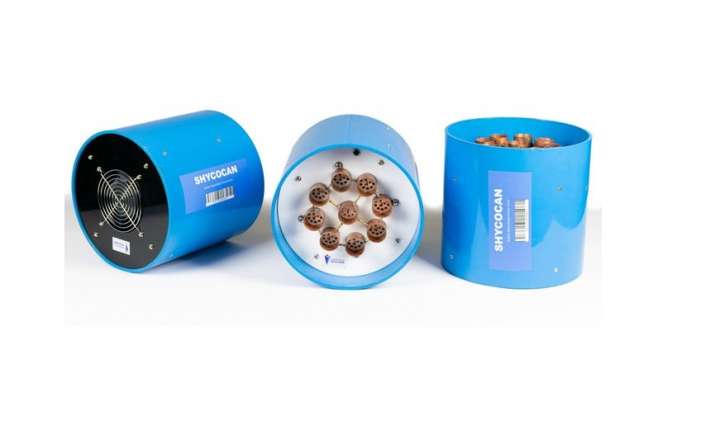
Bengaluru, Aug 2: Bengaluru based Centre for Advanced Research and Development (CARD), the research wing of organisation De scalene has come up with a device called "SHYCOCAN" (Scalene Hypercharge Corona Canon) which neutralizes the coronavirus.

Speaking to news agency Dr Rajah Vijay Kumar, Chairman, Organisation De Scalene said that the device will not kill any bacteria or fungus, however, neutralizes the coronavirus particles.

"The device was tested for its safety and efficacy and is soon going to be manufactured and marketed in the US under the Enforcement Discretion policy of USFDA and in Europe as the device is CE compliant and is CE marked," said Kumar.

He also added the device will cover a volume of 10,000 cubic feet.

The device Scalene Hypercharge Corona Canon (SHYCOCAN) is intended to be used in the residential, industrial and commercial environment and is designed for active containment by attenuation of Corona family of viruses. (Laboratories de Especialidades Immunological S.A. de C.V, Virucidal Activity concludes 99.9 per cent virus elimination), Kumar asserted.

"SHYCOCAN operates on regular 110/240V - 50/60 Hz wall socket and is a plug and play device, that delivers the necessary signals to a photon mediated electrons emitters (PMEE), that produces hypercharge high-velocity electrons by photon mediation that interacts with the negative seeking S-protein of Corona family of viruses thus reducing infectivity and prevent air and surface borne transmission of corona family of viruses," said Kumar.

The device does not use any chemicals, or any other consumables and does not produce harmful ozone gas or any other substances and is completely safe for use in any environment, he added.

"The attack mechanism of the Virus starts with the initial attachment of the virion to the host cell, it is initiated by interactions between the S-protein and its receptor on the "negative" cell membrane. The sites of receptor binding domains (RBD) within the S1 region of a coronavirus S-protein vary depending on the virus. 

The S-protein/receptor interaction is the primary determinant for a coronavirus to infect a host species and governs the tissue tropism of the virus. However, the end result is the fusion and release of the viral genome into the cytoplasm," said Kumar.

He continued saying that the counter mechanism by the device SHYCOCAN is that if negative seeking is the guidance mechanism of the S- Protein, attracted by the transmembrane potential of the host cells, then breaking this mechanism would block the Coronavirus infectivity and spread.

"The device has been in use for more than a year at the S-CARD campus, the headquarters of Scalene," said Kumar.

Comments

Add new comment

  • Coastaldigest.com reserves the right to delete or block any comments.
  • Coastaldigset.com is not responsible for its readers’ comments.
  • Comments that are abusive, incendiary or irrelevant are strictly prohibited.
  • Please use a genuine email ID and provide your name to avoid reject.
News Network
July 22,2020

Bengaluru, Jul 22: Karnataka's Covid-19 task force on Tuesday decided that the state government will regulate the supply of Remdesivir, the drug used in the treatment of coronavirus infected patients, to private hospitals to check black marketing and hoarding.

"Remdesivir which is currently available in the government hospitals will be supplied to private hospitals through the government.

This will help curb black marketing of this drug," Medical Education Minister K Sudhakar's office said in a release.

Along with Sudhakar, other task force members, including Health Minister Sriramulu, Deputy Chief Minister C N Ashwath Narayan and Chief Secretary T M Vijay Bhaskar attended the meeting. However, Home Minister Basavaraj Bommai was not part of it as he was out of Bengaluru.

At the meeting, the government has also fixed the rate for Covid-19 tests in private labs- Rs 2,000 for government referred cases and 3,000 for self-reporting cases.

It was also decided to purchase 4 lakh antigen test kits and 5 lakh swab test kits to ramp up testing, the release said, adding that approvals have also been given for additional drugs for the treatment of Covid-19 patients.

The decisions also included increasing monthly salary for Ayush doctors to 48,000, MBBS doctors to 80,000 and nurses to get 30,000 for next 6 months.

The task force also made it clear that private hospitals have to reserve 50 percent beds for the government for Covid-19 treatment. The remaining 50 percent can be used by the private hospitals for Covid-19 and non-Covid-19 treatment.

Private hospitals provide treatment under Ayushman Bharat scheme (ABARK) for Covid-19 patients.

Those cases in which treatment does not cover under the scheme can be charged as per the user charges, the release said.

A committee will be formed to supervise and recommend the purchase of equipment and medicines for Covid-19 treatment, which will be headed by ACS, ITBT Department.

Approval has been given for the procurement of N-95 masks and lakh PPE kits for the safety of healthcare workers. The decision also has been taken to connect oxygen pipeline to 4,736 beds in 17 government medical colleges, which will enable high flow oxygen for these beds besides being beneficial for future use as well.

According to the release, 16 RTPCR and 15 Automated RNA extraction units will be established to ramp up testing and this will help achieve the target of 50,000 tests per day. "On the whole approvals given for purchase of equipment and upgradation of existing facilities at government hospitals is estimated to be about Rs 500 Crore," it added.

Comments

Add new comment

  • Coastaldigest.com reserves the right to delete or block any comments.
  • Coastaldigset.com is not responsible for its readers’ comments.
  • Comments that are abusive, incendiary or irrelevant are strictly prohibited.
  • Please use a genuine email ID and provide your name to avoid reject.