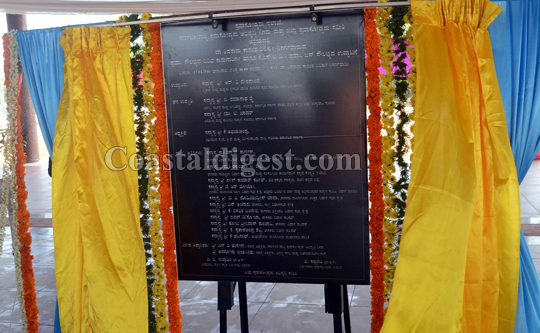
Minister flags off KSTDC Mangaluru special package tour

[email protected] (DHNS | Photos by Suresh)
April 17, 2016

Mangaluru, Apr 17: R V Deshpande, Minister for Tourism, Large and Medium Scale Industries, flagged off the Mangaluru Special Package Tour, initiated by the Karnataka State Tourism Development Corporation, at Dr Shivaram Karanth Pilikula Nisargadhama on Sunday.
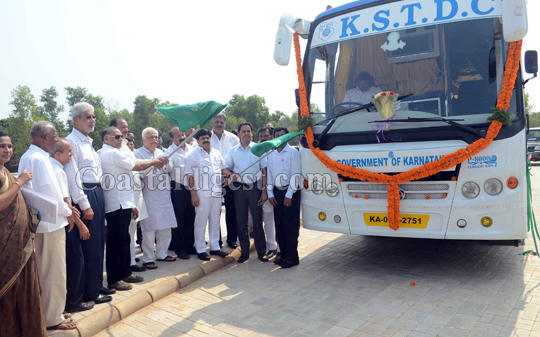
pilikula 5

Speaking on the occasion, the minister said that the state government has taken several measures to provide basic amenities and to ensure protection of visitors to various tourists spots in the state. The Department of Home Guards has deployed 125 trained security personnel at 319 tourist destinations. Another 250 people will be trained and the selection process is going on. Another new programme has been introduced by the government, with private companies adopting and developing tourist spots, as corporate social responsibility (CSR) activities, Deshpande added.

Development of beaches

The minister said that Rs 13 crore will be sanctioned soon to provide necessary equipment – including roads and drain facilities – at the beaches at Talapady, Surathkal, Ullal, Someshwar and Tannirbavi in the district.

He, meanwhile, said that relaxation to the Coastal Security Zone regulations has been sought by the state government from the Central Government Ministry of Environment, and added that the ministry has been requested to decrease the limit for carrying out beach development activities, from 250 metres to 90-100 metres, on selected beaches.

Minister R V Deshpande expressed a need for the district administration to improve the marketing strategy for the Pilikula Nisargadhama. The district administration also has to establish perfect coordination among various departments involved in the development of the Nisargadhama, he said.

The Tourism Department has plans to organise open street programmes in Mangaluru, said the minister, explaining further that on a particular day, zero traffic will be observed on MG?Road and cultural activities will be held.

K Abhayachandra Jain, Minister for Youth Empowerment, Sports and Fisheries, said that the government has allocated Rs six crore for surfing and other adventure sports. Also, a fund of Rs 15 crore is reserved in the budget to install an aquarium at Pilikula.

S A?Prabhakar Sharma, executive director of the Nisargadhama said that the Tourism Department had sanctioned Rs five crore for development works at Pilikula and Rs four crore had been used for the works. A project plan for second phase development work has been submitted to the Department of Tourism, he added.

MP Nalin Kumar Kateel, MLA B A?Mohiuddin Bava, MLC Ivan D'Souza, Jungle Lodges President Asagodu Jayasimha, KSTDC Chairman S A?Hussain and Deputy Commissioner A B Ibrahim were present among others.
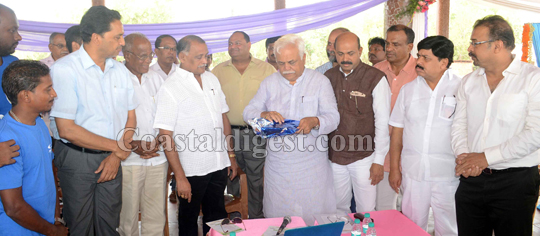

pilikula 1

pilikula 2

pilikula 4

pilikula 6

pilikula 7

Comments

Gopal Shetty M
 - 
Monday, 18 Apr 2016

The Mangaluru Darshana tour should also include a visit to the Govt. Museum at Bijai

Gopal Shetty M
 - 
Monday, 18 Apr 2016

The Mangaluru Darsjhana tour should also include a visit to the Govt. Museum at Bijai.

Add new comment

  • Coastaldigest.com reserves the right to delete or block any comments.
  • Coastaldigset.com is not responsible for its readers’ comments.
  • Comments that are abusive, incendiary or irrelevant are strictly prohibited.
  • Please use a genuine email ID and provide your name to avoid reject.
News Network
January 6,2020

Jan 6: A Thane resident lost a little over Rs 1 lakh in an online fraud involving popular payment gateways, police said on Saturday. The complainant, a resident of Patlipada, wanted to sell his furniture and posted an ad on Facebook on December 21, an official said.

On December 24, he received a call from one Rajendra Sharma who offered to buy the furniture and wanted to transfer the amount through payment gateways — Paytm and Google Pay, he said.

However, instead of the money getting credited to his account, the complainant found that Rs 1.01 lakh were debited from him during three transactions on two payment gateways, the official said.

The complainant realised that he had been cheated when the accused assured that he would return the money and asked him for another account number, he added.

An offense has been registered against the unidentified accused under section 420 (cheating) of the Indian Penal Code and Information Technology Act and further investigations are underway, he said.

Comments

Add new comment

  • Coastaldigest.com reserves the right to delete or block any comments.
  • Coastaldigset.com is not responsible for its readers’ comments.
  • Comments that are abusive, incendiary or irrelevant are strictly prohibited.
  • Please use a genuine email ID and provide your name to avoid reject.
News Network
January 5,2020

Mangaluru, Jan 5: In a frightening incident, a leopard which was trapped in a snare attacked and injured three persons in its successful bid to escape Balpa village in Sullia taluk of Dakshina Kannada. 

The incident occurred on Thursday when around 15 forest staff approached the trapped leopard to tranquilize it with a dart. The leopard, however, managed escape. 

While running away, it attacked a villager Balakrishna, aged about 70, who was working in the nearby plantation. He sustained injuries on his upper lips.

He was rushed to a hospital in Sullia and then was shifted to the Government Wenlock hospital for further treatment. He is learnt to be out of danger.

After this incident, the forest department kept a tab and tracked the leopard using a drone.  

According to V Karikalan, deputy conservator of forest (DCF), Dakshina Kannada, Between 5pm to 5.30pm on a tip off that leopard was spotted near a bush, the forest department tried to approach it again and the animal jumped on the officials, injuring Assistant Conservator of Forests Austin and forest guard Divith. 

The injured were rushed to a nearby hospital and then taken to Mangaluru for further treatment. They are learnt to be out of danger.

Meanwhile, the department is continuing combing in the village and surrounding areas. Three teams consisting of three RFOs and 10 Dy RFOs, supported by doctors are on the field. The forest department has also placed two leopard capturing cages in the area. Night patrolling will continue and public announcements are being made.

Comments

Add new comment

  • Coastaldigest.com reserves the right to delete or block any comments.
  • Coastaldigset.com is not responsible for its readers’ comments.
  • Comments that are abusive, incendiary or irrelevant are strictly prohibited.
  • Please use a genuine email ID and provide your name to avoid reject.
Agencies
May 8,2020

Washington D.C., May 8: The prime time for brain development in a child's life is the first year, where the infant spends most of the time asleep. It is the time when neural connections form and sensory memories are encoded.

However, when sleep is disrupted, as occurs more often among children with autism, brain development may be affected, too.

New research led by the University of Washington finds that sleep problems in a baby's first 12 months may not only precede an autism diagnosis but also may be associated with altered growth trajectory in a key part of the brain, the hippocampus.

The study, which was published in the American Journal of Psychiatry, researchers report that in a sample of more than 400 taken of 6- to 12-month-old infants, those who were later diagnosed with autism were more likely to have had difficulty falling asleep.

It also states that this sleep difficulty was associated with altered growth trajectories in the hippocampus.

"The hippocampus is critical for learning and memory, and changes in the size of the hippocampus have been associated with poor sleep in adults and older children.

As many as 80 per cent of the children with autism spectrum disorder have sleep problems," said Annette Estes, director of the UW Autism Center and senior author of the study.

"In our clinical experience, parents have a lot of concerns about their children's sleep, and in our work on early autism intervention, we observed that sleep problems were holding children and families back," added Estes, who is also a UW professor of speech and hearing sciences.

"It could be that altered sleep is part-and-parcel of autism for some children. One clue is that behavioural interventions to improve sleep don't work for all children with autism, even when their parents are doing everything just right. This suggests that there may be a biological component to sleep problems for some children with autism," said Estes.

To consider links among sleep, brain development, and autism, researchers at the IBIS Network looked at MRI scans of 432 infants, surveyed parents about sleep patterns, and measured cognitive functioning using a standardized assessment.

At the outset of the study, infants were classified according to their risk for developing autism: Those who were at higher risk of developing autism -- about two-thirds of the study sample -- had an older sibling who had already been diagnosed.

Infant siblings of children with autism have a 20 per cent chance of developing autism spectrum disorder -- a much higher risk than children in the general population.

In the current study, 127 of the 432 infants were identified as "low risk" at the time the MRI scans were taken because they had no family history of autism.

They later evaluated all the participants at 24 months of age to determine whether they had developed autism. Of the roughly 300 children originally considered "high familial risk," 71 were diagnosed with autism spectrum disorder at that age.

Problems with sleep were more common among the infants later diagnosed with an autism spectrum disorder, as were larger hippocampi. No other subcortical brain structures were affected, including the amygdala, which is responsible for certain emotions and aspects of memory, or the thalamus, a signal transmitter from the spinal cord to the cerebral cortex.

The authors note that while parents reported more sleep difficulties among infants who developed autism compared to those who did not, the differences were very subtle and only observed when looking at group averages across hundreds of infants.

Sleep patterns in the first years of life change rapidly as infants transition from sleeping around the clock to a more adult-like sleep/wake cycle. Until further research is completed, Estes said, it is not possible to interpret challenges with sleep as an early sign of increased risk for autism.

Comments

Add new comment

  • Coastaldigest.com reserves the right to delete or block any comments.
  • Coastaldigset.com is not responsible for its readers’ comments.
  • Comments that are abusive, incendiary or irrelevant are strictly prohibited.
  • Please use a genuine email ID and provide your name to avoid reject.