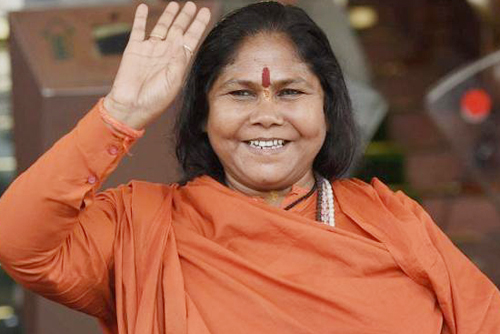
Minister Sadhvi apologizes for abusive remarks against Muslims, Christians

December 2, 2014

New Delhi, Dec 2: Prime Minister Nanrendra Modi’s aide and union minister Sadhvi Niranjan Jyoti on Tuesday expressed regret and apologized for her abusive and unconstitutional remarks in the Indian Parliament.

The Opposition party created a ruckus in both the Houses of Parliament over the controversy, forcing repeated adjournments. The Congress party even demanded her resignation.

abusivesadhvi

The newly inducted Minister of State for Food Processing Industries Niranjan Jyoti was caught using abusive language, besides claiming that everyone including Muslims and Christians of India are sons of Ram. She said those who don't believe in this ideology, do not belong to India, while campaigning for the BJP.

Questioning voters about their preference of leaders, who would govern them, she asked "Do you want a government of Ramzaadon (followers of Ram) or (those who are illegitimate-born)?" Later she had defended her Hindutva statements saying she was targeting the separatist and anti-national forces and people who indulge in plundering the wealth of the nation and stashing money abroad.

However, On Tuesday she apologized. As soon as Lok Sabha met for the day, Leader of Congress Mallikarjun Kharge reminded Speaker Sumitra Mahajan of the adjournment notices given by him and his party colleagues over the reported statements of the two ministers.

The Speaker rejected the notices saying though the matter is of urgent importance, the business of the day cannot be allowed to be disrupted. She, however, suggested that members can raise the issue during Zero Hour.

Kharge said the "objectionable" language used by Jyoti has created tension at a time when there have been communal riots.

Several Congress and Trinamool Congress members rushed to the Well shouting slogans. Congress members were heard demanding apology from Prime Minister Narendra Modi. The issue being raised by Trinamool Congress could not, however, be heard in the din.

Though the House took up two questions during Question Hour, the continuous pandemonium forced Mahajan to adjourn the House for 15 minutes till 11.30 a.m. While Jyoti was present in the Lok Sabha, Giriraj Singh could not be seen. Both the ministers had made certain controversial statements yesterday.

Comments

Add new comment

  • Coastaldigest.com reserves the right to delete or block any comments.
  • Coastaldigset.com is not responsible for its readers’ comments.
  • Comments that are abusive, incendiary or irrelevant are strictly prohibited.
  • Please use a genuine email ID and provide your name to avoid reject.
News Network
May 10,2020

New Delhi, May 10: The Delhi government has asked district magistrates to release 2,446 Tablighi Jamaat members from quarantine centres and ensure that they do not stay in any other place except their homes.

The district magistrates will explore the possibility of sending those Tablighi members, who belong to other states, in buses to their designated places in accordance with social distancing norms and other protocols, DDMA Special CEO K S Meena said in a letter to deputy commissioners (administration).

As man as 567 foreign attendees of the congregation held in Delhi's Nizamuddin area in March, will be handed over to the police, Meena said.

"They (foreign Jamaat attendees) will be handed over to police in connection with several violations like visa violation," a government official said on Saturday.

Delhi Home Minister Satyendar Jain had recently ordered the release of Tablighi members who have completed their required quarantine period in centres and tested negative for COVID-19.

"Out of such people belonging to Delhi, who could be released as per prescribed guidelines should be issued passes to travel from the quarantine centres.

"Under no circumstances, the aforesaid persons should be allowed to stay in any other places including mosques," Meena said in the letter.

In respect of those Tablighi members belonging to other states, it should be ensured by the nodal officer and the area ACP that such people reach their place of residence, he also said.

"The DC should also inform the respective resident commissioner of their states in respect of each and every movement of such persons from Delhi," the Delhi Disaster Management Authority (DDMA) Special CEO said.

Thousands of Tablighi Jamaat members had been taken out of its Markaz (centre) in Nizamuddin, where they had gathered for a religious congregation, and quarantined as the area became a major hotspot after a number of members tested positive for coronavirus.

On March 31, the Delhi Police's Crime Branch had lodged an FIR against seven people, including Maulana Saad Kandhalvi, on a complaint by Station House Officer, Nizamuddin, for holding the congregation.

Comments

Add new comment

  • Coastaldigest.com reserves the right to delete or block any comments.
  • Coastaldigset.com is not responsible for its readers’ comments.
  • Comments that are abusive, incendiary or irrelevant are strictly prohibited.
  • Please use a genuine email ID and provide your name to avoid reject.
News Network
July 20,2020

Aligarh, Jul 20: The son of a motor mechanic in Aligarh, who had received a scholarship, topped at his high school in the United States.

Mohammad Shadab, son of the motor mechanic, told ANI, "Last year, I received the Kennedy-Lugar youth exchange scholarship worth Rs 20 lakh from the US government. Following this, I went to the States to pursue my high school education."

Out of 800 students, Shadab was also selected Student of the Month at his school. On his achievement, he said, "It was an achievement for me to be awarded this tag."

"I have worked really hard to top the high school," Shabad said.

Shadab said, "The condition at home was not good and it is still not that good. I want to support my parents and make them feel proud."
He also thanked the Indian government. "I am thankful to the Indian government for making me the flag-bearer in another county and choosing me for this scholarship."

Shabad's father, Arshad Noor, who is working as a motor mechanic for the past 25 years, said, "We had sent him to the US for his education and I am happy that he topped at the school."
On being asked about his son, Arshad said, "I want my son to become an IAS officer and serve the country."

But Shadab expressed the desire to work at the United Nations as a human rights officer.

Comments

Add new comment

  • Coastaldigest.com reserves the right to delete or block any comments.
  • Coastaldigset.com is not responsible for its readers’ comments.
  • Comments that are abusive, incendiary or irrelevant are strictly prohibited.
  • Please use a genuine email ID and provide your name to avoid reject.
News Network
January 13,2020

Jan 13: For the first time in years, the government of India’s Prime Minister Narendra Modi is playing defense. Protests have sprung up across the country against an amendment to India’s laws — which came into effect on Friday — that makes it easier for members of some religions to become citizens of India. The government claims this is simply an attempt to protect religious minorities in the Muslim-majority countries that border India; but protesters see it as the first step toward a formal repudiation of India’s constitutionally guaranteed secularism — and one that must be resisted.

Modi was re-elected prime minister last year with an enhanced majority; his hold over the country’s politics is absolute. The formal opposition is weak, discredited and disorganized. Yet, somehow, the anti-Citizenship Act protests have taken hold. No political party is behind them; they are generally arranged by student unions, neighborhood associations and the like.

Yet this aspect of their character is precisely what will worry Modi and his right-hand man, Home Minister Amit Shah. They know how to mock and delegitimize opposition parties with ruthless efficiency. Yet creating a narrative that paints large, flag-waving crowds as traitors is not quite that easy.

For that is how these protests look: large groups of young people, many carrying witty signs and the national flag. They meet and read the preamble to India’s Constitution, into which the promise of secularism was written in the 1970’s.

They carry photographs of the Constitution’s drafter, the Columbia University-trained economist and lawyer B. R. Ambedkar. These are not the mobs the government wanted. They hoped for angry Muslims rampaging through the streets of India’s cities, whom they could point to and say: “See? We must protect you from them.” But, in spite of sometimes brutal repression, the protests have largely been nonviolent.

One, in Shaheen Bagh in a Muslim-dominated sector of New Delhi, began simply as a set of local women in a square, armed with hot tea and blankets against the chill Delhi winter. It has now become the focal point of a very different sort of resistance than what the government expected. Nothing could cure the delusions of India’s Hindu middle class, trained to see India’s Muslims as dangerous threats, as effectively as a group of otherwise clearly apolitical women sipping sweet tea and sharing their fears and food with anyone who will listen.

Modi was re-elected less than a year ago; what could have changed in India since then? Not much, I suspect, in most places that voted for him and his party — particularly the vast rural hinterland of northern India. But urban India was also possibly never quite as content as electoral results suggested. India’s growth dipped below 5% in recent quarters; demand has crashed, and uncertainty about the future is widespread. Worse, the government’s response to the protests was clearly ill-judged. University campuses were attacked, in one case by the police and later by masked men almost certainly connected to the ruling party.

Protesters were harassed and detained with little cause. The courts seemed uninterested. And, slowly, anger began to grow on social media — not just on Twitter, but also on Instagram, previously the preserve of pretty bowls of salad. Instagram is the one social medium over which Modi’s party does not have a stranglehold; and it is where these protests, with their photogenic signs and flags, have found a natural home. As a result, people across urban India who would never previously have gone to a demonstration or a political rally have been slowly politicized.

India is, in fact, becoming more like a normal democracy. “Normal,” that is, for the 2020’s. Liberal democracies across the world are politically divided, often between more liberal urban centers and coasts, and angrier, “left-behind” hinterlands. Modi’s political secret was that he was that rare populist who could unite both the hopeful cities and the resentful countryside. Yet this once magic formula seems to have become ineffective. Five of India’s six largest cities are not ruled by Modi’s Bharatiya Janata Party in any case — the financial hub of Mumbai changed hands recently. The BJP has set its sights on winning state elections in Delhi in a few weeks. Which way the capital’s voters will go is uncertain. But that itself is revealing — last year, Modi swept all seven parliamentary seats in Delhi.

In the end, the Citizenship Amendment Act is now law, the BJP might manage to win Delhi, and the protests might die down as the days get unmanageably hot and state repression increases. But urban India has put Modi on notice. His days of being India’s unifier are over: From now on, like all the other populists, he will have to keep one eye on the streets of his country’s cities.


Comments

Add new comment

  • Coastaldigest.com reserves the right to delete or block any comments.
  • Coastaldigset.com is not responsible for its readers’ comments.
  • Comments that are abusive, incendiary or irrelevant are strictly prohibited.
  • Please use a genuine email ID and provide your name to avoid reject.