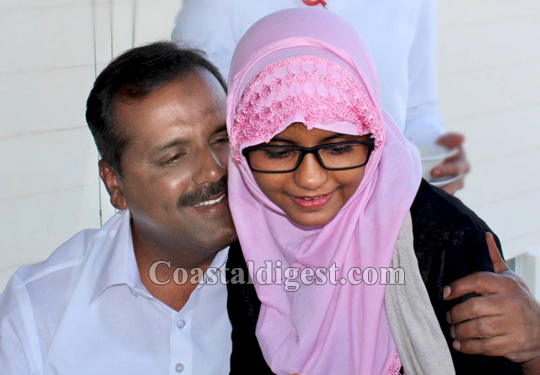
Minister's 13-yr-old daughter memorises the entire Quran, inspires many

[email protected] (CD Network)
December 27, 2016

Mangaluru, Dec 27: Memorizing the holy book of Quran is challenging in its own way. But this 13-year-old daughter of U T Khader, the minister for food, civil supplies and consumer affairs in government of Karnataka, has inspired all by remembering the entire book by heart at an early age.

utk

Hawwa Naseema began memorizing the holy book from the age of 11 and within two years, she's learned it all. The holy Quran has 114 beautiful chapters and powerful 6,236 verses.

Though she opted to lead a simple life and avoid publicity, Hawwa has emerged as a celebrity not only among Muslim community but also in the entire Karnataka, thanks to her achievement.

Video clips of Hawwa's Quran recitation started going viral on social media ever since she was formally conferred theHafizah' title at a convocation ceremony held at TMA Pai International Convention Centre in the city on December 24.

Thousands of netizens belonging to different faiths have hailed Hawwa's achievement. Inspired by her, many social media users have vowed to encourage their daughters to memorise the holy book.

The story behind Hawwa's achievement is touching: Khader sent Hawwa to learn the Quran to keep a vow he made near the Kaaba in Makkah, after the girl was lost in the crowd during the Haj pilgrimage a few years ago.

Interestingly, it was also the wish of Hawwa to discontinue material education after Class V and began Islamic studies. Despite being the only daughter of a prominent minister, Hawwa preferred to stay in a hostel to mingle with poor and orphaned children and understand their difficulties.

Initially, Hawwa joined an Islamic course at Madrasathul Bayan, Adkathbail, in Kasragod district of Kerala. Later, she joined Tanfeezul Quran Women's College at Konaje in Mangaluru Mangaluru. Al Hafiza Sumayya is her teacher at the institute, which is headed by Hafiz Muhammed Ziyad Nadvi from Thiruvananthapuram.

Hawwa has higher goals. She intends to pursue an Islamic course in a well-known university like the Islamic University of Madinah and then set up a religious education institution to help those who want to pursue Islamic studies.

Comments

Wellwisher
 - 
Wednesday, 28 Dec 2016

Ma Sha Allah.. May Allah guide her to the right path of Islam...

May Allah protect her from the fitnah of groupism.

May Allah fulfill her vision of graduating from University of Madinah.

May Allah choose her to be a Al Muttaqun.

Ameeen....

Hassanmukka
 - 
Wednesday, 28 Dec 2016

Mr.Nagesh,
You are curious about the future of this child. It is clear in the news item above regarding her plan. She may give spiritual dose of medicine to, particularly, woman folk ,thereby try to spread peace to the people. Ultimately ,the purpose of human existence is to obey the Creator,spread humanity , and lead a peaceful life.Finally,as everyone knows, we have to give our account to our creator.Hope you understand.

Abu Muhammad
 - 
Tuesday, 27 Dec 2016

Absolutely no problem or restriction for women in Islam either in claiming rightful share in her father's property or acquiring knowledge, leading the community, assuming any responsible position or doing any activity under the sun that are permitted by Islamic Law. Sister Hawwa has already set her goal to be the Head of the Islamic Institution and impart knowledge, we pray Allah (God) to grant her success and be a role model to other kids.

Mohammed Sherief
 - 
Tuesday, 27 Dec 2016

Masha Allah !!! Wonderful news. Many Congratulations to sister Hafiza Hawwa and her parents.

Priceless treasure...... Indeed, how greatly Allah has blessed you. What a priceless treasure you have been granted.

The entire world, together with all its wealth and riches, cannot match even one verse of the Qur'an you have in your heart, let alone the entire Qur'an. What a wealth!! Subhanallah.

You have became a special person of Allah.

May Allah Ta'ala bless you.

Fairman
 - 
Tuesday, 27 Dec 2016

The next steps commanded are

- Understand its meaning,
- Follow its teaching
- Share with others as much as possible, regardless their background from which faith they are. This is difficult job, but possible with HIKMATH and DIPLOMACY.

It is hard truth, because Islam has come for guidance for all, not just for Muslims only. So it belongs to all people. It is everybody's right to know and duty to know.

May God help us to learn the truth and practice it.

Abdul Hamid
 - 
Tuesday, 27 Dec 2016

Masha Allah! Mabrook! May Allah SWT Shower his blessings towards this little Hafizah and her entire family and also her well-wishers, Ameen!

Nagesh
 - 
Tuesday, 27 Dec 2016

Good to learn that the child is doing something not on Mobiles or iPads. But what next for this girl child? Can she become a Moulvi for Muslim men when she grows or a Khai? Does Islam provide this liberty to girls? Can the readers show some light on this?

Skazi
 - 
Tuesday, 27 Dec 2016

Masha Allah ....All the Best....lucky parents ...

Noorain Fathima
 - 
Tuesday, 27 Dec 2016

One of the rare qualities of Hafizah Hawwa Naseema is that she does not wear any gold ornaments. However, she was given a golden finger ring during the convocation by her institute. The institute gives golden ring to all the females who complete Hifz (memorizing Quran). This is the first and the only ornament worn by Hawwa.

Althaf
 - 
Tuesday, 27 Dec 2016

May allah subhanahutala Give you success in duniya and aqirah. Also Save you from Shirk and all types of Biddaths. Ameen
May allah accept your hard work. You are a role model to all muslims.

Abdul Qayyoom
 - 
Tuesday, 27 Dec 2016

Masha Allah, \HAFIZA\" Hawwa, Wish you all the best for your future endeavours and higher goul"

SA
 - 
Tuesday, 27 Dec 2016

Mashaa Allah..Subhanallah

sadiq
 - 
Tuesday, 27 Dec 2016

Masha allaha May allah Accept

Add new comment

  • Coastaldigest.com reserves the right to delete or block any comments.
  • Coastaldigset.com is not responsible for its readers’ comments.
  • Comments that are abusive, incendiary or irrelevant are strictly prohibited.
  • Please use a genuine email ID and provide your name to avoid reject.
News Network
March 23,2020

Mangaluru, Mar 23: The magisterial enquiry into the police firing during the anti-CAA protest on December 19 in Mangaluru, has been postponed following the lockdown of Dakshina Kannada district, Udupi DC G Jagadeesh announced on Monday.

The inquiry by Udupi DC G Jagadeesh was scheduled on Monday. Already, City Police Commissioner Dr P S Harsha and others have deposed before the magistrate. The Deputy Commissioner and the Assistant Commissioner were supposed to appear before the magistrate.

Following the December 19 violence and the death of  Nausheen and Jaleel due to alleged police firing, the state government had commissioned two probes-- one magisterial and the other, a CID inquiry.

 As per the government order, a report on the inquiry was to be submitted before March 23. On the request by the magistrate for more time since the documents and videos had to be examined, the government had asked him to submit the report by April 23.  
 

Comments

Add new comment

  • Coastaldigest.com reserves the right to delete or block any comments.
  • Coastaldigset.com is not responsible for its readers’ comments.
  • Comments that are abusive, incendiary or irrelevant are strictly prohibited.
  • Please use a genuine email ID and provide your name to avoid reject.
Agencies
February 20,2020

India ranked 77th on a sustainability index that takes into account per capita carbon emissions and ability of children in a nation to live healthy lives and secures 131st spot on a flourishing ranking that measures the best chance at survival and well-being for children, according to a UN-backed report.

The report was released on Wednesday by a commission of over 40 child and adolescent health experts from around the world. It was commissioned by the World Health Organization (WHO), UN Children's Fund (UNICEF) and The Lancet medical journal.

In the report assessing the capacity of 180 countries to ensure that their youngsters can survive and thrive, India ranks 77th on the Sustainability Index and 131 on the Flourishing Index, it said.

Flourishing is the geometric mean of Surviving and Thriving. For Surviving, the authors selected maternal survival, survival in children younger than 5 years old, suicide, access to maternal and child health services, basic hygiene and sanitation, and lack of extreme poverty.

For Thriving, the domains were educational achievement, growth and nutrition, reproductive freedom, and protection from violence.

Under the Sustainability Index, the authors noted that promoting today's national conditions for children to survive and thrive must not come at the cost of eroding future global conditions for children's ability to flourish.

The Sustainability Index ranks countries on excess carbon emissions compared with the 2030 target. This provides a convenient and available proxy for a country's contribution to sustainability in future.

The report noted that under realistic assumptions about possible trajectories towards sustainable greenhouse gas emissions, models predict that global carbon emissions need to be reduced from 39·7 giga­ tonnes to 22·8 gigatonnes per year by 2030 to maintain even a 66 per cent chance of keeping global warming below 1·5°C.

It said that the world's survival depended on children being able to flourish, but no country is doing enough to give them a sustainable future.

"No country in the world is currently providing the conditions we need to support every child to grow up and have a healthy future," said Anthony Costello, Professor of Global Health and Sustainability at University College London, one of the lead authors of the report.

"Especially, they're under immediate threat from climate change and from commercial marketing, which has grown hugely in the last decade," said Costello – former WHO Director of Mother, Child and Adolescent health.

Norway leads the table for survival, health, education and nutrition rates - followed by South Korea and the Netherlands. Central African Republic, Chad and Somalia come at the bottom.

However, when taking into account per capita CO2 emissions, these top countries trail behind, with Norway 156th, the Republic of Korea 166th and the Netherlands 160th.

Each of the three emits 210 per cent more CO2 per capita than their 2030 target, the data shows, while the US, Australia, and Saudi Arabia are among the 10 worst emitters. The lowest emitters are Burundi, Chad and Somalia.

According to the report, the only countries on track to beat CO2 emission per capita targets by 2030, while also performing fairly – within the top 70 – on child flourishing measures are: Albania, Armenia, Grenada, Jordan, Moldova, Sri Lanka, Tunisia, Uruguay and Vietnam.

"More than 2 billion people live in countries where development is hampered by humanitarian crises, conflicts, and natural disasters, problems increasingly linked with climate change," said Minister Awa Coll-Seck from Senegal, Co-Chair of the commission.

The report also highlights the distinct threat posed to children from harmful marketing.

Evidence suggests that children in some countries see as many as 30,000 advertisements on television alone in a single year, while youth exposure to vaping (e-cigarettes) advertisements increased by more than 250 per cent in the US over two years, reaching more than 24 million young people.

Studies in Australia, Canada, Mexico, New Zealand and the US – among many others – have shown that self-regulation has not hampered commercial ability to advertise to children.

Children's exposure to commercial marketing of junk food and sugary beverages is associated with purchase of unhealthy foods and overweight and obesity, linking predatory marketing to the alarming rise in childhood obesity, it said.

The number of obese children and adolescents increased from 11 million in 1975 to 124 million in 2016 – an 11-fold increase, with dire individual and societal costs, the report said.

To protect children, the authors call for a new global movement driven by and for children.

Specific recommendations include stopping CO2 emissions with the utmost urgency, to ensure children have a future on this planet; placing children and adolescents at the centre of global efforts to achieve sustainable development, the report said.

New policies and investment in all sectors to work towards child health and rights; incorporating children's voices into policy decisions and tightening national regulation of harmful commercial marketing, supported by a new Optional Protocol to the UN Convention on the Rights of the Child, it said.


Comments

Add new comment

  • Coastaldigest.com reserves the right to delete or block any comments.
  • Coastaldigset.com is not responsible for its readers’ comments.
  • Comments that are abusive, incendiary or irrelevant are strictly prohibited.
  • Please use a genuine email ID and provide your name to avoid reject.
Agencies
May 8,2020

Washington D.C., May 8: The prime time for brain development in a child's life is the first year, where the infant spends most of the time asleep. It is the time when neural connections form and sensory memories are encoded.

However, when sleep is disrupted, as occurs more often among children with autism, brain development may be affected, too.

New research led by the University of Washington finds that sleep problems in a baby's first 12 months may not only precede an autism diagnosis but also may be associated with altered growth trajectory in a key part of the brain, the hippocampus.

The study, which was published in the American Journal of Psychiatry, researchers report that in a sample of more than 400 taken of 6- to 12-month-old infants, those who were later diagnosed with autism were more likely to have had difficulty falling asleep.

It also states that this sleep difficulty was associated with altered growth trajectories in the hippocampus.

"The hippocampus is critical for learning and memory, and changes in the size of the hippocampus have been associated with poor sleep in adults and older children.

As many as 80 per cent of the children with autism spectrum disorder have sleep problems," said Annette Estes, director of the UW Autism Center and senior author of the study.

"In our clinical experience, parents have a lot of concerns about their children's sleep, and in our work on early autism intervention, we observed that sleep problems were holding children and families back," added Estes, who is also a UW professor of speech and hearing sciences.

"It could be that altered sleep is part-and-parcel of autism for some children. One clue is that behavioural interventions to improve sleep don't work for all children with autism, even when their parents are doing everything just right. This suggests that there may be a biological component to sleep problems for some children with autism," said Estes.

To consider links among sleep, brain development, and autism, researchers at the IBIS Network looked at MRI scans of 432 infants, surveyed parents about sleep patterns, and measured cognitive functioning using a standardized assessment.

At the outset of the study, infants were classified according to their risk for developing autism: Those who were at higher risk of developing autism -- about two-thirds of the study sample -- had an older sibling who had already been diagnosed.

Infant siblings of children with autism have a 20 per cent chance of developing autism spectrum disorder -- a much higher risk than children in the general population.

In the current study, 127 of the 432 infants were identified as "low risk" at the time the MRI scans were taken because they had no family history of autism.

They later evaluated all the participants at 24 months of age to determine whether they had developed autism. Of the roughly 300 children originally considered "high familial risk," 71 were diagnosed with autism spectrum disorder at that age.

Problems with sleep were more common among the infants later diagnosed with an autism spectrum disorder, as were larger hippocampi. No other subcortical brain structures were affected, including the amygdala, which is responsible for certain emotions and aspects of memory, or the thalamus, a signal transmitter from the spinal cord to the cerebral cortex.

The authors note that while parents reported more sleep difficulties among infants who developed autism compared to those who did not, the differences were very subtle and only observed when looking at group averages across hundreds of infants.

Sleep patterns in the first years of life change rapidly as infants transition from sleeping around the clock to a more adult-like sleep/wake cycle. Until further research is completed, Estes said, it is not possible to interpret challenges with sleep as an early sign of increased risk for autism.

Comments

Add new comment

  • Coastaldigest.com reserves the right to delete or block any comments.
  • Coastaldigset.com is not responsible for its readers’ comments.
  • Comments that are abusive, incendiary or irrelevant are strictly prohibited.
  • Please use a genuine email ID and provide your name to avoid reject.