


Ministers, Cong legislators bribing voters in Hebbal: DVS

February 13, 2016

Bengaluru, Feb 13: Union Law Minister D?V?Sadananda Gowda on Friday claimed that a few ministers in the Siddaramaiah Cabinet and some Congress legislators were distributing money to influence voters in the Hebbal Assembly constituency.
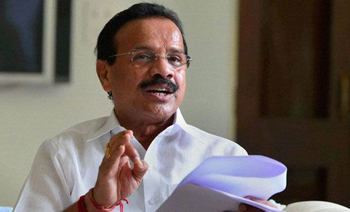
sadananda copyAddressing a press conference in Bengaluru, he said the Congress was indulging in electoral malpractices and illegalities after the deadline for campaigning closed on Thursday.

The bypoll for the Hebbal seat is scheduled for Saturday.

Gowda said he had information that Ministers Roshan Baig, Dinesh Gundu Rao, Legislators Byrathi Basavaraj, Muniratna, R?V?Devaraj and Bengaluru Mayor Manjunatha Reddy had been allotted specific pockets and wards in the constituency. He said Energy Minister D?K?Shivakumar was leading the entire operation.

The Union?minister said he had lodged a complaint with the Election?Commission, while also urging it to take steps to ensure free and fair polls. Outsiders should not be allowed into the constituency, he said. The police too should act impartially. Party volunteers will also be monitoring the polls. It is the responsibility of the government to ensure there are no illegalities and law and order is protected, he said. He claimed that money had been stashed at the residence of a manager of a private bank in V Nagenahalli. However, it was taken away in a car, fearing raids, Gowda said.

DKS?refutes charges

Energy Minister Shivakumar has, however, termed Sadananda Gowda’s charges baseless. “The BJP leaders have sensed defeat in the bypoll to the Hebbal Assembly constituency. Hence, they are making such baseless allegations on the eve of polling. The ruling party has not misused its power during the campaign. All the ministers left the constituency on Thursday itself,” he claimed.

The BJP has accepted defeat the day the party decided to field Narayanaswamy, he said. “The party failed to find a local leader to contest the bypoll. How can an outsider effectively represent the constituency? People are aware of this and they will take the right decision at the time of voting,” he added.

Comments

Zahoor Ahmed
 - 
Saturday, 13 Feb 2016

Shameless union minister ! Some time he does not know what he want to say. When he smell defeat he starts to bark.

Add new comment

  • Coastaldigest.com reserves the right to delete or block any comments.
  • Coastaldigset.com is not responsible for its readers’ comments.
  • Comments that are abusive, incendiary or irrelevant are strictly prohibited.
  • Please use a genuine email ID and provide your name to avoid reject.
News Network
June 9,2020

Bengaluru, Jun 9: JD(S) patriarch H D Deve Gowda on Tuesday filed his nomination as party's candidate for June 19 Rajya Sabha elections from Karnataka.

The former Prime Minister was accompanied by his sons former Chief Minister H D Kumaraswamy and former Minister H D Revanna, state JD(S) chief H K Kumaraswamy and others, as he filed his papers at the office of Legislative Assembly Secretary M K Vishalakshi, who is the returning officer for the polls. JD(S) on Monday had announced that Gowda will be contesting the Rajya Sabha polls.

Announcing the decision, Kumaraswamy had said Gowda decided to contest following the request of Congress President Sonia Gandhi, several national leaders and party legislators, and it was not an easy task to "persuade" him to enter the Rajya Sabha.

The JD(S), which has 34 seats in the assembly, is not in a position to win a seat in Rajya Sabha on its own and will need support from the Congress with its surplus votes. A minimum of 45 votes are required for a candidate to win. If he wins, this will be the second Rajya Sabha entry for 87-year-old Gowda, the first time being in 1996 as the Prime Minister.

Gowda was defeated in Tumkur constituency by BJP's G S Basavaraj by over 13,000 votes in the 2019 Lok Sabha polls. As joint candidate of the then ruling Congress-JDS coalition, Gowda had chosen to contest from Tumkur at the last minute after vacating Hassan-his home turf, to grandson Prajwal Revanna (a current MP).

Election is scheduled on June 19 to fill four Rajya Sabha seats from Karnataka, represented by Rajeev Gowda and BK Hariprasad of Congress, Prabhakar Kore of the BJP and D Kupendra Reddy of JD(S) that will fall vacant on June 25, with their retirement. Today is the last date for filing nominations. With BJP not fielding any candidate against Gowda, his election is likely to be unanimous.

Comments

Add new comment

  • Coastaldigest.com reserves the right to delete or block any comments.
  • Coastaldigset.com is not responsible for its readers’ comments.
  • Comments that are abusive, incendiary or irrelevant are strictly prohibited.
  • Please use a genuine email ID and provide your name to avoid reject.
News Network
January 3,2020

Bengaluru, Jan 3: Prime Minister Narendra Modi on Friday called on young scientists of India to "Innovate, Patent, Produce and Prosper," and said these four steps would lead our country towards faster development. The Prime Minister also stressed on the need to transform the landscape of Indian science, technology and innovation.

"The growth story of India depends on its success in the science and technology sector. There is a need to transform the landscape of Indian science, technology and innovation," Modi said.

Speaking after inaugurating the 107th Session of Indian Science Congress, he said, "My motto for the young scientists in this country is -Innovate, Patent, Produce and Prosper. These four steps will lead our country towards faster development."

"If we innovate we will patent and that in turn will make our production smoother and when we take these products to the people of our country, I'm sure they will prosper," he said, adding that innovation for the people and by the people is the direction of our new India. The Prime Minister also said he was happy to learn that India's ranking has improved in the Global Innovation Index to 52.

"Our programmes have created more technology business incubators in the last five years than in the previous 50 years. I congratulate our scientists for this achievement," he added.

Comments

Add new comment

  • Coastaldigest.com reserves the right to delete or block any comments.
  • Coastaldigset.com is not responsible for its readers’ comments.
  • Comments that are abusive, incendiary or irrelevant are strictly prohibited.
  • Please use a genuine email ID and provide your name to avoid reject.
Agencies
May 8,2020

Washington D.C., May 8: The prime time for brain development in a child's life is the first year, where the infant spends most of the time asleep. It is the time when neural connections form and sensory memories are encoded.

However, when sleep is disrupted, as occurs more often among children with autism, brain development may be affected, too.

New research led by the University of Washington finds that sleep problems in a baby's first 12 months may not only precede an autism diagnosis but also may be associated with altered growth trajectory in a key part of the brain, the hippocampus.

The study, which was published in the American Journal of Psychiatry, researchers report that in a sample of more than 400 taken of 6- to 12-month-old infants, those who were later diagnosed with autism were more likely to have had difficulty falling asleep.

It also states that this sleep difficulty was associated with altered growth trajectories in the hippocampus.

"The hippocampus is critical for learning and memory, and changes in the size of the hippocampus have been associated with poor sleep in adults and older children.

As many as 80 per cent of the children with autism spectrum disorder have sleep problems," said Annette Estes, director of the UW Autism Center and senior author of the study.

"In our clinical experience, parents have a lot of concerns about their children's sleep, and in our work on early autism intervention, we observed that sleep problems were holding children and families back," added Estes, who is also a UW professor of speech and hearing sciences.

"It could be that altered sleep is part-and-parcel of autism for some children. One clue is that behavioural interventions to improve sleep don't work for all children with autism, even when their parents are doing everything just right. This suggests that there may be a biological component to sleep problems for some children with autism," said Estes.

To consider links among sleep, brain development, and autism, researchers at the IBIS Network looked at MRI scans of 432 infants, surveyed parents about sleep patterns, and measured cognitive functioning using a standardized assessment.

At the outset of the study, infants were classified according to their risk for developing autism: Those who were at higher risk of developing autism -- about two-thirds of the study sample -- had an older sibling who had already been diagnosed.

Infant siblings of children with autism have a 20 per cent chance of developing autism spectrum disorder -- a much higher risk than children in the general population.

In the current study, 127 of the 432 infants were identified as "low risk" at the time the MRI scans were taken because they had no family history of autism.

They later evaluated all the participants at 24 months of age to determine whether they had developed autism. Of the roughly 300 children originally considered "high familial risk," 71 were diagnosed with autism spectrum disorder at that age.

Problems with sleep were more common among the infants later diagnosed with an autism spectrum disorder, as were larger hippocampi. No other subcortical brain structures were affected, including the amygdala, which is responsible for certain emotions and aspects of memory, or the thalamus, a signal transmitter from the spinal cord to the cerebral cortex.

The authors note that while parents reported more sleep difficulties among infants who developed autism compared to those who did not, the differences were very subtle and only observed when looking at group averages across hundreds of infants.

Sleep patterns in the first years of life change rapidly as infants transition from sleeping around the clock to a more adult-like sleep/wake cycle. Until further research is completed, Estes said, it is not possible to interpret challenges with sleep as an early sign of increased risk for autism.

Comments

Add new comment

  • Coastaldigest.com reserves the right to delete or block any comments.
  • Coastaldigset.com is not responsible for its readers’ comments.
  • Comments that are abusive, incendiary or irrelevant are strictly prohibited.
  • Please use a genuine email ID and provide your name to avoid reject.