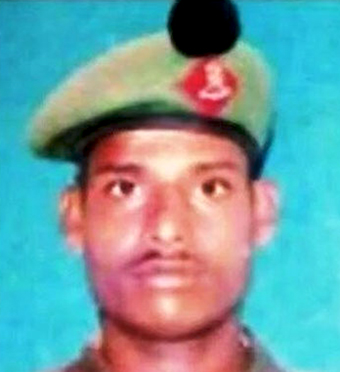
Miracle in Siachen: Soldier from Karnataka found alive after 6 days under 25 feet of snow

February 9, 2016

SiachenNew Delhi, Feb 9: Call it a nature's miracle or his will power to live, Lance Naik Hanamanthappa Koppad of Indian Army was pulled out alive by rescue teams in Siachen on Monday night.

Hanamanthappa was among the group of ten soldiers of the 19 Madras Regiment who were missing and presumed dead in a deadly avalanche six days ago.

He is said to be in a critical condition and efforts are being made to airlift him to Delhi's RR hospital, a premiere medical institute of the Indian armed forces.

Army's search party has also managed to dig out bodies of four other soldiers whereas, fate of five others remain uncertain.

Lance Naik Hanamanthappa, a resident of Dharwad District in Karnataka, has raised hopes of rescuers who have been digging the snow desert for the past six days.

Ten Indian Army soldiers were reported missing after a massive avalanche hit the high-altitude post manned by them in the Siachen glacier on Wednesday last week.

The trapped army personnel, including a Junior Commissioned Officer (JCO), were of the 19th battalion of Bihar regiment.

Comments

IBRAHIM.HUSSAIN
 - 
Tuesday, 9 Feb 2016

Really its a miracle. Still he his fighting for his life. I pray Allah for his health and confident his recovery will be soon.

Add new comment

  • Coastaldigest.com reserves the right to delete or block any comments.
  • Coastaldigset.com is not responsible for its readers’ comments.
  • Comments that are abusive, incendiary or irrelevant are strictly prohibited.
  • Please use a genuine email ID and provide your name to avoid reject.
News Network
March 21,2020

New Delhi, Mar 21: Karnataka Health and Family Welfare Minister B. Sriramulu on Saturday informed that one more person was tested positive for the coronavirus in the state.

He said that a total of 16 persons have been tested positive for COVID-19 in the state so far.

The victim had come from Mecca and was kept in quarantine facility by the state authorities.

"For a 32-year-old man, who had just returned from a trip to Mecca has found COVID-19 positive. The infection has been confirmed. He has already been treated at an isolated ward of the hospital. Citizens must not have any sort of anxiety," tweeted Sriramulu.

Also, the news and public relations department, the Indian Red Cross Society and the Karnataka State Labour Studies Institute have invited volunteers for the programme to provide real-time information to people to avoid spreading rumours and misinformation about coronavirus.

At least four volunteers will work in four shifts per day in each taluk of the state. There are about 120 volunteers in Bengaluru city and about 3,000 Corona Warriors are expected to register from across the state. Over 400 volunteers have registered via online application on the first day.

Comments

Add new comment

  • Coastaldigest.com reserves the right to delete or block any comments.
  • Coastaldigset.com is not responsible for its readers’ comments.
  • Comments that are abusive, incendiary or irrelevant are strictly prohibited.
  • Please use a genuine email ID and provide your name to avoid reject.
Agencies
May 8,2020

Washington D.C., May 8: The prime time for brain development in a child's life is the first year, where the infant spends most of the time asleep. It is the time when neural connections form and sensory memories are encoded.

However, when sleep is disrupted, as occurs more often among children with autism, brain development may be affected, too.

New research led by the University of Washington finds that sleep problems in a baby's first 12 months may not only precede an autism diagnosis but also may be associated with altered growth trajectory in a key part of the brain, the hippocampus.

The study, which was published in the American Journal of Psychiatry, researchers report that in a sample of more than 400 taken of 6- to 12-month-old infants, those who were later diagnosed with autism were more likely to have had difficulty falling asleep.

It also states that this sleep difficulty was associated with altered growth trajectories in the hippocampus.

"The hippocampus is critical for learning and memory, and changes in the size of the hippocampus have been associated with poor sleep in adults and older children.

As many as 80 per cent of the children with autism spectrum disorder have sleep problems," said Annette Estes, director of the UW Autism Center and senior author of the study.

"In our clinical experience, parents have a lot of concerns about their children's sleep, and in our work on early autism intervention, we observed that sleep problems were holding children and families back," added Estes, who is also a UW professor of speech and hearing sciences.

"It could be that altered sleep is part-and-parcel of autism for some children. One clue is that behavioural interventions to improve sleep don't work for all children with autism, even when their parents are doing everything just right. This suggests that there may be a biological component to sleep problems for some children with autism," said Estes.

To consider links among sleep, brain development, and autism, researchers at the IBIS Network looked at MRI scans of 432 infants, surveyed parents about sleep patterns, and measured cognitive functioning using a standardized assessment.

At the outset of the study, infants were classified according to their risk for developing autism: Those who were at higher risk of developing autism -- about two-thirds of the study sample -- had an older sibling who had already been diagnosed.

Infant siblings of children with autism have a 20 per cent chance of developing autism spectrum disorder -- a much higher risk than children in the general population.

In the current study, 127 of the 432 infants were identified as "low risk" at the time the MRI scans were taken because they had no family history of autism.

They later evaluated all the participants at 24 months of age to determine whether they had developed autism. Of the roughly 300 children originally considered "high familial risk," 71 were diagnosed with autism spectrum disorder at that age.

Problems with sleep were more common among the infants later diagnosed with an autism spectrum disorder, as were larger hippocampi. No other subcortical brain structures were affected, including the amygdala, which is responsible for certain emotions and aspects of memory, or the thalamus, a signal transmitter from the spinal cord to the cerebral cortex.

The authors note that while parents reported more sleep difficulties among infants who developed autism compared to those who did not, the differences were very subtle and only observed when looking at group averages across hundreds of infants.

Sleep patterns in the first years of life change rapidly as infants transition from sleeping around the clock to a more adult-like sleep/wake cycle. Until further research is completed, Estes said, it is not possible to interpret challenges with sleep as an early sign of increased risk for autism.


Comments

Add new comment

  • Coastaldigest.com reserves the right to delete or block any comments.
  • Coastaldigset.com is not responsible for its readers’ comments.
  • Comments that are abusive, incendiary or irrelevant are strictly prohibited.
  • Please use a genuine email ID and provide your name to avoid reject.
News Network
May 25,2020

Kasaragod, May 25: An autorickshaw driver from Belur in Kasaragod was admitted for surgery to a hospital after being hit on the head by a falling jackfruit. He was tested positive for the coronavirus. It is not clear how he contracted the viral infection.

“While he was trying to pluck a jackfruit off a tree, one of them fell on him, injuring his spine. His hands and legs were weakened too. His condition required surgery. Our protocol dictates that we subject everyone who require immediate surgery to the covid test, just to be sure. That’s when he tested positive,” said Dr K Sudeep, superintendent of the Pariyaram Medical College in Kannur.

“He had symptoms of Covid-19. But he has no recent travel history or contact with any infected person. We’re not sure if he got it through one of his passengers in the rickshaw. He had visited the district hospital once so he could have got it from there. Anyway, we are examining it and preparing the route maps,” he added.

His family will be quarantined and health workers have begun to trace his immediate primary contacts.

Though there have been a number of cases in Kerala where a person’s source of infection could not be correctly ascertained, such people have gone on to recover without spreading the infection to others.

The Kerala government is conducting testing of high-risk persons on the frontlines, such as police officials, grocery vendors and health workers, as part of its sentinel surveillance programme, but maintains that there’s little evidence of a community spread in the state.

Comments

Add new comment

  • Coastaldigest.com reserves the right to delete or block any comments.
  • Coastaldigset.com is not responsible for its readers’ comments.
  • Comments that are abusive, incendiary or irrelevant are strictly prohibited.
  • Please use a genuine email ID and provide your name to avoid reject.