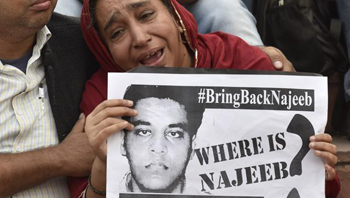
Missing JNU student Najeeb Ahmed in Aligarh, claims suspicious letter

November 19, 2016

New Delhi, Nov 19: A ‘mysterious letter’ delivered at Jawaharlal Nehru University four days ago claims that the missing JNU student Najeeb Ahmad was held captive in a village in Aligarh, reportedly.

najeebAccording to media reports, the Delhi Police is probing the letter that was apparently sent by a woman in Aligarh. She claimed to have important information about Najeeb.

The letter that was addressed to ‘Ahmed’ was received by the hostel’s president, reportedly. The president however, gave the letter to Ahmed’s mother ‘Fatima’ who later gave it to the Crime Branch.

According to media reports, the woman had written that she had seen Najeeb in a market in Aligarh. The letter further stated that Najeeb sought the woman’s help saying that he had been held captive by some people and had somehow managed to escape. However, by the time the woman could call for help, Najeeb had disappeared, reportedly.

The woman had also mentioned an address in the letter where she could be contacted. However, according to media reports, when the police reached the address, no one could be found.

Reportedly, the letter didn’t mention anything about the village where Najeeb was locked up or about a ransom amount.

The police suspect that it was a prank. However, according to media sources, they are going to find out the location from where the letter was dispatched to be sent to the JNU hostel.

Only recently, the CCTV footage sought by Delhi Police from the Jamia authorities in connection with the disappearance of JNU student Najeeb Ahmed had been found erased as the authorities store a day’s clips for one month, prompting the probe team to seek help from Forensic Science Laboratory (FSL) to retrieve the images.

Meanwhile, the reward amount for providing information on Najeeb’s whereabouts has been increased from Rs 2 lakh to Rs 5 lakh owing to the “sensitivity” of the matter.

Najeeb went missing on October 15 following an on-campus scuffle allegedly with ABVP members the night before.

The case was last week transferred from South District Police to Crime Branch in order to have a “fresh look” at the case.

Comments

Ansari
 - 
Sunday, 20 Nov 2016

and same time Modi anounced Note Ban....there was Shariah issue ...Modi banned Notes ....there was other scams ...Modi same time Bans Notes....WOw what double Mind

Add new comment

  • Coastaldigest.com reserves the right to delete or block any comments.
  • Coastaldigset.com is not responsible for its readers’ comments.
  • Comments that are abusive, incendiary or irrelevant are strictly prohibited.
  • Please use a genuine email ID and provide your name to avoid reject.
News Network
April 24,2020

New Delhi, Apr 24: The trajectory of COVID-19 cases could have plateaued and might even fall for some weeks after the lockdown is lifted but India is likely to see a second wave in late July or August with a surge in the number of cases during the monsoon, say scientists.

The timing of the peak will depend on how India is able to control physical distancing and on the level of infection spreads after restrictions are relaxed, they said.

It looks apparent that the trajectory of daily new cases has reached a plateau and eventually it will take a downward fall, maybe for some weeks or even months, Samit Bhattacharya, associate professor at the Department of Mathematics, Shiv Nadar University, said.

Still, we may get a surge of new cases of the same coronavirus and this will be considered a second wave, Bhattacharya explained.

The second epidemic may come back in late July or August in the monsoon, although the peak timing will depend on how we control social distancing during that time, he said.

Rajesh Sundaresan, professor at Bengaluru's Indian Institute of Science (IISc), agreed.

“Once we return to normal activity levels, there is a chance that infection may begin to rise again. China is seeing this to some extent post easing of some restrictions on travel,” Sundaresan, corresponding author of a working paper by researchers at IISc and the Tata Institute of Fundamental Research (TIFR) in Mumbai, said.

On March 25, when the number of coronavirus cases was 618 with 13 deaths, the government announced a nationwide lockdown that was later extended to May 3.

On Friday, the death toll due to COVID-19 rose to 718 and the number of cases to 23,077, according to the Union Health Ministry.

In good news, officials said this week that the doubling rate of cases has slowed down in the period, going from 3.4 days before lockdown to 7.5 days, with 18 states doing better than the national average. The recovery rate has also almost doubled in the last 10 days.

"Looking at the new cases in the past few days, it seems the growth of new daily infection is much slower than earlier. This apparently indicates that we might have reached at the plateau of the growth curve, Bhattacharya said.

He noted that recent studies in China and Europe observed that the infection might relapse in those people who have already recovered from earlier phases.

So, there is no evidence that the earlier infection may help acquire immunity against the second infection. And in that way, the entire population may be vulnerable to the second wave to some extent, said the scientist.

In their study unveiled this week, IISc and TIFR researchers analysed the impact of strategies such as case isolation, home quarantine, social distancing and various post-lockdown restrictions on COVID-19 that might remain in force for some time.

The study modelled on Bengaluru and Mumbai suggests the infection is likely to have a second wave and the public health threat will remain, unless steps are taken to aggressively trace, localise, isolate the cases, and prevent influx of new infections.

The new levels and the peaking times for healthcare demand depend on the levels of infection spreads in each city at the time of relaxation of restrictions, they said.

The lockdown is currently upon us. It has given us valuable time. Let us test, trace, quarantine, isolate, practice better hygiene, search for a vaccine, etc. We should do these anyway, and these are being done. When and how to lift the lockdown is going to be a difficult decision to make, said Sundaresan.

It's clear that it's going to be phased. What our team is focusing on is to come up with tools to help the decision makers assess the public health impact of various choices, he said.

According to the experts, infectious diseases spread via contact between infectious and susceptible people. In the absence of any control measures, an outbreak will grow as long as the average number of people infected by each infectious person is more than one.

Once enough people are immune there will be fewer people susceptible to the infection and the outbreak will die.

However, when an outbreak is brought under control by social distancing and other interventions, it is possible only a small proportion of the population will have been infected and gained immunity, they said.

This means enough susceptible people may remain to fuel a second wave if controls are relaxed and infection is reintroduced.

Until the vaccine comes on the market, we have to remain alert Once sporadic cases occur here and there in the country, we immediately need to implement quarantine or social distancing locally for the people in that region, and also need to perform tests to identify positive cases irrespective of showing symptoms, Bhattacharya explained.

Note that these monsoon months are also flu season in many places of India. So, we should not ignore the early signs of the flu symptoms. Irrespective of symptoms, we need to increase tests in the hotspots to identify people and contain the surge, he said.

Sundaresan added that the timeline for a second wave will depend on a lot of circumstances which may change as the time passes.

Significant testing may have been underway, there may be behavioural changes with people becoming more careful about their hygiene, wearing masks may become more common, etc. All these responses may help restrict the second wave, he said.

A study published in The Lancet journal earlier this month modelled the potential adverse consequences of premature relaxation of interventions, and found it might lead to a second wave of infections.

The finding is critical to governments globally, because it warns against premature relaxation of strict interventions, the researchers said.

While interventions to control the spread of SARS-CoV-2 are in place, countries will need to work toward returning to normalcy; thus, knowledge of the effect of each intervention is urgently required, they said in the study.

According to a recent analysis by the Harvard Chan School of Public Health, the best strategy to ease the critical care burden and loss of life from COVID-19 might be on-again, off-again social distancing.

In the absence of such interventions, surveillance and intermittent distancing may need to be maintained into 2022, which would present a substantial social and economic burden, the researchers wrote.p


Comments

Add new comment

  • Coastaldigest.com reserves the right to delete or block any comments.
  • Coastaldigset.com is not responsible for its readers’ comments.
  • Comments that are abusive, incendiary or irrelevant are strictly prohibited.
  • Please use a genuine email ID and provide your name to avoid reject.
Agencies
February 7,2020

Thiruvananthapuram, Feb 7: Kerala Finance Minister T M Thomas Isaac on Friday began presenting the fifth budget of the CPI(M)-led LDF government for the 2020-21 fiscal by making remarks against the Citizenship Amendment Act and the unanimous resolution passed by the state assembly against it.

Stating the amended act was posing a threat to the basic credentials of the Constitution, he said the country was witnessing the biggest protests ever in the post-Independence era.

Students and women are at the forefront of the anti- CAA agitations and the hope of the country lies in the youth who hit the streets vowing they would not let the country down, he said.

Coming down heavily on the BJP-led NDA government at the Centre, Isaac said a communalised government machinery, leaders who talk only about "disgust and hatred" and their party workers who consider violence as their duty was the current reality in the country.

"Generally speaking, it is the present India...The concerns triggered by Citizenship Amendment Act (CAA) and the National Register of Citizens (NRC) are beyond words. The fear of detention centres are hanging above the head of over 19 lakh people of Assam who have lived as Indians till yesterday," he said.

Quoting from a poem 'Fear' by a 15-year old boy from Wayanad Dhruvath Gautham who wrote 'fear is country and silence is an ornament!,' Isaac said "even the imagination of our children is now filled with fear".

Referring to the stringent opposition raised by the Left government in the state against the CAA and NRC, the finance minister lavished praise on the joint protests led by the ruling LDF and opposition UDF against the central act.

Setting aside political differences, the rival fronts in the state had joined hands to protest when the country had faced existential threat which had become a model for other states, he said.

When Chief Minister Pinarayi Vijayan and Leader of the Opposition Ramesh Chennithala jointly protested at the same venue against CAA, Kerala became a model to other states, the senior leader added.

The state showcased the same unity while passing a resolution requesting the centre to repeal the CAA and filing a suit in the apex court against this under the Article 130, he said.

"The country's economy is heading towards a severe economic crisis like that witnessed in 2009," he said.

Earlier, the references to anti-CAA protests had found a place in the Pinarayi Vijayan government's policy address also.

While presenting the policy address in the House, Governor Arif Mohammed Khan had read out references to anti- CAA resolution passed by the house, despite disagreeing with it.

Reading out the the anti-CAA stand of the state government, the Governor said "our citizenship can never be on the basis of religion as this goes against the grain of secularism which is part of the basic structure of our constitution.

Comments

Add new comment

  • Coastaldigest.com reserves the right to delete or block any comments.
  • Coastaldigset.com is not responsible for its readers’ comments.
  • Comments that are abusive, incendiary or irrelevant are strictly prohibited.
  • Please use a genuine email ID and provide your name to avoid reject.
News Network
February 24,2020

New Delhi, Dec 24: The Delhi Police said that a head constable was killed during clashes over the Citizenship Amendment Act (CAA) in northeast Delhi today.

Deputy Commissioner of Police, Shahdara, Amit Sharma was also injured during clashes, a senior official said. Sharma suffered injuries to his head and hand. He was hospitalised and is doing fine, the official added.

Tension escalated in northeast Delhi with protesters torching at least two houses and a fire tender in the Jaffrabad and Maujpur areas, where pro and anti-CAA groups clashed for the second consecutive day on Monday and hurled stones at each other.

Violence was also reported from the Chandbagh area in Jaffrabad.

Police fired tear gas shells and also resorted to lathicharge to disperse the protesters.

According to officials, a fire tender was damaged by the protesters after it responded to a fire call in the area.

The Delhi Metro closed entry and exit at the Jaffrabad and Maujpur-Babarpur stations as an uneasy calm prevailed in the area.

"Entry & exit of Jaffrabad and Maujpur-Babarpur are closed. Trains will not be halting at these stations," the Delhi Metro Rail Corporation (DMRC) said in a tweet.

Entry and exit were closed at the Jaffrabad metro station for over 24 hours.

Clashes broke out on Sunday evening between pro and anti-CAA groups near Jaffrabad after a large number of people protesting against the Citizenship (Amendment) Act (CAA) blocked a road, while similar sit-ins were launched in several other parts of the national capital.

Delhi chief minister Arvind Kejriwal has urged lieutenant governor of Delhi and the Union home minister to restore order.

Nobody should be allowed to orchestrate violence, he said.

Delhi Lt Governor Anil Baijal instructed the police commissioner to maintain law and order in the national capital in the wake of violence.

"Instructed @DelhiPolice and @CPDelhi to ensure that law and order is maintained in North East Delhi. The situation is being closely monitored. I urge everyone to exercise restraint for maintenance of peace and harmony," Baijal tweeted.

Delhi minister and Babarpur MLA Gopal Rai on Monday urged the people in the area to maintain peace, saying some people were purposely trying to disturb the atmosphere.

"With folded hands, I request people in Babarpur Assembly to maintain peace. Some people are purposely trying to spoil the atmosphere. I have spoken to Delhi LG and he has assured me that more policemen will be deployed to bring the situation under control," Rai said in a tweet.

Comments

Add new comment

  • Coastaldigest.com reserves the right to delete or block any comments.
  • Coastaldigset.com is not responsible for its readers’ comments.
  • Comments that are abusive, incendiary or irrelevant are strictly prohibited.
  • Please use a genuine email ID and provide your name to avoid reject.