



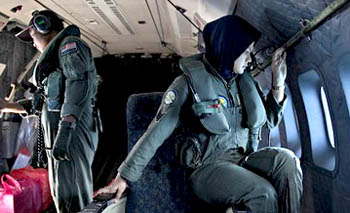
Missing Malaysian flight MH 370: Computer sent plane off flight path

March 18, 2014

Flight_MH_370Washington, Mar 18: The first turn to the west that diverted the missing Malaysia Airlines plane from its planned flight path from Kuala Lumpur to Beijing was carried out through a computer system that was most likely programmed by someone in the plane's cockpit who was knowledgeable about airplane systems, according to senior US officials.

Instead of manually operating the plane's controls, whoever altered flight 370's path typed seven or eight keystrokes into a computer on a knee-high pedestal between the captain and the first officer, according to officials. The Flight Management System, as the computer is known, directs the plane from point to point specified in the flight plan submitted before each flight. It is not clear whether the plane's path was reprogrammed before or after it took off.

The fact that the turn away from Beijing was programmed into the computer has reinforced the belief of investigators — first voiced by Malaysian officials — that the plane was deliberately diverted and that foul play was involved. It has also increased their focus on the plane's captain and first officer.

Prime Minister Najib Razak of Malaysia told reporters on Saturday that his government believed the plane had been diverted, because its transponder and other communications devices had been manually turned off several minutes apart. US officials were told of the new information over the weekend.

But Malaysian authorities on Monday reversed themselves on the sequence of events they believe took place on the plane in the crucial minutes before ground controllers lost contact with it early March 8. They said it was the plane's first officer — the co-pilot — who was the last person in the cockpit to speak to ground control. And they withdrew their assertion that another automated system on the plane called Aircraft Communications Addressing and Reporting System, or ACARS, had been disabled when the co-pilot spoke.

Flight 370's Flight Management System reported its status to ACARS, which in turn transmitted information back to a maintenance base, according to a US official. This shows that the reprogramming happened before ACARS stopped working. ACARS ceased to function about the same time oral radio contact was lost and the airplane's transponder also stopped, fuelling suspicions that foul play was involved in the plane's disappearance.

Investigators are scrutinizing radar tapes from when the plane first departed Kuala Lumpur because they believe the tapes would show that after the plane first changed its course, it passed through several pre-established "waypoints," which are like virtual mile markers in the sky. That would suggest that the plane was under control of a knowledgeable pilot, because passing through those points without using the computer would have been unlikely.

According to investigators, it appears that a waypoint was added to the planned route. Pilots do that in the ordinary course of flying if air traffic controllers tell them to take a different route, to avoid weather or traffic. But in this case, the waypoint was far off the path to Beijing.

Whoever changed the plane's course would have had to be familiar with Boeing aircraft, though not necessarily the 777 — the type of plane that disappeared. US officials and aviation experts said it was far-fetched to believe that a passenger could have reprogrammed the Flight Management System.

Normal procedure is to key in a five-letter code — gibberish to non-aviators — that is the name of a waypoint. A normal flight plan consists of a series of such waypoints, ending in the destination airport. For an ordinary flight, waypoints can be entered manually or uploaded into the FMS by the airline.

One of the pilots' keys in a waypoint on a separate screen known as a scratchpad, and after confirming that it has no typographical errors, pushes another button to move it into the sequence in the flight plan. Normal practice is to orally confirm the waypoint with the other pilot, then push another button to instruct the airplane to go there. With the change in course, the plane would bank at a comfortable angle, around 20 degrees, and make the turn. Passengers would not feel anything unusual.

ABC News reported on Sunday that the programmed turn had led investigators to believe that it was being controlled by the pilot or hijackers.

One US safety expert, John Cox, a former airline union safety official, said someone taking such pains to divert the plane does not fit the pattern of past cases when pilots intentionally crashed and killed everyone on board.

"There's an inconsistency in what we've seen historically," he said, comparing the disappearance of Flight 370 with two murder-suicides, of an Egyptair flight off Nantucket Island in 1999 and a SilkAir jet in

Indonesia in 1997. In those crashes, he said, the pilot involved simply pushed the nose of the plane down and flew into the water.

The authorities searched the homes of the pilots in Kuala Lumpur on Saturday, seizing a flight simulator that one of them had in his home.

In an effort to determine whether the pilot had practiced taking down the plane, the authorities have reassembled the simulator for experts to examine. US investigators would like access to the flight simulator and any other electronic information seized from the pilots, but as of Monday night they had not been given access to those materials.

Meanwhile, as the search for the missing Boeing 777 jet stretched into a 10th day, two of the nations helping in the hunt, Australia and Indonesia, agreed to divide between them a vast area of the southeastern Indian Ocean, with Indonesia focusing on equatorial waters and Australia beginning to search farther south for traces of the aircraft. To the north, China and Kazakhstan checked their radar records and tried to figure out whether the jet could have landed somewhere on their soil.

Comments

Marisol
 - 
Sunday, 24 Jul 2016

I see your blog needs some fresh & unique content. Writing manually is time consuming, there is tool for this task.
Just search in gogle for; Fejlando's tips

Here is my homepage ... ReneeBarffed: http://twitter.com/Nila

Add new comment

  • Coastaldigest.com reserves the right to delete or block any comments.
  • Coastaldigset.com is not responsible for its readers’ comments.
  • Comments that are abusive, incendiary or irrelevant are strictly prohibited.
  • Please use a genuine email ID and provide your name to avoid reject.
Agencies
July 1,2020

The ILO has warned that if another Covid-19 wave hits in the second half of 2020, there would be global working-hour loss of 11.9 percent - equivalent to the loss of 340 million full-time jobs.

According to the 5th edition of International Labour Organisation (ILO) Monitor: Covid-19 and the world of work, the recovery in the global labour market for the rest of the year will be uncertain and incomplete.

The report said that there was a 14 percent drop in global working hours during the second quarter of 2020, equivalent to the loss of 400 million full-time jobs.

The number of working hours lost across the world in the first half of 2020 was significantly worse than previously estimated. The highly uncertain recovery in the second half of the year will not be enough to go back to pre-pandemic levels even in the best scenario, the agency warned.

The baseline model – which assumes a rebound in economic activity in line with existing forecasts, the lifting of workplace restrictions and a recovery in consumption and investment – projects a decrease in working hours of 4.9 percent (equivalent to 140 million full-time jobs) compared to last quarter of 2019.

It says that in the pessimistic scenario, the situation in the second half of 2020 would remain almost as challenging as in the second quarter.

“Even if one assumes better-tailored policy responses – thanks to the lessons learned throughout the first half of the year – there would still be a global working-hour loss of 11.9 per cent at the end of 2020, or 340 million full-time jobs, relative to the fourth quarter of 2019,” it said.

The pessimistic scenario assumes a second pandemic wave and the return of restrictions that would significantly slow recovery. The optimistic scenario assumes that workers’ activities resume quickly, significantly boosting aggregate demand and job creation. With this exceptionally fast recovery, the global loss of working hours would fall to 1.2 per cent (34 million full-time jobs).

The agency said that under the three possible scenarios for recovery in the next six months, “none” sees the global job situation in better shape than it was before lockdown measures began.

“This is why we talk of an uncertain but incomplete recovery even in the best of scenarios for the second half of this year. So there is not going to be a simple or quick recovery,” ILO Director-General Guy Ryder said.

The new figures reflect the worsening situation in many regions over the past weeks, especially in developing economies. Regionally, working time losses for the second quarter were: Americas (18.3 percent), Europe and Central Asia (13.9 percent), Asia and the Pacific (13.5 percent), Arab States (13.2 percent), and Africa (12.1 percent).

The vast majority of the world’s workers (93 per cent) continue to live in countries with some sort of workplace closures, with the Americas experiencing the greatest restrictions.

During the first quarter of the year, an estimated 5.4 percent of global working hours (equivalent to 155 million full-time jobs) were lost relative to the fourth quarter of 2019. Working- hour losses for the second quarter of 2020 relative to the last quarter of 2019 are estimated to reach 14 per cent worldwide (equivalent to 400 million full-time jobs), with the largest reduction (18.3 per cent) occurring in the Americas.

The ILO Monitor also found that women workers have been disproportionately affected by the pandemic, creating a risk that some of the modest progress on gender equality made in recent decades will be lost, and that work-related gender inequality will be exacerbated.

The severe impact of Covid-19 on women workers relates to their over-representation in some of the economic sectors worst affected by the crisis, such as accommodation, food, sales and manufacturing.

Globally, almost 510 million or 40 percent of all employed women work in the four most affected sectors, compared to 36.6 percent of men, it said.

The report said that women also dominate in the domestic work and health and social care work sectors, where they are at greater risk of losing their income and of infection and transmission and are also less likely to have social protection.

The pre-pandemic unequal distribution of unpaid care work has also worsened during the crisis, exacerbated by the closure of schools and care services.

Even as countries have adopted policy measures with unprecedented speed and scope, the ILO Monitor highlights some key challenges ahead, including finding the right balance and sequencing of health, economic and social and policy interventions to produce optimal sustainable labour market outcomes; implementing and sustaining policy interventions at the necessary scale when resources are likely to be increasingly constrained and protecting and promoting the conditions of vulnerable, disadvantaged and hard-hit groups to make labour markets fairer and more equitable.

“The decisions we adopt now will echo in the years to come and beyond 2030. Although countries are at different stages of the pandemic and a lot has been done, we need to redouble our efforts if we want to come out of this crisis in a better shape than when it started,” Ryder said. 

Comments

Add new comment

  • Coastaldigest.com reserves the right to delete or block any comments.
  • Coastaldigset.com is not responsible for its readers’ comments.
  • Comments that are abusive, incendiary or irrelevant are strictly prohibited.
  • Please use a genuine email ID and provide your name to avoid reject.
News Network
April 12,2020

London, Apr 12: British Prime Minister Boris Johnson has thanked the medics and staff of the state-funded National Health Service (NHS) for saving his life after he tested positive for the coronavirus, saying he owed them his life.

In his first public statement since being moved out of the intensive care at St. Thomas’ Hospital in London on Saturday, the 55-year-old Johnson said, “I can't thank them enough, I owe them my life.”

Downing Street has said that Johnson, who completes a week in hospital on Sunday after being shifted there with persistent COVID-19 symptoms, continues to make “very good progress” while on the ward.

Coronavirus India update: State-wise total number of confirmed cases, deaths on April 12

He has been able to take short walks as his doctors monitor his recovery after being moved out of the intensive care and has been watching films and doing puzzles in his hospital bed.

Johnson's fiancee Carrie Symonds, who is pregnant with their first child, is said to have sent him letters and baby scans to lift his spirits during his time in the hospital.

Thousands of get-well-soon cards have also poured in for the prime minister since he went into self-isolation after testing positive for coronavirus over two weeks ago.

Asked about plans for his return to work, UK Home Secretary Priti Patel said on Saturday that the UK PM needed "time and space to rest, recuperate and recover".

The Indian-origin Cabinet minister, who led the daily Downing Street update on the pandemic on Saturday, revealed that the UK had recorded 917 new coronavirus deaths, taking the total deaths in the country to 9,875.

According to the Johns Hopkins University data, the country has nearly 80,000 coronavirus cases.

Patel urged people to stay at home over the Easter weekend to curb the spread of the virus, despite warm and sunny weather across parts of the UK.

“We have given the police powers to enforce the necessary measures we have put in place, including through enforcement fines," said Patel.

"If you don't play your part... our selfless police will be unafraid to act. You will be endangering the lives of your own family, friends and loved ones," she said.

Meanwhile, an Easter message posted on the official 10 Downing Street Twitter account on behalf of the prime minister also urged people to stay at home to save lives.

It read: “Wishing everyone a very happy Easter from Downing Street.

“This year across the country churches will remain closed, and families will spend the day apart. But by staying home, remember, you are protecting the NHS and saving lives.” 

Comments

Add new comment

  • Coastaldigest.com reserves the right to delete or block any comments.
  • Coastaldigset.com is not responsible for its readers’ comments.
  • Comments that are abusive, incendiary or irrelevant are strictly prohibited.
  • Please use a genuine email ID and provide your name to avoid reject.
News Network
June 26,2020

Washington, Jun 26: The US is reviewing its global deployment of forces to ensure it is postured appropriately to counter the People's Liberation Army, given the increasing threat posed by China to Asian countries like India, Malaysia, Indonesia, and the Philippines, Secretary of State Mike Pompeo said on Thursday.

Mr Pompeo made those remarks in response to a question during the virtual Brussels Forum 2020 of the German Marshall Fund.

"We're going to make sure we're postured appropriately to counter the PLA. We think that the challenge of our times, and we're going to make sure we have resources in place to do that," Mr Pompeo said.
 
The force posture review is being done at the direction of President Donald Trump, as part of which the US is reducing the number of its troops in Germany from about 52,000 to 25,000, he said.

Mike Pompeo said that the force posture would be dictated by the ground realities.

"In certain places there will be fewer American resources. There'll be other places - I just talked about the threat from the Chinese Communist Party, so now threats to India, threats to Vietnam, threats to Malaysia, Indonesia, South China Sea challenges, the Philippines," he said.

"To the extent that that changed, the difference in what the US decided to do impacts adversely a threat some place, it may be that other nations need to step up and take responsibility for their own defense in ways that they hadn't done previously. So, we want to do this in full consultation with all of our partners all around the world, and certainly our friends in Europe," Mr Pompeo said.

President Trump is being criticised for reducing troops from Germany. His critics say that this will increase the threat from Russia to Europe.

Mike Pompeo, however, did not agree with that argument.

It has been a long time since there has been a strategic review of our force posture all across the world. The US undertook that starting about 2.5 years ago, whether that was our forces in Africa, our forces in Asia, the force we have in the Middle East and in Europe, he said.

"We began to say these are often decisions that were made in a different time. Should we reallocate those a different way? Should we have a different composition of those forces? Everyone always wants to talk about ground troops. I get it. I was a young tank officer. You described that. There's nothing I like as much as a good M1 tank.

"But it's often the case that the capacity to deter Russia or other adversaries isn''t determined any longer by just having a bunch of folks garrisoned someplace. So, we really went to back fundamentally relook, what is the nature of the conflict, what''s the nature of the threat, and how should we allocate our resources, whether that''s our resources in the intelligence community, our resources from the Air Force or the Marines and Army," Mr Pompeo said.

Last week, Mike Pompeo criticised the Chinese Army for "escalating" the border tension with India and militarising the strategic South China Sea. He also described the ruling Communist Party of China (CPC) as a "rogue actor".

"Our broad set of allocation of security apparatus, our ability to counter cyber threats, how do we allocate them? What''s the best way to do this? And the decision that you see the president made with respect to Germany is an outcome from a collective set of decisions about how we''re going to posture our resources around the world," said the top American diplomat on Thursday.

Changes in force posture is being taken in consultations with allies and friends, Mr Pompeo said.

"President Trump has spoken to this. (Defense) Secretary (Mark) Esper will be in London today and in Brussels tomorrow. We''ll talk about our plan and how we''re thinking about delivering it," he said.

"But you should understand this, and I hope our European partners will understand this as well. When you see what we ultimately conclude, how we ultimately deliver on the statements of the president made, that they''re aimed squarely at what we believe to be democracies'' fundamental interest and certainly America's most fundamental interest," Mr Pompeo said.

Earlier this month, Mike Pompeo had said that China's actions, be it on the India border, or in Hong Kong or in the South China Sea, were part of the behaviour of the ruling Communist Party in Beijing in the recent past.

China has been fast expanding military and economic influence in the Indo-Pacific region, triggering concern in various countries of the region and beyond.

China is engaged in hotly contested territorial disputes in both the South China Sea and the East China Sea. Beijing has built up and militarised many of the islands and reefs it controls in the region. Both areas are stated to be rich in minerals, oil and other natural resources and are vital to global trade.

Comments

Add new comment

  • Coastaldigest.com reserves the right to delete or block any comments.
  • Coastaldigset.com is not responsible for its readers’ comments.
  • Comments that are abusive, incendiary or irrelevant are strictly prohibited.
  • Please use a genuine email ID and provide your name to avoid reject.