



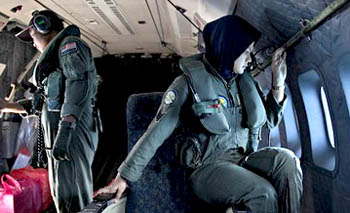
Missing Malaysian flight MH 370: Computer sent plane off flight path

March 18, 2014

Flight_MH_370Washington, Mar 18: The first turn to the west that diverted the missing Malaysia Airlines plane from its planned flight path from Kuala Lumpur to Beijing was carried out through a computer system that was most likely programmed by someone in the plane's cockpit who was knowledgeable about airplane systems, according to senior US officials.

Instead of manually operating the plane's controls, whoever altered flight 370's path typed seven or eight keystrokes into a computer on a knee-high pedestal between the captain and the first officer, according to officials. The Flight Management System, as the computer is known, directs the plane from point to point specified in the flight plan submitted before each flight. It is not clear whether the plane's path was reprogrammed before or after it took off.

The fact that the turn away from Beijing was programmed into the computer has reinforced the belief of investigators — first voiced by Malaysian officials — that the plane was deliberately diverted and that foul play was involved. It has also increased their focus on the plane's captain and first officer.

Prime Minister Najib Razak of Malaysia told reporters on Saturday that his government believed the plane had been diverted, because its transponder and other communications devices had been manually turned off several minutes apart. US officials were told of the new information over the weekend.

But Malaysian authorities on Monday reversed themselves on the sequence of events they believe took place on the plane in the crucial minutes before ground controllers lost contact with it early March 8. They said it was the plane's first officer — the co-pilot — who was the last person in the cockpit to speak to ground control. And they withdrew their assertion that another automated system on the plane called Aircraft Communications Addressing and Reporting System, or ACARS, had been disabled when the co-pilot spoke.

Flight 370's Flight Management System reported its status to ACARS, which in turn transmitted information back to a maintenance base, according to a US official. This shows that the reprogramming happened before ACARS stopped working. ACARS ceased to function about the same time oral radio contact was lost and the airplane's transponder also stopped, fuelling suspicions that foul play was involved in the plane's disappearance.

Investigators are scrutinizing radar tapes from when the plane first departed Kuala Lumpur because they believe the tapes would show that after the plane first changed its course, it passed through several pre-established "waypoints," which are like virtual mile markers in the sky. That would suggest that the plane was under control of a knowledgeable pilot, because passing through those points without using the computer would have been unlikely.

According to investigators, it appears that a waypoint was added to the planned route. Pilots do that in the ordinary course of flying if air traffic controllers tell them to take a different route, to avoid weather or traffic. But in this case, the waypoint was far off the path to Beijing.

Whoever changed the plane's course would have had to be familiar with Boeing aircraft, though not necessarily the 777 — the type of plane that disappeared. US officials and aviation experts said it was far-fetched to believe that a passenger could have reprogrammed the Flight Management System.

Normal procedure is to key in a five-letter code — gibberish to non-aviators — that is the name of a waypoint. A normal flight plan consists of a series of such waypoints, ending in the destination airport. For an ordinary flight, waypoints can be entered manually or uploaded into the FMS by the airline.

One of the pilots' keys in a waypoint on a separate screen known as a scratchpad, and after confirming that it has no typographical errors, pushes another button to move it into the sequence in the flight plan. Normal practice is to orally confirm the waypoint with the other pilot, then push another button to instruct the airplane to go there. With the change in course, the plane would bank at a comfortable angle, around 20 degrees, and make the turn. Passengers would not feel anything unusual.

ABC News reported on Sunday that the programmed turn had led investigators to believe that it was being controlled by the pilot or hijackers.

One US safety expert, John Cox, a former airline union safety official, said someone taking such pains to divert the plane does not fit the pattern of past cases when pilots intentionally crashed and killed everyone on board.

"There's an inconsistency in what we've seen historically," he said, comparing the disappearance of Flight 370 with two murder-suicides, of an Egyptair flight off Nantucket Island in 1999 and a SilkAir jet in

Indonesia in 1997. In those crashes, he said, the pilot involved simply pushed the nose of the plane down and flew into the water.

The authorities searched the homes of the pilots in Kuala Lumpur on Saturday, seizing a flight simulator that one of them had in his home.

In an effort to determine whether the pilot had practiced taking down the plane, the authorities have reassembled the simulator for experts to examine. US investigators would like access to the flight simulator and any other electronic information seized from the pilots, but as of Monday night they had not been given access to those materials.

Meanwhile, as the search for the missing Boeing 777 jet stretched into a 10th day, two of the nations helping in the hunt, Australia and Indonesia, agreed to divide between them a vast area of the southeastern Indian Ocean, with Indonesia focusing on equatorial waters and Australia beginning to search farther south for traces of the aircraft. To the north, China and Kazakhstan checked their radar records and tried to figure out whether the jet could have landed somewhere on their soil.

Comments

Marisol
 - 
Sunday, 24 Jul 2016

I see your blog needs some fresh & unique content. Writing manually is time consuming, there is tool for this task.
Just search in gogle for; Fejlando's tips

Here is my homepage ... ReneeBarffed: http://twitter.com/Nila

Add new comment

  • Coastaldigest.com reserves the right to delete or block any comments.
  • Coastaldigset.com is not responsible for its readers’ comments.
  • Comments that are abusive, incendiary or irrelevant are strictly prohibited.
  • Please use a genuine email ID and provide your name to avoid reject.
Agencies
May 25,2020

The Japan government on Monday decided to lift the state of emergency for COVID-19 in Tokyo and four other prefectures of the country, the only places where the measure implemented to curb the pandemic had remained in force.

The lifting of the alert was backed by the coronavirus advisory panel and will be formally approved by the government later day, the economic revitalization minister and head of the working group to coordinate Japan's fight against COVID-19, Yasutoshi Nishimura, said.

The Japanese authorities made the decision after taking into account the number of infections and the situation of the health system in Tokyo, the three neighbouring prefectures of Chiba, Kanagawa and Saitama and the northern Hokkaido, the only ones where the state of emergency declared more than a month ago to control the pandemic remained in effect, reports Efe news.

The health alert was initially declared in Tokyo and six other prefectures on April 17 and subsequently extended across the country.

It allowed local authorities to ban large-scale public events and close bars and restaurants at night, among other measures, while the government has launched a campaign to encourage teleworking and staying at home.

The government resorted to this measure for the first time in the country's recent history to contain the spread of the virus and is now withdrawing it after a sustained slowdown in infections throughout the archipelago, where around 16,600 confirmed COVID-19 cases and 839 deaths have been recorded, according to the latest data.

The group of experts advising the government appreciated the efforts made by citizens to comply with the recommendations to achieve the target of reducing interpersonal contact by 80 percent, top government spokesperson Yoshihide Suga said at a press conference on Monday.

The recommendation for citizens to avoid unnecessary trips outside and the request for non-essential businesses to close were not mandatory nor accompanied by fines or other penalties for non-compliance, unlike the stricter containment measures implemented in other countries.

The government plans to formally approve the lifting of the state of emergency on Monday after consulting with other political parties in parliament and another meeting with the advisory panel, following which Japanese Prime Minister Shinzo Abe will hold a press conference.

The government had already decided to lift the emergency in 39 prefectures on May 14 after they reported a marked decrease in the number of infections, leaving out the more populated regions such as Tokyo and Osaka.

To avoid new outbreaks of the virus, Abe has urged people to become accustomed to a "new lifestyle" that includes maintaining social distancing, the use of masks outside as well as a series of guidelines for the reopening of shops, restaurants and public facilities.

Comments

Add new comment

  • Coastaldigest.com reserves the right to delete or block any comments.
  • Coastaldigset.com is not responsible for its readers’ comments.
  • Comments that are abusive, incendiary or irrelevant are strictly prohibited.
  • Please use a genuine email ID and provide your name to avoid reject.
Agencies
July 13,2020

New Delhi, Jul 13: Google CEO Sundar Pichai on Monday announced an investment of Rs 75,000 crore or approximately US$10 billion into India over the next five to seven years through 'Google for India Digistation Fund'.

This move is significant as it comes in the middle of the COVID-19 pandemic and as multinational companies across the world look at alternative investment destinations.

"Excited to announce Google for India Digitisation Fund. Through it, we will invest Rs 75,000 crore or approx US$10 Billon into India over the next 5-7 yrs. We'll do this through a mix of equity investments, partnerships and operational infrastructure in ecosystem investments," said Pichai.

Pichai along with Union Minister Ravi Shankar Prasad virtually attended the sixth annual edition of Google for India.

"This is a reflection of our confidence in the future of India and its digital economy," said Pichai.
He added that the investments will focus on four areas important to India's digitisation.

Listing out the areas, Pichai elaborated, "First enabling affordable access and information to every Indian in their own language. Second, building new products and services that are deeply relevant to India's unique needs. Third, empowering businesses as they continue or embark on the digital transformation. Fourth, leveraging technology in AI for social good in areas like health, education and agriculture."

"When I was young, every piece of technology brought new opportunities to learn and grow but I always had to wait for it to arrive from some places. Today people in India no more have to wait for technology to come to you. A whole new generation of technologies is happening in India first," said Pichai.

Earlier today Prime Minister Narendra Modi interacted with Pichai and discussed a range of subjects like a new work culture in coronavirus times, data security and cyber safety.

Comments

Add new comment

  • Coastaldigest.com reserves the right to delete or block any comments.
  • Coastaldigset.com is not responsible for its readers’ comments.
  • Comments that are abusive, incendiary or irrelevant are strictly prohibited.
  • Please use a genuine email ID and provide your name to avoid reject.
Agencies
March 15,2020

Houston, Mar 15: Researchers, studying the novel coronavirus, have found that the time between cases in a chain of transmission is less than a week, and over 10 per cent of patients are infected by someone who has the virus, but does not show symptoms yet, a finding that may help public health officials contain the pandemic.

The study, published in the journal Emerging Infectious Diseases, estimated what's called the serial interval of the coronavirus by measuring the time it takes for symptoms to appear in two people with the virus -- the person who infects another, and the infected second person.

According to the researchers, including those from the University of Texas at Austin, the average serial interval for the novel coronavirus in China was approximately four days.

They said the speed of an epidemic depends on two things -- how many people each case infects, and how long it takes cases to spread.

The first quantity, the scientists said, is called the reproduction number, and the second is the serial interval.

Due to the short serial interval of the disease caused by the coronavirus -- COVID-19 -- they said, emerging outbreaks will grow quickly, and could be difficult to stop.

“Ebola, with a serial interval of several weeks, is much easier to contain than influenza, with a serial interval of only a few days,” said Lauren Ancel Meyers, study co-author from UT Austin.

Meyers explained that public health responders to Ebola outbreaks have much more time to identify and isolate cases before they infect others.

“The data suggest that this coronavirus may spread like the flu. That means we need to move quickly and aggressively to curb the emerging threat,” Meyers added.

In the study, the scientists examined more than 450 infection case reports from 93 cities in China, and found the strongest evidence yet that people without symptoms must be transmitting the virus -- known as pre-symptomatic transmission.

More than one in ten infections were from people who had the virus but did not yet feel sick, the scientists said.

While researchers across the globe had some uncertainty until now about asymptomatic transmission with the coronavirus, the new evidence could provide guidance to public health officials on how to contain the spread of the disease.

“This provides evidence that extensive control measures including isolation, quarantine, school closures, travel restrictions and cancellation of mass gatherings may be warranted,” Meyers said.

The researchers cautioned that asymptomatic transmission makes containment more difficult.

With hundreds of new cases emerging around the world every day, the scientists said, the data may offer a different picture over time.

They said infection case reports are based on people's memories of where they went and whom they had contact with, and if health officials move quickly to isolate patients, that may also skew the data.

“Our findings are corroborated by instances of silent transmission and rising case counts in hundreds of cities worldwide. This tells us that COVID-19 outbreaks can be elusive and require extreme measures,” Meyers said.

Comments

Add new comment

  • Coastaldigest.com reserves the right to delete or block any comments.
  • Coastaldigset.com is not responsible for its readers’ comments.
  • Comments that are abusive, incendiary or irrelevant are strictly prohibited.
  • Please use a genuine email ID and provide your name to avoid reject.