


Modi to get US President-like reception in Israel; terrorism, economic ties on agenda

Agencies
July 4, 2017

New Delhi, Jul 4: Prime Minister Narendra Modi's historic visit to Israel, beginning on Tuesday, will see discussions between him and his Israeli counterpart Benjamin Netanyahu exploring ways to enhance cooperation in key strategic areas.
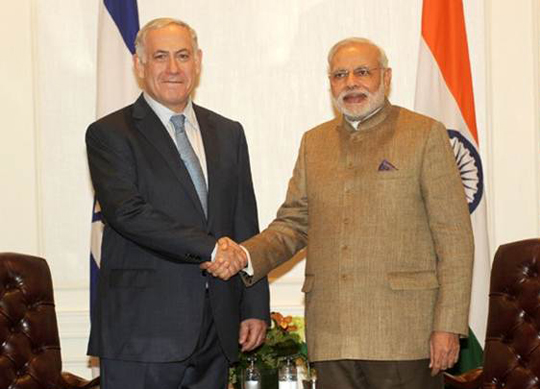
netanyahu

His visit will be the first by an Indian PM to Israel.

This year, India and Israel are marking 25 years of their diplomatic relations.

The two sides are expected to sign number of agreements in the field of innovation, development, science and technology and space.

Apart from boosting cooperation in the water and agriculture sectors, India and Israel will also discuss ways to strengthen people-to-people contact, air connectivity and investments.

During the visit, a deal with the Uttar Pradesh government is also likely to be signed to clean-up a patch of river Ganges apart from setting up of industrial research and development fund of USD 40 million.

Before the visit, the Ministry of External Affairs ministry in New Delhi said it will provide an impetus for deeper bilateral engagement in areas of mutual interest, as per news agency.

PM Modi's schedule:

PM Modi will be received by Netanyahu at the airport. This is a special gesture only accorded to the Pope or the US president.

The Israeli PM will also host a dinner for PM Modi.

Netanyahu will accompany him to most of the events, including the community reception on July 5.

PM Modi will pay homage to Indian soldiers at the Indian Cemetery in Haifa.

He will meet 26/11 Mumbai terror attack survivor Holtzberg Moshe, who was only two when he was saved by his Indian nanny Sandra Samuel.

Moshe's father Rabbi Gavriel and mother Rivkah were among eight Israeli nationals killed in the 2008 terror strike.

On the eve of his visit to Israel, PM Modi on Monday said he will discuss with Netanyahu common challenges like terrorism and ways to boost the economic ties.

"Tomorrow, I begin a historic visit to Israel, a very special partner of India's. As the first Indian PM to do so, I am greatly looking forward to this unprecedented visit that will bring our two countries and people closer," he said in a statement.

"I look forward to holding extensive talks with my friend, Israeli PM Netanyahu, who shares a commitment for vibrant India-Israel ties," he tweeted.

The PM said he will have 'in-depth talks' with Netanyahu "on the full spectrum of our partnership and strengthening it in diverse fields for mutual benefit. We will also have the chance to discuss major common challenges like terrorism."

"My programme during the visit gives me an opportunity to engage with a cross-section of Israeli society. I am particularly looking forward to interacting with the large vibrant Indian diaspora in Israel that represents an enduring link between our two peoples," PM Modi added.

On the economic side, he said, "I will join with leading Indian and Israeli CEOs and start-ups to discuss our shared priority of expanding business and investment collaboration on the ground."

In addition, he said, "I hope to get insights into Israel's accomplishments in technology and innovation through on-site visits."

On July 6, PM Modi will travel to Hamburg for the G-20 Summit being hosted by Germany on July 7-8.

Netanyahu hails PM Modi's visit to Israel as a 'very significant step'

Earlier, the Israeli premier had hailed PM Modi's visit as a "very significant step" in strengthening bilateral relations that are on a "constant upswing".

"Next week, the Indian Prime Minister, my friend, Narendra Modi will arrive in Israel, This is a historic visit to Israel. In the 70 years of the country's existence, no Indian Prime Minister has ever visited and this is further expression of the state of Israel's military, economic and diplomatic strength," Netanyahu had said.

"This is a very significant step in strengthening relations between the two countries," he had added.

The two leaders have already met twice on foreign soil on the sidelines of UN-related events and are said to be constantly in touch with each other over the phone.

PM Modi would also be meeting Israeli President Reuven Rivlin and the leader of Opposition Isaac Herzog on July 5.

He will not travelling to neighbouring Palestine during the visit, a clear signal of de-hyphenation of its ties with the two West Asian nations.

President Pranab Mukherjee in 2015 and External Affairs Minister Sushma Swaraj in 2016 visited both the countries.

Israeli Prime Minister Ariel Sharon and President Ezer Weizman visited India in 2003 and 1997 respectively.

Israeli President Reuven Rivlin had also paid a visit to India in November last year.

Comments

Muhammed Rafique
 - 
Friday, 7 Jul 2017

Viren, Your comments doesn't even deserve any response

but the matter of fact is you are such a sick and communal person who encourage riot and disrupt peace.The current situation in DK is bcos of people like u, instigated by Padil and Kalladka

Viren Kotian
 - 
Friday, 7 Jul 2017

RIP Sharat. Your blood will not be wasted. nationalist forces will soon eliminate anti-national forces, fanatics and terrorists.

Hara Hara Mahaadev!

Abdul
 - 
Friday, 7 Jul 2017

So called nationalists, breaking section , ohh DK & Udupi MPs spotted again , they will disappear when real culprits get caught ( like Karthik raj case)

Mohammad Beary
 - 
Tuesday, 4 Jul 2017

Lynchist with terrorist...

NOOR
 - 
Tuesday, 4 Jul 2017

For a muslims, Everything happens with the will of ALLAH...
ALLAH the creator of all that exists, Knows well of all that is happening around the globe...
ALLAH is the best of Planners...
ALhamudllillah.. Thanks to ALLAH for making us Muslims.

Fear ALLAH, the creator..
and Never Fear the Creations of ALLAH. U will be successful

abdul
 - 
Tuesday, 4 Jul 2017

both from the same creed & creature-anti human

Add new comment

  • Coastaldigest.com reserves the right to delete or block any comments.
  • Coastaldigset.com is not responsible for its readers’ comments.
  • Comments that are abusive, incendiary or irrelevant are strictly prohibited.
  • Please use a genuine email ID and provide your name to avoid reject.
Agencies
July 15,2020

Lucknow, Jul 15: As many as 122 alleged criminals were killed in over 6,000 encounters in Uttar Pradesh in the past three years, while 13 policemen also lost their lives during this period, a senior police official said.

He also said over 2,000 criminals were injured in police action, while over 13,000 of them have been arrested.

"Thirteen policemen have been killed in action in as many as 6,126 encounters (in UP), while as many as 122 criminals have been gunned down," Additional Director General of Police (Law and Order) Prashant Kumar said while sharing details of police encounters from March 20, 2017, to July 10, 2020.

As many as 13,361 criminals have been arrested, while 2,296 criminals were injured in police encounters, he said, adding 909 policemen were also injured in these incidents.

Referring to the Kanpur ambush in which eight policemen were killed, Kumar said, "Of the 21 named accused in the incident, six have been killed and four arrested so far. A hunt is on to nab the 11 other accused."

Eight police personnel, including a DSP, were gunned down by the henchmen of gangster Vikas Dubey in Bikru village of Kanpur on July 3.

Seven others, including a civilian, were injured in the attack after the police team entered the village past July 2 midnight to arrest the gangster.

Dubey was later killed in an encounter on July 10 after police claimed that he tried to escape from the spot in the Bhauti area where the vehicle carrying him from Ujjain to Kanpur met with an accident.

Kumar said overall there has been a decline in the crime rate in the state this year compared to the last year.

"A total of 579 instances of loot took place in the state from January 1, 2020, to June 15, 2020. This is 44.17 per cent less compared to the crimes committed in the same period in 2019, the ADG (Law and Order) said.

He said 33 incidents of dacoity have been reported in the state this year so far. It is 37.74 per cent less compared to the crimes committed in the same period in 2019 .

Similarly, 2,604 instances of burglary have taken this year so far and is 30.97 per cent less compared to the crimes committed in the same period last year, Kumar added.

He said 1,019 dowry-related deaths have taken place this year, registering a 6.34 per cent decline compared to the previous year.

As many as 913 incidents of rape have been reported this year so far, a decline of 25.41 per cent compared to the last year, Kumar said.

Comments

Add new comment

  • Coastaldigest.com reserves the right to delete or block any comments.
  • Coastaldigset.com is not responsible for its readers’ comments.
  • Comments that are abusive, incendiary or irrelevant are strictly prohibited.
  • Please use a genuine email ID and provide your name to avoid reject.
News Network
May 28,2020

May 28: Abdul Kareem was forced out of school and into a life of odd jobs like repairing bicycles before he finally managed to pull his family out of abject poverty transporting goods across Delhi in a mini truck.

The job, and the slim financial security that came with it, was the first stepping stone to a better life.

All that is now gone as India reels under the economic impact of its protracted coronavirus lockdown. Mr Kareem's out of a job and stranded in his village in Uttar Pradesh with his wife and two children. Their minuscule savings from his Rs 9,000 a month job have been exhausted, and the money he saved for books and school uniforms is spent.

"I don't know what the job situation will be in Delhi once we go back," Mr Kareem said. "We can't stay hungry so I will do whatever I find."

At least 49 million people across the world are expected to plunge into "extreme poverty" -- those living on less than $1.90 per day -- as a direct result of the pandemic's economic destruction and India leads that projection, with the World Bank estimating some 12 million of its citizens will be pushed to the very margins this year.

Some 122 million Indians were forced out of jobs last month alone, according to estimates from the Center for Monitoring Indian Economy, a private sector think tank. Daily wage workers and those employed by small businesses have taken the worst hit. These include hawkers, roadside vendors, workers employed in the construction industry and many who eke out a living by pushing handcarts and rickshaws.

For Prime Minister Narendra Modi, who came to power in 2014 promising to lift the poorest citizens out of poverty, the fallout from the lockdown brings with it significant political risk. He won an even larger second term majority last year on the strength of his government's popular social programs that directly targeted the poor, such as the provision of cooking gas cylinders, power and public housing. The breadth and depth of this renewed economic pain will only increase the pressure on his government as it works to steer the country's economy back on track.

"Much of the Indian government's efforts to mitigate poverty over the years could be negated in a matter of just a few months," said Ashwajit Singh, managing director of IPE Global, a development sector consultancy that advises several multinational aid agencies. Noting that he did not expect unemployment rates to improve this year, Singh said: "More people could die from hunger than the virus."

Desperate Times

Mr Singh points to a United Nations University study estimating 104 million Indians could fall below the World Bank-determined poverty line of $3.2 a day for lower-middle-income countries. This will take the proportion of people living in poverty from 60% -- or 812 million currently, to 68% or 920 million -- a situation last seen in the country more than a decade ago, he said.

A World Bank report found the country had been making significant progress and was close to losing its status as the country with the most poor citizens. The impact of PM Modi's lockdown risks reversing those gains.

The World Bank and the CMIE estimates were published in late April and early May respectively. Since then the situation has only become grimmer, with harrowing images of people making desperate attempts to reach their villages, on crowded buses, the flatbeds of trucks and even on foot or on bicycles dominating media coverage.

The Rustandy Center for Social Sector Innovation at the University of Chicago Booth School of Business analyzed the unemployment data from the CMIE, collected through surveys covering about 5,800 homes across 27 states in April.

Researchers found rural areas were the hardest hit, and the economic misery was the result of the lockdown, rather than the spread of infections in the hinterland. More than 80% of households had experienced a drop income and many won't survive much longer without aid, they wrote in a report.

The government has promised cheap credit to farmers, direct transfer of money to the poor and eased access to food security programs -- but these help people who have some documentation, which many of the poorest don't. With millions of impoverished people now in transit across the country, the food security situation is dire -- news reports are emerging of people foraging through piles of rotting fruit or eating leaves.

Shattered Economy

The economy was already growing at its slowest pace in over a decade when the virus struck. The lockdown, which came into effect on March 25, has hammered it, stalling business activity and putting a lid on consumption, pushing the economy to what may be its first full-year contraction in more than four decades.

It's dire enough to warrant the country exiting its lockdown, as it has been doing incrementally since May 4, even as its infections are surging. India is now Asia's virus hotspot with infections crossing 151,000 according to data from Johns Hopkins University.

PM Modi, who has come under criticism for the pain inflicted on the poor, has said his government will spend $265 billion or about 10% of its GDP to help Asia's third-largest economy weather the pandemic's fallout. But experts say only a part of it is direct fiscal stimulus, and probably smaller than the total damage done to the economy during the lockdown period.

"What is especially worrying is the government's response," said Reetika Khera, an economics professor at the Indian Institute of Technology in Delhi. "The epidemic will magnify existing -- and already high -- inequalities in India."

Still, the economic measures aren't going to kick in for some time and industry will likely struggle to restart because of the flight of labour from industrial hubs.

And as the harsh summer unfolds more pain lies in store in the villages now dealing with returning migrant workers.

"There are no factories or industries here, there are just hills," said Surendra Hadia Damor, who had walked nearly 100 km from Ahmedabad, Gujarat, before a voluntary organisation drove him to his village in the neighboring state of Rajasthan. "We can survive for a month or two and then try and find a job nearby -- we will see what happens."

Comments

Add new comment

  • Coastaldigest.com reserves the right to delete or block any comments.
  • Coastaldigset.com is not responsible for its readers’ comments.
  • Comments that are abusive, incendiary or irrelevant are strictly prohibited.
  • Please use a genuine email ID and provide your name to avoid reject.
Agencies
March 12,2020

The Ministry of Health and Family Welfare has prepared a draft for guidelines for home quarantine, as well as for the use of masks by public, in view of coronavirus.

What to do in Home Quarantine?

The government says, for those taking refuge to home quarantine should stay in a well-ventilated single-room preferably with an attached or separate toilet. It adds that if another family member needs to stay in the same room, it's advisable to maintain a distance of at least 1 metre between the two.

The government advised, coronavirus patients to stay away from elderly people, pregnant women, children and persons with co-morbidities within the household as their immune system may be low. The health minister also suggested to restrict the patient's movement within the house. "Under no circumstances attend any social/religious gathering e.g. wedding, condolences, etc, said the guideline.

It also instructed the corona virus infected person to avoid sharing household items like dishes, drinking glasses, cups, eating utensils, towels, bedding, or other items with others at home. The guideline also demanded that even though home quarantine, the patient should wear a surgical mask at all times. "The mask should be changed every 6-8 hours and disposed off. Disposable masks are never to be reused, it added.

"Masks used by patients/ caregivers/ close contacts during home care should be disinfected using ordinary bleach solution (5 per cent) or sodium hypochlorite solution (1%) and then disposed of either by burning or deep burial," instructs the government.

Even for family members of a patient, the health ministry clearly instructs to use disposable gloves when cleaning the surfaces or handling soiled linen. No visitors, under any circumstances will be allowed, said the guideline.

"In case the person being quarantined becomes symptomatic, all his close contacts will be home quarantined (for 14 days) and followed up for an additional 14 days or till the report of such case turns out negative on lab testing," states the draft.

How to wear & dump masks?

There is a specific and elaborate do's and don'ts also released by the ministry. For those unsure in which mask to choose, it says, "Medical masks of different sizes and shapes are available in the market. The common ones are flat pleated masks of woven fabric which covers the nose and mouth and affixed behind the head with straps/ elastic fasteners. There are also conical or duck bill shaped masks with valves (or without valves) that fit in the contour of face over the nose and mouth, but are costlier."

However, the ministry warns, medical masks should not be used by healthy persons who are not having any symptoms "because it creates a false sense of security". Instead, it suggests to refrain from touching face, mouth, nose and eyes as well as washing hands regularly with soap for 20 seconds each time.

However, when a person develops a cough or fever, the suspected patient needs to switch to medical masks. "Use of medical three layer masks when ill, will prevent your infection from spreading to others. However you also need to wash your hands frequently to avoid spreading infection to others," read the guideline.

Even if one is not tested positive but showing symptoms, they are advised to wear masks while visiting a healthcare facility. "Close family contacts of such suspect/confirmed cases undergoing home care should also use Triple layer medical mask," it warns.

The ministry has also given point by point guideline on how to use a mask like to make sure that they are facing down while unfolding or for that matter to ensure there are no gaps on either side of the mask.

It even warns, "Fit flexible nose piece (a metallic strip that can easily be located) over nose-bridge" to ensure no one else are infected. The government also warns against simple dumping of the masks once used. Instead one should disinfect "using ordinary bleach solution (5 per cent) or sodium hypochlorite solution (1 per cent) and then disposed of either by burning or deep burial," says the Health Ministry.

COVID-19 emerged in early December 2019 in China's Wuhan province and has now spread to over 100 countries. As on March 9, 2020, India has reported 42 cases mostly among those who had travelled from affected countries.

However the government says, "It causes a minor illness in majority of patients with symptoms of fever and or cough. A small proportion of such persons may progress to severe disease with difficulty in breathing."

Comments

Add new comment

  • Coastaldigest.com reserves the right to delete or block any comments.
  • Coastaldigset.com is not responsible for its readers’ comments.
  • Comments that are abusive, incendiary or irrelevant are strictly prohibited.
  • Please use a genuine email ID and provide your name to avoid reject.