


Modi to get US President-like reception in Israel; terrorism, economic ties on agenda

Agencies
July 4, 2017

New Delhi, Jul 4: Prime Minister Narendra Modi's historic visit to Israel, beginning on Tuesday, will see discussions between him and his Israeli counterpart Benjamin Netanyahu exploring ways to enhance cooperation in key strategic areas.
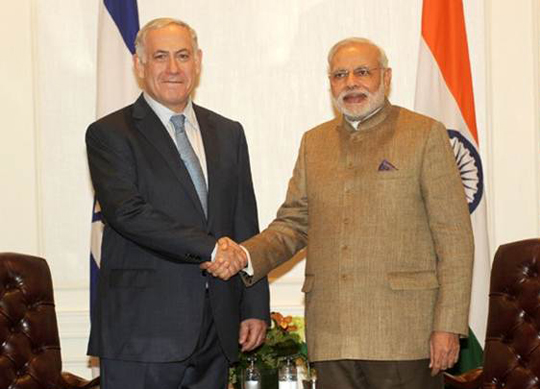
netanyahu

His visit will be the first by an Indian PM to Israel.

This year, India and Israel are marking 25 years of their diplomatic relations.

The two sides are expected to sign number of agreements in the field of innovation, development, science and technology and space.

Apart from boosting cooperation in the water and agriculture sectors, India and Israel will also discuss ways to strengthen people-to-people contact, air connectivity and investments.

During the visit, a deal with the Uttar Pradesh government is also likely to be signed to clean-up a patch of river Ganges apart from setting up of industrial research and development fund of USD 40 million.

Before the visit, the Ministry of External Affairs ministry in New Delhi said it will provide an impetus for deeper bilateral engagement in areas of mutual interest, as per news agency.

PM Modi's schedule:

PM Modi will be received by Netanyahu at the airport. This is a special gesture only accorded to the Pope or the US president.

The Israeli PM will also host a dinner for PM Modi.

Netanyahu will accompany him to most of the events, including the community reception on July 5.

PM Modi will pay homage to Indian soldiers at the Indian Cemetery in Haifa.

He will meet 26/11 Mumbai terror attack survivor Holtzberg Moshe, who was only two when he was saved by his Indian nanny Sandra Samuel.

Moshe's father Rabbi Gavriel and mother Rivkah were among eight Israeli nationals killed in the 2008 terror strike.

On the eve of his visit to Israel, PM Modi on Monday said he will discuss with Netanyahu common challenges like terrorism and ways to boost the economic ties.

"Tomorrow, I begin a historic visit to Israel, a very special partner of India's. As the first Indian PM to do so, I am greatly looking forward to this unprecedented visit that will bring our two countries and people closer," he said in a statement.

"I look forward to holding extensive talks with my friend, Israeli PM Netanyahu, who shares a commitment for vibrant India-Israel ties," he tweeted.

The PM said he will have 'in-depth talks' with Netanyahu "on the full spectrum of our partnership and strengthening it in diverse fields for mutual benefit. We will also have the chance to discuss major common challenges like terrorism."

"My programme during the visit gives me an opportunity to engage with a cross-section of Israeli society. I am particularly looking forward to interacting with the large vibrant Indian diaspora in Israel that represents an enduring link between our two peoples," PM Modi added.

On the economic side, he said, "I will join with leading Indian and Israeli CEOs and start-ups to discuss our shared priority of expanding business and investment collaboration on the ground."

In addition, he said, "I hope to get insights into Israel's accomplishments in technology and innovation through on-site visits."

On July 6, PM Modi will travel to Hamburg for the G-20 Summit being hosted by Germany on July 7-8.

Netanyahu hails PM Modi's visit to Israel as a 'very significant step'

Earlier, the Israeli premier had hailed PM Modi's visit as a "very significant step" in strengthening bilateral relations that are on a "constant upswing".

"Next week, the Indian Prime Minister, my friend, Narendra Modi will arrive in Israel, This is a historic visit to Israel. In the 70 years of the country's existence, no Indian Prime Minister has ever visited and this is further expression of the state of Israel's military, economic and diplomatic strength," Netanyahu had said.

"This is a very significant step in strengthening relations between the two countries," he had added.

The two leaders have already met twice on foreign soil on the sidelines of UN-related events and are said to be constantly in touch with each other over the phone.

PM Modi would also be meeting Israeli President Reuven Rivlin and the leader of Opposition Isaac Herzog on July 5.

He will not travelling to neighbouring Palestine during the visit, a clear signal of de-hyphenation of its ties with the two West Asian nations.

President Pranab Mukherjee in 2015 and External Affairs Minister Sushma Swaraj in 2016 visited both the countries.

Israeli Prime Minister Ariel Sharon and President Ezer Weizman visited India in 2003 and 1997 respectively.

Israeli President Reuven Rivlin had also paid a visit to India in November last year.

Comments

Muhammed Rafique
 - 
Friday, 7 Jul 2017

Viren, Your comments doesn't even deserve any response

but the matter of fact is you are such a sick and communal person who encourage riot and disrupt peace.The current situation in DK is bcos of people like u, instigated by Padil and Kalladka

Viren Kotian
 - 
Friday, 7 Jul 2017

RIP Sharat. Your blood will not be wasted. nationalist forces will soon eliminate anti-national forces, fanatics and terrorists.

Hara Hara Mahaadev!

Abdul
 - 
Friday, 7 Jul 2017

So called nationalists, breaking section , ohh DK & Udupi MPs spotted again , they will disappear when real culprits get caught ( like Karthik raj case)

Mohammad Beary
 - 
Tuesday, 4 Jul 2017

Lynchist with terrorist...

NOOR
 - 
Tuesday, 4 Jul 2017

For a muslims, Everything happens with the will of ALLAH...
ALLAH the creator of all that exists, Knows well of all that is happening around the globe...
ALLAH is the best of Planners...
ALhamudllillah.. Thanks to ALLAH for making us Muslims.

Fear ALLAH, the creator..
and Never Fear the Creations of ALLAH. U will be successful

abdul
 - 
Tuesday, 4 Jul 2017

both from the same creed & creature-anti human

Add new comment

  • Coastaldigest.com reserves the right to delete or block any comments.
  • Coastaldigset.com is not responsible for its readers’ comments.
  • Comments that are abusive, incendiary or irrelevant are strictly prohibited.
  • Please use a genuine email ID and provide your name to avoid reject.
Agencies
March 1,2020

Kolkata, Mar 1: The Calcutta High Court has ruled that it is not mandatory for foreigners to produce a valid passport and its particulars for processing of application for grant of Indian citizenship if he is able to satisfy the appropriate authorities the reasons for non-availability of the document.

Justice Sabysachi Bhattacharya passed the order while disposing off a petition by granting the petitioner liberty to file an application before the authority "as contemplated in Rule 11 of the Citizenship Rules 2009, upon furnishing explanation as to the non-availability of the passport".

Bismillah Khan had filed the petition saying he was being denied the citizenship of India because of his inability to file an application under Section 5 (1) (c) of the Citizenship Act, 1955, apparently due to the mandatory requirement of furnishing a copy of the passport for such application.

The petitioner's counsel submitted that Khan was a Pakhtoon citizen and due to political turmoil in the said state, which subsequently merged partially into Afghanistan and partially into Pakistan, he, as a five-year old, had to migrate to India with his father in 1973.

Under such circumstances, the petitioner could not have any opportunity of having a valid passport, since they were refugees under distress, the counsel said.

The petitioner had previously approached a coordinate Bench of the court, wherein a single judge, passed an order on July 25, 2018, directing him to comply with the formalities required, as communicated by the secretary to the Government of India to the Secretary to the Government of West Bengal (Home), vide a letter dated December 7, 2017.

The court had then also given liberty to the petitioner to apply afresh before the appropriate authority under Section 5(1)(c) of the 1955 Act, having complied with all the formalities.

The petitioner then moved Bhattacharya's court submitting that a complete application as directed by the Coordinate Bench cannot be possibly filed by his client due to the mandatory requirement of uploading a copy of his passport, which the petitioner does not have due to reasons beyond his control.

The counsel said Khan is married to an Indian citizen, has a daughter and living in India for close to half a century.

The counsel for the union of India submitted that in view of no application having been filed by the petitioner, there is no scope of granting such proposed application at the present juncture for the Union.

The counsel argued that it is mandatory to file an application in Form III for the application of the petitioner under Section 5(1)(c) of the Act to be considered at all.

In view of the petitioner not complying with the mandatory requirement of submitting a copy of his passport, the state government cannot, under the law, forward such application to the union government.

After hearing all sides, Justice Bhattacharya said although the rule "contemplates that an application shall not be entertained unless the application is made in Form III, such provision ipso facto does not make the availability of a passport a mandatory requirement".

"..the Form given with the Rules or the Rules themselves cannot override the provision of the statute itself, under which the said Rules are framed, which does not stipulate such a mandate on the applicants for citizenship under Section 5 (1)(c) of the 1955 Act mandatorily to carry a passport".

The court said although such provision is included in the Form, which has to be complied with by the applicant, "it is nowhere indicated in such Form that all the relevant particulars, including the particulars regarding passport of the petitioner have to be furnished mandatorily, along with a copy of a valid foreign passport, even in the event the petitioner, for valid reasons, is not in a position to produce such passport".

Justice Bhattacharya ruled that under such circumstances, it cannot be held that the provision of producing a passport and its particulars is mandatory in nature and there has to be a relaxation in such requirement "in case the petitioner is able to satisfy the appropriate authorities the reasons for non- availability of such passport".

"Unless such a leeway is given to the applicants, genuine persons who otherwise have all the formal documents indicating that they have been residing in India for a long time and have married a resident of India would also be unable to apply for Indian Citizenship despite having lived their entire lives and contributed to the economy and diverse culture of this country."

He said such a scenario would be contradictory to the spirit of Article 14 of the Constitution of India.

"In such view of the matter, the requirement of having a passport has to be read as optional in Form III of the Citizenship Rules, 2009 and the authorities are deemed to have the power to relax such 6 requirement in the event the applicant satisfied the authorities for genuine reasons why the applicant is not in a position to produce such passport," the February 24 order said.

The court ruled that despite the provision of making applications online, a provision has to be made for persons who do not have all the particulars of their passport, which is read as optional, to file applications manually, which are to be treated as valid applications under Rule 5 of the Citizenship Rules, 2009.

The court also ordered that alternatively the necessary software be amended so that the online applications can be presented with or without passports, in the latter case furnishing detailed reasons as to non-furnishing of passports.

"Sanctioning of such forms, however, will be conditional upon the satisfaction of the relevant authorities about the reasons for the applicant not being able to produce her/his passport," the order said.

Comments

Add new comment

  • Coastaldigest.com reserves the right to delete or block any comments.
  • Coastaldigset.com is not responsible for its readers’ comments.
  • Comments that are abusive, incendiary or irrelevant are strictly prohibited.
  • Please use a genuine email ID and provide your name to avoid reject.
coastaldigest.com web desk
June 16,2020

New Delhi, Jun 16: Despite Prime Minister Narendra Modi led government’s attempt to downplay the border dispute with China, matters have heated up unprecedentedly along the Line of Actual Control (LAC)- the effective Sino-India border in Eastern Ladakh. 

The country has lost three precious lives – an army officer and two soldiers. The last time blood was spilled on the LAC, before the latest episode, was 45 years ago when the Chinese ambushed an Assam Rifles patrol in Tulung La.

India had lost four soldiers on October 20, 1975 in Tulung La, the last time bullets were fired on the India-China border though both the countries witnessed bitter stand-offs later at Sumdorong Chu valley in 1987, Depsang in 2013, Chumar in 2014 and Doklam in 2017.

Between 1962 and 1975, the biggest clash between India and China took place in Nathu La pass in 1967 when reports suggest that around 80 Indian soldiers were killed and many more Chinese personnel.

While three soldiers, including a Commanding Officer, were killed in the latest episode in Galwan Valley, the government describes it as a "violent clash" and does not mention opening fire.

New Delhi described the locality where the 1975 incident took place as "well within" its territory only to be rebuffed by Beijing as "sheer reversal of black and white and confusion of right and wrong".

The Ministry of External Affairs had then said that the Chinese had crossed the LAC and ambushed the soldiers while Beijing claimed the Indians entered their territory and did not return despite warnings.

The Indian government maintained that the ambush on the Assam Rifles' patrol in 1975 took place "500 metres south of Tulung" on the border between India and Tibet and "therefore in Indian territory". It said Chinese soldiers "penetrating" Indian territory implied a "change in China's position" on the border question but the Chinese denied this and blamed India for the incident.

The US diplomatic cables quoted an Indian military intelligence officer saying that the Chinese had erected stone walls on the Indian side of Tulung La and from these positions fired several hundred rounds at the Indian patrol.

"Four of the Indians had gone into a leading position while two (the ones who escaped) remained behind. The senior military intelligence officer emphasised that the soldiers on the Indian patrol were from the area and had patrolled that same region many times before," the cable said.

One of the US cables showed that former US Secretary of State and National Security Adviser Henry Kissinger sought details of the October 1975 clash "without approaching the host governments on actual location of October 20 incident". He also wanted to know what ground rules were followed regarding the proximity of LAC by border patrols.

A cable sent from the US mission in India on November 4, 1975 appeared to have doubts about the Chinese account saying it was "highly defensive".

"Given the unsettled situation on the sub-continent, particularly in Bangladesh, both Chinese and Indian authorities have authorised stepped up patrols along the disputed border. The clash may well have ensued when two such patrols unexpectedly encountered each other," it said.

Another cable from China on the same day quoted another October 1974 cable, which spoke about Chinese officials being concerned for long that "some hotheaded person on the PRC (People's Republic of China) might provoke an incident that could lead to renewed Sino-Indian hostilities. It went on to say that this clash suggested that "such concerns and apprehensions are not unwarranted".

According to the United States diplomatic cables, Chinese Foreign Ministry on November 3, 1975 disputed the statement of the MEA spokesperson, who said the incident took place inside Indian territory.

The Chinese had said "sheer reversal of black and white and confusion of right and wrong". In its version of the 1975 incident, they said Indian troops crossed the LAC at 1:30 PM at Tulung Pass on the Eastern Sector and "intruded" into their territory when personnel at the Civilian Checkpost at Chuna in Tibet warned them to withdraw.

Ignoring this, they claimed, Indian soldiers made "continual provocation and even opened fire at the Chinese civilian checkpost personnel, posing a grave threat to the life of the latter. The Chinese civilian checkpost personnel were obliged to fire back in self defence."

The Chinese Foreign Ministry spokesperson had also said they told the Indian side that they could collect the bodies "anytime" and on October 28, collected the bodies, weapons and ammunition and "signed a receipt".

The US cables from the then USSR suggested that the official media carried reports from Delhi on the October 1975 incident and they cited only Indian accounts of the incident "ridiculing alleged Chinese claims that the Indians crossed the line and opened fire first".

Comments

Add new comment

  • Coastaldigest.com reserves the right to delete or block any comments.
  • Coastaldigset.com is not responsible for its readers’ comments.
  • Comments that are abusive, incendiary or irrelevant are strictly prohibited.
  • Please use a genuine email ID and provide your name to avoid reject.
News Network
February 1,2020

When it comes to the economy, dark days do loom large over India. May it be growth (lowest since 2008), inflation (highest in the last six years), or revenue collection (lowest in 10 years), the Indian economy is faltering. Hence, there is little leeway that can be assumed in the incumbent Union Budget 2020 (the first of the decade) if the economy needs to be boosted.

While presenting the decade's first Budget for India, finance minister Nirmala Sitharaman said on Saturday in Parliament:

Taxation

•             AADHAR based tax verification introduced

•             Review of customs duty exemptions in September 2020

•             GST refund process simplified

•             Electronic invoice implementation in phases

•             New digital scheme for tax litigation

•             PAN to be instantly allotted online against Aadhar

•             Vivaad se Vishwas Scheme: Defaulter to pay only disputed tax and no penalty or interest by 31 March 2020, post which additional amount can be paid till June 2020

•             Measure to promote affordable housing - tax holiday extended for developers

•             Concession on real estate transactions

•             Turnover threshold for audit raised to Rs 5 crore from 1 crore

•             Company audit requirements eased

•             Taxes on ESOPs (employee stock ownership) in start-ups deferred by 5 years

•             100% per cent tax exemption

•             Corporate Tax at 15%

•             Dividend Distribution Tax removed, dividend taxed only for recipients

•             No tax for 0-5 lakh

•             30% above 15 lakh

•             25% for income between Rs 12.5-15 lakh

•             20% for income between Rs 10-12.5 lakh

•             15% for income between Rs 7.5-10 lakh

•             10% for income between Rs 5-7.5 lakh, against the prevailing 20%

•             A new, optional simplified personal income tax regime for those not seeking exemptions


Major steps and initiatives taken by the government in finance

•             3.8 percent fiscal deficit estimated

•             GDP nominal growth expected at 10 per cent

•             Govt to sell part of holding LIC via IPO (initial public offering)- partial LIC disinvestment

•             Partial credit guarantee for NBFCs

•             New law for netting of financial contracts

•             Mechanism to end liquidity crisis

•             NRIs (non resident Indians) can invest in certain govt securities


Aspirational India: Caring society

•             App-based invoice financing loans for MSMEs

•             Amendment to Factoring Regulation Act to aid MSMEs

•             Pension Fund Regulatory and Development Authority (PFRDI) Act amendments

•             No criminal liabilities for civil acts

•             Auto-enrolment in universal pension scheme

•             5958 cr allocated for Ladakh

•             30757 cr allocated for J&K

•             Insurance for depositors raised to 5 lakh from 1 lakh

•             Robust mechanisms in place to monitor all PSU banks

•             Depositors’ money safe

•             100 cr for hosting G20 in 2022

•             National Recruitment Agency to be set up

•             Tax payers’ charter to be enshrined in statutes

•             Amendments for Companies Act

•             Tax payer charter proposed to free citizens from tax harassment

•             Businesses should have confidence that system is fair

•             4400 crore allocation for clean air and climate change policy

•             Aim to reduce carbon footprint - Warning to old thermal plants

•             Committed to preserve environment, tackle climate change

•             23150 crore for culture ministry

•             2500 crore for tourism sector

•             Institute of Heritage and Conservation to come up soon

•             Aim to set up more museums

•             5 archaeological sites to be made iconic

•             Proposal to end manual scavenging

•             53700 crore for welfare of STs

•             85000 crore for SCs and OBCs for 2021

•             35600 crore for nutritional schemes

•             Gross enrollment ratio of girls higher than boys in elementary level

•             Beti Bachao, Beti Padhao - tremendous results


Aspirational India: Infrastructure and economic development

•             Further reforms for transparent price discovery for natural gas

•             22000 crore for power sector

•             8000 crore for quantum technology in next 6 years

•             Two national level science schemes

•             Expand Jan Aushadhi Scheme

•             1 lakh gram panchayats to be connected via Bharat Net

•             6000 crore for Bharat Net

•             Data Centre parks to be set up across the country

•             National Gas Grid to be expanded

•             Reforms to help stressed DISCOMS (distribution companies)

•             Delhi-Mumbai Expressway by 2023

•             100 more airports by 2024

•             Plans to energise economic activity along river banks

•             Need to enhance sea ports

•             High Speed Mumbai-Ahmedabad train

•             More Tejas-type trains

•             4 station redevelopment projects under PP model

•             2000 km of strategic highways to be built, 11000 km of track electrification

•             Accelerated development of highways

•             National Logistics Policy to be released soon

•             Big push on infrastructure - 100 lakh crore

•             National Technical Textiles Mission to be set up

•             1480 crore outlay for textile sector

•             27300 crore for industrial development by 2021

•             Digital refund of duties for exporters

•             Boost domestic manufacturing - electronic equipment, mobile phone, medical devices

•             5 new smart cities in collaboration with states

•             Investment clearance cell to be set up for end to end facilitation

•             Entrepreneurship has been the strength of India


Aspirational India: Education and skills

•             High need for medical teachers and paramedics

•             Internships for engineers in panchayats

•             Rs 99300 cr for education sector

•             Large hospitals to be encouraged to start PG courses

•             Attach medical colleges to district hospitals

•             National police university to be set up

•             IND-SAT programme for overseas students for studying in India

•             New courses in 159 universities by 2026

•             Focus on education for jobs

•             Propose a fresh education policy

•             Urban local bodies should give opportunities to new engineers

•             Education needs more finances


Aspirational India: Healthcare

•             AI (artificial intelligence) to be used for Ayushman Bharat Scheme

•             69000 crore for health sector

•             Propose to set up more hospitals

•             Holistic vision for national healthcare


Aspirational India: Agriculture, Irrigation and rural development

•             Need to liberalise farm markets

•             108 million metric tonne milk production by 2021

•             2.83 lakh cr allocation for agriculture and irrigation

•             Propose raising fish production to 200 lakh tonne

•             Zero budget national farming

•             NABARD refinance scheme to be expanded

•             Village credit card scheme

•             Agriculture credit target for 2020 set at Rs 15 lakh crore

•             Village storage scheme for farmers, zero budget natural farming

•             Dhanya Lakshmi scheme for women in villages

•             Krishi Udaan by civil aviation ministry for air transport of such commodities over longer distances

•             Indian railways to set up 'kisan rail'

•             Govt to provide help to geo-tag warehouses

•             Financial inclusion has helped raise farm incomes

•             Plan for 100 water stressed districts

•             Scheme for 20 lakh farmers to set up solar pumps

•             Doubling farm income - model agricultural land leasing act, balanced use of fertilisers, solar pumps for 20 lakh farmers


Budget 2020 and its three focuses

•             Budget's first focus is 'Aspirational India'. Second focus: economic development for all. Third focus: building a caring society.

•             FDI at 284 billion dollars, achieved 7.84% growth

•             GST formalised the economy

•             Efficiency gained in logistics

•             16 lakh new tax payers added

•             Fundamentals of economy hold strong

•             Scaled up implementation of pro-poor schemes


Key challenges FM faces

•             India needs to grow by 9 per cent to 10 per cent a year to become the $5 trillion economy by 2024, as projected by the government. The government is now forecasting growth will come in at 5 per cent

•             The IMF, which had originally predicted 6.1 per cent growth for India in 2019, has revised that downwards to 4.8 per cent

•             The government’s likely to miss its fiscal deficit target for the current fiscal year of 3.3 per cent and hike its target to as much as 4 per cent for the next financial year

•             India will struggle to achieve 5 per cent GDP growth in 2020 - Economist Steve Hanke, Johns Hopkins University

•             Investment is forecast to grow at less than 1 per cent -- the lowest since 2004-05

•             India's unemployment rate rose to 7.5 per cent during September-December 2019 quarter, according to data released by think-tank Centre for Monitoring Indian Economy


Comments

Add new comment

  • Coastaldigest.com reserves the right to delete or block any comments.
  • Coastaldigset.com is not responsible for its readers’ comments.
  • Comments that are abusive, incendiary or irrelevant are strictly prohibited.
  • Please use a genuine email ID and provide your name to avoid reject.