


Modi to get US President-like reception in Israel; terrorism, economic ties on agenda

Agencies
July 4, 2017

New Delhi, Jul 4: Prime Minister Narendra Modi's historic visit to Israel, beginning on Tuesday, will see discussions between him and his Israeli counterpart Benjamin Netanyahu exploring ways to enhance cooperation in key strategic areas.
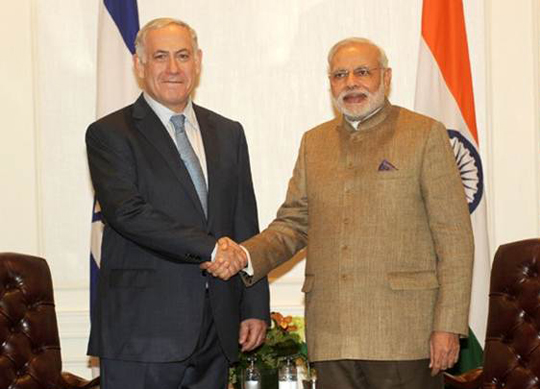
netanyahu

His visit will be the first by an Indian PM to Israel.

This year, India and Israel are marking 25 years of their diplomatic relations.

The two sides are expected to sign number of agreements in the field of innovation, development, science and technology and space.

Apart from boosting cooperation in the water and agriculture sectors, India and Israel will also discuss ways to strengthen people-to-people contact, air connectivity and investments.

During the visit, a deal with the Uttar Pradesh government is also likely to be signed to clean-up a patch of river Ganges apart from setting up of industrial research and development fund of USD 40 million.

Before the visit, the Ministry of External Affairs ministry in New Delhi said it will provide an impetus for deeper bilateral engagement in areas of mutual interest, as per news agency.

PM Modi's schedule:

PM Modi will be received by Netanyahu at the airport. This is a special gesture only accorded to the Pope or the US president.

The Israeli PM will also host a dinner for PM Modi.

Netanyahu will accompany him to most of the events, including the community reception on July 5.

PM Modi will pay homage to Indian soldiers at the Indian Cemetery in Haifa.

He will meet 26/11 Mumbai terror attack survivor Holtzberg Moshe, who was only two when he was saved by his Indian nanny Sandra Samuel.

Moshe's father Rabbi Gavriel and mother Rivkah were among eight Israeli nationals killed in the 2008 terror strike.

On the eve of his visit to Israel, PM Modi on Monday said he will discuss with Netanyahu common challenges like terrorism and ways to boost the economic ties.

"Tomorrow, I begin a historic visit to Israel, a very special partner of India's. As the first Indian PM to do so, I am greatly looking forward to this unprecedented visit that will bring our two countries and people closer," he said in a statement.

"I look forward to holding extensive talks with my friend, Israeli PM Netanyahu, who shares a commitment for vibrant India-Israel ties," he tweeted.

The PM said he will have 'in-depth talks' with Netanyahu "on the full spectrum of our partnership and strengthening it in diverse fields for mutual benefit. We will also have the chance to discuss major common challenges like terrorism."

"My programme during the visit gives me an opportunity to engage with a cross-section of Israeli society. I am particularly looking forward to interacting with the large vibrant Indian diaspora in Israel that represents an enduring link between our two peoples," PM Modi added.

On the economic side, he said, "I will join with leading Indian and Israeli CEOs and start-ups to discuss our shared priority of expanding business and investment collaboration on the ground."

In addition, he said, "I hope to get insights into Israel's accomplishments in technology and innovation through on-site visits."

On July 6, PM Modi will travel to Hamburg for the G-20 Summit being hosted by Germany on July 7-8.

Netanyahu hails PM Modi's visit to Israel as a 'very significant step'

Earlier, the Israeli premier had hailed PM Modi's visit as a "very significant step" in strengthening bilateral relations that are on a "constant upswing".

"Next week, the Indian Prime Minister, my friend, Narendra Modi will arrive in Israel, This is a historic visit to Israel. In the 70 years of the country's existence, no Indian Prime Minister has ever visited and this is further expression of the state of Israel's military, economic and diplomatic strength," Netanyahu had said.

"This is a very significant step in strengthening relations between the two countries," he had added.

The two leaders have already met twice on foreign soil on the sidelines of UN-related events and are said to be constantly in touch with each other over the phone.

PM Modi would also be meeting Israeli President Reuven Rivlin and the leader of Opposition Isaac Herzog on July 5.

He will not travelling to neighbouring Palestine during the visit, a clear signal of de-hyphenation of its ties with the two West Asian nations.

President Pranab Mukherjee in 2015 and External Affairs Minister Sushma Swaraj in 2016 visited both the countries.

Israeli Prime Minister Ariel Sharon and President Ezer Weizman visited India in 2003 and 1997 respectively.

Israeli President Reuven Rivlin had also paid a visit to India in November last year.

Comments

Muhammed Rafique
 - 
Friday, 7 Jul 2017

Viren, Your comments doesn't even deserve any response

but the matter of fact is you are such a sick and communal person who encourage riot and disrupt peace.The current situation in DK is bcos of people like u, instigated by Padil and Kalladka

Viren Kotian
 - 
Friday, 7 Jul 2017

RIP Sharat. Your blood will not be wasted. nationalist forces will soon eliminate anti-national forces, fanatics and terrorists.

Hara Hara Mahaadev!

Abdul
 - 
Friday, 7 Jul 2017

So called nationalists, breaking section , ohh DK & Udupi MPs spotted again , they will disappear when real culprits get caught ( like Karthik raj case)

Mohammad Beary
 - 
Tuesday, 4 Jul 2017

Lynchist with terrorist...

NOOR
 - 
Tuesday, 4 Jul 2017

For a muslims, Everything happens with the will of ALLAH...
ALLAH the creator of all that exists, Knows well of all that is happening around the globe...
ALLAH is the best of Planners...
ALhamudllillah.. Thanks to ALLAH for making us Muslims.

Fear ALLAH, the creator..
and Never Fear the Creations of ALLAH. U will be successful

abdul
 - 
Tuesday, 4 Jul 2017

both from the same creed & creature-anti human

Add new comment

  • Coastaldigest.com reserves the right to delete or block any comments.
  • Coastaldigset.com is not responsible for its readers’ comments.
  • Comments that are abusive, incendiary or irrelevant are strictly prohibited.
  • Please use a genuine email ID and provide your name to avoid reject.
News Network
July 9,2020

Ujjain, Jul 9: Kanpur encounter main accused Vikas Dubey has been arrested at a police station here on Thursday, as per sources in the Uttar Pradesh government.

"Vikas Dubey, the main accused in Kanpur encounter case, has been arrested at a police station in Ujjain," said UP government sources.

Dubey is the main accused in the encounter that took place in Kanpur last week, in which a group of assailants allegedly opened fire on a police team, which had gone to arrest him.

Eight police personnel were killed in the encounter.

Earlier today, Bahua Dubey and Prabhat Mishra, close aides of the main accused, were killed in separate encounters in Etawah and Kanpur respectively.

Whereas, Shyamu Bajpai, also an aide to Dubey, has been arrested by Chaubeypur police following an encounter. He carried a reward of Rs 25,000. Uttar Pradesh's Special Task Force (STF) had gunned down Vikas Dubey's close aide Amar Dubey in Hamirpur district, earlier on Wednesday.

Comments

Add new comment

  • Coastaldigest.com reserves the right to delete or block any comments.
  • Coastaldigset.com is not responsible for its readers’ comments.
  • Comments that are abusive, incendiary or irrelevant are strictly prohibited.
  • Please use a genuine email ID and provide your name to avoid reject.
News Network
August 3,2020

Indore, Aug 3: In a bizarre development, the Indore Bench of the Madhya Pradesh High Court has granted bail to an accused in a sexual harassment case on the condition that he will request the victim to tie a ‘rakhi’ on him with a promise to protect her “to the best of his ability for all times to come”.

Justice Rohit Arya on July 30 also ordered the man to pay Rs 11,000 to the complainant as a “customary ritual usually offered by brothers to sisters” on Raksha Bandhan and seek her blessings while visiting her with his wife and a box of sweets. “The applicant shall also tender Rs 5,000 to the son of the complainant for purchase of clothes and sweets,” the order said.

The court directed the accused to take photographs and receipts of payment made to the victim and her son, which should be filed through his lawyer for placing on record of the case before the Registry.

The victim, a resident of Ujjain district, had alleged that her neighbour, Vikram Bagri, entered her house and sexually harassed her on April 20. The police registered a case under Sections 452 (House-trespass after preparation for hurt, assault or wrongful restraint), 354 (A) (Sexual harassment and punishment for sexual harassment), 354 (Assault or criminal force to woman with intent to outrage her modesty), 323 (Punishment for voluntarily causing hurt) and 506 (Punishment for criminal intimidation) of the Indian Penal Code.

The order said the man, in jail for more than two months, was released on bail, on furnishing a personal bond of Rs 50,000 with “one solvent surety in the like amount to the satisfaction of the trial court, on the condition that he shall remain present before the court concerned during trial,” and comply with conditions under Section 437 (3) of CrPC, along with other conditions.

Comments

Add new comment

  • Coastaldigest.com reserves the right to delete or block any comments.
  • Coastaldigset.com is not responsible for its readers’ comments.
  • Comments that are abusive, incendiary or irrelevant are strictly prohibited.
  • Please use a genuine email ID and provide your name to avoid reject.
News Network
April 24,2020

New Delhi, Apr 24: The trajectory of COVID-19 cases could have plateaued and might even fall for some weeks after the lockdown is lifted but India is likely to see a second wave in late July or August with a surge in the number of cases during the monsoon, say scientists.

The timing of the peak will depend on how India is able to control physical distancing and on the level of infection spreads after restrictions are relaxed, they said.

It looks apparent that the trajectory of daily new cases has reached a plateau and eventually it will take a downward fall, maybe for some weeks or even months, Samit Bhattacharya, associate professor at the Department of Mathematics, Shiv Nadar University, said.

Still, we may get a surge of new cases of the same coronavirus and this will be considered a second wave, Bhattacharya explained.

The second epidemic may come back in late July or August in the monsoon, although the peak timing will depend on how we control social distancing during that time, he said.

Rajesh Sundaresan, professor at Bengaluru's Indian Institute of Science (IISc), agreed.

“Once we return to normal activity levels, there is a chance that infection may begin to rise again. China is seeing this to some extent post easing of some restrictions on travel,” Sundaresan, corresponding author of a working paper by researchers at IISc and the Tata Institute of Fundamental Research (TIFR) in Mumbai, said.

On March 25, when the number of coronavirus cases was 618 with 13 deaths, the government announced a nationwide lockdown that was later extended to May 3.

On Friday, the death toll due to COVID-19 rose to 718 and the number of cases to 23,077, according to the Union Health Ministry.

In good news, officials said this week that the doubling rate of cases has slowed down in the period, going from 3.4 days before lockdown to 7.5 days, with 18 states doing better than the national average. The recovery rate has also almost doubled in the last 10 days.

"Looking at the new cases in the past few days, it seems the growth of new daily infection is much slower than earlier. This apparently indicates that we might have reached at the plateau of the growth curve, Bhattacharya said.

He noted that recent studies in China and Europe observed that the infection might relapse in those people who have already recovered from earlier phases.

So, there is no evidence that the earlier infection may help acquire immunity against the second infection. And in that way, the entire population may be vulnerable to the second wave to some extent, said the scientist.

In their study unveiled this week, IISc and TIFR researchers analysed the impact of strategies such as case isolation, home quarantine, social distancing and various post-lockdown restrictions on COVID-19 that might remain in force for some time.

The study modelled on Bengaluru and Mumbai suggests the infection is likely to have a second wave and the public health threat will remain, unless steps are taken to aggressively trace, localise, isolate the cases, and prevent influx of new infections.

The new levels and the peaking times for healthcare demand depend on the levels of infection spreads in each city at the time of relaxation of restrictions, they said.

The lockdown is currently upon us. It has given us valuable time. Let us test, trace, quarantine, isolate, practice better hygiene, search for a vaccine, etc. We should do these anyway, and these are being done. When and how to lift the lockdown is going to be a difficult decision to make, said Sundaresan.

It's clear that it's going to be phased. What our team is focusing on is to come up with tools to help the decision makers assess the public health impact of various choices, he said.

According to the experts, infectious diseases spread via contact between infectious and susceptible people. In the absence of any control measures, an outbreak will grow as long as the average number of people infected by each infectious person is more than one.

Once enough people are immune there will be fewer people susceptible to the infection and the outbreak will die.

However, when an outbreak is brought under control by social distancing and other interventions, it is possible only a small proportion of the population will have been infected and gained immunity, they said.

This means enough susceptible people may remain to fuel a second wave if controls are relaxed and infection is reintroduced.

Until the vaccine comes on the market, we have to remain alert Once sporadic cases occur here and there in the country, we immediately need to implement quarantine or social distancing locally for the people in that region, and also need to perform tests to identify positive cases irrespective of showing symptoms, Bhattacharya explained.

Note that these monsoon months are also flu season in many places of India. So, we should not ignore the early signs of the flu symptoms. Irrespective of symptoms, we need to increase tests in the hotspots to identify people and contain the surge, he said.

Sundaresan added that the timeline for a second wave will depend on a lot of circumstances which may change as the time passes.

Significant testing may have been underway, there may be behavioural changes with people becoming more careful about their hygiene, wearing masks may become more common, etc. All these responses may help restrict the second wave, he said.

A study published in The Lancet journal earlier this month modelled the potential adverse consequences of premature relaxation of interventions, and found it might lead to a second wave of infections.

The finding is critical to governments globally, because it warns against premature relaxation of strict interventions, the researchers said.

While interventions to control the spread of SARS-CoV-2 are in place, countries will need to work toward returning to normalcy; thus, knowledge of the effect of each intervention is urgently required, they said in the study.

According to a recent analysis by the Harvard Chan School of Public Health, the best strategy to ease the critical care burden and loss of life from COVID-19 might be on-again, off-again social distancing.

In the absence of such interventions, surveillance and intermittent distancing may need to be maintained into 2022, which would present a substantial social and economic burden, the researchers wrote.p

Comments

Add new comment

  • Coastaldigest.com reserves the right to delete or block any comments.
  • Coastaldigset.com is not responsible for its readers’ comments.
  • Comments that are abusive, incendiary or irrelevant are strictly prohibited.
  • Please use a genuine email ID and provide your name to avoid reject.