


Modi to get US President-like reception in Israel; terrorism, economic ties on agenda

Agencies
July 4, 2017

New Delhi, Jul 4: Prime Minister Narendra Modi's historic visit to Israel, beginning on Tuesday, will see discussions between him and his Israeli counterpart Benjamin Netanyahu exploring ways to enhance cooperation in key strategic areas.
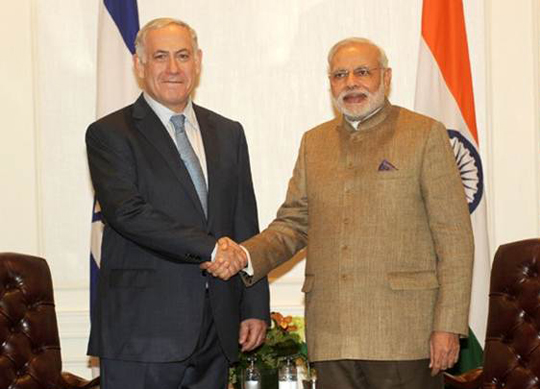
netanyahu

His visit will be the first by an Indian PM to Israel.

This year, India and Israel are marking 25 years of their diplomatic relations.

The two sides are expected to sign number of agreements in the field of innovation, development, science and technology and space.

Apart from boosting cooperation in the water and agriculture sectors, India and Israel will also discuss ways to strengthen people-to-people contact, air connectivity and investments.

During the visit, a deal with the Uttar Pradesh government is also likely to be signed to clean-up a patch of river Ganges apart from setting up of industrial research and development fund of USD 40 million.

Before the visit, the Ministry of External Affairs ministry in New Delhi said it will provide an impetus for deeper bilateral engagement in areas of mutual interest, as per news agency.

PM Modi's schedule:

PM Modi will be received by Netanyahu at the airport. This is a special gesture only accorded to the Pope or the US president.

The Israeli PM will also host a dinner for PM Modi.

Netanyahu will accompany him to most of the events, including the community reception on July 5.

PM Modi will pay homage to Indian soldiers at the Indian Cemetery in Haifa.

He will meet 26/11 Mumbai terror attack survivor Holtzberg Moshe, who was only two when he was saved by his Indian nanny Sandra Samuel.

Moshe's father Rabbi Gavriel and mother Rivkah were among eight Israeli nationals killed in the 2008 terror strike.

On the eve of his visit to Israel, PM Modi on Monday said he will discuss with Netanyahu common challenges like terrorism and ways to boost the economic ties.

"Tomorrow, I begin a historic visit to Israel, a very special partner of India's. As the first Indian PM to do so, I am greatly looking forward to this unprecedented visit that will bring our two countries and people closer," he said in a statement.

"I look forward to holding extensive talks with my friend, Israeli PM Netanyahu, who shares a commitment for vibrant India-Israel ties," he tweeted.

The PM said he will have 'in-depth talks' with Netanyahu "on the full spectrum of our partnership and strengthening it in diverse fields for mutual benefit. We will also have the chance to discuss major common challenges like terrorism."

"My programme during the visit gives me an opportunity to engage with a cross-section of Israeli society. I am particularly looking forward to interacting with the large vibrant Indian diaspora in Israel that represents an enduring link between our two peoples," PM Modi added.

On the economic side, he said, "I will join with leading Indian and Israeli CEOs and start-ups to discuss our shared priority of expanding business and investment collaboration on the ground."

In addition, he said, "I hope to get insights into Israel's accomplishments in technology and innovation through on-site visits."

On July 6, PM Modi will travel to Hamburg for the G-20 Summit being hosted by Germany on July 7-8.

Netanyahu hails PM Modi's visit to Israel as a 'very significant step'

Earlier, the Israeli premier had hailed PM Modi's visit as a "very significant step" in strengthening bilateral relations that are on a "constant upswing".

"Next week, the Indian Prime Minister, my friend, Narendra Modi will arrive in Israel, This is a historic visit to Israel. In the 70 years of the country's existence, no Indian Prime Minister has ever visited and this is further expression of the state of Israel's military, economic and diplomatic strength," Netanyahu had said.

"This is a very significant step in strengthening relations between the two countries," he had added.

The two leaders have already met twice on foreign soil on the sidelines of UN-related events and are said to be constantly in touch with each other over the phone.

PM Modi would also be meeting Israeli President Reuven Rivlin and the leader of Opposition Isaac Herzog on July 5.

He will not travelling to neighbouring Palestine during the visit, a clear signal of de-hyphenation of its ties with the two West Asian nations.

President Pranab Mukherjee in 2015 and External Affairs Minister Sushma Swaraj in 2016 visited both the countries.

Israeli Prime Minister Ariel Sharon and President Ezer Weizman visited India in 2003 and 1997 respectively.

Israeli President Reuven Rivlin had also paid a visit to India in November last year.

Comments

Muhammed Rafique
 - 
Friday, 7 Jul 2017

Viren, Your comments doesn't even deserve any response

but the matter of fact is you are such a sick and communal person who encourage riot and disrupt peace.The current situation in DK is bcos of people like u, instigated by Padil and Kalladka

Viren Kotian
 - 
Friday, 7 Jul 2017

RIP Sharat. Your blood will not be wasted. nationalist forces will soon eliminate anti-national forces, fanatics and terrorists.

Hara Hara Mahaadev!

Abdul
 - 
Friday, 7 Jul 2017

So called nationalists, breaking section , ohh DK & Udupi MPs spotted again , they will disappear when real culprits get caught ( like Karthik raj case)

Mohammad Beary
 - 
Tuesday, 4 Jul 2017

Lynchist with terrorist...

NOOR
 - 
Tuesday, 4 Jul 2017

For a muslims, Everything happens with the will of ALLAH...
ALLAH the creator of all that exists, Knows well of all that is happening around the globe...
ALLAH is the best of Planners...
ALhamudllillah.. Thanks to ALLAH for making us Muslims.

Fear ALLAH, the creator..
and Never Fear the Creations of ALLAH. U will be successful

abdul
 - 
Tuesday, 4 Jul 2017

both from the same creed & creature-anti human

Add new comment

  • Coastaldigest.com reserves the right to delete or block any comments.
  • Coastaldigset.com is not responsible for its readers’ comments.
  • Comments that are abusive, incendiary or irrelevant are strictly prohibited.
  • Please use a genuine email ID and provide your name to avoid reject.
News Network
June 15,2020

New Delhi, Jun 15: On Monday, petrol and diesel prices across the country were raised for the ninth consecutive day by 48 paise and 59 paise, respectively.

Petrol price per litre was raised to Rs 76.26 in New Delhi, Rs 83.17 in Mumbai, Rs 79.96 in Chennai, Rs 79.17 in Hyderabad, Rs 78.73 in Bengaluru and Rs 78.10 in Kolkata.

Diesel price per litre was hiked to Rs 74.62 in New Delhi, Rs 73.21 in Mumbai, Rs 72.69 in Chennai, Rs 72.93 in Hyderabad, Rs 70.95 in Bengaluru and Rs 70.33 in Kolkata.

Since 7 June, after ending their 82-day hiatus in daily revision, state-owned oil marketing companies have increased petrol price by Rs 5 per litre and diesel by Rs 5.23 per litre.

These prices are close to levels last seen in October-November 2018 when international oil prices had spiked close to $80 per barrel. In October 2018, petrol price in Mumbai had crossed Rs 90-mark and in Delhi, it was around Rs 83 per litre.

Comparatively, on Monday, Brent crude, the international benchmark for crude oil prices, fell 2.3 percent to $37.84 a barrel over concerns of subdued demand for fuel as new coronavirus infections were reported in China and the US.

The present spike in fuel prices in India could be attributed to the fact that central and state governments, along with oil marketing companies are looking to make up for their loss in revenues due to the lockdown.

Last month, the central government had increased the excise duty on per litre of petrol by Rs 10 and per litre of diesel by Rs 13. Several state governments have also hiked their VAT or cess on fuel in the last month. In fact, now around 70 percent of the retail price of fuel is just some form of tax.

Comments

Add new comment

  • Coastaldigest.com reserves the right to delete or block any comments.
  • Coastaldigset.com is not responsible for its readers’ comments.
  • Comments that are abusive, incendiary or irrelevant are strictly prohibited.
  • Please use a genuine email ID and provide your name to avoid reject.
News Network
June 17,2020

New Delhi, Jun 17: Petrol and diesel prices were increased in metros on Wednesday, marking the eleventh straight day of increase since state-owned oil companies returned to the normal practice of daily reviews following a 12-week pause. With effect from 6 am, the price of petrol was increased by 55 paise per litre, and diesel by 69 paise per litre in Delhi, compared to the previous day. While the price of petrol was revised to Rs 77.28 per litre in the national capital from Rs 76.73 per litre the previous day, the diesel rate was increased to Rs 75.79 per litre from Rs 75.19 per litre, according to notifications from state-run Indian Oil Corporation, the country's largest fuel retailer. In the 11-day period, the price of petrol has been increased by a cumulative Rs 6.02 per litre, and diesel by Rs 6.49 per litre.

International crude oil prices retreated on Wednesday, weighed down by an increase in US crude inventories and worries about a potential second wave of the coronavirus pandemic. Brent crude futures - the global benchmark for crude oil - were last seen trading 1.0 per cent lower at $40.56 per barrel.

State-run oil marketing companies revise the prices of petrol and diesel from time to time, besides aviation turbine fuel (ATF) - or jet fuel - and liquefied petroleum gas (LPG). However, since March 16, the oil companies had kept petrol and diesel prices on hold, possibly due to the volatility in global oil markets.

Fuel retailing in the country is dominated by state refiners - Indian Oil Corporation, Bharat Petroleum Corporation and Hindustan Petroleum Corporation. The three own about 90 per cent of the retail fuel outlets in the country.

Comments

Add new comment

  • Coastaldigest.com reserves the right to delete or block any comments.
  • Coastaldigset.com is not responsible for its readers’ comments.
  • Comments that are abusive, incendiary or irrelevant are strictly prohibited.
  • Please use a genuine email ID and provide your name to avoid reject.
Agencies
January 20,2020

New Delhi, Jan 20: The BJP has got a brand new President in the form of JP Nadda. At around 2.30 pm, the announcement was made, bringing an end to the Amit Shah era in BJP. The party's Working President Jagat Prakash Nadda won unopposed, sparking celebrations outside the BJP headquarters here on Monday. 

Amit Shah himself was among the people who proposed Nadda's name along with Nitin Gadkari and Rajnath Singh. Soon after his annointment, BJP election returning officer Radha Mohan Singh told the media, "I announce JP Nadda as the new BJP President." Shah was also seen hugging Nadda.

The nomination process for the post of the BJP President began at 10 am and went on till 12.30 pm. For the next hour, the filed nomination paper, which was just one, was examined. Party members waitied till 2.30 pm for the candidate to withdraw if he wished to. It was after this that Nadda was declared as the man who would step into the shoes of Amit Shah.

Many in the BJP believe that although Nadda is the BJP chief now, Shah would still make all macro-level decisions like pre poll alliances or top organisational appointments. Nadda would be in charge of monitoring the day-to-day needs of the organisation. BJP sources say that Amit Shah himself wanted an arrangement like this one and personally wanted Nadda to take over. as he helped Shah formulate legislations like Triple Talaq and Citizenship Amendment Act.

The party constitution mandates completion of election of at least 50 per cent of state Presidents for the election of national President to happen. In the last few days, the BJP has completed the election of a slew of state Presidents like in West Bengal, Nagaland among others.

The process of election of the national BJP President is quite elaborate and has been described in detail in the party constitution, which says that the national president shall be elected by an electoral college, comprising members of the national council and the state councils.

"Any 20 members of the electoral college of a state can jointly propose the name of a person, who has been an active member for four terms and has 15 years of membership, for the post of national president. Such joint proposal should come from not less than five states where elections have been completed for the national council. The consent of the candidate is necessary," it says.

Who is JP Nadda?

Jagat Prakash Nadda, 59, who has his roots in the Rashtriya Swayamsevak Sangh (RSS) and its affiliates, was appointed the Bharatiya Janata Party (BJP) national President on Monday, replacing his 'mentor' and Union Home Minister Amit Shah.

Former environment, health and law minister from Himachal Pradesh, which has just four of the Lok Sabha's 543 seats, Nadda has tried to carve out his own space in national politics with his low profile and astute organisational skills, believe his party leaders.

He rose through the ranks from the Akhil Bharatiya Vidyarthi Parishad (ABVP), the student wing of the RSS, from where he has managed to build inroads from university to the state politics.

Nadda has been active on the national political scene since 2010 when he was picked by then BJP chief Nitin Gadkari to join his new team. He was made the party's national general secretary.

Born on December 2, 1960, Nadda did his graduation from Patna and holds a post-graduate degree in political science and Bachelor of Legislative Law (LL.B) from Himachal Pradesh University in Shimla.

Starting his political career as a student leader of the ABVP in 1978, Nadda had also worked both with Gadkari and Shah even in the party's youth wing -- the Bharatiya Yuva Morcha -- from 1991 to 1994.

His wife Mallika Nadda, who teaches history at the Himachal Pradesh University and is currently posted in university's campus in Delhi, was an ABVP activist too, and its national general secretary from 1988 to 1999.

In the previous BJP government (2007-12) in the state, Nadda was forced to resign as Forest Minister in 2010 owing to differences between him and then chief minister Prem Kumar Dhumal.

He was elected to the Rajya Sabha in 2012.

Nadda won his first Assembly election from Bilaspur (Sadar) in Himachal in 1993. In 1998, he again won from that seat and became the state Health Minister.

He lost the Assembly elections in 2003, but again won in 2007 and was appointed the Forest Minister in the Himachal Pradesh.

Nadda, as a forest minister, was the brain behind opening forest police stations to check forest crimes, launching community-driven plantation, setting up forest ponds and the massive plantation of deodars to boost the depleting green cover of the 'Queen of Hills', as Shimla was fondly called by the British.

A close confidant of Prime Minister Narendra Modi, Nadda was among those who were mentioned as likely aspirants to the BJP top post after Rajnath Singh was inducted into the Central government as the Home Minister in 2014.

Later, Nadda was inducted into the union cabinet in its first expansion in 2014 as the Health Minister.

Hailing Nadda's appointment, Chief Minister Jai Ram Thakur told IANS it is a proud moment that a leader belonging to a small state in the national politics is today the leader of the country's biggest national party.

His father N.L. Nadda, who was a Vice-Chancellor of the Ranchi University, resides in Bilaspur town.

Comments

Add new comment

  • Coastaldigest.com reserves the right to delete or block any comments.
  • Coastaldigset.com is not responsible for its readers’ comments.
  • Comments that are abusive, incendiary or irrelevant are strictly prohibited.
  • Please use a genuine email ID and provide your name to avoid reject.