


Modi to get US President-like reception in Israel; terrorism, economic ties on agenda

Agencies
July 4, 2017

New Delhi, Jul 4: Prime Minister Narendra Modi's historic visit to Israel, beginning on Tuesday, will see discussions between him and his Israeli counterpart Benjamin Netanyahu exploring ways to enhance cooperation in key strategic areas.
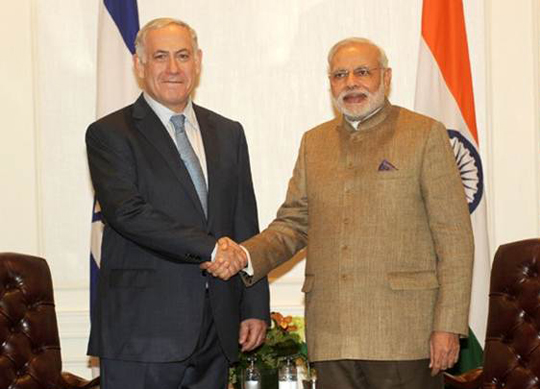
netanyahu

His visit will be the first by an Indian PM to Israel.

This year, India and Israel are marking 25 years of their diplomatic relations.

The two sides are expected to sign number of agreements in the field of innovation, development, science and technology and space.

Apart from boosting cooperation in the water and agriculture sectors, India and Israel will also discuss ways to strengthen people-to-people contact, air connectivity and investments.

During the visit, a deal with the Uttar Pradesh government is also likely to be signed to clean-up a patch of river Ganges apart from setting up of industrial research and development fund of USD 40 million.

Before the visit, the Ministry of External Affairs ministry in New Delhi said it will provide an impetus for deeper bilateral engagement in areas of mutual interest, as per news agency.

PM Modi's schedule:

PM Modi will be received by Netanyahu at the airport. This is a special gesture only accorded to the Pope or the US president.

The Israeli PM will also host a dinner for PM Modi.

Netanyahu will accompany him to most of the events, including the community reception on July 5.

PM Modi will pay homage to Indian soldiers at the Indian Cemetery in Haifa.

He will meet 26/11 Mumbai terror attack survivor Holtzberg Moshe, who was only two when he was saved by his Indian nanny Sandra Samuel.

Moshe's father Rabbi Gavriel and mother Rivkah were among eight Israeli nationals killed in the 2008 terror strike.

On the eve of his visit to Israel, PM Modi on Monday said he will discuss with Netanyahu common challenges like terrorism and ways to boost the economic ties.

"Tomorrow, I begin a historic visit to Israel, a very special partner of India's. As the first Indian PM to do so, I am greatly looking forward to this unprecedented visit that will bring our two countries and people closer," he said in a statement.

"I look forward to holding extensive talks with my friend, Israeli PM Netanyahu, who shares a commitment for vibrant India-Israel ties," he tweeted.

The PM said he will have 'in-depth talks' with Netanyahu "on the full spectrum of our partnership and strengthening it in diverse fields for mutual benefit. We will also have the chance to discuss major common challenges like terrorism."

"My programme during the visit gives me an opportunity to engage with a cross-section of Israeli society. I am particularly looking forward to interacting with the large vibrant Indian diaspora in Israel that represents an enduring link between our two peoples," PM Modi added.

On the economic side, he said, "I will join with leading Indian and Israeli CEOs and start-ups to discuss our shared priority of expanding business and investment collaboration on the ground."

In addition, he said, "I hope to get insights into Israel's accomplishments in technology and innovation through on-site visits."

On July 6, PM Modi will travel to Hamburg for the G-20 Summit being hosted by Germany on July 7-8.

Netanyahu hails PM Modi's visit to Israel as a 'very significant step'

Earlier, the Israeli premier had hailed PM Modi's visit as a "very significant step" in strengthening bilateral relations that are on a "constant upswing".

"Next week, the Indian Prime Minister, my friend, Narendra Modi will arrive in Israel, This is a historic visit to Israel. In the 70 years of the country's existence, no Indian Prime Minister has ever visited and this is further expression of the state of Israel's military, economic and diplomatic strength," Netanyahu had said.

"This is a very significant step in strengthening relations between the two countries," he had added.

The two leaders have already met twice on foreign soil on the sidelines of UN-related events and are said to be constantly in touch with each other over the phone.

PM Modi would also be meeting Israeli President Reuven Rivlin and the leader of Opposition Isaac Herzog on July 5.

He will not travelling to neighbouring Palestine during the visit, a clear signal of de-hyphenation of its ties with the two West Asian nations.

President Pranab Mukherjee in 2015 and External Affairs Minister Sushma Swaraj in 2016 visited both the countries.

Israeli Prime Minister Ariel Sharon and President Ezer Weizman visited India in 2003 and 1997 respectively.

Israeli President Reuven Rivlin had also paid a visit to India in November last year.

Comments

Muhammed Rafique
 - 
Friday, 7 Jul 2017

Viren, Your comments doesn't even deserve any response

but the matter of fact is you are such a sick and communal person who encourage riot and disrupt peace.The current situation in DK is bcos of people like u, instigated by Padil and Kalladka

Viren Kotian
 - 
Friday, 7 Jul 2017

RIP Sharat. Your blood will not be wasted. nationalist forces will soon eliminate anti-national forces, fanatics and terrorists.

Hara Hara Mahaadev!

Abdul
 - 
Friday, 7 Jul 2017

So called nationalists, breaking section , ohh DK & Udupi MPs spotted again , they will disappear when real culprits get caught ( like Karthik raj case)

Mohammad Beary
 - 
Tuesday, 4 Jul 2017

Lynchist with terrorist...

NOOR
 - 
Tuesday, 4 Jul 2017

For a muslims, Everything happens with the will of ALLAH...
ALLAH the creator of all that exists, Knows well of all that is happening around the globe...
ALLAH is the best of Planners...
ALhamudllillah.. Thanks to ALLAH for making us Muslims.

Fear ALLAH, the creator..
and Never Fear the Creations of ALLAH. U will be successful

abdul
 - 
Tuesday, 4 Jul 2017

both from the same creed & creature-anti human

Add new comment

  • Coastaldigest.com reserves the right to delete or block any comments.
  • Coastaldigset.com is not responsible for its readers’ comments.
  • Comments that are abusive, incendiary or irrelevant are strictly prohibited.
  • Please use a genuine email ID and provide your name to avoid reject.
News Network
April 27,2020

New Delhi, Apr 27: A private hospital here claimed that a coronavirus patient, who was administered plasma therapy for the first time in the facility, was discharged on Sunday after being completely cured.

The 49-year-old man had tested positive for COVID-19 on April 4 and was admitted to Max Hospital, Saket, it said in a statement.

As his condition deteriorated, he was put on ventilator support on April 8, the hospital added.

When the patient showed no signs of improvement, his family requested for administration of plasma therapy on compassionate grounds, it said, adding that the family arranged a donor for extracting plasma.

The patient was administered fresh plasma as a treatment modality as a side-line to standard treatment protocols on the night of April 14, the statement said.

Subsequently, the patient showed improvement and by the fourth day, was weaned off ventilator support and continued on supplementary oxygen. He was shifted to a room with round-the-clock monitoring on Monday after testing negative twice within 24 hours, it said.

He has now fully recovered and was discharged, the hospital said, adding that he will stay at home for another two weeks.

Group medical director of Max Healthcare and senior director of the Institute of Internal Medicine Dr Sandeep Budhiraja said, "We can say that plasma therapy could have worked as a catalyst in speeding up his recovery. We cannot attribute 100 per cent recovery to plasma therapy only, as there are multiple factors which carved his path to recovery."

Comments

Add new comment

  • Coastaldigest.com reserves the right to delete or block any comments.
  • Coastaldigset.com is not responsible for its readers’ comments.
  • Comments that are abusive, incendiary or irrelevant are strictly prohibited.
  • Please use a genuine email ID and provide your name to avoid reject.
News Network
May 22,2020

New Delhi, May 22: India on Friday recorded its biggest spike in COVID-19 cases with 6,088 new cases and 148 deaths reported in the last 24 hours, taking the tally of coronavirus cases in the country to 1,18,447, as per the Union Ministry of Health and Family Welfare (MoHFW).

Out of the total cases, 66,330 are active cases and 3,583 have succumbed to the infection.

As many as 48,533 patients have been cured/discharged and one migrated till date.

Maharashtra continues to remain the worst-affected state with 41,642 cases, followed by Tamil Nadu (13,967 cases), Gujarat (12,905 cases), and Delhi (11,659 cases).

While Rajasthan has confirmed 6,227 cases of which 3,485 people have recovered while 151 patients are dead, Madhya Pradesh reported 5,981 cases including 2,843 patients recovered and 270 patients dead.

Uttar Pradesh has 5,515 COVID-19 positive cases.

In Kerala, which reported the first COVID-19 case, 690 people have been detected positive for coronavirus.

Ladakh has confirmed 44 coronavirus cases, 1,449 people have infected by the virus in Jammu and Kashmir.

Comments

Add new comment

  • Coastaldigest.com reserves the right to delete or block any comments.
  • Coastaldigset.com is not responsible for its readers’ comments.
  • Comments that are abusive, incendiary or irrelevant are strictly prohibited.
  • Please use a genuine email ID and provide your name to avoid reject.
News Network
April 21,2020

New Delhi, Apr 21: The historic rout in oil markets that sent US crude prices plummeting to as much as minus USD 40 a barrel is unlikely to translate into any big reduction in petrol and diesel prices in India as domestic pricing is based on different benchmark, and refineries are already filled up to brim and cannot buy US crude just yet.

With storage capacity already overflowing amid coronavirus-induced demand collapse, traders rushed to to get rid of unwanted stocks triggering the collapse of US West Texas Intermediate (WTI) crude for May delivery.

Indian Oil Corp (IOC) Chairman Sanjiv Singh said the collapse was triggered by traders unable to take deliveries of crude they had previously booked because of a demand collapse. And so they paid the seller to keep oil in their storage.

"If you look at June futures, it is trading in positive territory... around USD 20 per barrel," he said.

Low oil prices may seem good in short-term but in the long run it will hurt the oil economy as producers will have no surplus to invest in exploration and production which will lead to a drop in production, he said.

He did not comment on retail fuel prices that have been static since March 16.

Oil companies have not changed rates despite a fall in international prices as they first adjusted them against the increase that was warranted from a Rs 3 per litre hike in excise duty and close to Re 1 per litre additional cost of switching over to cleaner BS-VI grade fuel from April 1.

Petrol in Delhi is priced at Rs 69.59 a litre and diesel comes for Rs 62.29 per litre.

"The negative price has no direct impact on India or Indian oil prices, as this has taken place due to crude oil produced and traded within the US. India's prices are driven partly by another benchmark, the Brent, which is still trading at USD 25/barrel. Therefore, the retail price of fuels in India are unlikely to fall," said Amit Bhandari, Fellow, Energy and Environment Studies, Gateway House.

Also, Indian refineries are already overflowing as fuel demand has evaporated due to the unprecedented nationwide lockdown imposed to curb spread of COVID-19. So, they can't rush to buy US crude.

The refineries have already cut operating rate to half because the fuel they produce has not been sold yet.

India imports 4 million barrels/day (1.4 billion barrels/year) of oil. The country has been benefitting from the falling prices of oil for the last five years, when oil dropped from a peak of USD 110/barrel to USD 50-60/barrel last year, enabling India to invest in public service programmes.

"However, the additional USD 30 fall of this week is good for India - but there is also a downside. If oil prices are too low, the economies of oil-rich gulf countries will be hurt, threatening the job prospects of the 8 million Indians working in the Gulf countries. India is the largest recipient of foreign remittances due to these workers – very low oil prices will hurt this cash stream," Bhandari said.

He said the negative price of oil shows how much oil oversupply exists in international markets today. "Global oil consumption has fallen due to the COVID-19 pandemic that traders are willing to pay customers to get rid of the barrels they can't store. The world does not have enough storage capacity, and dumping the oil is an environmental crime."

The first half of April saw Brent crude oil prices plummet 63.6 per cent to USD 26.9 per barrel. Prices of Western Texas Intermediate (WTI), the American oil, had also fallen similarly by 63.1 per cent.

But on April 20, WTI prices turned rapidly negative because traders on the Nymex exchange rushed to offload their May futures positions a day before expiry of contracts (on April 21).

Such WTI futures are traded on the Nymex exchange with contracts settled in physical crude oil. Problem is, those who had gone long are unable to find storage facilities for the oil and had to liquidate their contracts before expiry. This caused the plunge in WTI prices.

Contrast to this, June WTI Nymex futures prices is hovering around USD 21, while Brent for June delivery is at USD 25.

Miren Lodha, Director, CRISIL Research said the demand for crude oil was declining already because of economic slowdown when the COVID-19 pandemic-driven lockdowns crushed it further.

Consequently, oil demand is expected to contract by 8-10 million barrels per day (mbpd) in 2020 assuming demand recovery begins from the third quarter of the year, he said, adding if recovery doesn't happen by then, further demand destruction could occur.

On the supply side, producers reining in output following a strategic deal between OPEC members, Russia and the US.

Under this agreement, OPEC+ would reduce oil production by 9.7 mbpd for May and June, but gradually ease the curb to 7.7 mbpd between July and December 2020, and to 5.8 mbpd till April 2022 to stabilise prices.

"This is expected to reduce some surplus in the market by the end of 2020," Lodha said.

Crude oil demand is expected to decline by over 20 mbpd in April alone. Typically, monthly global demand is about 100 mbpd. Given this scenario, supply curbs would have limited influence.

Consequently, Brent oil prices is expected to be in the USD 25-30 range for the second quarter while increasing marginally in the last 2 quarters of 2020.

"The gigantic inventory build-ups and lack of storage facilities would also put pressure on prices," he said, adding overall Brent could average USD 30-35 in 2020, with a strong downward bias.

Comments

Add new comment

  • Coastaldigest.com reserves the right to delete or block any comments.
  • Coastaldigset.com is not responsible for its readers’ comments.
  • Comments that are abusive, incendiary or irrelevant are strictly prohibited.
  • Please use a genuine email ID and provide your name to avoid reject.