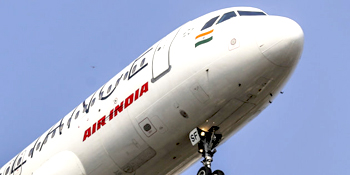
Modi govt imposes up to Rs 8,500 levy per flight; airfares to rise

November 11, 2016

New Delhi, Nov 11: Airfares are set to rise with the government deciding to levy up to Rs 8,500 per flight on major routes to fund the regional air connectivity scheme.

airfaresThe levy amount would be for an entire flight and the price of each ticket could go up depending on the number of seats in that particular flight.

Civil Aviation Secretary R N Choubey today said the levy would be up to Rs 8,500 per flight depending on distance. The ambitious scheme -- UDAN (Ude Desh ka Aam Naagrik) -- seeks to connect small cities by air as well as make flying more affordable for the masses.

To provide viability gap funding for the flights operated under the regional connectivity scheme, the Ministry would impose a levy on every departure on major air routes such as the national capital, Mumbai, Chennai, Hyderabad, Bengaluru and Kolkata.

"The levy for an up to 1,000 kilometre length of scheduled flight will be Rs 7,500 per flight, Rs 8,000 for a 1,000 to 1,500 kilometre flight and Rs 8,500 for flights above 1,500 kilometre," Choubey said here.

For UDAN, the government would be creating the Regional Connectivity Fund (RCF).

With the levy, the government estimates to have Rs 400 crore for RCF, Choubey said. "In addition to this, another 20 per cent (funding) will come from state governments. We are roughly looking at around Rs 500 crore per year available in the kitty," he noted.

The move would push airfares slightly higher as airlines are expected to pass on the burden to fliers.

The funding is being provided since the fares of half of the seats operated in a particular flight under UDAN would be capped at Rs 2,500 for one-hour duration. This cap would be applicable for distance of 476-500 kilometres.

The limit of RCS airfare would vary from Rs 1,420 to Rs 3,500 for fixed-wing aircraft. For helicopters, half-an-hour ride under the scheme would cost Rs 2,500 and for over one- hour duration, the cap would be Rs 5,000.

RCF is to be funded by the Centre and respective state government participating in UDAN.

Comments

Abdul
 - 
Saturday, 12 Nov 2016

This feku is looting the Rs 15 lakhs from aam aadmi. These things will happen when u people elect chaiwala as a PM. He is only to trouble aam aadmi bcoz he has allergy to Aam Aadmi Party

naren kotian
 - 
Saturday, 12 Nov 2016

Please put it on gulf route and we also need complete x ray body scanners at airports to clamp down on smugglings and its fine price will be go up by 50 rs . we are okay with it .

Add new comment

  • Coastaldigest.com reserves the right to delete or block any comments.
  • Coastaldigset.com is not responsible for its readers’ comments.
  • Comments that are abusive, incendiary or irrelevant are strictly prohibited.
  • Please use a genuine email ID and provide your name to avoid reject.
Media Release
February 14,2020

Veteran journalist P. Sainath has said that the nation is in a crisis. And this crisis is not limited to just the rural area. It has become a national crisis at various areas such as agriculture, education, economy, job creation etc.

He was delivering the endowment lecture on the topic ‘Indian democracy at the post-liberalization and post-truth era’ at Media Manthan 2020 organized by the PG department of journalism and mass communication at St Aloysius College (Autonomous). 

Mr Sainath said that the many policies adopted in the 90s led to India becoming unusually unequal. Referring to the speech Ambedkar had made at the Constituent Assembly while handing over the draft of the Constitution, Mr Sainath said, “Ambedkar had warned about the weakness of Indian democracy that liberty without equality allows the supremacy of a few over the multitude. Liberty, equality and fraternity must be kept together as we cannot have one without the other.” 

Mr Sainath stated that the agrarian crisis was no longer about the loss of productivity, employment or about farmer suicide; it was a societal, civilizational crisis. Commenting on the lopsided policies such as cow-slaughter ban, he explained how cow slaughter ban had adversely affected many industries due to their interdependency. While Muslims who slaughtered cows were rendered helpless, the cattle traders who were mostly OBCs lost their earnings as the cattle prices crashed. An important industry like Kolhapur sandals industry in Maharashtra went bankrupt as a result of the cow slaughter ban in Maharashtra. He said the policymakers had no idea how the rural industries were interconnected. Demonetisation too devastated the rural economy as 98 percent of rural transactions happen through cash. 

Mr Sainath also spoke about the crisis of inequality which affects the Dalits and the Adivasis far more than anyone else as 90 percent of the rural households take home less than Rs 10,000/- per month. “Women are yet another group whose labour is never counted in the gross domestic product. Women and girls globally do unpaid work which amounts to about 12.5 billion working hours per year. Monetarily speaking, this is worth 10.8 trillion dollars,” Mr Sainath added. 

Speaking about the crisis of jobs Mr Sainath said that major companies were laying off employees just to create more profits for the investors and the adoption of artificial intelligence in the industry would further destroy millions of jobs.

Rector of St Aloysius College Institutions Fr Dionysius Vaz SJ, Principal Dr (Fr) Praveen Martis SJ, HOD of Journalism and Mass Communication department Dr (Fr) Melwyn Pinto SJ were present.

‘Veerappan and Vijay Mallya’s business models are interesting!’

Addressing the gathering during his endowment lecture on Friday, Mr Sainath made an interesting comment on the so called ‘revenue model’. “Whenever I visit IIMs and IITs for lectures on my PARI project, the students there ask me what my revenue model for my project is. I tell them that I do not have a revenue model. In fact, journalism does not begin with a revenue model. Gandhiji, Ambedkar, Bhagat Singh were all great journalists. But they did not have a revenue model,” Mr Sainath said.

On a lighter note, he said that the best revenue model that he liked was that of forest brigand Veerappan and liquor baron Vijay Mallya. “Veerappan ruled the forest for forty years and from the top ministers to the villagers he could dictate terms and liver royally. Similarly, Mallya’s revenue model was to steal the banks and run away abroad and live like a king,” Mr Sainath added.

Journalism is not and can never be a business. It is a calling, he opined. While newspaper can be a business, television can be a business, journalism per se cannot be reduced to a business. “Unfortunately today, journalists are recruited on a contract basis and they have no bargaining power; and there are no unions to fight for their cause. Hence, they are at the mercy of the corporate media houses for their survival and are made to write stories that cannot be called journalism,” Mr Sainath said.

Answering a question as to the pressures he faced as a journalist, he said that external pressures from the government or others could be very well handled. It is the internal pressures from once own media house that journalists find it difficult to manage.


 

Comments

Add new comment

  • Coastaldigest.com reserves the right to delete or block any comments.
  • Coastaldigset.com is not responsible for its readers’ comments.
  • Comments that are abusive, incendiary or irrelevant are strictly prohibited.
  • Please use a genuine email ID and provide your name to avoid reject.
News Network
May 2,2020

Bengaluru, May 2: The Centre’s classification of districts created confusion in Karnataka as the state’s own categorisation deviates significantly from the health ministry’s list.

For instance, the Centre put the number of districts in the red zone in state at three, while the state Covid-19 war room puts it at 14. Bengaluru Urban and Mysuru figure in the red zone in both lists. While Bengaluru Rural with zero active cases on May 1makes it to the Centre’s red-zone list, it is in the orange zone according to the state.

In addition to these two, the state classifies Belagavi, Kalaburagi, Vijayapura, Bagalkot, Mandya, Bidar, Dakshina Kannada, Chikkaballapura, Dharwad, Gadag, Tumakuru and Davanagere as red-zone districts.

State Covid war-room authorities said they would take a look at the Centre’s criteria for classification and take a call. Besides, incharge Munish Mudgil pointed out that states are allowed to make additions to the red and orange zones. According to the Centre’s list, Karnataka has 13 districts in the orange zone and 14 in the green zone.

Sudan said, “the districts were earlier designated as hotspots or red zones, orange zones and green zones primarily based on the cumulative cases reported and the doubling rate. Since recovery rates have gone up, the districts are now being designated across various zones duly broad-basing the criteria.

This classification takes into consideration incidence of cases, doubling rate, extent of testing and surveillance feedback. A district will be considered under the green zone if there are no confirmed cases so far or if there is no reported case in the past 21 days.”

Comments

Add new comment

  • Coastaldigest.com reserves the right to delete or block any comments.
  • Coastaldigset.com is not responsible for its readers’ comments.
  • Comments that are abusive, incendiary or irrelevant are strictly prohibited.
  • Please use a genuine email ID and provide your name to avoid reject.
News Network
May 29,2020

Udupi, May 29: As many as 15 fresh coronavirus positive cases were reported in Udupi district today. 

11 among the new 15 covid-19 patients are males and four are females. The patients also include two children aged 6 and 7.

All of them are said to be Maharashtra returnees. 

With this, the total confirmed covid-19 cases in the district mounted to 164.

Comments

Add new comment

  • Coastaldigest.com reserves the right to delete or block any comments.
  • Coastaldigset.com is not responsible for its readers’ comments.
  • Comments that are abusive, incendiary or irrelevant are strictly prohibited.
  • Please use a genuine email ID and provide your name to avoid reject.