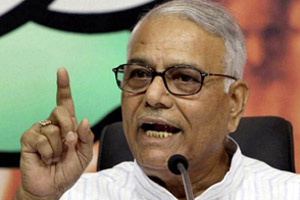
Modi govt may meet same fate as that of Indira's: Yashwant

January 31, 2016

Dona Paula (Goa), Jan 31: Veteran BJP leader Yashwant Sinha today tore into Prime Minister Narendra Modi and his government, saying there is no dialogue and they may meet the same fate as the Indira Gandhi-led Congress which was drubbed in the elections after Emergency.yashwant

Sinha, who along with some other BJP veterans has been marginalised in the party, was speaking at a panel discussion at the 'Difficult Dialogues' conference here, where CPI-M general secretary Sitaram Yechury also spoke.

"There is absolutely no scope of no dialogue... This is the great strength of Indian democracy. There will be aberrations here and there, there might be concerns about the present situation. But the great Indian society will take care of it and consign to dust those who do not believe in dialogue in India," Sinha said.

"The people of India will consign him to the dust, you just have to wait for the next elections," Sinha, who was finance minister in Atal Bihari Vajpayee government, said without naming Modi.

Alluding to the general elections in 1977 when Congress was ousted from power, he said such a neglect (of dialogue) will make the government last "19 months", the same duration as the Emergency.

We all know how the people of India reacted to the Emergency which was the "most concerted democratic effort in our country to still the voice of dissent", he said.

Replying to intervention from Yechury on need to ensure that dialogue in the society doesn't get stifled, he said, "I would only say that the stifler is in for serious trouble."

The veteran BJP leader also rued the fact that Opposition was not letting Parliament function. Without naming, he took a potshot at a Congress leader, who he said never raised concerns on the GST Bill in the standing committee meetings but later raised objections.

Under Vajpayee, the NDA government was able to pass several important legislations with the help of dialogue (with opposition), Sinha said.

His onslaught comes on the same day when another BJP leader, actor-MP Shatrughan Sinha, said that veteran leaders Vajpayee, L K Advani and Murli Manohar Joshi "deserve much more than what they have been given".

"Currently these leaders including me are trapped between oppression and respect," Shatrughan said in Pune.

Comments

aharkul
 - 
Sunday, 31 Jan 2016

Just wait and see.... within one year what happen Indian democracy..

Goodman
 - 
Sunday, 31 Jan 2016

BJP built on wrong ideology, wrong foundation. So tower can not stand on cracking foundation.

Add new comment

  • Coastaldigest.com reserves the right to delete or block any comments.
  • Coastaldigset.com is not responsible for its readers’ comments.
  • Comments that are abusive, incendiary or irrelevant are strictly prohibited.
  • Please use a genuine email ID and provide your name to avoid reject.
News Network
May 22,2020

New Delhi, May 22: Air India on Friday started booking for domestic flights amid the COVID-19 lockdown.

"We have started bookings for domestic flights," said Air India in a statement.

The airlines will operate a total of 8,428 flights each week for the next three months from May 25 to August 25 as the Central government has announced the resumption of domestic flights.

Civil Aviation Minister Hardeep Singh Puri on Thursday said that a minimum and maximum fare for three months has been set for the domestic flight services, which resume from May 25.

In the case of Delhi, Mumbai the minimum fare would be Rs 3,500 for a journey between 90-120 minutes. The maximum fare would be Rs 10,000.

"This is operative for three months -- till one minute to midnight on August 24," said Puri at a press conference here.

Puri said that guidelines have been issued for the passengers and airports, which are to be followed during flight operations.

He also said that self-declaration or Aarogya Setu App status on a compatible device would be obtained to ensure that a person does not have COVID-19 symptoms.

Comments

Add new comment

  • Coastaldigest.com reserves the right to delete or block any comments.
  • Coastaldigset.com is not responsible for its readers’ comments.
  • Comments that are abusive, incendiary or irrelevant are strictly prohibited.
  • Please use a genuine email ID and provide your name to avoid reject.
News Network
March 7,2020

Thiruvananthapuram, Mar 7: Kerala Chief Minister Pinarayi Vijayan on Saturday came down heavily on the BJP-led government at the Centre for imposing a ban on two Malayalam channels in connection with the Delhi violence reporting, saying an "undeclared emergency" was prevailing in the country.

Terming the ban as a "dangerous trend", the left leader said it was an indication of the coming dangers. "The Centre has made an infringement into the freedom of the press, crossing all limits. There is a threat that if anybody criticises RSS and Sangh Parivar, they will be taught a lesson," he said here in a statement.

The channels- Asianet News and MediaOne were suspended for 48 hours over their coverage of last month's riots in Delhi, with the official orders saying they covered events on February 25 in a manner that "highlighted the attack on places of worship and siding towards a particular community".

However, the ban was lifted on Saturday morning. Urging everyone to adopt a "democratic vigil" against such trends, the Chief Minister said the tactics of the Centre was to bring everyone under its control by instilling fear.

It was seen that such an approach had repeatedly been made on Parliament, constitutional bodies and judiciary in recent times, he said. Claiming that one of the reasons for the ban was criticism of RSS and the Delhi police by the channels, he said no one is beyond that. "How can it be illegal to criticise RSS? The Constitution guarantees the right of any citizen to express his opinion fearlessly," he said.

People have the right to know what is happening in the country and the media has the right and responsibility to report it, Vijayan said adding that the fourth estate should be allowed to act "freely and equitably". The ban on Asianet News was lifted at 1.30 am, while the ban on Media One was lifted at 9.30 am on Saturday, a source at the Ministry of Information and Broadcasting told PTI.

Sources said the two channels had written to the ministry seeking revocation of the bans, following which it was lifted. "Channel's reporting on Delhi violence seems to be biased as it is deliberately focusing on the vandalism of CAA supporters," the ministry order on Media One had said.

"It also questions RSS and alleges Delhi Police inaction. Channel seems to be critical towards Delhi Police and RSS." The ministry had ordered prohibition of transmission or re-transmission of Media One and Asianet News for 48 hours on any platform throughout India with effect from 7.30 pm on Friday to 7.30 pm on Sunday. The Congress and the CPI had flayed the government over the suspension of Media One and Asianet News, calling the clampdown as "stifling of media freedom".

Former chief minister Oommen Chandy said the ban on the two malayalam channels was an "affront" on the democratic rights of the media. The fourth estate is the pillar of democracy and attempts to suppress the media by the government is "extremely worrying", he said in a facebook post.

"I join all democratic minded citizens in strongly condemning such attempts to muzzle the media by the government," he said. Meanwhile, Press Club, Kerala Union of Working Jouranlists (KUWJ) and Kerala Newspaper Employees Federation (KNEF) took out a march to the General Post Office here against the Centre's action on the two channels.

Media personnel holding placards and raising slogans participated in the march against the centre's decision. Similar protests were held in various parts of the state.

Comments

Indian
 - 
Saturday, 7 Mar 2020

All these are happening in our nation only because of EVM tamper. Unless Ballot voting criminals will spoil our nations unity and image.


Jai Hind


Add new comment

  • Coastaldigest.com reserves the right to delete or block any comments.
  • Coastaldigset.com is not responsible for its readers’ comments.
  • Comments that are abusive, incendiary or irrelevant are strictly prohibited.
  • Please use a genuine email ID and provide your name to avoid reject.
News Network
February 19,2020

New Delhi, Feb 19: India will switch to the world's cleanest petrol and diesel from April 1 as it leapfrogs straight to Euro-VI emission compliant fuels from Euro-IV grades now - a feat achieved in just three years and not seen in any of the large economies around the globe.

India will join the select league of nations using petrol and diesel containing just 10 parts per million of sulphur as it looks to cut vehicular emissions that are said to be one of the reasons for the choking pollution in major cities.

Sanjiv Singh, Chairman of Indian Oil Corp (IOC) - the firm that controls roughly half of the country's fuel market, said almost all refineries began producing ultra-low sulphur BS-VI (equivalent to Euro-VI grade) petrol and diesel by the end of 2019 and oil companies have now undertaken the tedious task of replacing every drop of fuel in the country with the new one.

"We are absolutely on track for supplying BS-VI fuel from April 1. Almost all refineries have begun supplying BS-VI fuel and the same has reached storage depots across the country," he said.

From storage depots, the fuel has started travelling to petrol pumps and in the next few weeks all of them will only have BS-VI grade petrol and diesel, he said. "We are 100 per cent confident that fuel that will flow from nozzles at all the petrol pumps in the country on April 1 will be BS-VI emission compliant fuel."

India adopted Euro-III equivalent (or Bharat Stage-III) fuel with a sulphur content of 350 ppm in 2010 and then took seven years to move to BS-IV that had a sulphur content of 50 ppm. From BS-IV to BS-VI it took just three years.

"It was a conscious decision to leapfrog to BS-VI as first upgrading to BS-V and then shifting to BS-VI would have prolonged the journey to 4 to 6 years. Besides, oil refineries, as well as automobile manufacturers, would have had to make investments twice - first to producing BS-V grade fuel and engines and then BS-VI ones," he said.

State-owned oil refineries spent about Rs 35,000 crore to upgrade plants that could produce ultra-low sulphur fuel. This investment is on top of Rs 60,000 crore they spent on refinery upgrades in the previous switchovers.

BS-VI has a sulphur content of just 10 ppm and emission standards are as good as CNG.

Originally, Delhi and its adjoining towns were to have BS-VI fuel supplies by April 2019 and the rest of the country was to get same supplies from April 2020.

But oil marketing companies switched over to supply of BS-VI grade fuels in the national capital territory of Delhi on April 1, 2018.

The supply of BS-VI fuels was further extended to four contiguous districts of Rajasthan and eight of Uttar Pradesh in the National Capital Region (NCR) on April 1, 2019, together with the city of Agra.

BS-VI grade fuels were made available in 7 districts of Haryana from October 1, 2019.

Singh said the new fuel will result in a reduction in NOx in BS-VI compliant vehicles by 25 per cent in petrol cars and by 70 per cent in diesel cars.

The switchover, he said, is a tedious task as every drop of old, higher-sulphur content fuel has to be flushed out in depots, pipelines and tanks before being replaced by BS-VI.

"We are confident of disruption-free switchover to BS-VI supplies across the country," he said. "What we will be supplying is the best quality available anywhere in the world. You don't have any better fuel that is supplied in any part of the world. Perhaps our BS-VI fuel will be better than equivalent fuel in some parts of the US and Europe."

India adopted a fuel upgradation programme in the early 1990s. Low lead gasoline (petrol) was introduced in 1994 in Delhi, Mumbai, Kolkata and Chennai. On February 1, 2000, unleaded gasoline was mandated nationwide.

Similarly, BS-2000 (Euro-I equivalent, BS-1) vehicle emission norms were introduced for new vehicles from April 2000. BS-II (Euro-II equivalent) emission norms for new cars were introduced in Delhi from 2000 and extended to the other metro cities in 2001.

Benzene limits have been reduced progressively from 5 per cent in 2000 to 1 per cent nationwide. Lead content in gasoline was removed in phases and only unleaded gasoline is being produced and sold from February 1, 2000.

The octane number of gasoline signifies the improved performance of the engine. Loss in octane number due to phasing out of lead was made up by installing new facilities in the refinery and changes in refinery operation. RON (Research Octane Number) of gasoline for BS-2000 spec was increased to 88. This has over time been increased to 91.

Singh said sulphur reduction will reduce Particulate Matter (PM) emissions even in the in-use older generation diesel vehicles.


Comments

Add new comment

  • Coastaldigest.com reserves the right to delete or block any comments.
  • Coastaldigset.com is not responsible for its readers’ comments.
  • Comments that are abusive, incendiary or irrelevant are strictly prohibited.
  • Please use a genuine email ID and provide your name to avoid reject.