


Modi govt may meet same fate as that of Indira's: Yashwant

January 31, 2016

Dona Paula (Goa), Jan 31: Veteran BJP leader Yashwant Sinha today tore into Prime Minister Narendra Modi and his government, saying there is no dialogue and they may meet the same fate as the Indira Gandhi-led Congress which was drubbed in the elections after Emergency.yashwant
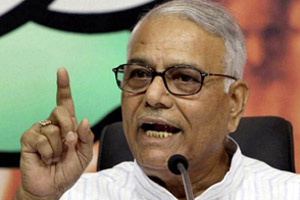
Sinha, who along with some other BJP veterans has been marginalised in the party, was speaking at a panel discussion at the 'Difficult Dialogues' conference here, where CPI-M general secretary Sitaram Yechury also spoke.

"There is absolutely no scope of no dialogue... This is the great strength of Indian democracy. There will be aberrations here and there, there might be concerns about the present situation. But the great Indian society will take care of it and consign to dust those who do not believe in dialogue in India," Sinha said.

"The people of India will consign him to the dust, you just have to wait for the next elections," Sinha, who was finance minister in Atal Bihari Vajpayee government, said without naming Modi.

Alluding to the general elections in 1977 when Congress was ousted from power, he said such a neglect (of dialogue) will make the government last "19 months", the same duration as the Emergency.

We all know how the people of India reacted to the Emergency which was the "most concerted democratic effort in our country to still the voice of dissent", he said.

Replying to intervention from Yechury on need to ensure that dialogue in the society doesn't get stifled, he said, "I would only say that the stifler is in for serious trouble."

The veteran BJP leader also rued the fact that Opposition was not letting Parliament function. Without naming, he took a potshot at a Congress leader, who he said never raised concerns on the GST Bill in the standing committee meetings but later raised objections.

Under Vajpayee, the NDA government was able to pass several important legislations with the help of dialogue (with opposition), Sinha said.

His onslaught comes on the same day when another BJP leader, actor-MP Shatrughan Sinha, said that veteran leaders Vajpayee, L K Advani and Murli Manohar Joshi "deserve much more than what they have been given".

"Currently these leaders including me are trapped between oppression and respect," Shatrughan said in Pune.

Comments

aharkul
 - 
Sunday, 31 Jan 2016

Just wait and see.... within one year what happen Indian democracy..

Goodman
 - 
Sunday, 31 Jan 2016

BJP built on wrong ideology, wrong foundation. So tower can not stand on cracking foundation.

Add new comment

  • Coastaldigest.com reserves the right to delete or block any comments.
  • Coastaldigset.com is not responsible for its readers’ comments.
  • Comments that are abusive, incendiary or irrelevant are strictly prohibited.
  • Please use a genuine email ID and provide your name to avoid reject.
Agencies
May 31,2020

New Delhi, May 31: The fourth phase of the coronavirus-triggered lockdown, which began on May 18, saw 85,974 COVID-19 cases till 8 am on Sunday, which is nearly half of the total cases reported in the country so far.

Lockdown 4.0, which will end on May 31 midnight, has accounted for 47.20 per cent of the total coronavirus infection cases, number crunching from the Union Health Ministry data reveals.

The lockdown, which was first clamped on March 25 and spanned for 21 days, had registered 10,877 cases, while the second phase of the curbs that began on April 15 and stretched for 19 days till May 3, saw 31,094 cases.

The third phase of the lockdown that was in effect for 14 days ending on May 17, recorded 53,636 cases till 8 am of May 18.

The country had registered 512 coronavirus infection cases till March 24.

India is the ninth worst-hit nation by the COVID-19 pandemic as of now.        

The first case of COVID-19 in India was reported on January 30 from Kerala after a medical student of Wuhan university, who had returned to India, tested  positive for the virus.

India registered its highest single-day spike of COVID-19 cases on Sunday, with 8,380 new infections reported in the last 24 hours, taking the country's tally to 1,82,143, while the death toll rose to 5,164, according to the Union Health Ministry.

The number of active COVID-19 cases stood to 89,995, while 86,983 people have recovered and one patient has migrated, it said.

"Thus, around 47.75 per cent patients have recovered so far," a senior Health Ministry official said.

With the fourth phase of lockdown ending on Sunday, the Home Ministry on Saturday said 'Unlock-1' will be initiated in the country from June 8 under which the nationwide lockdown will be relaxed to a great extent, including opening of shopping malls, restaurants and religious places, even as strict restrictions will remain in place till June 30 in the country's worst-hit areas.

While announcing the extension of the lockdown in containment zones across the country, the Home Ministry said temples, mosques, churches and other religious places and shopping malls will be allowed to open in a phased manner from June 8, while a decision on opening of schools and colleges will be taken in July in consultation with states.

Comments

Add new comment

  • Coastaldigest.com reserves the right to delete or block any comments.
  • Coastaldigset.com is not responsible for its readers’ comments.
  • Comments that are abusive, incendiary or irrelevant are strictly prohibited.
  • Please use a genuine email ID and provide your name to avoid reject.
March 27,2020

Mumbai, Mar 27: The RBI on Friday put on hold EMI payments on all term loans for three months and cut interest rate by steepest in more than 11 years as it joined the government effort to rescue a slowing economy that has now got caught in coronavirus whirlwind.

The Reserve Bank of India (RBI) cut repo to 4.4 per cent, the lowest in at least 15 years. Also, it reduced the cash reserve ratio maintained by the banks for the first time in over seven years. CRR for all banks was cut by 100 basis points to release Rs 1.37 lakh crore across banking system.

The reverse repo rate was cut by 90 bps to 4 per cent, creating an asymmetrical corridor.

RBI Governor Shaktikanta Das predicted a big global recession and said India will not be immune.

It all depends how India responds to the situation, he said.

Global slowdown could make things difficult for India too, despite some help from falling crude prices, Das said, adding food prices may soften even further on record crop production.

Aggregate demand may weaken and ease core inflation further, he noted.

The liquidity measures announced include auction of targeted long-term repo operation of 3 year tenor for total amount of Rs 1 lakh crore at floating rate and accommodation under Marginal Standing Facility to be increased from 2 per cent to 3 per cent of Statutory Liquidity Ratio (SLR) with immediate effect till June 30.

Combined, these three measures will make available a total Rs 3,74,000 crore to the country's financial system.

After cutting policy rates five times in 2019, the RBI had been on a pause since December in view of high inflation.

The measures announced come a day after the government unveiled a Rs 1.7 lakh crore package of free foodgrains and cash doles to the poor to deal with the economic impact of the unprecedented 21-day nationwide lockdown.

While the Monetary Policy Committee (MPC) of the RBI originally was slated to meet in the first week of April, it was advanced by a week to meet the challenge of coronavirus.

Comments

Add new comment

  • Coastaldigest.com reserves the right to delete or block any comments.
  • Coastaldigset.com is not responsible for its readers’ comments.
  • Comments that are abusive, incendiary or irrelevant are strictly prohibited.
  • Please use a genuine email ID and provide your name to avoid reject.
News Network
January 9,2020

Mumbai, Jan 9: India's weddings are famously lavish -- lasting days and with hundreds if not thousands of guests -- but this season many families are cutting costs even if it risks their social standing.

It is symptomatic of a sharp slowdown in the world's fifth-largest economy, with Indians spending less on everything from daily essentials to once-in-a-lifetime celebrations.

Growth has hit a six-year low and unemployment a four-decade high under Prime Minister Narendra Modi. Prices are rising too, squeezing spending on everything from shampoo to mobile data.

Chartered accountant Palak Panchamiya, for example, has already slashed the budget on her upcoming Mumbai nuptials by a third, trimming spending on clothing and the guest list.

"Initially I chose a dress that cost 73,000 rupees ($1,000)," Panchamiya told news agency as she picked through outfits at a recent marriage trade fair.

"But my partner felt it was too expensive, and so now I am here reworking my options and looking for something cheaper."

India's massive wedding industry is worth an estimated $40-50 billion a year, according to research firm KPMG.

The celebrations can last a week and involve several functions, a dazzling variety of cuisines, music and dance performances, and lots of gifts.

Foreigners can even buy tickets to some events.

But these days, except for the super-rich -- a recent Ambani family wedding reportedly cost $100 million -- extravagance is out and frugality is in as families prioritise saving.

"Earlier Indian weddings were like huge concerts, but now things have changed," said Maninder Sethi, founder of Wedding Asia, which organises marriage fairs around the country.

Cracks emerged in 2016 when the Indian wedding season, which runs from September to mid-January, was hit by the government's shock withdrawal of vast amounts of banknotes from circulation in a bid to crack down on undeclared earnings.

Mumbai-based trousseau maker Sapna Designs Studio shut for months as the economy was turned on its head by Modi's move.

"No exhibitions were happening and there were no avenues for us to sell either," said Vishal Hariyani, owner of the clothing studio.

Hopes for a recovery proved short-lived when the cash ban was followed by a botched rollout of a nationwide goods and services tax (GST) in 2017 that saw many small-scale businesses close.

Since then, keeping his studio afloat has been a challenge, with consumers increasingly reluctant to spend too much, says Hariyani.

"We customise our clothes as per their budgets, and now week-long weddings have been converted to just a 36-hour ceremony," he told news agency.

"We have to pay GST, pay workers and even offer discounts to customers," he added.

"The whole economy has slowed down and reduced spending on weddings is a by-product of that. Everyone except the super-rich are affected," Pradip Shah from IndAsia Fund Advisors told news agency.

"It is reflective of how sombre the mood is," he said.

In a country where families traditionally spend heavily on weddings -- including taking on debt in some cases -- the downturn is also a source of sadness and shame, with elaborate celebrations often seen as a measure of social status.

"We haven't even invited our neighbours. It is embarrassing but the current situation doesn't offer us much respite," 52-year-old Tara Shetty said ahead of her son's wedding.

"In my era, we always spent a lot and had thousands of people attending the weddings," she explained.

"My wedding was supremely grand, and now my son's is the polar opposite."

Comments

Add new comment

  • Coastaldigest.com reserves the right to delete or block any comments.
  • Coastaldigset.com is not responsible for its readers’ comments.
  • Comments that are abusive, incendiary or irrelevant are strictly prohibited.
  • Please use a genuine email ID and provide your name to avoid reject.