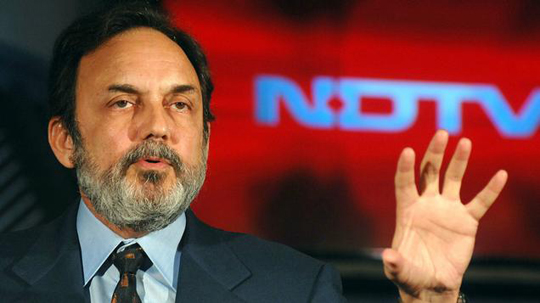
Modi govt puts on hold one-day ban on NDTV after channel moves SC

November 7, 2016

New Delhi, Nov 7: The Information and Broadcasting ministry has put on hold the order against Hindi channel NDTV India, sources told PTI on Monday.

ndtv

Earlier, NDTV India had moved the Supreme Court against the government's order banning its telecast for a day on November 9 for its coverage of the Pathankot terror attack.

The petition challenged the Constitutional validity of the government order, the channel said in filing to the stock exchanges.

In the filing, NDTV said the Ministry of Information and Broadcasting had directed stopping of transmission or re- transmission of its Hindi news channel, NDTV India for a day from 00.01 hrs of November 9, 2016 till 00.01 hrs of November 10, 2016.

"We now update that NDTV Ltd and others have filed a writ petition before the Hon'ble Supreme Court challenging the said order, inter-alia, challenging the constitutional validity of the said order and the provisions of law pursuant to which the said order has purportedly been passed," the company said.

Sources said a senior advocate was likely to mention the matter tomorrow, a day before the channel had been asked to keep away from broadcasting. 

Earlier post:

NDTV India moves SC against Modi govt's one day ban order

New Delhi, Nov 7: NDTV India today moved the Supreme Court against the government's order banning its telecast for a day on November 9 for its coverage of the Pathankot terror attack.

The petition challenges the Constitutional validity of the government order, the channel said in filing to the stock exchanges.

In the filing, NDTV said the Ministry of Information and Broadcasting had directed stopping of transmission or re- transmission of its Hindi news channel, NDTV India for a day from 00.01 hrs of November 9, 2016 till 00.01 hrs of November 10, 2016.

"We now update that NDTV Ltd and others have filed a writ petition before the Hon'ble Supreme Court challenging the said order, inter-alia, challenging the constitutional validity of the said order and the provisions of law pursuant to which the said order has purportedly been passed," the company said.

Sources said a senior advocate is likely to mention the matter tomorrow, a day before the channel has been asked to keep away from broadcasting.

On its website, NDTV has mentioned that it has challenged the government's one-day ban.

NDTV has refuted the allegations and pointed out that other channels and newspapers reported the same information.

The ban has been widely condemned by journalists and editors with all press councils drawing parallels to the Emergency of the 1970s when basic constitutional rights including the freedom of the press were blatantly violated, the channel said on its website.

Comments

ali
 - 
Tuesday, 8 Nov 2016

One who roams around rss and bjp and publish news according to them gets reward like arnab goswami. One who goes against modi/feku he gets ban.

Ye anda kanoon hain

Rikaz
 - 
Monday, 7 Nov 2016

Some are saying time to ban NDTV.....because NDTV is not talking or walking or listening to the tone of Modi....NDTV brings real news in front of people...I appreciate the way they do their job...good job NDTV, I am sure you will win the case....

Althaf
 - 
Monday, 7 Nov 2016

After Modi Becomes PM of india, our country turned to Gunda Raaj .Acche Din for Bhakts only

Add new comment

  • Coastaldigest.com reserves the right to delete or block any comments.
  • Coastaldigset.com is not responsible for its readers’ comments.
  • Comments that are abusive, incendiary or irrelevant are strictly prohibited.
  • Please use a genuine email ID and provide your name to avoid reject.
News Network
April 18,2020

Bengaluru, Apr 18: Karnataka Congress president DK Shivakumar on Saturday appealed to Prime Minister Narendra Modi to deposit at least Rs 10,000 in bank accounts of people belonging to the unorganised sector.

"The unorganised sector comprises barbers, dhobi, cooks, carpenters, sweepers, drivers and autorickshaw drivers. Prime Minister Narendra Modi did not mention anything about giving subsistence to these people," Shivakumar, told ANI, referring to the Prime Minister's address earlier this week.

Modi had announced the extension of the ongoing nationwide lockdown till May 3 in order to curb the spread of coronavirus.

"I appeal to Prime Minister Modi to register the members of the unregistered sector under the National Rural Employment Guarantee Act (NREGA) or deposit at least Rs 10,000 to the bank accounts of each of the members of unorganised sector to help them survive the lockdown," he added.

Though the Congress party will continue the central government and state government's fight against coronavirus, he said, both the governments need to help people who are part of the unorganised sector.

"The farmers have told me that due to the lockdown they are ready to sell the vegetables, which once used to be sold at Rs 100 per kg, at even Rs 5 per kg," he said.

Speaking on the suggestions he made to Chief Minister BS Yediyurappa, Shivakumar said, "I requested the Chief Minister to send a team to do a videograph and make an assessment of the on-ground situation. However, till now, no one has gone."

Comments

Add new comment

  • Coastaldigest.com reserves the right to delete or block any comments.
  • Coastaldigset.com is not responsible for its readers’ comments.
  • Comments that are abusive, incendiary or irrelevant are strictly prohibited.
  • Please use a genuine email ID and provide your name to avoid reject.
News Network
April 18,2020

Bengaluru, Apr 18: The Karnataka government has fixed the cost of test for COVID-19 in private laboratories at Rs 2,250, an official said on Friday.

"Based on the discussions and negotiations, the cost per test has been fixed at Rs 2,250. This includes the screening test and a confirmatory test," said order by Health and Family Welfare Department's Additional Chief Secretary Jawaid Akhtar.

A total of 16 laboratories (11 government and 5 private) have been approved by the Indian Council of Medical Research (ICMR) for testing samples of possible COVID-19 cases in the state.

Realising that early detection of coronavirus cases and timely treatment was the need of the hour, meetings were held to rope in more private laboratories to conduct COVID-19 sample tests.

As per the protocol by the Centre, testing the samples of suspected COVID-19 cases can be taken up in private laboratories subject to conditions which include sharing the lab data pertaining to the diagnosis of COV1D-19 with the state government and with the ICMR on a timely basis.

As per the Union Health Ministry, 353 people have infected from coronavirus in the state of which 83 are cured and discharged and 13 succumbed to the virus.

Comments

Add new comment

  • Coastaldigest.com reserves the right to delete or block any comments.
  • Coastaldigset.com is not responsible for its readers’ comments.
  • Comments that are abusive, incendiary or irrelevant are strictly prohibited.
  • Please use a genuine email ID and provide your name to avoid reject.
Ram Puniyani
February 10,2020

Noam Chomsky is one of the leading peace workers in the world. In the wake of America’s attack on Vietnam, he brought out his classic formulation, ‘manufacturing consent’. The phrase explains the state manipulating public opinion to have the public approve of it policies—in this case, the attack of the American state on Vietnam, which was then struggling to free itself from French colonial rule.

In India, we are witness to manufactured hate against religious minorities. This hatred serves to enhance polarisation in society, which undermines India’s democracy and Constitution and promotes support for a Hindu nation. Hate is being manufactured through multiple mechanisms. For example, it manifests in violence against religious minorities. Some recent ghastly expressions of this manufactured hate was the massive communal violence witnessed in Mumbai (1992-93), Gujarat (2002), Kandhamal (2008) and Muzaffarnagar (2013). Its other manifestation was in the form of lynching of those accused of having killed a cow or consumed beef. A parallel phenomenon is the brutal flogging, often to death, of Dalits who deal with animal carcasses or leather.

Yet another form of this was seen when Shambhulal Regar, indoctrinated by the propaganda of Hindu nationalists, burned alive Afrazul Khan and shot the video of the heinous act. For his brutality, he was praised by many. Regar was incited into the act by the propaganda around love jihad. Lately, we have the same phenomenon of manufactured hate taking on even more dastardly proportions as youth related to Hindu nationalist organisations have been caught using pistols, while police authorities look on.

Anurag Thakur, a BJP minster in the central government recently incited a crowd in Delhi to complete his chant of what should happen to ‘traitors of the country...” with a “they should be shot”. Just two days later, a youth brought a pistol to the site of a protest at Jamia Millia Islamia university and shouted “take Azaadi!” and fired it. One bullet hit a student of Jamia. This happened on 30 January, the day Nathuram Godse had shot Mahatma Gandhi in 1948. A few days later, another youth fired near the site of protests against the CAA and NRC at Shaheen Bagh. Soon after, he said that in India, “only Hindus will rule”.

What is very obvious is that the shootings by those associated with Hindu nationalist organisations are the culmination of a long campaign of spreading hate against religious minorities in India in general and against Muslims in particular. The present phase is the outcome of a long and sustained hate campaign, the beginning of which lies in nationalism in the name of religion; Muslim nationalism and Hindu nationalism. This sectarian nationalism picked up the communal view of history and the communal historiography which the British introduced in order to pursue their ‘divide and rule’ policy.

In India what became part of “social common sense” was that Muslim kings had destroyed Hindu temples, that Islam was spread by force, and that it is a foreign religion, and so on. Campaigns, such as the one for a temple dedicated to the Hindu god Rama to be built at the site where the Babri masjid once stood, further deepened the idea of a Muslim as a “temple-destroyer”. Aurangzeb, Tipu Sultan and other Muslim kings were tarnished as the ones who spread Islam by force in the subcontinent. The tragic Partition, which was primarily due to British policies, and was well-supported by communal streams also, was entirely attributed to Muslims. The Kashmir conflict, which is the outcome of regional, ethnic and other historical issues, coupled with the American policy of supporting Pakistan’s ambitions of regional hegemony, (which also fostered the birth of Al-Qaeda), was also attributed to the Muslims.

With recurring incidents of communal violence, these falsehoods went on going deeper into the social thinking. Violence itself led to ghettoisation of Muslims and further broke inter-community social bonds. On the one hand, a ghettoised community is cut off from others and on the other hand the victims come to be presented as culprits. The percolation of this hate through word-of-mouth propaganda, media and re-writing of school curricula, had a strong impact on social attitudes towards the minorities.

In the last couple of decades, the process of manufacturing hate has been intensified by the social media platforms which are being cleverly used by the communal forces. Swati Chaturvedi’s book, I Am a Troll: Inside the Secret World of the BJP’s Digital Army, tells us how the BJP used social media to spread hate. Whatapp University became the source of understanding for large sections of society and hate for the ‘Other’, went up by leaps and bounds. To add on to this process, the phenomenon of fake news was shrewdly deployed to intensify divisiveness.

Currently, the Shaheen Bagh movement is a big uniting force for the country; but it is being demonised as a gathering of ‘anti-nationals’. Another BJP leader has said that these protesters will indulge in crimes like rape. This has intensified the prevalent hate.

While there is a general dominance of hate, the likes of Shambhulal Regar and the Jamia shooter do get taken in by the incitement and act out the violence that is constantly hinted at. The deeper issue involved is the prevalence of hate, misconceptions and biases, which have become the part of social thinking.

These misconceptions are undoing the amity between different religious communities which was built during the freedom movement. They are undoing the fraternity which emerged with the process of India as a nation in the making. The processes which brought these communities together broadly drew from Gandhi, Bhagat Singh and Ambedkar. It is these values which need to be rooted again in the society. The communal forces have resorted to false propaganda against the minorities, and that needs to be undone with sincerity.

Combating those foundational misconceptions which create hatred is a massive task which needs to be taken up by the social organisations and political parties which have faith in the Indian Constitution and values of freedom movement. It needs to be done right away as a priority issue in with a focus on cultivating Indian fraternity yet again.


Comments

Add new comment

  • Coastaldigest.com reserves the right to delete or block any comments.
  • Coastaldigset.com is not responsible for its readers’ comments.
  • Comments that are abusive, incendiary or irrelevant are strictly prohibited.
  • Please use a genuine email ID and provide your name to avoid reject.