


Modi govt puts on hold one-day ban on NDTV after channel moves SC

November 7, 2016

New Delhi, Nov 7: The Information and Broadcasting ministry has put on hold the order against Hindi channel NDTV India, sources told PTI on Monday.
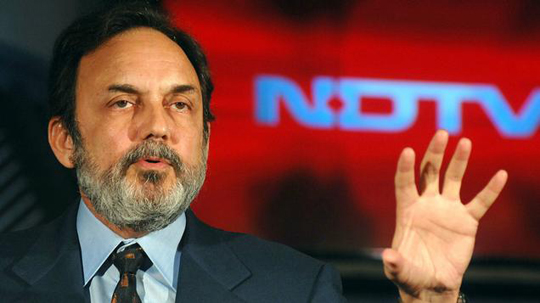
ndtv

Earlier, NDTV India had moved the Supreme Court against the government's order banning its telecast for a day on November 9 for its coverage of the Pathankot terror attack.

The petition challenged the Constitutional validity of the government order, the channel said in filing to the stock exchanges.

In the filing, NDTV said the Ministry of Information and Broadcasting had directed stopping of transmission or re- transmission of its Hindi news channel, NDTV India for a day from 00.01 hrs of November 9, 2016 till 00.01 hrs of November 10, 2016.

"We now update that NDTV Ltd and others have filed a writ petition before the Hon'ble Supreme Court challenging the said order, inter-alia, challenging the constitutional validity of the said order and the provisions of law pursuant to which the said order has purportedly been passed," the company said.

Sources said a senior advocate was likely to mention the matter tomorrow, a day before the channel had been asked to keep away from broadcasting. 

Earlier post:

NDTV India moves SC against Modi govt's one day ban order

New Delhi, Nov 7: NDTV India today moved the Supreme Court against the government's order banning its telecast for a day on November 9 for its coverage of the Pathankot terror attack.

The petition challenges the Constitutional validity of the government order, the channel said in filing to the stock exchanges.

In the filing, NDTV said the Ministry of Information and Broadcasting had directed stopping of transmission or re- transmission of its Hindi news channel, NDTV India for a day from 00.01 hrs of November 9, 2016 till 00.01 hrs of November 10, 2016.

"We now update that NDTV Ltd and others have filed a writ petition before the Hon'ble Supreme Court challenging the said order, inter-alia, challenging the constitutional validity of the said order and the provisions of law pursuant to which the said order has purportedly been passed," the company said.

Sources said a senior advocate is likely to mention the matter tomorrow, a day before the channel has been asked to keep away from broadcasting.

On its website, NDTV has mentioned that it has challenged the government's one-day ban.

NDTV has refuted the allegations and pointed out that other channels and newspapers reported the same information.

The ban has been widely condemned by journalists and editors with all press councils drawing parallels to the Emergency of the 1970s when basic constitutional rights including the freedom of the press were blatantly violated, the channel said on its website.

Comments

ali
 - 
Tuesday, 8 Nov 2016

One who roams around rss and bjp and publish news according to them gets reward like arnab goswami. One who goes against modi/feku he gets ban.

Ye anda kanoon hain

Rikaz
 - 
Monday, 7 Nov 2016

Some are saying time to ban NDTV.....because NDTV is not talking or walking or listening to the tone of Modi....NDTV brings real news in front of people...I appreciate the way they do their job...good job NDTV, I am sure you will win the case....

Althaf
 - 
Monday, 7 Nov 2016

After Modi Becomes PM of india, our country turned to Gunda Raaj .Acche Din for Bhakts only

Add new comment

  • Coastaldigest.com reserves the right to delete or block any comments.
  • Coastaldigset.com is not responsible for its readers’ comments.
  • Comments that are abusive, incendiary or irrelevant are strictly prohibited.
  • Please use a genuine email ID and provide your name to avoid reject.
News Network
April 29,2020

Washington, Apr 29: A US government panel on Tuesday called for India to be put on a religious freedom blacklist over a "drastic" downturn under Prime Minister Narendra Modi, triggering a sharp rebuttal from New Delhi.

The US Commission on International Religious Freedom recommends but does not set policy, and there is virtually no chance the State Department will follow its lead on India, an increasingly close US ally.

In an annual report, the bipartisan panel narrowly agreed that India should join the ranks of "countries of particular concern" that would be subject to sanctions if they do not improve their records.

"In 2019, religious freedom conditions in India experienced a drastic turn downward, with religious minorities under increasing assault," the report said.

It called on the United States to impose punitive measures, including visa bans, on Indian officials believed responsible and grant funding to civil society groups that monitor hate speech.

The commission said that Modi's Hindu nationalist government, which won a convincing election victory last year, "allowed violence against minorities and their houses of worship to continue with impunity, and also engaged in and tolerated hate speech and incitement to violence."

It pointed to comments by Home Minister Amit Shah, who notoriously referred to mostly Muslim migrants as "termites," and to a citizenship law that has triggered nationwide protests.

It also highlighted the revocation of the autonomy of Kashmir, which was India's only Muslim-majority state, and allegations that Delhi police turned a blind eye to mobs who attacked Muslim neighborhoods in February this year.

Coronavirus state-wise India update: Total number of confirmed cases, deaths on April 29

The Indian government, long irritated by the commission's comments, quickly rejected the report.

"Its biased and tendentious comments against India are not new. But on this occasion, its misrepresentation has reached new levels," foreign ministry spokesman Anurag Srivastava said.

"We regard it as an organization of particular concern and will treat it accordingly," he said in a statement.

The State Department designates nine "countries of particular concern" on religious freedom -- China, Eritrea, Iran, Myanmar, North Korea, Pakistan, Saudi Arabia, Tajikistan and Turkmenistan.

The commission asked that all nine countries remain on the list. In addition to India, it sought the inclusion of four more -- Nigeria, Russia, Syria and Vietnam.

Pakistan, India's historic rival, was added by the State Department in 2018 after years of appeals by the commission.

In its latest report, the commission said that Pakistan "continued to trend negatively," voicing alarm at forced conversions of Hindus and other minorities, abuse of blasphemy prosecutions and a ban on the Ahmadi sect calling itself Muslim.

India's citizenship law fast-tracks naturalization for minorities from neighbouring countries -- but not if they are Muslim.

Modi's government says it is not targeting Muslims but rather providing refuge to persecuted people and should be commended.

But critics consider it a watershed move by Modi to define the world's largest democracy as a Hindu nation and chip away at independent India's founding principle of secularism.

Tony Perkins, the commission's chair, called the law a "tipping point" and voiced concern about a registry in the northeastern state of Assam, under which 1.9 million people failed to produce documentation to prove that they were Indian citizens before 1971 when mostly Muslim migrants flowed in during Bangladesh's bloody war of independence.

"The intentions of the national leaders are to bring this about throughout the entire country," Perkins told an online news conference.

"You could potentially have 100 million people, mostly Muslims, left stateless because of their religion. That would be, obviously, an international issue," said Perkins, a Christian activist known for his opposition to gay rights who is close to President Donald Trump's administration.

Three of the nine commissioners dissented -- including another prominent Christian conservative, Gary Bauer, who voiced alarm about India's direction but said the ally could not be likened to non-democracies such as China.

"I am deeply concerned that this public denunciation risks exactly the opposite outcome than the one we all desire," Bauer said.

Trump, who called for a ban on Muslim immigration to the US when he ran for president, hailed Modi on a February visit to New Delhi.

Comments

Add new comment

  • Coastaldigest.com reserves the right to delete or block any comments.
  • Coastaldigset.com is not responsible for its readers’ comments.
  • Comments that are abusive, incendiary or irrelevant are strictly prohibited.
  • Please use a genuine email ID and provide your name to avoid reject.
Agencies
July 8,2020

The Central Board of Secondary Education (CBSE) has rationalised by up to 30 per cent the syllabus for classes 9 to 12 for the academic year 2020-21 to reduce course load on students amid the COVID-19 crisis, Union HRD Minister Ramesh Pokhriyal 'Nishank' announced on Tuesday.

The curriculum has been rationalised while retaining the core elements, the Human Resource Development said.

Among the chapters dropped after the rationalisation exercise are lessons on democracy and diversity, demonetisation, nationalism, secularism, India's relations with its neighbours and growth of local governments in India, among others.

"Looking at the extraordinary situation prevailing in the country and the world, CBSE was advised to revise the curriculum and reduce course load for the students of classes 9 to 12.

"To aid the decision, a few weeks back I also invited suggestions from all educationists on the reduction of syllabus for students and I am glad to share that we received more than 1.5K suggestions. Thank you, everyone, for the overwhelming response," Nishank tweeted.

"Considering the importance of learning achievement, it has been decided to rationalise syllabus up to 30 per cent by retaining the core concepts," he added.

The Union minister said the changes made in the syllabi have been finalised by the respective course committees with the approval of the curriculum committee and the Governing Body of the Board.

"The heads of schools and teachers have been advised by the board to ensure that the topics that have been reduced are also explained to the students to the extent required to connect different topics. However, the reduced syllabus will not be part of the topics for internal assessment and year-end board examination.

"Alternative academic calendar and inputs from the NCERT on transacting the curriculum using different strategies shall also be part of the teaching pedagogy in the affiliated schools," a senior official of the HRD ministry said.

For classes 1 to 8, the National Council of Education Research and Training (NCERT) has already notified an alternative calendar and learning outcomes.

According to the updated curriculum, among the chapters deleted from class 10 syllabus are-- democracy and diversity, gender, religion and caste, popular struggles and movement, challenges to democracy

For class 11, the deleted portions included chapters on federalism, citizenship, nationalism, secularism, growth of local governments in India.

Similarly, class 12 students will not be required to study chapters on India's relations with its neighbours, changing nature of India's economic development, social movements in India and demonetisation, among others.

Universities and schools across the country have been closed since March 16 when the central government announced a nationwide classroom shutdown as one of the measures to contain the COVID-19 outbreak.

A nationwide lockdown was announced on March 24, which came into effect the next day. While the government has eased several restrictions, schools and colleges continue to remain closed.

Comments

Add new comment

  • Coastaldigest.com reserves the right to delete or block any comments.
  • Coastaldigset.com is not responsible for its readers’ comments.
  • Comments that are abusive, incendiary or irrelevant are strictly prohibited.
  • Please use a genuine email ID and provide your name to avoid reject.
News Network
April 24,2020

Bengaluru, Apr 24: Karnataka is likely to start Convalescent Plasma Therapy for COVID-19 patients, who are critical, from tomorrow, Medical Education Minister K Sudhakar said here on on Friday. "We have already got approval for Convalescent Plasma Therapy.

There is no need for any special permission for it....when I was in BMC (Bangalore Medical College) I spoke to We may probably start it for the first patient from tomorrow itself. The donor has also agreed," Sudhakar said.

Speaking to reporters here, he said the convalescent Plasma Therapy was only for patients who are critical, in Intensive Care Units or on ventilator. According to the latest update, five COVID-19 patients are in ICUs in the state.

After attending video conferencing by Union Health Minister Harsh Vardhan with health and medical education Ministers of all states, Sudhakar said the Minister lauded the good practices adopted by Karnataka in its fight against COVID-19 and asked to share the same with other states.

Responding to a question, he made it clear that COVID-19 is something that was not going to end by May 3 or by May end and like other viruses, would continue to exist. Sudhakar, who is leading the government's efforts against COVID-19 in Bengaluru and is in charge of the state war room, said many people are treating corona as a social stigma, which was not right.

There was no reason to get frightened about it as the infection can be cured, he said. "We have to take precautions so that it doesn't spread further....like fever, cold and cough- corona also can be cured... 97% people it can be cured, those with comorbidity and those above 60 years have to take some precautions. We have to bring in certain changes in our lifestyle and maintain social distancing," he added.

Comments

Add new comment

  • Coastaldigest.com reserves the right to delete or block any comments.
  • Coastaldigset.com is not responsible for its readers’ comments.
  • Comments that are abusive, incendiary or irrelevant are strictly prohibited.
  • Please use a genuine email ID and provide your name to avoid reject.