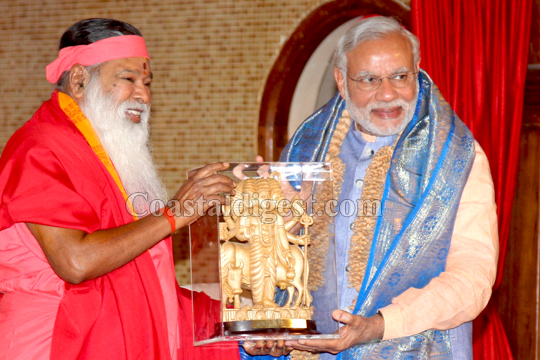
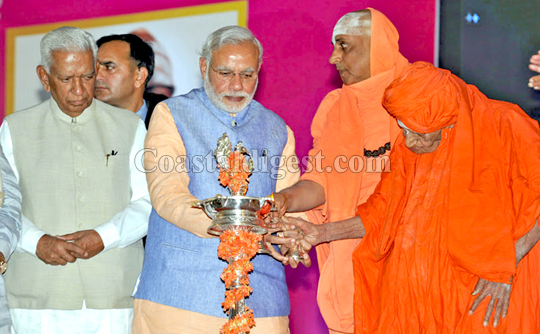
Modi launches birth centenary of Suttur seer in Mysuru

January 3, 2016

Mysuru,?Jan 3: Prime Minister Narendra Modi has said that knowledge and information are the new ammunition in the new age and India’s sages had realised this thousands of years ago.

pmmysore1

Inaugurating the centenary celebrations of the late seer of Suttur mutt Shivaratri Rajendra Swami at Maharaja’s College grounds here on Saturday, the prime minister said that one cannot run a nation with just money and military power.

“The world understands that knowledge is power and it has been accorded utmost importance in India since ages. Now, technology is so advanced that innovations are surpassing our dreams and imagination. But, can we expect miracles in the field of knowledge and information? That is why seers and pontiffs are establishing seats of higher education. The spiritual and religious institutions are actually doing what the governments should be doing. They are helping ease the government’s burden,” he said.

Recalling the unveiling of a statue of social reformer Basaveshwara in London recently, Modi said that he was happy to be associated with the legacy of the great reformer by visiting the Suttur mutt, which is a major centre for prorogating Basaveshwara’s principles. “Today, we are talking about democracy, social equality and women’s empowerment, but Basaveshwara not only preached them, he practised them some 900 years ago. Whenever society was treading a wrong path due to degeneration of values, our saints have emerged as reformers and have saved society,” he said.

Describing Mahatma Gandhi as a saint, Modi said that the saints emerged as leaders in the 20th century and stepped out to reform society through education and social movements. “Even the 1857 uprising was influenced by spiritual leaders, while it was taken to a logical end in 1947, again by a saint,” he said. Earlier, the prime minister inaugurated a new building of Sri Ganapathy Sachchidananda Hospital on the premises of Sri Avadhoota Datta Peetha.

pmmysore2

pmmysore4

pmmysore5

pmmysore6

pmmysore7

pmmysore8


pmmysore3

Comments

THINKERs
 - 
Sunday, 3 Jan 2016

NA TASYA PRATIMA ASTI...

Add new comment

  • Coastaldigest.com reserves the right to delete or block any comments.
  • Coastaldigset.com is not responsible for its readers’ comments.
  • Comments that are abusive, incendiary or irrelevant are strictly prohibited.
  • Please use a genuine email ID and provide your name to avoid reject.
News Network
May 13,2020

Bengaluru, May 13: Former chief minister and senior Congress leader Siddaramaiah on Wednesday called the measures announced by Finance Minister Nirmala Sitharaman as 'disastrous' and said it is 'non-existent' in terms of benefits to poor migrants, labourers, contract employees and farmers.

"The first set of measures announced by @FinMinIndia @nsitharaman, after 8 PM speech by @narendramodi, is disastrous & non-existent in terms of benefits to poor migrants, labourers, contract employees, farmers, etc," Siddaramaiah said in a tweet.

The Congress leader said most of the intended benefits may not reach the end recipient.

This comes a day after Prime Minister Narendra Modi announced a Rs 20 lakh crore special economic package to revive the COVID-19 hit economy.

"The contribution by the government for the schemes announced are mostly notional and less of actuals and the devil lies in the detail," the Congress leader said in another tweet.

After Sitharaman announced support measures for MSMEs, Siddaramaiah said, "The credit infusion to MSMEs may help them clear dues to vendors but it is doubtful if they shall utilise the credit available to pay their labourers & to prevent job cuts. @FinMinIndia should have taken measures to pay part of the salaries to the employees in MSMEs."

Further questioning the Centre on 'ignoring the spending for boosting consumption', Siddaramaiah said, "The government is interested in capital infusion in the form of credits but totally ignorant of the actual spending that needs to be done to boost consumption. How can credit be considered as government spending?"

Siddaramaiah said the next set of measures should benefit the marginalised sections.

"Will be looking forward to next set of measures & I hope it will be something to benefit the marginalised sections. Direct benefits to the poorest sections will help them survive this pandemic. COVID-19 fight should not be another perception battle but a real one," he added in another tweet.

Sitharaman earlier announced Rs 3 lakh crore collateral-free automatic loans for businesses, including MSMEs.

Besides this, she also stated that to provide stressed MSMEs with equity support, the government will facilitate the provision of Rs 20,000 crore as subordinate debt.

Comments

Add new comment

  • Coastaldigest.com reserves the right to delete or block any comments.
  • Coastaldigset.com is not responsible for its readers’ comments.
  • Comments that are abusive, incendiary or irrelevant are strictly prohibited.
  • Please use a genuine email ID and provide your name to avoid reject.
Agencies
February 20,2020

India ranked 77th on a sustainability index that takes into account per capita carbon emissions and ability of children in a nation to live healthy lives and secures 131st spot on a flourishing ranking that measures the best chance at survival and well-being for children, according to a UN-backed report.

The report was released on Wednesday by a commission of over 40 child and adolescent health experts from around the world. It was commissioned by the World Health Organization (WHO), UN Children's Fund (UNICEF) and The Lancet medical journal.

In the report assessing the capacity of 180 countries to ensure that their youngsters can survive and thrive, India ranks 77th on the Sustainability Index and 131 on the Flourishing Index, it said.

Flourishing is the geometric mean of Surviving and Thriving. For Surviving, the authors selected maternal survival, survival in children younger than 5 years old, suicide, access to maternal and child health services, basic hygiene and sanitation, and lack of extreme poverty.

For Thriving, the domains were educational achievement, growth and nutrition, reproductive freedom, and protection from violence.

Under the Sustainability Index, the authors noted that promoting today's national conditions for children to survive and thrive must not come at the cost of eroding future global conditions for children's ability to flourish.

The Sustainability Index ranks countries on excess carbon emissions compared with the 2030 target. This provides a convenient and available proxy for a country's contribution to sustainability in future.

The report noted that under realistic assumptions about possible trajectories towards sustainable greenhouse gas emissions, models predict that global carbon emissions need to be reduced from 39·7 giga­ tonnes to 22·8 gigatonnes per year by 2030 to maintain even a 66 per cent chance of keeping global warming below 1·5°C.

It said that the world's survival depended on children being able to flourish, but no country is doing enough to give them a sustainable future.

"No country in the world is currently providing the conditions we need to support every child to grow up and have a healthy future," said Anthony Costello, Professor of Global Health and Sustainability at University College London, one of the lead authors of the report.

"Especially, they're under immediate threat from climate change and from commercial marketing, which has grown hugely in the last decade," said Costello – former WHO Director of Mother, Child and Adolescent health.

Norway leads the table for survival, health, education and nutrition rates - followed by South Korea and the Netherlands. Central African Republic, Chad and Somalia come at the bottom.

However, when taking into account per capita CO2 emissions, these top countries trail behind, with Norway 156th, the Republic of Korea 166th and the Netherlands 160th.

Each of the three emits 210 per cent more CO2 per capita than their 2030 target, the data shows, while the US, Australia, and Saudi Arabia are among the 10 worst emitters. The lowest emitters are Burundi, Chad and Somalia.

According to the report, the only countries on track to beat CO2 emission per capita targets by 2030, while also performing fairly – within the top 70 – on child flourishing measures are: Albania, Armenia, Grenada, Jordan, Moldova, Sri Lanka, Tunisia, Uruguay and Vietnam.

"More than 2 billion people live in countries where development is hampered by humanitarian crises, conflicts, and natural disasters, problems increasingly linked with climate change," said Minister Awa Coll-Seck from Senegal, Co-Chair of the commission.

The report also highlights the distinct threat posed to children from harmful marketing.

Evidence suggests that children in some countries see as many as 30,000 advertisements on television alone in a single year, while youth exposure to vaping (e-cigarettes) advertisements increased by more than 250 per cent in the US over two years, reaching more than 24 million young people.

Studies in Australia, Canada, Mexico, New Zealand and the US – among many others – have shown that self-regulation has not hampered commercial ability to advertise to children.

Children's exposure to commercial marketing of junk food and sugary beverages is associated with purchase of unhealthy foods and overweight and obesity, linking predatory marketing to the alarming rise in childhood obesity, it said.

The number of obese children and adolescents increased from 11 million in 1975 to 124 million in 2016 – an 11-fold increase, with dire individual and societal costs, the report said.

To protect children, the authors call for a new global movement driven by and for children.

Specific recommendations include stopping CO2 emissions with the utmost urgency, to ensure children have a future on this planet; placing children and adolescents at the centre of global efforts to achieve sustainable development, the report said.

New policies and investment in all sectors to work towards child health and rights; incorporating children's voices into policy decisions and tightening national regulation of harmful commercial marketing, supported by a new Optional Protocol to the UN Convention on the Rights of the Child, it said.


Comments

Add new comment

  • Coastaldigest.com reserves the right to delete or block any comments.
  • Coastaldigset.com is not responsible for its readers’ comments.
  • Comments that are abusive, incendiary or irrelevant are strictly prohibited.
  • Please use a genuine email ID and provide your name to avoid reject.
coastaldigest.com news network
June 28,2020

Mandya, Jun 28: Prime Minister Narendra Modi praised an 83-year-old farmer from Malavalli taluk in Mandya district of Karnataka for his efforts in water conservation.

While urging the people to focus on saving water, Modi, in his 'Man Ki Baat' on All India Radio quoted Kamegowda from Dasna Doddi village who single handedly dug small 16 ponds over the years in his farm land and in nearby hill while taking his animals for grazing.

"Kamegowda ji is an ordinary farmer, albeit possessing an extraordinary personality. He has achieved a personal feat that will leave anyone awestruck! Kamegowda ji, aged 80-85 takes out his animals for grazing but at the same time he has taken it upon himself to build new ponds in his area", the PM said in his Mann Ki Baat, a monthly radio address on Sunday.

To overcome problems of water scarcity in the area, Gowda started building small ponds. Thereby, he contributed a lot for water conservation, the PM said.

"... An octagenerarian like Kamegowda ji, till now, has dug 16 ponds through his hard work and the sweat of his brow. It is possible that the ponds he has constructed may not be very big but then his efforts are huge. Today, the entire area has got a new lease of life on account of these ponds," the PM said.

A little effort by us helps nature and environment quite significantly. Many of our countrymen are putting extraordinary efforts in this endeavour, the PM said. 

Kamegowda, used to take his sheep and goats to nearby hill for grazing. After finding no water to sheeps, he started digging ponds to address water scarcity. With collection of rain water, these lakes are brimming with water even during peak summer.

Comments

Add new comment

  • Coastaldigest.com reserves the right to delete or block any comments.
  • Coastaldigset.com is not responsible for its readers’ comments.
  • Comments that are abusive, incendiary or irrelevant are strictly prohibited.
  • Please use a genuine email ID and provide your name to avoid reject.