


New Delhi, Mar 17: Praising Islam for its message of peace and harmony, Prime Minister Narendra Modi today said none of Allah's 99 names stands for violence and asserted the fight against terrorism is not a confrontation against any religion and the two should be delinked.
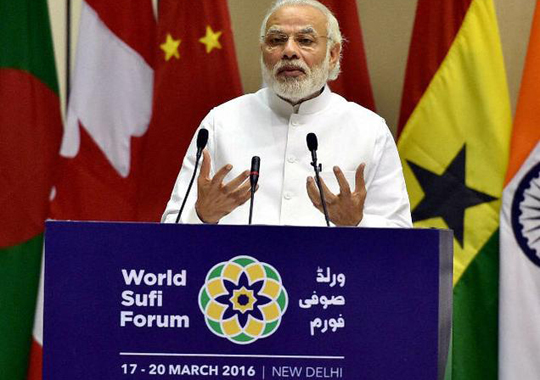
Addressing the first World Sufi Forum, he said, "This is an extraordinary event of great importance to the world, at a critical time for humanity. At a time when the dark shadow of violence is becoming longer, you are the noor, or the light of hope. When young laughter is silenced by guns on the streets, you are the voice that heals."
Emphasising advancing of the message of Sufism that stands for the principles of Islam and the highest human values, he chose the occasion to stress that the fight against terrorism is not a confrontation against any religion.
"The fight against terrorism is not a confrontation against any religion. It cannot be. It is a struggle between the values of humanism and the forces of inhumanity. It is not a conflict to be fought only through military, intelligence or diplomatic means.
"It is also a battle that must be won through the strength of our values and the real message of religions. As I have said before, we must reject any link between terrorism and religion. Those who spread terror in the name of religion are anti-religious," he said.
Terming Sufism, a spiritual quest that traces its origin from the Holy Prophet and the fundamental values of Islam, which literally means peace, Modi said, "And, it reminds us that when we think of the 99 names of Allah, none stand for force and violence, and that the first two names denote the most compassionate and the most merciful. Allah is Rahman and Raheem."
Earlier Modi was welcomed with the chant of 'Bharat Mata Ki Jai' at the forum convened by the All India Ulama and Mashaikh Board, to discuss the role of Sufism in countering rising global terror.
Modi's message came at a time when his government has been facing Opposition flak on the issue of communalism and amid a raging debate on nationalism. The four-day event, beginning today is being attended by over 200 delegates, including foreign delegates from 20 countries.
Spiritual leaders, scholars, academicians and theologists from Egypt, Jordan, Turkey, the UK, the US, Canada and Pakistan, among other countries are coming for the event.
During his around 30-minute speech, Modi quoted a number of Sufi scholars to drive home the message of unity of mankind preached by all religions. "When the spiritual love of Sufism, not the violent force of terrorism, flows across the border, this region will be the paradise on earth that Amir Khusrau spoke about... Terrorism divides and destroys us.
"Indeed, when terrorism and extremism have become the most destructive force of our times, the message of Sufism has global relevance," he said.
Noting that every year over 100 billion dollars are spent on securing the world from terrorism, he said that the money should have been spent on building lives of the poor instead.
In an oblique reference to Pakistan, which has often been accused of harbouring terrorists, Modi said,"there are forces and groups that are instruments of state policy and design. There are others recruited to the cause in misguided belief."
In the backdrop of youths from many countries having joined the ISIS with radicalisation happening through Internet, Modi said while there are some who are trained in organised camps, "there are those who find their inspiration in the border less world of cyber space".
"Terrorism uses diverse motivations and causes, none of which can be justified. Terrorists distort a religion whose cause they profess to support.
"They kill and destroy more in their own land and among their own people than they do elsewhere. And, they are putting entire regions to peril and making the world more insecure and violent," he said.
He said that advance the message of Sufism that stands for the principles of Islam and the highest human values is a task that states, societies, sages, scholars and families must pursue.
Noting that the message of Sufism is not just confined to combating terrorism, the Prime Minister spoke of the "rich diversity" of India stressing that the values of harmony, welfare, compassion and love for human beings are the foundation of a just society.
He said this is the principle behind his idea of 'Sab Ka Saath, Sab Ka Vikaas'. "And, these values are important to preserve and nurture diversity in our societies. Diversity is a basic reality of Nature and source of richness of a society; and, it should not be a cause of discord.
"We need just not constitutional provisions or legal safeguards, but also social values to build an inclusive and peaceful society, in which everyone belongs, secure about his rights and confident of her future," he said.
Speaking on the challenge of violence, the Prime Minister underlined the need to remember the teaching of Holy Quran that if anyone slew one innocent person, it would be as if he slew a whole people and if anyone saved one life, it would be as if he saved a whole people. He also underlined the message of non-violence propagated by Lord Buddha and Mahavira.
"In many parts of the world, there is uncertainty about the future, and how to deal with it as nations and societies. These are precisely the times that the world is most vulnerable to violence and conflicts," he said.
The Prime Minister stressed that the global community to be must be more vigilant than ever before and counter the forces of darkness with the radiant light of human values.
In his speech, he quoted profusely from the Bible and the Quran apart from Hindu scriptures and referred to Sufi saints and scholars including Hazrat Moinuddin Chishti, Persian Sufi poet Saadi Jalaluddin Rumi to drive home the message of unity.
Modi also hailed India as "land that is a timeless fountain of peace, and an ancient source of traditions and faiths, which has received and nurtured religions from the world" and its people "with an abiding belief in Vasudhaiva Kutumbakam, the World is one family".
Modi compared the existence of varies communities in the country with strings of a sitar in which they together create melody.
"Like the strings of sitar that each produces a note, but come together to create a beautiful melody. This is the spirit of India. This is the strength of our nation. All our people, Hindus, Muslims, Sikhs, Christians, Jains, Buddhists, the micro-minority of Parsis, believers, non-believers, are an integral part of India," he said.
Alluding to the Partition, the Prime Minister said, "at the dawn of Independence some chose to go away and, I believe, it also had to do with colonial politics of that time."
He underlined that leaders like Maulana Azad, and important spiritual leaders such as Maulana Hussain Madani, and millions and millions of ordinary citizens rejected the idea of division on the basis of religion.
The Prime Minister gave the credit to "every member of every faith in our diverse and yet united nation" for India moving forward in all spheres. On the spread of terror, he said in this digital century, the reach of terror is growing and its toll is rising every year.
"Since the beginning of this century, tens of thousands of families have lost their loved ones in thousands of terrorist incidents globally. Last year alone, I am talking about 2015, over 90 countries experienced terrorist attacks.
"Parents in 100 countries live with the daily pain of their children lost to the battlefields of Syria. And, in a globally mobile world, one incident can claim citizens of many nations," he said.
He said terrorism is a "daily threat" from the centres of conflict in West Asia to calm cities in distant countries and in remote villages of Africa to the towns in our own region.
"Each day brings us terrible news and horrifying images of schools turned into graveyards of innocence, of prayer gatherings turned into funeral processions, of call to prayer or Azaan drowned by the sound of explosion, of blood on the beach, massacres in malls and smouldering cars on streets, of thriving cities ruined and priceless heritage destroyed, and of parents bearing coffins, entire communities dislocated, millions displaced, and refugees caught between fire and stormy seas," the Prime Minister said.
Modi said the conference should send a message to the world of "a melody of harmony and humanity, the embrace of diversity, the spirit of oneness, of service with compassion and generosity, a resolve against terrorism, a rejection of extremism and, a determination to advance peace".
Earlier post:
Allah has 99 names, none stands for violence: Modi at World Sufi Forum
New Delhi, Mar 17: Allah has 99 names and none of it stands for violence, Prime Minister Narendra Modi underscored today at the World Sufi Forum in Delhi, denouncing terrorism in no uncertain terms.
"Terrorism divides and destroys us... Indeed, when terrorism and extremism have become the most destruction of our times, the message of Sufism has global relevance," he said at the inauguration of the four-day meet.
The reach of terrorism, he said, is growing and the toll is rising every year. "Last year alone, over 90 countries experienced terrorist attacks... Parents in 100 countries live with daily pain of their children lost to the battlefield of Syria."
But the impact of terrorism, he said, cannot be fully captured in statistics alone. "It is changing the way we live. There are forces and groups that are instruments of state policy and design."
The fight against terrorism is not a confrontation against any religion, he said. "It is struggle between values of humanism and forces of inhumanity."
In the backdrop of the Bharat Mata ki Jai slogan controversy, the Prime Minister also underscored the importance of maintaining the diversity and pluralism in Indian society.
"All our people, Hindus, Muslims, Sikhs, Christians, Jains, Buddhists, Parsis, believers, non-believers, are an integral part of India... Diversity is a basic reality of nature and source of richness of a society; and, it should not be a cause of discord," he added.
It is this diversity, he pointed out, that has given birth to Sufism. "Sufism blossomed in India's openness and pluralism. It engaged with her spiritual tradition and evolved its own Indian ethos."
More than 200 spiritual leaders, scholars and academicians are participating in the four-day event, which is being organised by All India Ulama and Mashaikh Board (AIUMB), the apex body of Sufi Dargahs in India.

Comments
What he spoke about ALLAH is TRUTH.. ALLAH take cares to spread his message of TRUTH even from the Enemies Mouth.. Everything happens with the will of ALLAH...
Worship the CREATOR not his CREATION.
Those who look for the TRUTH honestly are the really Guided by ALLAH to know the reality of the TRUE GOD and False deities, which some authorities FOOL people alwz to keep away from TRUE GOD.
On 2 April 2016 Modi will travel to Saudi Arabia for two days that is the reason for all this drama
YAAA Allah,
Grant Modiji Hidayah, Show him the truth, gudie him with the true message of Islam.
When Pophet Muhammad(SAW) pray for both Umars y not we pray for Modiji
Devil speaks about Allah, and Islam. The man one who was a perpetrator of Gujarat Pogrom against innocent Muslims speaks about the peace. As 5 states ahead of election BJP wanted to please the Muslims for vote politics. It is unfortunate Sufi Clads of India invited this butcher as a guest of seminar.
I feel sorry for these Bariailvi Muslims clerics did not learn lessons from the RSS/BJP . Very sad to note.
MODHIJI WE DONT NEED YOUR TALKING WE NEED ACTION ...
ALLOW ALL RELIGION IN INDIA TO LEAVE PEACEFULLY
AND BAN RSS VHP
Abe... enough enough. Stop preaching. Go and start working. U are PM. dont do Mullah's work
Modi ji.. what's the use if u praise islam and then ditch people of all religions in India by practically allowing Sanghis to create divide between them?. this is just like sanghis shouting bolo bharat mata ki jai and then raping women.
Try to practice what u scream. then The most merciful's mercy will be upon you!
Add new comment