Modi, Rajnath assure to include Tulu in 8th schedule of constitution

[email protected] (CD Network)
September 1, 2016

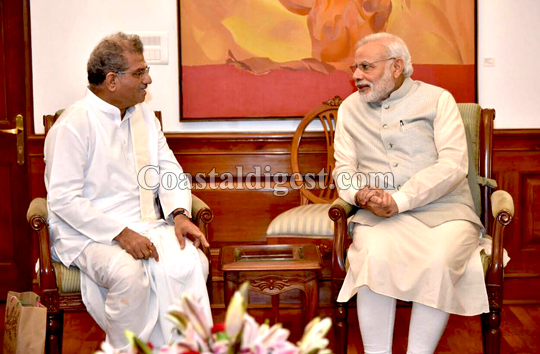
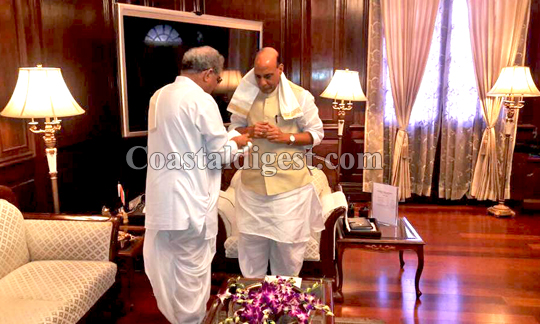
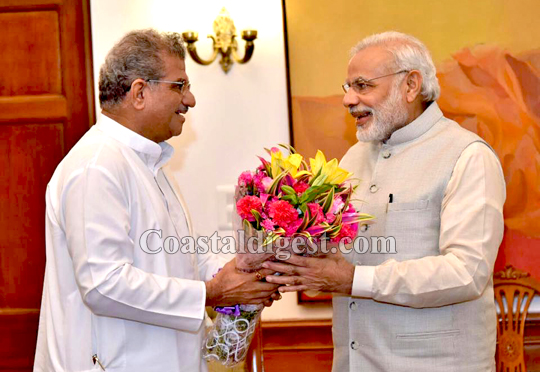
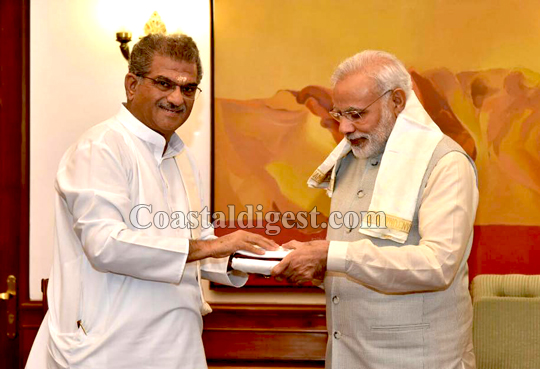
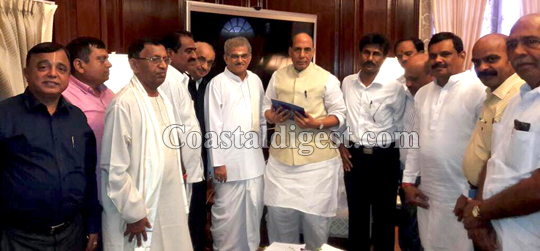
Mangaluru, Sep 1: Prime Minister Narendra Modi and Home Minister Rajnath Singh have reportedly responded positively to the long pending demand of people of Tulu Nadu to include Tulu language in the Eighth Schedule of the Indian Constitution.
veerendrahegde 1

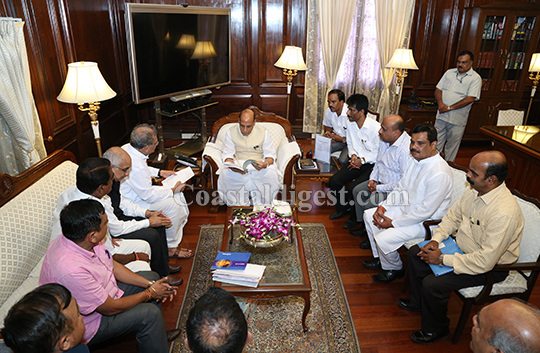
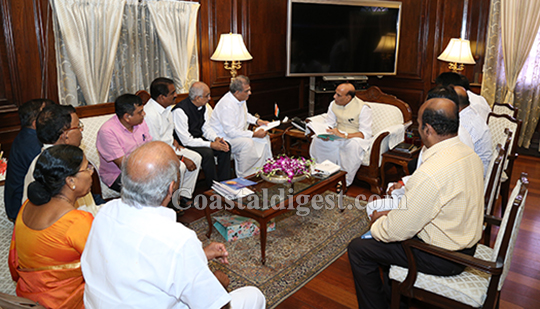
A high-powered delegation headed by D Veerendra Heggade, dharmadhikari, Sri Kshetra Dharmasthala called on the duo on Wednesday. The delegation pointed to the PM and home minister about the more than 2,800-year history of Tulu that belongs to the Dravidian family of languages.

In the oral discussions with the PM and Rajnath Singh, it was pointed that using techniques of Lexico-Statistics, scholars concluded that this language developed as an independent language since 8th century BC. Highly stylized classical literature has also developed in Tulu language.

However, with all efforts, Tulu has not been included in the Eighth Schedule which currently contains list of 22 scheduled languages, out of which 18 belong to other parts of India.

The remaining four languages namely, Malayalam, Tamil, Telugu and Kannada belong to South India. Inclusion of Tulu language in the Eighth Schedule is a long pending demand of Tulvas, the delegation stated hoping the duo will do justice for this language. Recently, Tulu Wikipedia has been activated where more than 1500 scholarly articles uploaded. The delegation also handed over a detailed memorandum in this regard with all relevant supporting.

Though Tulu is one of the five Dravidian languages, unlike other Dravidian languages its speakers do not have a separate state. Tulu people have been living harmoniously with others over the years yet they have shown their individuality and uniqueness in culture and literature.

Tulu speakers have always left a distinct mark in whatever sphere they have been in. Janaki Brahmavara, president of Karnataka Tulu Sahitya Academy was part of the delegation.
veerendrahegde 2

veerendrahegde 3

veerendrahegde 4

veerendrahegde 5

tuluu 1

tuluu 2

tuluu 3

Comments

PREM
 - 
Thursday, 1 Sep 2016

What is the need for it...
People are dying in the shoulders of their fathers.
Y cant this HI Fi show-offs request demand for improvement of hospitals and other areas which are still backward?

Add new comment

  • Coastaldigest.com reserves the right to delete or block any comments.
  • Coastaldigset.com is not responsible for its readers’ comments.
  • Comments that are abusive, incendiary or irrelevant are strictly prohibited.
  • Please use a genuine email ID and provide your name to avoid reject.
News Network
June 26,2020

Bengaluru, Jun 26: The National Restaurant Association of India (NRAI) on Thursday came up with a Standard Operating Procedure (SOP) for restaurants whereby among other physical distancing norms, it has suggested a 2-metre gap between tables.

Formulated in partnership with Releski, a Bengaluru based skill-tech company, the SoP suggests that in case of back-to-back seating, people sitting with their backs towards each other will have their seats divided by 'Plexiglass' divider raised up to 2 meters from the ground.

"In a typical restaurant, the improvised seating plan should have a minimum distance of 2 metres between tables. The distance of 2 metres (6 feet) between tables should measure from one edge of the table to the other table's edge," it said.

In case of loose or free seating such as in banquet style or food court style seating, a minimum 2 meters of distance should be maintained between tables.

The guidelines noted that, to encourage physical distancing, restaurants have to sacrifice their seating capacity, to promote health and safety, and also to gain trust from their patrons.

"In order to perform this, divide your restaurants under different sectors. Pull out your restaurant's floor plan and colour code different sections red and yellow. Red sections are potential areas where maximum footfall or traffic is observed. Yellow sections are areas where the footfalls are average," it said.

All the red sections are encircled or bordered by placing barricades or Q manager and will open at specific points to access the yellow section and all the opening points will have hand sanitisers and sprays, and every guest who walks from red zones to yellow zones will sanitise himself/herself to reduce the chances of contamination.

For air conditioning, the guidelines of CPWD shall be followed which inter alia emphasises that the temperature setting of all air conditioning devices should be in the range of 24-30 degree Celsius, relative humidity should be in the range of 40- 65 per cent, intake of fresh air should be as much as possible and cross ventilation should be adequate, the guidelines suggested.

The industry body has also suggested appointment of a COVID-free Ambassador who would operate as the Chief Health Officer within the restaurant team, preferably from the management team in each shift.

The ambassador's would put the new daily work routines into practice, to monitor compliance with good practice and to lead the preventative measures, adapt to health & safety recommendations and requirements of the restaurant and oversee the implementation of the norms.

Anurag Katriar, President of NRAI and CEO & Executive Director of deGustibus Hospitality, said: "Every restaurant cutting across formats is facing the harsh reality of subdued to shut business volumes in the present and the uncertainty of business environment in the future. One thing is certain that hygiene and safety will be a key differentiator in the post-pandemic restaurant operations."

Comments

Add new comment

  • Coastaldigest.com reserves the right to delete or block any comments.
  • Coastaldigset.com is not responsible for its readers’ comments.
  • Comments that are abusive, incendiary or irrelevant are strictly prohibited.
  • Please use a genuine email ID and provide your name to avoid reject.
News Network
March 15,2020

Bengaluru, Mar 15: The Karnataka government has intensified screening all international passengers at airports by classifying them into three risk categories.

Passengers, who are symptomatic on arrival fall under risk category 1, those aged above 60 and have Symptoms fall under category 2. Those who fall in both these categories are being quarantined at designated facilities for 14 days from arrival.

Asymptomatic passengers arriving from any of the COVID-19 affected countries will fall under category 3 and will be advised to be under strict home quarantine for 14 days, Medical Education Minister Dr K Sudhakar said here on Sunday.

Comments

Add new comment

  • Coastaldigest.com reserves the right to delete or block any comments.
  • Coastaldigset.com is not responsible for its readers’ comments.
  • Comments that are abusive, incendiary or irrelevant are strictly prohibited.
  • Please use a genuine email ID and provide your name to avoid reject.
News Network
February 23,2020

Madikeri, Feb 23: Back-to-back floods and landslides in the last two years, has led to a fall in the number of tourists coming to the coffee-growing region of Kodagu, forcing the district administration to intervene and take confidence-building measures, telling tourists that Kodagu was safe to visit.

According to the statistics of the Karnataka State Tourism Department, Kodagu recorded a moderately good number of tourists in 2018 and 2019, the years that the district witnessed devastating floods and landslides.

The Department’s statistics reveal that 17 lakh tourists visited Kodagu in 2018 and 18 lakh in 2019. This means the flood-ravaged years did attract tourists contrary to what the stakeholders had claimed.

Comments

Add new comment

  • Coastaldigest.com reserves the right to delete or block any comments.
  • Coastaldigset.com is not responsible for its readers’ comments.
  • Comments that are abusive, incendiary or irrelevant are strictly prohibited.
  • Please use a genuine email ID and provide your name to avoid reject.