Modi, Rajnath assure to include Tulu in 8th schedule of constitution

[email protected] (CD Network)
September 1, 2016

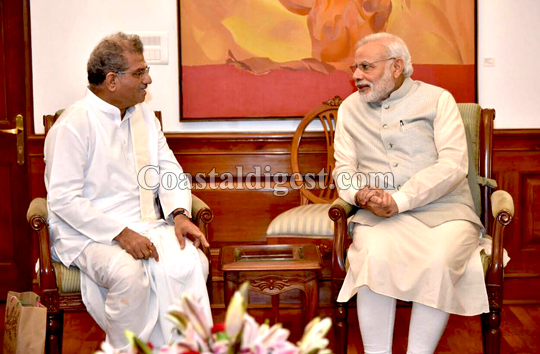
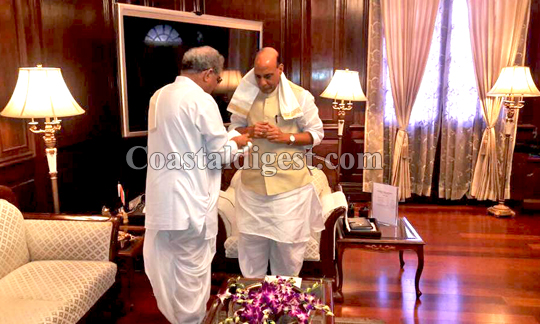
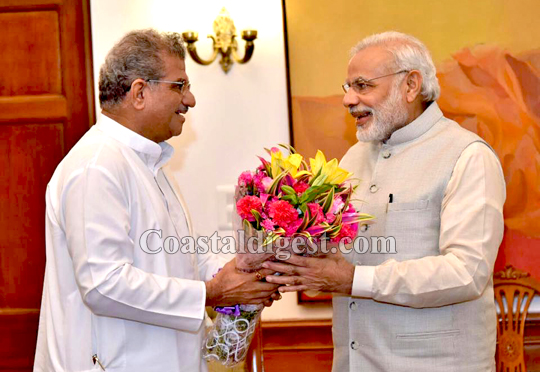
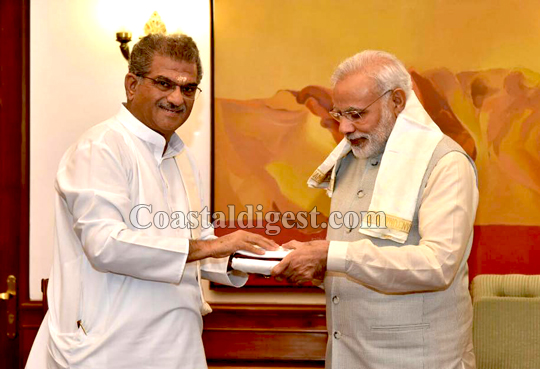
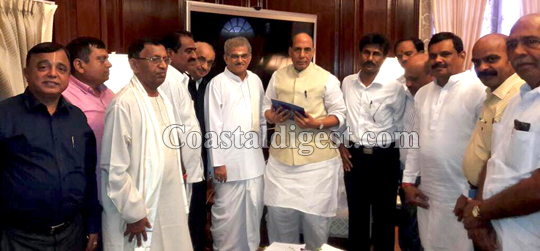
Mangaluru, Sep 1: Prime Minister Narendra Modi and Home Minister Rajnath Singh have reportedly responded positively to the long pending demand of people of Tulu Nadu to include Tulu language in the Eighth Schedule of the Indian Constitution.
veerendrahegde 1

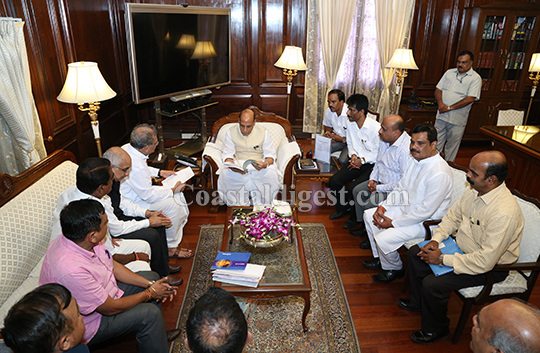
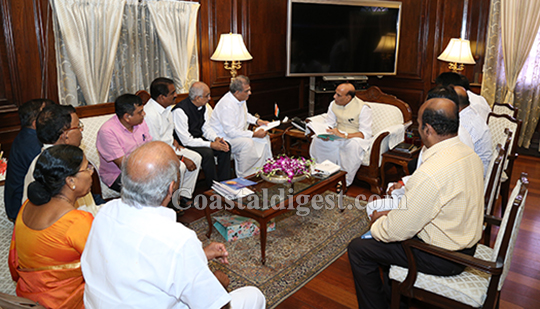
A high-powered delegation headed by D Veerendra Heggade, dharmadhikari, Sri Kshetra Dharmasthala called on the duo on Wednesday. The delegation pointed to the PM and home minister about the more than 2,800-year history of Tulu that belongs to the Dravidian family of languages.

In the oral discussions with the PM and Rajnath Singh, it was pointed that using techniques of Lexico-Statistics, scholars concluded that this language developed as an independent language since 8th century BC. Highly stylized classical literature has also developed in Tulu language.

However, with all efforts, Tulu has not been included in the Eighth Schedule which currently contains list of 22 scheduled languages, out of which 18 belong to other parts of India.

The remaining four languages namely, Malayalam, Tamil, Telugu and Kannada belong to South India. Inclusion of Tulu language in the Eighth Schedule is a long pending demand of Tulvas, the delegation stated hoping the duo will do justice for this language. Recently, Tulu Wikipedia has been activated where more than 1500 scholarly articles uploaded. The delegation also handed over a detailed memorandum in this regard with all relevant supporting.

Though Tulu is one of the five Dravidian languages, unlike other Dravidian languages its speakers do not have a separate state. Tulu people have been living harmoniously with others over the years yet they have shown their individuality and uniqueness in culture and literature.

Tulu speakers have always left a distinct mark in whatever sphere they have been in. Janaki Brahmavara, president of Karnataka Tulu Sahitya Academy was part of the delegation.
veerendrahegde 2

veerendrahegde 3

veerendrahegde 4

veerendrahegde 5

tuluu 1

tuluu 2

tuluu 3

Comments

PREM
 - 
Thursday, 1 Sep 2016

What is the need for it...
People are dying in the shoulders of their fathers.
Y cant this HI Fi show-offs request demand for improvement of hospitals and other areas which are still backward?

Add new comment

  • Coastaldigest.com reserves the right to delete or block any comments.
  • Coastaldigset.com is not responsible for its readers’ comments.
  • Comments that are abusive, incendiary or irrelevant are strictly prohibited.
  • Please use a genuine email ID and provide your name to avoid reject.
Media Release
February 14,2020

Veteran journalist P. Sainath has said that the nation is in a crisis. And this crisis is not limited to just the rural area. It has become a national crisis at various areas such as agriculture, education, economy, job creation etc.

He was delivering the endowment lecture on the topic ‘Indian democracy at the post-liberalization and post-truth era’ at Media Manthan 2020 organized by the PG department of journalism and mass communication at St Aloysius College (Autonomous). 

Mr Sainath said that the many policies adopted in the 90s led to India becoming unusually unequal. Referring to the speech Ambedkar had made at the Constituent Assembly while handing over the draft of the Constitution, Mr Sainath said, “Ambedkar had warned about the weakness of Indian democracy that liberty without equality allows the supremacy of a few over the multitude. Liberty, equality and fraternity must be kept together as we cannot have one without the other.” 

Mr Sainath stated that the agrarian crisis was no longer about the loss of productivity, employment or about farmer suicide; it was a societal, civilizational crisis. Commenting on the lopsided policies such as cow-slaughter ban, he explained how cow slaughter ban had adversely affected many industries due to their interdependency. While Muslims who slaughtered cows were rendered helpless, the cattle traders who were mostly OBCs lost their earnings as the cattle prices crashed. An important industry like Kolhapur sandals industry in Maharashtra went bankrupt as a result of the cow slaughter ban in Maharashtra. He said the policymakers had no idea how the rural industries were interconnected. Demonetisation too devastated the rural economy as 98 percent of rural transactions happen through cash. 

Mr Sainath also spoke about the crisis of inequality which affects the Dalits and the Adivasis far more than anyone else as 90 percent of the rural households take home less than Rs 10,000/- per month. “Women are yet another group whose labour is never counted in the gross domestic product. Women and girls globally do unpaid work which amounts to about 12.5 billion working hours per year. Monetarily speaking, this is worth 10.8 trillion dollars,” Mr Sainath added. 

Speaking about the crisis of jobs Mr Sainath said that major companies were laying off employees just to create more profits for the investors and the adoption of artificial intelligence in the industry would further destroy millions of jobs.

Rector of St Aloysius College Institutions Fr Dionysius Vaz SJ, Principal Dr (Fr) Praveen Martis SJ, HOD of Journalism and Mass Communication department Dr (Fr) Melwyn Pinto SJ were present.

‘Veerappan and Vijay Mallya’s business models are interesting!’

Addressing the gathering during his endowment lecture on Friday, Mr Sainath made an interesting comment on the so called ‘revenue model’. “Whenever I visit IIMs and IITs for lectures on my PARI project, the students there ask me what my revenue model for my project is. I tell them that I do not have a revenue model. In fact, journalism does not begin with a revenue model. Gandhiji, Ambedkar, Bhagat Singh were all great journalists. But they did not have a revenue model,” Mr Sainath said.

On a lighter note, he said that the best revenue model that he liked was that of forest brigand Veerappan and liquor baron Vijay Mallya. “Veerappan ruled the forest for forty years and from the top ministers to the villagers he could dictate terms and liver royally. Similarly, Mallya’s revenue model was to steal the banks and run away abroad and live like a king,” Mr Sainath added.

Journalism is not and can never be a business. It is a calling, he opined. While newspaper can be a business, television can be a business, journalism per se cannot be reduced to a business. “Unfortunately today, journalists are recruited on a contract basis and they have no bargaining power; and there are no unions to fight for their cause. Hence, they are at the mercy of the corporate media houses for their survival and are made to write stories that cannot be called journalism,” Mr Sainath said.

Answering a question as to the pressures he faced as a journalist, he said that external pressures from the government or others could be very well handled. It is the internal pressures from once own media house that journalists find it difficult to manage.


Comments

Add new comment

  • Coastaldigest.com reserves the right to delete or block any comments.
  • Coastaldigset.com is not responsible for its readers’ comments.
  • Comments that are abusive, incendiary or irrelevant are strictly prohibited.
  • Please use a genuine email ID and provide your name to avoid reject.
News Network
February 7,2020

Mangaluru, Feb 7: In an attempt to promote menstrual hygiene among women, the Karnataka State Road Transport Corporation (KSRTC) has installed vending machines and incinerators to dispense and dispose off sanitary napkins at 10 bus stands of the state including Mangaluru.

The machines have been installed inside the women's washroom and women can purchase sanitary napkins from the vending machines by inserting five rupee coins.

Nearly 100 napkins can be stored in the vending machines at a time and housekeeping personnel have been instructed to replenish the stock, as and when required.

While directions on how to use the machine have been displayed near the machines, people can get seek assistance from housekeeping staff if needed.

Initially, the machines were installed at two depots in Bengaluru on a pilot basis and in the second phase it has been extended to 10 KSRTC bus depots.

Comments

Add new comment

  • Coastaldigest.com reserves the right to delete or block any comments.
  • Coastaldigset.com is not responsible for its readers’ comments.
  • Comments that are abusive, incendiary or irrelevant are strictly prohibited.
  • Please use a genuine email ID and provide your name to avoid reject.
News Network
March 21,2020

Mangaluru, Mar 21: Southern Railway has cancelled some more trains in view of poor patronage due to restrictions in place to prevent the spread of COVID-19.

Train No.16565 Yesvantpur-Mangaluru Central Weekly Express has been cancelled on March 22 and March 29.

Train No.16566 Mangaluru Central-Yesvantpur Weekly Express will not run on March 23 and March 30.

Train No.10215 Madgaon-Ernakulam Weekly Superfast Express will not be operated on March 22 and March 29.

Train No. 10216 Ernakulam-Madgaon Weekly Superfast Express will not run on March 23 and March 30.

Train No.16355 Kochuveli-Mangaluru Junction Antyodaya Express, scheduled to leave Kochuveli on March 21, 26 and on March 28 stands cancelled.

Train No.16356 Mangaluru Junction-Kochuveli Antyodaya Express, scheduled to leave Mangaluru Junction on March 22, 27 and March 29 will not be operated, a Southern Railway release said.

Hubballi–KSR Bengaluru–Hubballi Janashatabdi (Daily) Express (12079/12080), Mysuru–Yelahanka–Mysuru Malgudi (Daily Express)

(16023/16024), Yeshwantpur–Pandharpur–Yeshwantpur (Weekly) Express (16541/16542), Mysuru–KSR Bengaluru–Mysuru Rajyarani Express

(16557/16558), Shivamogga–Yeshwantpur –Shivamogga Express Special (06539/06540), Mysuru–Renigunta–Mysuru Weekly Express

(11065/11066), Mysuru–Sainagar Shirdi–Mysuru Weekly Express (16217/16218), Yeshwantpur–Mangaluru–Yeshwantpur Weekly Express (16565/16566), and Belagavi–Mysuru Vishwamanava (Daily) Express (17326).

Mysuru–Belagavi Vishwamanava (Daily) Express (17325) has been cancelled till April 1.

The services of Train No.16023/16024 Mysuru-Yelahanka-Mysuru Malgudi Express has been cancelled from March 20 to March 31.

Similarly, Train No.16557/16558 Mysuru-KSR Bengaluru-Mysuru Rajya Rani Express will not ply from March 20 to March 31, according to a railway release.

Train No. 17325 Belagavi-Mysuru Vishwamanava Express will not operate from March 21 to April 1 and the corresponding service of Train No.17326 from Mysuru to Belagavi will remain cancelled from March 20 to March 31.

The authorities have also cancelled the service of Train No.11065 Mysuru to Renigunta weekly express which was to operate on March 20 and March 27 and the corresponding service from Renigunta to Mysuru on March 21 and March 28.

Likewise, Train No.16217 Mysuru to Sainagar Shirdi weekly express will not operate on March 23 and March 30 and the journey in the return direction of Train No.16218 Sainagar Shirdi to Mysuru weekly express on March 24 and March 31 stands cancelled.

The railway authorities have cancelled the Hubballi-KSR Bengaluru-Hubballi Janshatabdi superfast express from March 20 to March 31 and the services of Train No.06539/06540 Yasvantpur- Shivamogga Town-Yasvantpur express for March 20, 24, 25, 26, 27 and March 31 stands cancelled.

The other trains cancelled for a limited period include Train No.16541 Yasvantpur to Pandharpur weekly express for its journey commencing on March 19 and 26 and the return journey on March 20 and 27.

Comments

Add new comment

  • Coastaldigest.com reserves the right to delete or block any comments.
  • Coastaldigset.com is not responsible for its readers’ comments.
  • Comments that are abusive, incendiary or irrelevant are strictly prohibited.
  • Please use a genuine email ID and provide your name to avoid reject.