Modi, Rajnath assure to include Tulu in 8th schedule of constitution

[email protected] (CD Network)
September 1, 2016

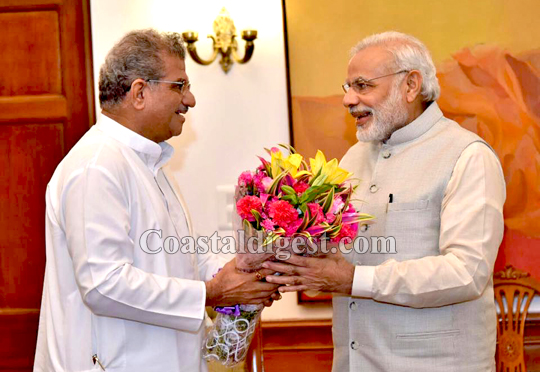
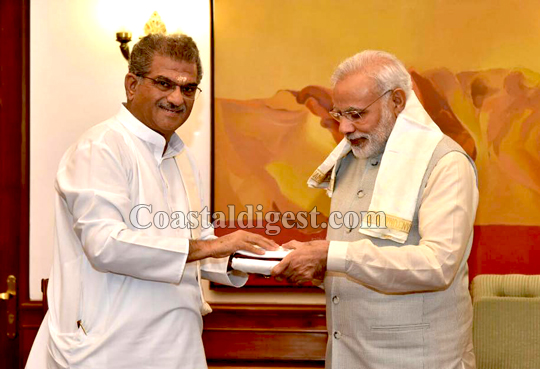
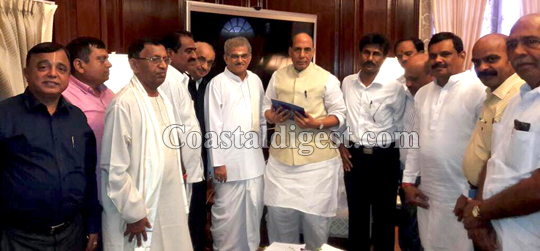
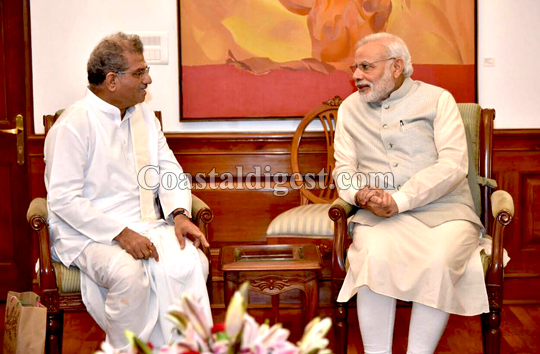
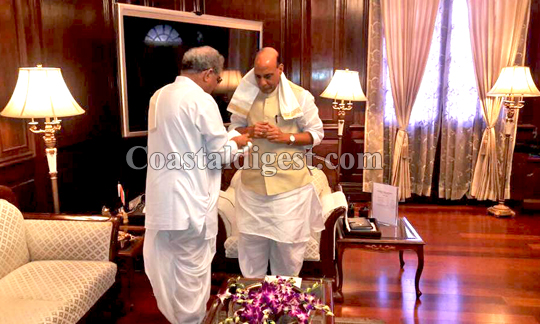
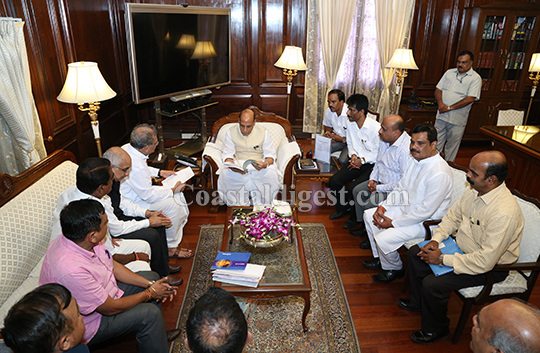
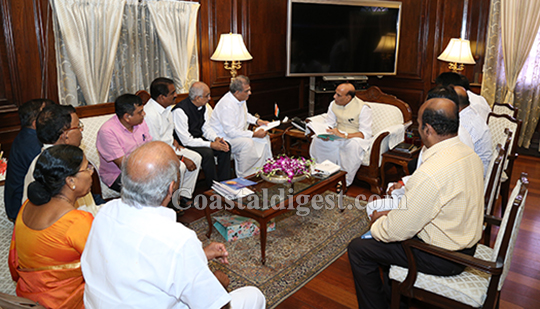
Mangaluru, Sep 1: Prime Minister Narendra Modi and Home Minister Rajnath Singh have reportedly responded positively to the long pending demand of people of Tulu Nadu to include Tulu language in the Eighth Schedule of the Indian Constitution.

veerendrahegde 1

A high-powered delegation headed by D Veerendra Heggade, dharmadhikari, Sri Kshetra Dharmasthala called on the duo on Wednesday. The delegation pointed to the PM and home minister about the more than 2,800-year history of Tulu that belongs to the Dravidian family of languages.

In the oral discussions with the PM and Rajnath Singh, it was pointed that using techniques of Lexico-Statistics, scholars concluded that this language developed as an independent language since 8th century BC. Highly stylized classical literature has also developed in Tulu language.

However, with all efforts, Tulu has not been included in the Eighth Schedule which currently contains list of 22 scheduled languages, out of which 18 belong to other parts of India.

The remaining four languages namely, Malayalam, Tamil, Telugu and Kannada belong to South India. Inclusion of Tulu language in the Eighth Schedule is a long pending demand of Tulvas, the delegation stated hoping the duo will do justice for this language. Recently, Tulu Wikipedia has been activated where more than 1500 scholarly articles uploaded. The delegation also handed over a detailed memorandum in this regard with all relevant supporting.

Though Tulu is one of the five Dravidian languages, unlike other Dravidian languages its speakers do not have a separate state. Tulu people have been living harmoniously with others over the years yet they have shown their individuality and uniqueness in culture and literature.

Tulu speakers have always left a distinct mark in whatever sphere they have been in. Janaki Brahmavara, president of Karnataka Tulu Sahitya Academy was part of the delegation.

veerendrahegde 2

veerendrahegde 3

veerendrahegde 4

veerendrahegde 5

tuluu 1

tuluu 2

tuluu 3

Comments

PREM
 - 
Thursday, 1 Sep 2016

What is the need for it...
People are dying in the shoulders of their fathers.
Y cant this HI Fi show-offs request demand for improvement of hospitals and other areas which are still backward?

Add new comment

  • Coastaldigest.com reserves the right to delete or block any comments.
  • Coastaldigset.com is not responsible for its readers’ comments.
  • Comments that are abusive, incendiary or irrelevant are strictly prohibited.
  • Please use a genuine email ID and provide your name to avoid reject.
News Network
April 19,2020

Kasaragod, Apr 19: Kasaragod, Kerala's COVID-19 hotspot, is the only district in the southern state lacking adequate health infrastructure.

In spite of treating the highest number of COVID-19 patients in the state with meagre infrastructural facilities and even without the support of a medical college in the north Kerala district, no deaths have been reported due to coronavirus.

The state health department views the performance of M Kunhiraman and his team, consisting of Janardhana Naik and Krishna Naik, at the General hospital in Kasaragod as a success story.

"Not only did they control the situation quickly with minimum infrastructure, they also started turning out a large number of negative cases within a few weeks and creditably ensured zero mortality.

This can be showcased as a best global model," Chairman of the Information Education and Communication (IEC) Committee and Project Director Kerala State Aids Control Society, R Ramesh said.

Recalling the ordeal, Janardhana Naik said his first major challenge was the physical examination of a patient with suspected COVID-19.

"Even with the PPE kit, nobody knew how effective they were and it took a whole 30 minutes to wear them properly.

But as time passed, we got accustomed to it," he said.

The traditional method of dealing with a patient involved knowing his or her history, observation and physical examination.

For hundreds of years, the hands-on body approach has been the soul of the doctor-patient relationship -- taking the pulse, tapping on and listening to the chest, feeling lumps.

With the onset of COVID-19 all that has changed.

"In fact, the whole exercise was fraught with grave risks because everything connected with COVID-19 was new.

Doctors have to keep a distance even though the physical examination wearing a Personal Protective Equipment (PPE) is difficult.

Sounds from the body are inaudible, vision is blurred through the smog-covered goggles and a stethoscope seldom has any use," Janardhana Naik said.

It was from March 15 that the hospital started receiving COVID-19 patients, primarily from Dubai.

By the time the first person came, the hospital was ready for him.

Soon, patient numbers began to swell and in a couple of weeks they reached about 91.

From then on, it was teamwork.

Committees were formed for each and every task, including the help desk, IT, treatment, medical board, training, food, waste disposal and data maintenance.

Initially, patients had many misgivings about the hospital.

"Some were disillusioned and even aggressive. Some were not happy with the facilities the hospital had to offer.

But gradually through good treatment and counselling by a psychiatrist, who visited the hospital on alternate days, the confidence and mood of the patients changed and they became friendly with the staff," Naik elaborated.

Counselling was also given to the concerned family members of the patients.

Besides treatment, the medical staff had to spend a considerable amount of time clearing the doubts of patients.

When they got discharged some patients insisted on seeing the faces of the medical staff, who till then were anonymous entities covered from head to toe.

Some even wanted to take selfies with them.

However, the medical team politely turned down their requests and preferred to remain hidden in their work attires.

The mood of the patients also rubbed off on the doctors and hospital staff.

All the physicians and hospital staff are now more confident of dealing with contagious diseases after treating COVID-19 patients.

"Our previous experience of treating H1N1, Chikungunya and Dengue cases helped us a lot.

Words of encouragement from the Health Minister K K Shailaja, Health Principal Secretary Dr Rajan N Khobragade and Health Services Director Dr Sarita R L gave us the impetus to build up confidence.

Moreover, the field health workers did a wonderful job in containing the viral spread," Naik added.

As the number of coronavirus cases rose, the state government on April 5 deputed a 26-member medical team from Thiruvananthapuram to set up a COVID-19 hospital in the district.

They turned a block of the under construction Government Medical College as a hospital-like facility, setting up a 200 bed facility to treat coronavirus patients.


Comments

Add new comment

  • Coastaldigest.com reserves the right to delete or block any comments.
  • Coastaldigset.com is not responsible for its readers’ comments.
  • Comments that are abusive, incendiary or irrelevant are strictly prohibited.
  • Please use a genuine email ID and provide your name to avoid reject.
News Network
January 16,2020

Udupi, Jan 16: Admar Mutt Junior seer Eshapriya Theertha Swami is all set to take over the reins of Krishna Mutt during the 250th Paryayotsava, scheduled to be held on January 17 and 18.

The uniqueness lies in the fact that the Admar Mutt, one of the Ashta Mutts of Krishna Mutt in this Temple town Udupi, ushers in the new Paryaya cycle (32nd). The Paryaya of outgoing seer Vidyadheesha Theertha Swami of Palimaru Mutt, Admar’s dwandwa (associate) mutt, marks the end of the cycle of eight mutts.

Under the system initiated by the Madhwa philosopher and saint Madwacharya, the seers of Ashta mutts would take turns to worship Lord Krishna every two months. Seer Vadiraja (1481-1601) ended the system and introduced the system of f running the temple administration once in two years.

Comments

Add new comment

  • Coastaldigest.com reserves the right to delete or block any comments.
  • Coastaldigset.com is not responsible for its readers’ comments.
  • Comments that are abusive, incendiary or irrelevant are strictly prohibited.
  • Please use a genuine email ID and provide your name to avoid reject.
News Network
April 9,2020

Kasaragod, April 9: After Supreme Court intervened and settled the Border issue with Karnataka authorities who had consented to allow the critically-ill patients from in and around Kasaragod and nearby areas to cross over to nearby Mangalore for getting urgent and critical care treatment, the Karnataka authorities is alleged to continue to be hostile either by blocking way ahead or turning a deaf ear to the patients reaching there.

It was on Wednesday onwards that the check post at Thalapadi near here on the Kozhikode-Mangalore National Highway was opened for the critically-ill patients to cross over to Mangalore hospitals for medical treatment.

However, reports reaching here said two out of the three critically-ill patients, who made it to Mangalore were allegedly ill-treated or given no treatment forcing them to return back to Kerala.

Comments

Add new comment

  • Coastaldigest.com reserves the right to delete or block any comments.
  • Coastaldigset.com is not responsible for its readers’ comments.
  • Comments that are abusive, incendiary or irrelevant are strictly prohibited.
  • Please use a genuine email ID and provide your name to avoid reject.