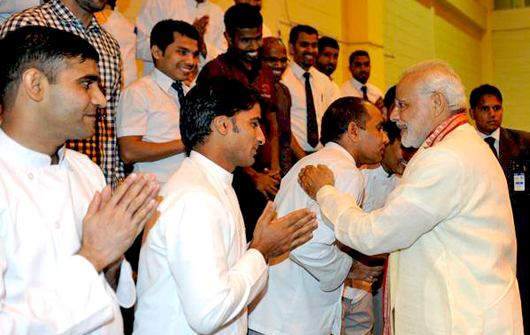
Modi reaches out to Indian workers who build glitzy skyscrapers in UAE

August 17, 2015

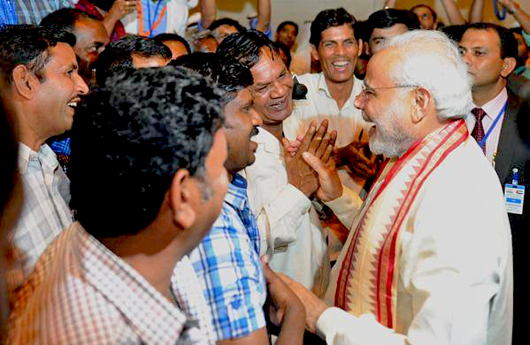
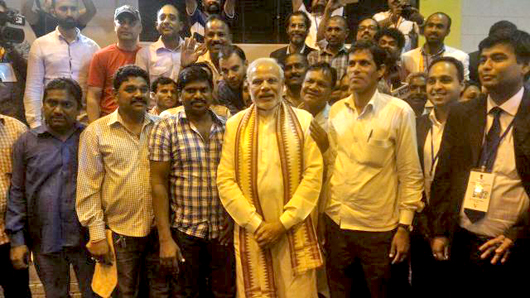
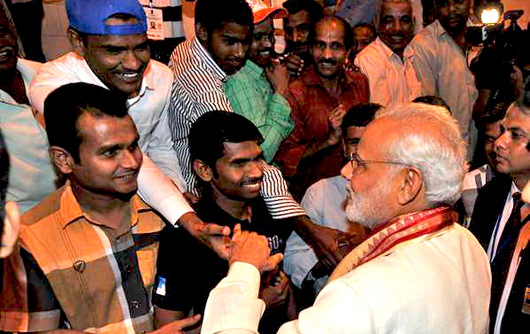
New Delhi, Aug 17: Prime Minister Narendra Modi visited a labour camp in Abu Dhabi on Sunday to highlight New Delhi's concern about the welfare of its migrant workers helping to build glitzy skyscrapers, hotels and museums in the oil-rich Gulf state.
modinri 4

PM Modi's two-day visit to the United Arab Emirates coincides with international calls to improve workers' conditions in Gulf countries, which rely on Asian labour for mega projects such as the World Expo 2020 in Dubai and the FIFA World Cup 2022 in Qatar.

Some 2.6 million Indians live and work in the UAE, according to Indian embassy figures. The embassy estimates about 60 per cent of those are blue-collar workers.

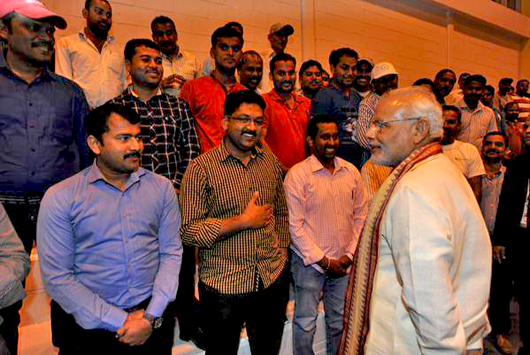
About 200 workers broke into applause when PM Modi arrived at an indoor basketball court at the labour camp in the Industrial City of Abu Dhabi. PM Modi chatted with the workers, enquiring about the place and their welfare and jobs, but made no comments to the media.

The Prime Minister is due to attend a public event in Dubai on Monday with some 40,000 Indian expatriates expected to attend.

"He wants to convey that the safety, security and welfare conditions for Indian workers should not be ignored," a senior Indian government official told Reuters in New Delhi.

"The Indian government is aware that the UAE will employ thousands of Indian workers to organize the World Expo 2020, but after the recent Qatar experience, the government wants to send a clear message that India will not allow rampant exploitation of its workers."

In November, India launched a campaign for higher wages for its workers in the Gulf states. Indian diplomats raised the minimum salaries they recommend because of higher living costs.
modinri 2

UAE officials, including the labour minister, have said that labour legislation in the country is in line with the UAE constitution. Laws regulate the labour market, providing protection of workers and their rights, they said.

Several measures, including mid-day breaks for workers in the country's sweltering summer heat, better healthcare facilities and accommodation have been provided across the UAE. But rights groups think a lot more needs to be done.

"Lack of proper regulation by the authorities in both India and the UAE of the booming migrant-worker recruitment industry, including visa brokers, has allowed rogue recruiting agents to cause serious human rights abuses with impunity," Salil Shetty, secretary-general of Amnesty International said.

"Some welcome improvements by the UAE over the last decade have been put in serious doubt by the crackdown on labour activists and failure to carry out meaningful reform of the kafala system, further increasing the vulnerability of migrant workers to human rights abuses."

PM Modi will be seeking to engage Abu Dhabi, one of the richest sovereign wealth funds in the world, to invest in India as well as expand cooperation in the energy sector. Abu Dhabi accounts for 9 percent of India's energy needs and India wants to increase that, the official said.

"The orientation of the Gulf countries has always been towards US and Europe, but the prime minister wants to highlight the benefits of investing in India and he wants to engage Abu Dhabi on long-term projects," the official said.
modiw

modinri 1

modinri 3

Comments

Theresa
 - 
Tuesday, 10 Jan 2017

Its like you read my mind! You seem to know a lot about this,
like you wrote the book in it or something. I think that you can do with some pics to drive the message home a
bit, but instead of that, this is fantastic blog.
A great read. I will definitely be back.

my web blog: auto transport: http://kfta.korea.com/xe/?document_srl=6817969

Add new comment

  • Coastaldigest.com reserves the right to delete or block any comments.
  • Coastaldigset.com is not responsible for its readers’ comments.
  • Comments that are abusive, incendiary or irrelevant are strictly prohibited.
  • Please use a genuine email ID and provide your name to avoid reject.
News Netwok
April 25,2020

Bengaluru, Apr 25: KPCC president D K Shivakumar, has alleged that BJP leaders from the state have sold rice that was meant to be distributed to the poor in Tamil Nadu.

Speaking to newsmen here on Friday, he stated that Congress fully supports the government’s work in the prevention of the spread of COVID-19, but maybe unknown to the Chief Minister, corrupt dealings are which we want to bring to his attention.

He alleged that 1,879 quintals of rice brought from Haryana have been illegally sold to a businessman in Hosur, Tamil Nadu.

Comments

Add new comment

  • Coastaldigest.com reserves the right to delete or block any comments.
  • Coastaldigset.com is not responsible for its readers’ comments.
  • Comments that are abusive, incendiary or irrelevant are strictly prohibited.
  • Please use a genuine email ID and provide your name to avoid reject.
News Network
July 2,2020

Mangaluru, Jul 2: Mangaluru BJP Corporator Manohar Shetty, who entered a manhole to clean a drain, said that he did it to avoid waterlogging ahead of monsoon as people were facing several problems for the past few years.

"In my ward, there is a rainwater drain at Kadri Kambla junction and for the past few years, there was a waterlogging problem due to trash water used to collect and vehicles used to find it difficult to pass in that area," Shetty said.

"Since there was a lot of trash it had to be cleared to avoid waterlogging. We changed our dresses, and then I along with my three party workers entered manhole and cleared the trash," he said.

The Mangaluru BJP Corporator further said that it was not a publicity stunt, and he cleaned the drain to solve the problem of people. "During elections, I had promised people to get the drain cleaned. Since monsoon was coming; something had to be done; we did not do it for publicity but to solve a problem," he said.

Comments

Add new comment

  • Coastaldigest.com reserves the right to delete or block any comments.
  • Coastaldigset.com is not responsible for its readers’ comments.
  • Comments that are abusive, incendiary or irrelevant are strictly prohibited.
  • Please use a genuine email ID and provide your name to avoid reject.
Agencies
June 17,2020

Riyadh, Jun 17: Saudi Arabia is expected to scale back or call off this year's hajj pilgrimage for the first time in its modern history, observers say, a perilous decision as coronavirus cases spike.

Muslim nations are pressing Riyadh to give its much-delayed decision on whether the annual ritual will go ahead as scheduled in late July.

But as the kingdom negotiates a call fraught with political and economic risks in a tinderbox region, time is running out to organise logistics for one of the world's largest mass gatherings.

A full-scale hajj, which last year drew about 2.5 million pilgrims, appears increasingly unlikely after authorities advised Muslims in late March to defer preparations due to the fast-spreading disease.

"It's a toss-up between holding a nominal hajj and scrapping it entirely," a South Asian official in contact with Saudi hajj authorities said.

A Saudi official said: "The decision will soon be made and announced."

Indonesia, the world's most populous Muslim nation, withdrew from the pilgrimage this month after pressing Riyadh for clarity, with a minister calling it a "very bitter and difficult decision".

Malaysia, Senegal and Singapore followed suit with similar announcements.

Many other countries with Muslim populations -- from Egypt and Morocco to Turkey, Lebanon and Bulgaria -- have said they are still awaiting Riyadh's decision.

In countries like France, faith leaders have urged Muslims to "postpone" their pilgrimage plans until next year due to the prevailing risks.

The hajj, a must for able-bodied Muslims at least once in their lifetime, represents a major potential source of contagion as it packs millions of pilgrims into congested religious sites.

But any decision to limit or cancel the event risks annoying Muslim hardliners for whom religion trumps health concerns.

It could also trigger renewed scrutiny of the Saudi custodianship of Islam's holiest sites -- the kingdom's most powerful source of political legitimacy.

A series of deadly disasters over the years, including a 2015 stampede that killed up to 2,300 worshippers, has prompted criticism of the kingdom's management of the hajj.

"Saudi Arabia is caught between the devil and the deep blue sea," Umar Karim, a visiting fellow at the Royal United Services Institute in London, told AFP.

"The delay in announcing its decision shows it understands the political consequences of cancelling the hajj or reducing its scale."

"Buying time"

The kingdom is "buying time" as it treads cautiously, the South Asian official said.

"At the last minute if Saudi says 'we are ready to do a full hajj', (logistically) many countries will not be in a position" to participate, he said.

Amid an ongoing suspension of international flights, a reduced hajj with only local residents is a likely scenario, the official added.

A decision to cancel the hajj would be a first since the kingdom was founded in 1932.

Saudi Arabia managed to hold the pilgrimage during previous outbreaks of Ebola and MERS.

But it is struggling to contain the virus amid a serious spike in daily cases and deaths since authorities began easing a nationwide lockdown in late May.

In Saudi hospitals, sources say intensive care beds are fast filling up and a growing number of health workers are contracting the virus as the total number of cases has topped 130,000. Deaths surpassed 1,000 on Monday.

To counter the spike, authorities this month tightened lockdown restrictions in the city of Jeddah, gateway to the pilgrimage city of Mecca.

"Heartbroken"

"The hajj is the most important spiritual journey in the life of any Muslim, but if Saudi Arabia proceeds in this scenario it will not only exert pressure on its own health system," said Yasmine Farouk from the Carnegie Endowment for International Peace.

"It could also be widely held responsible for fanning the pandemic."

A cancelled or watered-down hajj would represent a major loss of revenue for the kingdom, which is already reeling from the twin shocks of the virus-induced slowdown and a plunge in oil prices.

The smaller year-round umrah pilgrimage was already suspended in March.

Together, they add $12 billion to the Saudi economy every year, according to government figures.

A negative decision would likely disappoint millions of Muslim pilgrims around the world who often invest their life savings and endure long waiting lists to make the trip.

"I can't help but be heartbroken -- I've been waiting for years," Indonesian civil servant Ria Taurisnawati, 37, told AFP as she sobbed.

"All my preparations were done, the clothes were ready and I got the necessary vaccination. But God has another plan."

Comments

Add new comment

  • Coastaldigest.com reserves the right to delete or block any comments.
  • Coastaldigset.com is not responsible for its readers’ comments.
  • Comments that are abusive, incendiary or irrelevant are strictly prohibited.
  • Please use a genuine email ID and provide your name to avoid reject.