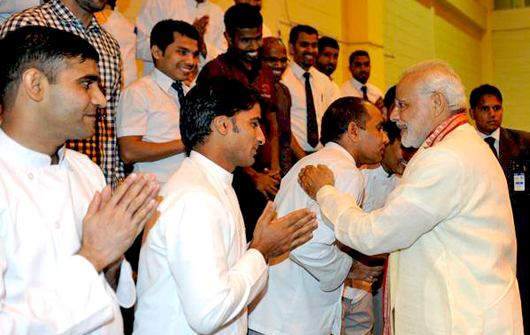
Modi reaches out to Indian workers who build glitzy skyscrapers in UAE

August 17, 2015

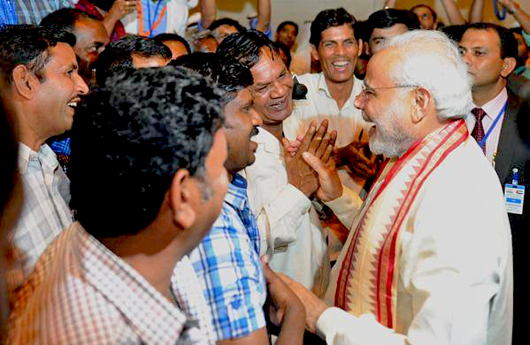
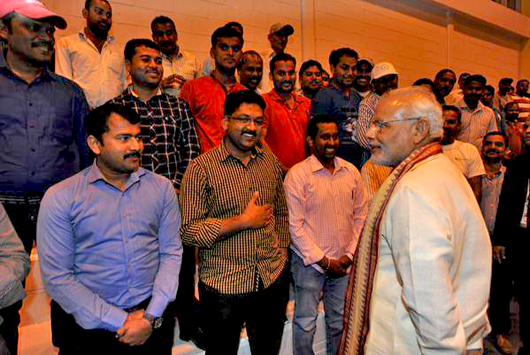
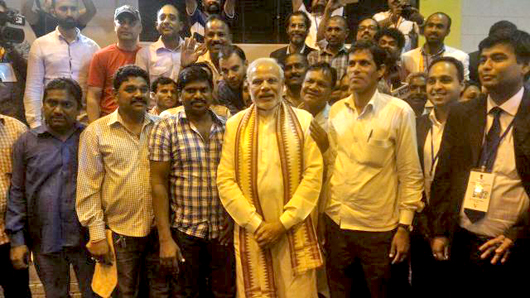
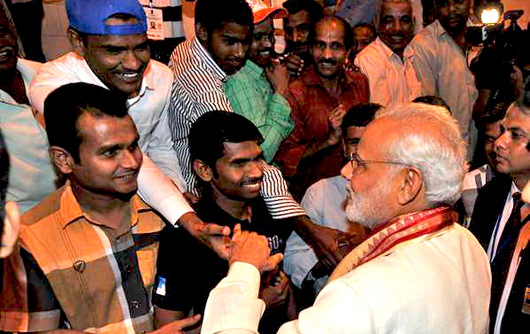
New Delhi, Aug 17: Prime Minister Narendra Modi visited a labour camp in Abu Dhabi on Sunday to highlight New Delhi's concern about the welfare of its migrant workers helping to build glitzy skyscrapers, hotels and museums in the oil-rich Gulf state.
modinri 4

PM Modi's two-day visit to the United Arab Emirates coincides with international calls to improve workers' conditions in Gulf countries, which rely on Asian labour for mega projects such as the World Expo 2020 in Dubai and the FIFA World Cup 2022 in Qatar.

Some 2.6 million Indians live and work in the UAE, according to Indian embassy figures. The embassy estimates about 60 per cent of those are blue-collar workers.

About 200 workers broke into applause when PM Modi arrived at an indoor basketball court at the labour camp in the Industrial City of Abu Dhabi. PM Modi chatted with the workers, enquiring about the place and their welfare and jobs, but made no comments to the media.

The Prime Minister is due to attend a public event in Dubai on Monday with some 40,000 Indian expatriates expected to attend.

"He wants to convey that the safety, security and welfare conditions for Indian workers should not be ignored," a senior Indian government official told Reuters in New Delhi.

"The Indian government is aware that the UAE will employ thousands of Indian workers to organize the World Expo 2020, but after the recent Qatar experience, the government wants to send a clear message that India will not allow rampant exploitation of its workers."

In November, India launched a campaign for higher wages for its workers in the Gulf states. Indian diplomats raised the minimum salaries they recommend because of higher living costs.
modinri 2

UAE officials, including the labour minister, have said that labour legislation in the country is in line with the UAE constitution. Laws regulate the labour market, providing protection of workers and their rights, they said.

Several measures, including mid-day breaks for workers in the country's sweltering summer heat, better healthcare facilities and accommodation have been provided across the UAE. But rights groups think a lot more needs to be done.

"Lack of proper regulation by the authorities in both India and the UAE of the booming migrant-worker recruitment industry, including visa brokers, has allowed rogue recruiting agents to cause serious human rights abuses with impunity," Salil Shetty, secretary-general of Amnesty International said.

"Some welcome improvements by the UAE over the last decade have been put in serious doubt by the crackdown on labour activists and failure to carry out meaningful reform of the kafala system, further increasing the vulnerability of migrant workers to human rights abuses."

PM Modi will be seeking to engage Abu Dhabi, one of the richest sovereign wealth funds in the world, to invest in India as well as expand cooperation in the energy sector. Abu Dhabi accounts for 9 percent of India's energy needs and India wants to increase that, the official said.

"The orientation of the Gulf countries has always been towards US and Europe, but the prime minister wants to highlight the benefits of investing in India and he wants to engage Abu Dhabi on long-term projects," the official said.
modiw

modinri 1

modinri 3

Comments

Theresa
 - 
Tuesday, 10 Jan 2017

Its like you read my mind! You seem to know a lot about this,
like you wrote the book in it or something. I think that you can do with some pics to drive the message home a
bit, but instead of that, this is fantastic blog.
A great read. I will definitely be back.

my web blog: auto transport: http://kfta.korea.com/xe/?document_srl=6817969

Add new comment

  • Coastaldigest.com reserves the right to delete or block any comments.
  • Coastaldigset.com is not responsible for its readers’ comments.
  • Comments that are abusive, incendiary or irrelevant are strictly prohibited.
  • Please use a genuine email ID and provide your name to avoid reject.
Wafa Sultana
April 4,2020

Over the last couple of days when the world was occupied with unifying efforts to fight the deadly Covid19 pandemic, sections of Indian media provided viewers a familiar scapegoat – the Indian Muslims – who are often stereotyped as a community being constantly at loggerheads with the citizenry and the State. Biased media channels were quick to resort to blaming the entire Muslim community for the spread of the disease in the country, thanks to an ill-timed Tablighi Jamaat gathering at its international headquarters in Delhi’s Nizamuddin. Unsurprisingly, the opprobrium was also marked by a sudden spike in WhatsApp forwards of videos with people wearing skullcaps licking spoons and performing Sufi breathing rituals, suggesting some sort of wild conspiracy on the part of the community to spread the virus.  Some media channels were quick to formulate, hypothesize and provide loose definitions of a newly discovered form of Jihad i.e. ‘Corona Jihad ’ thereby vilifying the Islamic faith and its followers.

While the investigation on the culpability of the organizers of the Nizamuddin event is still ongoing, there is enough information to suggest that the meeting was held before any lockdown was in force, and the problem began when there was no way of getting people out once the curfew was announced. Be that as it may, there is little doubt that organizing a meet of such a scale when there is a global pandemic smacks of gross misjudgment, and definitely the organizers should be held accountable if laws or public orders were defied. Attendees who attempt to defy quarantine measures must be dealt with strictly. However, what is alarming is that the focus and narrative have now shifted from the unfortunate event at Nizamuddin to the Tablighi Jamaat itself.

For those not familiar with the Tablighi Jamaat, the organization was founded in 1926 in Mewat by scholar Maulana Mohammad Ilyas. The Jamaat’s main objective was to get Muslim youth to learn and practice pristine Islam shorn of external influences. This is achieved through individuals dedicating time for moral and spiritual upliftment secluded from the rest of the world for a brief period of time. There is no formal membership process. More senior and experienced participants typically travel from one mosque to other delivering talks on religious topics, inviting local youth to attend and then volunteer for a spiritual retreat for a fixed number of days to a mosque in a nearby town or village to present the message to their co-religionists. Contrary to ongoing Islamophobic rhetoric, the movement does not actively proselytize. The focus is rather on getting Muslims to learn the teachings and practices of Islam.  This grassroots India-based movement has now grown to almost all countries with substantial Muslim populations. Its annual meets, or ‘ijtemas’ are among the largest Islamic congregations in the world after the annual Haj. One of the reasons for its popularity and wide network in the subcontinent and wordwide is the fact that it has eschewed the need for scholarly intervention, focusing on peer learning of fundamental beliefs and practice rather than high-falutin ideological debates. The Tablighi Jamaat also distinguishes itself from other Islamic movements through its strictly apolitical nature, with a focus on individual self-improvement rather than political mobilization. Hardships and difficulty in the world are expected to be face through ‘sabr’ (patience) and ‘dua’ (supplication),  than through quest for political power or influence. In terms of ideology, it is very much based on mainstream Sunni Islamic principles derived from the Deobandi school.

So, why is all this background important in the current context? While biased media entities have expectedly brought out their Islamophobic paraphernalia out for full display, more neutral commentators have tried to paint the Tablighi Jamaat as a fringe group and have tried to distance it from 'mainstream Muslims'. While the intent is no doubt innocent, this is a trap we must not fall into. This narrative, unfortunately, is also gaining ground due to apathy some Muslims have for the group, accusing it of being “disconnected from the realities of the world”. Unlike other Muslim organizations and movements, the Tablighi Jamat, by virtue of its political indifference, does not boast of high-profile advocates and savvy spokespersons who can defend it in mainstream or social media.  The use of adjectives such as 'outdated' and 'orthodox' by liberal columnists to describe the Jamaat feeds into the malignant attempt to change the narrative from the control of the spread of the pandemic due to the Nizamuddin gathering to 'raison d'etre' of the organization itself.

A large mainstream religious group like the Tablighi Jamaat with nearly a hundred-year history, normally considered to be peaceful, apolitical and minding its own business is now suddenly being villainized owing to unfortunate circumstances. Biased media reactions filled with disgust and hate seem to feed the Indian public conscience with a danngerous misconception - to be a nominal Muslim is okay but being a practicing one is not.  For those committed to the truth and fighting the spread of Islamophobia, the temptation to throw the entire Tablighi Jamaat under the bus must be resisted.

The writer is a lawyer and research scholar at Qatar University. Her research interests include Islamic law and politics.

Comments

zahoorahmed
 - 
Saturday, 4 Apr 2020

great article! provides a great perspective on tableeg jamat

Add new comment

  • Coastaldigest.com reserves the right to delete or block any comments.
  • Coastaldigset.com is not responsible for its readers’ comments.
  • Comments that are abusive, incendiary or irrelevant are strictly prohibited.
  • Please use a genuine email ID and provide your name to avoid reject.
coastaldigest.com web desk
May 12,2020

Mangaluru, May 12: The first repatriation flight to Mangaluru from Dubai with nearly 180 passengers landed at the international airport here. 

The total passengers, including 88 men, 84 women, five children and two infants arrived by the Air India Express flight IX 384 late Tuesday night, airport sources said.

There were 12 medical emergency cases and 38 pregnant women among them, they said. The district administration had made arrangements for receiving the passengers, who were provided with sanitizers and masks. They were advised to maintain social distancing as per the health protocol.

All the foreign returnees were screened as per the standard operating procedure to ensure that they were asymptomatic.

The passengers were taken to their chosen place of accommodation in KSRTC buses. They will be undergoing a 14-day quarantine in the places, which will be monitored by doctors assigned by the health department. More than 17 hotels and 12 hostels have been arranged for the accommodation of the returnees.

Passengers were also asked to download the mandatory 'Aroygya Sethu' app for contact tracing. Rahul Shinde IAS who is in charge of arranging quarantine facilities, airport director V V Rao and district health officer Ramachandra Bairy were present at the airport.

Comments

Add new comment

  • Coastaldigest.com reserves the right to delete or block any comments.
  • Coastaldigset.com is not responsible for its readers’ comments.
  • Comments that are abusive, incendiary or irrelevant are strictly prohibited.
  • Please use a genuine email ID and provide your name to avoid reject.
coastaldigest.com news network
June 7,2020

Mangaluru/Udupi, Jun 7: Coastal districts of Dakshina Kannada and Udupi have recorded 17 and 13 new coronavirus positive cases between 5 p.m. on June 6 and 5 p.m. on June 7. 

16 among 17 new covid patients in Dakshina Kannada are returnees from Maharashtra, while one returned from Goa recently.

Maharashtra returnees comprise 14 males, including three teenagers t, and two females aged 32 and 41. The Goa returnee is a 32-year-old male.

All of them have all been admitted to the designated COVID hospital in the district.

With this, the total tally of coronavirus cases in Dakshina Kannada has risen to 203, out of which 47 are currently active. As many as 150 patients have recovered and been discharged, and seven have died.

Among the 13 in Udupi, 12 are Maharashtra returnees, while process of contact tracing of one patient, a 30-year-old woman, is going on.

The patients comprise eight males, including a 7-year-old boy, and five females. They have all been admitted to the designated hospital.

This takes the total number of coronavirus cases in Udupi district to 902, out of which 798 are currently active, 103 discharged, and one patient has died.

Comments

Add new comment

  • Coastaldigest.com reserves the right to delete or block any comments.
  • Coastaldigset.com is not responsible for its readers’ comments.
  • Comments that are abusive, incendiary or irrelevant are strictly prohibited.
  • Please use a genuine email ID and provide your name to avoid reject.