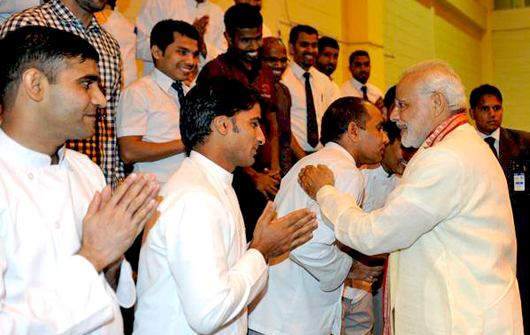
Modi reaches out to Indian workers who build glitzy skyscrapers in UAE

August 17, 2015

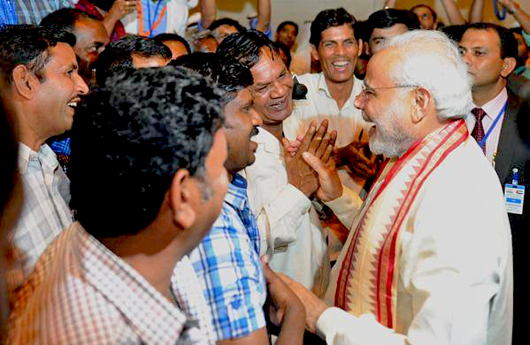
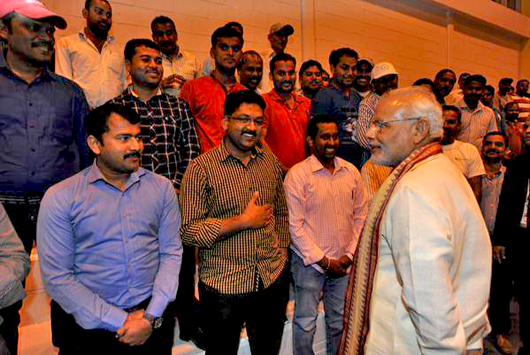
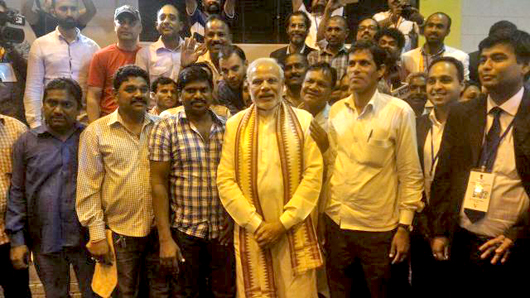
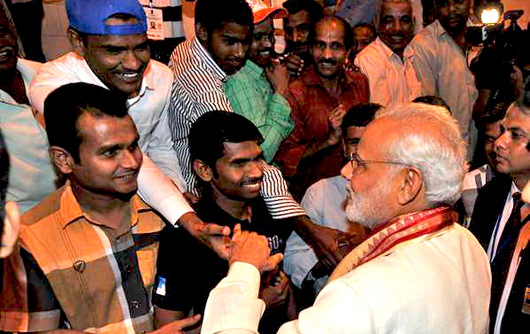
New Delhi, Aug 17: Prime Minister Narendra Modi visited a labour camp in Abu Dhabi on Sunday to highlight New Delhi's concern about the welfare of its migrant workers helping to build glitzy skyscrapers, hotels and museums in the oil-rich Gulf state.
modinri 4

PM Modi's two-day visit to the United Arab Emirates coincides with international calls to improve workers' conditions in Gulf countries, which rely on Asian labour for mega projects such as the World Expo 2020 in Dubai and the FIFA World Cup 2022 in Qatar.

Some 2.6 million Indians live and work in the UAE, according to Indian embassy figures. The embassy estimates about 60 per cent of those are blue-collar workers.

About 200 workers broke into applause when PM Modi arrived at an indoor basketball court at the labour camp in the Industrial City of Abu Dhabi. PM Modi chatted with the workers, enquiring about the place and their welfare and jobs, but made no comments to the media.

The Prime Minister is due to attend a public event in Dubai on Monday with some 40,000 Indian expatriates expected to attend.

"He wants to convey that the safety, security and welfare conditions for Indian workers should not be ignored," a senior Indian government official told Reuters in New Delhi.

"The Indian government is aware that the UAE will employ thousands of Indian workers to organize the World Expo 2020, but after the recent Qatar experience, the government wants to send a clear message that India will not allow rampant exploitation of its workers."

In November, India launched a campaign for higher wages for its workers in the Gulf states. Indian diplomats raised the minimum salaries they recommend because of higher living costs.
modinri 2

UAE officials, including the labour minister, have said that labour legislation in the country is in line with the UAE constitution. Laws regulate the labour market, providing protection of workers and their rights, they said.

Several measures, including mid-day breaks for workers in the country's sweltering summer heat, better healthcare facilities and accommodation have been provided across the UAE. But rights groups think a lot more needs to be done.

"Lack of proper regulation by the authorities in both India and the UAE of the booming migrant-worker recruitment industry, including visa brokers, has allowed rogue recruiting agents to cause serious human rights abuses with impunity," Salil Shetty, secretary-general of Amnesty International said.

"Some welcome improvements by the UAE over the last decade have been put in serious doubt by the crackdown on labour activists and failure to carry out meaningful reform of the kafala system, further increasing the vulnerability of migrant workers to human rights abuses."

PM Modi will be seeking to engage Abu Dhabi, one of the richest sovereign wealth funds in the world, to invest in India as well as expand cooperation in the energy sector. Abu Dhabi accounts for 9 percent of India's energy needs and India wants to increase that, the official said.

"The orientation of the Gulf countries has always been towards US and Europe, but the prime minister wants to highlight the benefits of investing in India and he wants to engage Abu Dhabi on long-term projects," the official said.
modiw

modinri 1

modinri 3

Comments

Theresa
 - 
Tuesday, 10 Jan 2017

Its like you read my mind! You seem to know a lot about this,
like you wrote the book in it or something. I think that you can do with some pics to drive the message home a
bit, but instead of that, this is fantastic blog.
A great read. I will definitely be back.

my web blog: auto transport: http://kfta.korea.com/xe/?document_srl=6817969

Add new comment

  • Coastaldigest.com reserves the right to delete or block any comments.
  • Coastaldigset.com is not responsible for its readers’ comments.
  • Comments that are abusive, incendiary or irrelevant are strictly prohibited.
  • Please use a genuine email ID and provide your name to avoid reject.
News Network
May 23,2020

Bengaluru, May 23: The Karnataka government on Friday said returnees from six states with high COVID-19 cases will be kept in institutional quarantine for seven days.

The states are - Maharashtra, Gujarat, Delhi, Tamil Nadu, Rajasthan and Madhya Pradesh.

As per the standard operating procedure released by the government, all people to arrive via rain, air road are expected to quarantine.

After they test negative for the disease in pool testing, they will be sent for home quarantine for another seven days, the government said.

Returnees from other low prevalence states will be asked to follow 14 days of home quarantine, according to the standard operating procedure (SOP) for entry of persons from other states to Karnataka issued by the state health department late on Friday night.

However home quarantine is allowed for pregnant ladies, people above 80 years, patients with comorbidities and children below 10 years of age, along with one attendant after they test negative.

In special cases like businessmen coming for urgent work, the quarantine period will be waived if they furnish a report from an ICMR-approved laboratory showing they tested negative for COVID-19, it said.

However, if they don't have reports, they will have to stay in institutional quarantine and can leave once their results test negative.

In case their stay exceeds 5 days, they will be sent to the fever clinic and get a five-day extension if found asymptomatic.

The report should not be more than two days old from the date of travel.

All Karnataka returnees who entered from 4 May will be tested from 5-7 days from the time of their arrival.

If found COVID-19 negative, they will be sent to home quarantine and will have to follow due precautions, the SOP stated.

Comments

Add new comment

  • Coastaldigest.com reserves the right to delete or block any comments.
  • Coastaldigset.com is not responsible for its readers’ comments.
  • Comments that are abusive, incendiary or irrelevant are strictly prohibited.
  • Please use a genuine email ID and provide your name to avoid reject.
Media Release
February 14,2020

Veteran journalist P. Sainath has said that the nation is in a crisis. And this crisis is not limited to just the rural area. It has become a national crisis at various areas such as agriculture, education, economy, job creation etc.

He was delivering the endowment lecture on the topic ‘Indian democracy at the post-liberalization and post-truth era’ at Media Manthan 2020 organized by the PG department of journalism and mass communication at St Aloysius College (Autonomous). 

Mr Sainath said that the many policies adopted in the 90s led to India becoming unusually unequal. Referring to the speech Ambedkar had made at the Constituent Assembly while handing over the draft of the Constitution, Mr Sainath said, “Ambedkar had warned about the weakness of Indian democracy that liberty without equality allows the supremacy of a few over the multitude. Liberty, equality and fraternity must be kept together as we cannot have one without the other.” 

Mr Sainath stated that the agrarian crisis was no longer about the loss of productivity, employment or about farmer suicide; it was a societal, civilizational crisis. Commenting on the lopsided policies such as cow-slaughter ban, he explained how cow slaughter ban had adversely affected many industries due to their interdependency. While Muslims who slaughtered cows were rendered helpless, the cattle traders who were mostly OBCs lost their earnings as the cattle prices crashed. An important industry like Kolhapur sandals industry in Maharashtra went bankrupt as a result of the cow slaughter ban in Maharashtra. He said the policymakers had no idea how the rural industries were interconnected. Demonetisation too devastated the rural economy as 98 percent of rural transactions happen through cash. 

Mr Sainath also spoke about the crisis of inequality which affects the Dalits and the Adivasis far more than anyone else as 90 percent of the rural households take home less than Rs 10,000/- per month. “Women are yet another group whose labour is never counted in the gross domestic product. Women and girls globally do unpaid work which amounts to about 12.5 billion working hours per year. Monetarily speaking, this is worth 10.8 trillion dollars,” Mr Sainath added. 

Speaking about the crisis of jobs Mr Sainath said that major companies were laying off employees just to create more profits for the investors and the adoption of artificial intelligence in the industry would further destroy millions of jobs.

Rector of St Aloysius College Institutions Fr Dionysius Vaz SJ, Principal Dr (Fr) Praveen Martis SJ, HOD of Journalism and Mass Communication department Dr (Fr) Melwyn Pinto SJ were present.

‘Veerappan and Vijay Mallya’s business models are interesting!’

Addressing the gathering during his endowment lecture on Friday, Mr Sainath made an interesting comment on the so called ‘revenue model’. “Whenever I visit IIMs and IITs for lectures on my PARI project, the students there ask me what my revenue model for my project is. I tell them that I do not have a revenue model. In fact, journalism does not begin with a revenue model. Gandhiji, Ambedkar, Bhagat Singh were all great journalists. But they did not have a revenue model,” Mr Sainath said.

On a lighter note, he said that the best revenue model that he liked was that of forest brigand Veerappan and liquor baron Vijay Mallya. “Veerappan ruled the forest for forty years and from the top ministers to the villagers he could dictate terms and liver royally. Similarly, Mallya’s revenue model was to steal the banks and run away abroad and live like a king,” Mr Sainath added.

Journalism is not and can never be a business. It is a calling, he opined. While newspaper can be a business, television can be a business, journalism per se cannot be reduced to a business. “Unfortunately today, journalists are recruited on a contract basis and they have no bargaining power; and there are no unions to fight for their cause. Hence, they are at the mercy of the corporate media houses for their survival and are made to write stories that cannot be called journalism,” Mr Sainath said.

Answering a question as to the pressures he faced as a journalist, he said that external pressures from the government or others could be very well handled. It is the internal pressures from once own media house that journalists find it difficult to manage.


Comments

Add new comment

  • Coastaldigest.com reserves the right to delete or block any comments.
  • Coastaldigset.com is not responsible for its readers’ comments.
  • Comments that are abusive, incendiary or irrelevant are strictly prohibited.
  • Please use a genuine email ID and provide your name to avoid reject.
News Network
February 3,2020

Bengaluru, Feb 3: The Karnataka government on Monday ordered high alert across border districts after neighbouring Kerala reported the second confirmed case of dreaded n-CoV Coronavirus. District administrations in Kodagu, Mangaluru, Chamarajanagar and Mysuru that share boundary with Kerala have been put on high alert over the movement of people with suspected cases.

In a statement released on Monday, the Health and Family welfare department said that these districts have been directed to immediately report to the State Surveillance Unit (SSU) if they come across any suspected cases of people infected with Coronavirus.

Currently, about 51 people who returned from Coronavirus-affected regions have been identified and 46 are under home isolation across Karnataka. So far, 44 samples have been sent to the National Institute of Virology, Pune for analysis and out of which 29 samples have revealed negative results. Yet, the state government has put in all possible measures to check the spread of the virus in any part of the state.

Comments

Add new comment

  • Coastaldigest.com reserves the right to delete or block any comments.
  • Coastaldigset.com is not responsible for its readers’ comments.
  • Comments that are abusive, incendiary or irrelevant are strictly prohibited.
  • Please use a genuine email ID and provide your name to avoid reject.