Modi reaches out to Indian workers who build glitzy skyscrapers in UAE

August 17, 2015

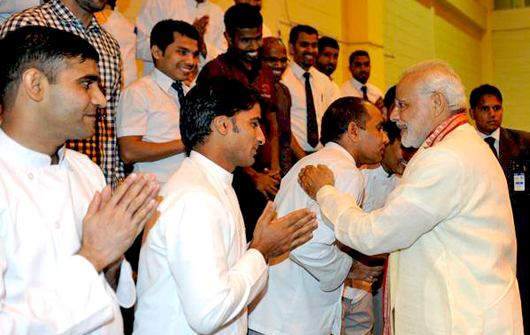
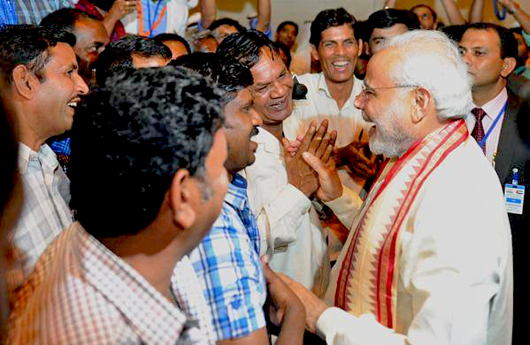
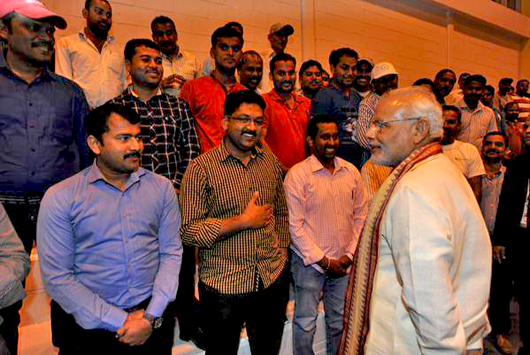
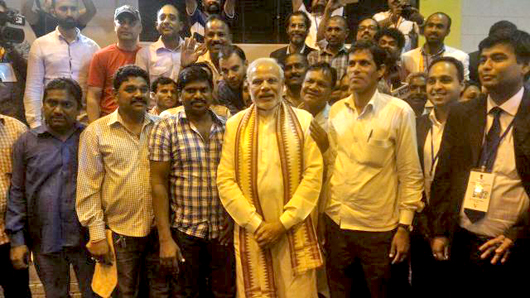
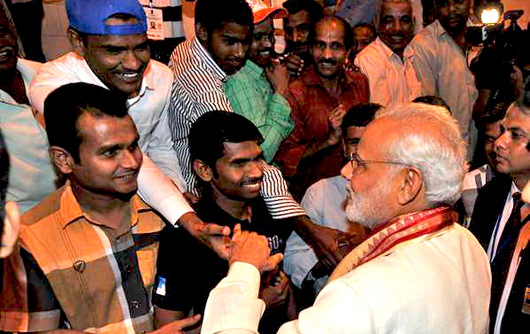
New Delhi, Aug 17: Prime Minister Narendra Modi visited a labour camp in Abu Dhabi on Sunday to highlight New Delhi's concern about the welfare of its migrant workers helping to build glitzy skyscrapers, hotels and museums in the oil-rich Gulf state.
modinri 4

PM Modi's two-day visit to the United Arab Emirates coincides with international calls to improve workers' conditions in Gulf countries, which rely on Asian labour for mega projects such as the World Expo 2020 in Dubai and the FIFA World Cup 2022 in Qatar.

Some 2.6 million Indians live and work in the UAE, according to Indian embassy figures. The embassy estimates about 60 per cent of those are blue-collar workers.

About 200 workers broke into applause when PM Modi arrived at an indoor basketball court at the labour camp in the Industrial City of Abu Dhabi. PM Modi chatted with the workers, enquiring about the place and their welfare and jobs, but made no comments to the media.

The Prime Minister is due to attend a public event in Dubai on Monday with some 40,000 Indian expatriates expected to attend.

"He wants to convey that the safety, security and welfare conditions for Indian workers should not be ignored," a senior Indian government official told Reuters in New Delhi.

"The Indian government is aware that the UAE will employ thousands of Indian workers to organize the World Expo 2020, but after the recent Qatar experience, the government wants to send a clear message that India will not allow rampant exploitation of its workers."

In November, India launched a campaign for higher wages for its workers in the Gulf states. Indian diplomats raised the minimum salaries they recommend because of higher living costs.
modinri 2

UAE officials, including the labour minister, have said that labour legislation in the country is in line with the UAE constitution. Laws regulate the labour market, providing protection of workers and their rights, they said.

Several measures, including mid-day breaks for workers in the country's sweltering summer heat, better healthcare facilities and accommodation have been provided across the UAE. But rights groups think a lot more needs to be done.

"Lack of proper regulation by the authorities in both India and the UAE of the booming migrant-worker recruitment industry, including visa brokers, has allowed rogue recruiting agents to cause serious human rights abuses with impunity," Salil Shetty, secretary-general of Amnesty International said.

"Some welcome improvements by the UAE over the last decade have been put in serious doubt by the crackdown on labour activists and failure to carry out meaningful reform of the kafala system, further increasing the vulnerability of migrant workers to human rights abuses."

PM Modi will be seeking to engage Abu Dhabi, one of the richest sovereign wealth funds in the world, to invest in India as well as expand cooperation in the energy sector. Abu Dhabi accounts for 9 percent of India's energy needs and India wants to increase that, the official said.

"The orientation of the Gulf countries has always been towards US and Europe, but the prime minister wants to highlight the benefits of investing in India and he wants to engage Abu Dhabi on long-term projects," the official said.
modiw

modinri 1

modinri 3

Comments

Theresa
 - 
Tuesday, 10 Jan 2017

Its like you read my mind! You seem to know a lot about this,
like you wrote the book in it or something. I think that you can do with some pics to drive the message home a
bit, but instead of that, this is fantastic blog.
A great read. I will definitely be back.

my web blog: auto transport: http://kfta.korea.com/xe/?document_srl=6817969

Add new comment

  • Coastaldigest.com reserves the right to delete or block any comments.
  • Coastaldigset.com is not responsible for its readers’ comments.
  • Comments that are abusive, incendiary or irrelevant are strictly prohibited.
  • Please use a genuine email ID and provide your name to avoid reject.
Media Release
May 6,2020

Mangaluru, May 6: The Kanara Chamber of Commerce and Industry has urged the government to consider erstwhile undivided Dakshina Kannada (now DK & Udupi) as one unit for the purpose of movement of people. KCCI president Isaac Vas has written a letter to Karnataka chief secretary T M Vijay Bhaskar in this regard. 

Mr Vas said: Even though the erstwhile Dakshina Kannada district was bifurcated in 1997 for administration purposes, the two districts are actually an urban agglomeration with most of the population residing in suburbs/towns. Office Staff, technical crew and labour of many industries reside in either district and commute daily for work within an efficient transport system.

The present restriction on Inter-district movement in view of the Lockdown is hindering the kick starting of industries and commerce. Workers are deprived of their livelihood and Industry and business owners are finding it challenging to move forward. To add to this, the migrant labour is moving back to their native places further aggravating the situation. Many Industries and Commercial establishments have requested us to take up this matter with the government, he said.

“Hence, we kindly request you to consider these two districts as one geographical area for the movement of people and private vehicles,” he said adding that this would facilitate movement of people for employment and business in either districts of Dakshina Kannada & Udupi.

He pointed out that Bangalore Rural, Bangalore Urban, Ramanagara, Chikkaballapur and Kolar are considered as a single unit as per your order No. RD158/TNR 2020 dt 03/05/2020 (Clause 2(a)).

Comments

Add new comment

  • Coastaldigest.com reserves the right to delete or block any comments.
  • Coastaldigset.com is not responsible for its readers’ comments.
  • Comments that are abusive, incendiary or irrelevant are strictly prohibited.
  • Please use a genuine email ID and provide your name to avoid reject.
News Network
June 20,2020

Bengaluru, Jun 20: Amid calls for boycott of Chinese products in the backdrop of Indo-China border face-off, former Karnataka chief minister HD Kumaraswamy sought to know from the BJP government in Karnataka the status of the "Compete with China" policy brought during the previous JDS-Congress rule.

Boycotting Chinese products was not easy like sloganeering but required a creative policy and the coalition government's initiative was a model for it, he said in a series of tweets.

"After the border skirmish, some people got the realisation to boycott the Chinese products but during my tenure (as chief minister) a serious thought was given to it," the JDS leader said.

He was apparently referring to growing clamour for boycott of China-made products after a violent clash between Indian and Chinese troops in the Galwan Valley in Ladakh left 20 Indian Army personnel dead early this week.

Mr Kumaraswamy said he had brought the Compete With China policy to effectively deal with the neighbouring country.

"My government's objective was to offer jobs to the local residents, snatch away market opportunities for China and discard the Chinese products."

"However, what has the present government done to our scheme? It is not known whether it is still continuing or not," Mr Kumaraswamy said.

The Kumarswamy government had identified clusters and earmarked Rs 2,000 crore for their development.

Comments

Add new comment

  • Coastaldigest.com reserves the right to delete or block any comments.
  • Coastaldigset.com is not responsible for its readers’ comments.
  • Comments that are abusive, incendiary or irrelevant are strictly prohibited.
  • Please use a genuine email ID and provide your name to avoid reject.
News Network
January 29,2020

Newsroom, Jan 29: Karnataka’s capital has earned the unwelcome distinction of global capital of traffic congestion. According to a report by TomTom, the Netherlands-based global provider of navigation, traffic and map products, Bengaluru beat 415 other cities across 57 countries to earn the title of world's most traffic congested city in 2019.

“Bengaluru takes the top spot this year with drivers in the southern Indian city expecting to spend an average of 71% extra travel time stuck in traffic," TomTom said in the ninth edition of its annual Traffic Index.

Three other Indian cities, namely, Mumbai, Pune and New Delhi are also ranked in the 2019 edition of TomTom’s Traffic Index of the world’s most traffic-congested cities. 

The report released on Tuesday ranks cities by the average time added to a trip. TomTom index also includes details on when congestion is heaviest and lightest, how highways compare with surface streets, and how much time drivers wasted waiting for other drivers to get out of their way.

Following closely on the heels of Bengaluru is Manila, Philippines, with the similar 71% traffic congestion. Among the top five worst traffic affected cities are Mumbai and Pune from India at the fourth and fifth place respectively, while Bogota, Colombia is on third spot.

Delhi, the national capital of India is on the 8th spot, while Moscow (Russia), Lima (Peru), Istanbul (Turkey) and Jakarta (Indonesia) are on 6th, 7th, 9th and 10th spot respectively.

Mumbai recorded a 65% traffic congestion with 9th September, 2019 being the worst day. On an average, a Mumbaikar lost 209 hours in traffic congestion. Pune has 59% traffic congestion with 2nd August, 2019 being the worst day. 193 hours are lost due to congestion. Delhi, on the other hand, has 56% traffic congestion. 23rd October, 2019 was the worst day, while 190 hours are lost in traffic congestion.

Interestingly, among all the four Indian cities, Delhi has the most number of cars. Previous studies have concluded that Delhi has the best road conditions among the Metro cities of India.

If you are wondering what exactly the percentages mean, a 53% congestion level in Bangkok, for example, means that a trip will take 53% more time than it would during Bangkok’s baseline uncongested conditions.

TomTom calculates the baseline per city by analyzing free-flow travel times of all vehicles on the entire road network – recorded 24/7, 365 days a year. The report by Dutch navigation and mapping company ranks cities by the average time added to a trip. It also includes details on when congestion is heaviest and lightest, and how much time drivers wasted waiting for other drivers to get out of their way.

Comments

Add new comment

  • Coastaldigest.com reserves the right to delete or block any comments.
  • Coastaldigset.com is not responsible for its readers’ comments.
  • Comments that are abusive, incendiary or irrelevant are strictly prohibited.
  • Please use a genuine email ID and provide your name to avoid reject.