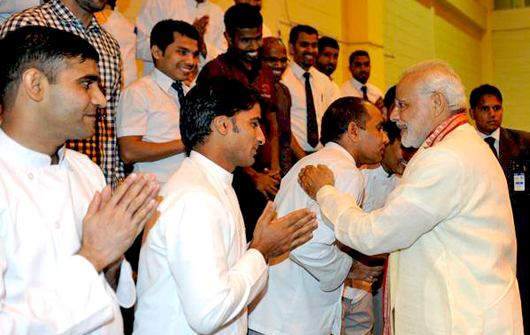
Modi reaches out to Indian workers who build glitzy skyscrapers in UAE

August 17, 2015

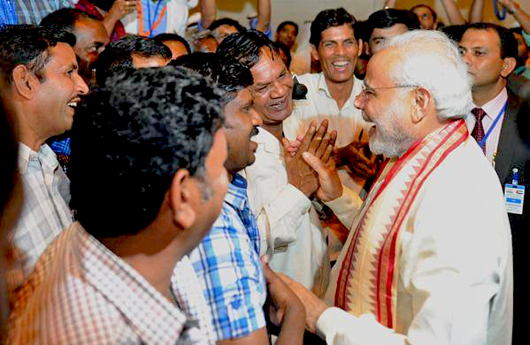
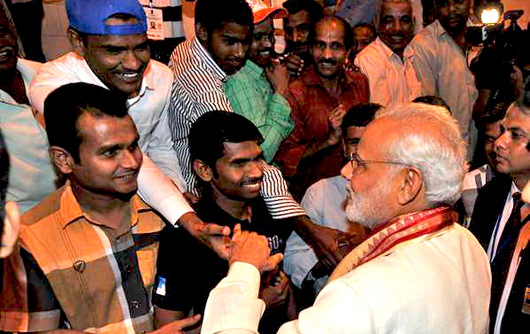
New Delhi, Aug 17: Prime Minister Narendra Modi visited a labour camp in Abu Dhabi on Sunday to highlight New Delhi's concern about the welfare of its migrant workers helping to build glitzy skyscrapers, hotels and museums in the oil-rich Gulf state.
modinri 4

PM Modi's two-day visit to the United Arab Emirates coincides with international calls to improve workers' conditions in Gulf countries, which rely on Asian labour for mega projects such as the World Expo 2020 in Dubai and the FIFA World Cup 2022 in Qatar.

Some 2.6 million Indians live and work in the UAE, according to Indian embassy figures. The embassy estimates about 60 per cent of those are blue-collar workers.

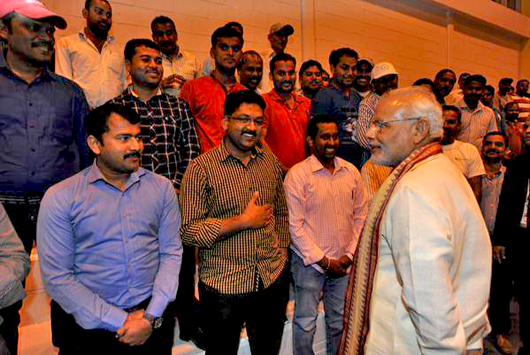
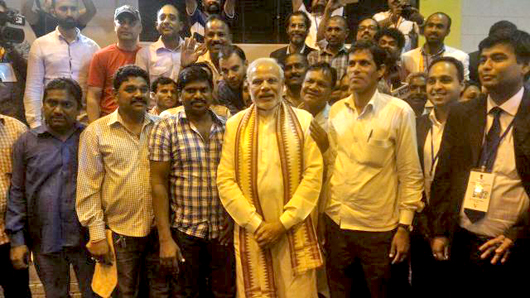
About 200 workers broke into applause when PM Modi arrived at an indoor basketball court at the labour camp in the Industrial City of Abu Dhabi. PM Modi chatted with the workers, enquiring about the place and their welfare and jobs, but made no comments to the media.

The Prime Minister is due to attend a public event in Dubai on Monday with some 40,000 Indian expatriates expected to attend.

"He wants to convey that the safety, security and welfare conditions for Indian workers should not be ignored," a senior Indian government official told Reuters in New Delhi.

"The Indian government is aware that the UAE will employ thousands of Indian workers to organize the World Expo 2020, but after the recent Qatar experience, the government wants to send a clear message that India will not allow rampant exploitation of its workers."

In November, India launched a campaign for higher wages for its workers in the Gulf states. Indian diplomats raised the minimum salaries they recommend because of higher living costs.
modinri 2

UAE officials, including the labour minister, have said that labour legislation in the country is in line with the UAE constitution. Laws regulate the labour market, providing protection of workers and their rights, they said.

Several measures, including mid-day breaks for workers in the country's sweltering summer heat, better healthcare facilities and accommodation have been provided across the UAE. But rights groups think a lot more needs to be done.

"Lack of proper regulation by the authorities in both India and the UAE of the booming migrant-worker recruitment industry, including visa brokers, has allowed rogue recruiting agents to cause serious human rights abuses with impunity," Salil Shetty, secretary-general of Amnesty International said.

"Some welcome improvements by the UAE over the last decade have been put in serious doubt by the crackdown on labour activists and failure to carry out meaningful reform of the kafala system, further increasing the vulnerability of migrant workers to human rights abuses."

PM Modi will be seeking to engage Abu Dhabi, one of the richest sovereign wealth funds in the world, to invest in India as well as expand cooperation in the energy sector. Abu Dhabi accounts for 9 percent of India's energy needs and India wants to increase that, the official said.

"The orientation of the Gulf countries has always been towards US and Europe, but the prime minister wants to highlight the benefits of investing in India and he wants to engage Abu Dhabi on long-term projects," the official said.
modiw

modinri 1

modinri 3

Comments

Theresa
 - 
Tuesday, 10 Jan 2017

Its like you read my mind! You seem to know a lot about this,
like you wrote the book in it or something. I think that you can do with some pics to drive the message home a
bit, but instead of that, this is fantastic blog.
A great read. I will definitely be back.

my web blog: auto transport: http://kfta.korea.com/xe/?document_srl=6817969

Add new comment

  • Coastaldigest.com reserves the right to delete or block any comments.
  • Coastaldigset.com is not responsible for its readers’ comments.
  • Comments that are abusive, incendiary or irrelevant are strictly prohibited.
  • Please use a genuine email ID and provide your name to avoid reject.
Agencies
June 13,2020

New Delhi, Jun 13: Loss of smell or taste has been added to the list of COVID-19 symptoms, according to the revised clinical management protocols released by the Union Health Ministry on Saturday.

The ministry said that coronavirus-infected patients reporting to various COVID-19 treatment facilities have been reporting symptoms like fever, cough, fatigue, shortness of breath, expectoration, myalgia, rhinorrhea, sore throat and diarrhea.

They have also complained of loss of smell (anosmia) or loss of taste (ageusia) preceding the onset of respiratory symptoms.

Older people and immune-suppressed patients in particular may present with atypical symptoms such as fatigue, reduced alertness, reduced mobility, diarrhoea, loss of appetite, delirium, and absence of fever, the ministry said.

Children might not have reported fever or cough as frequently as adults.

The US's national public health institute, the Centers for Disease Control and Prevention (CDC), had in early May incorporated "a new loss of taste or smell" in the list of COVID-19 symptoms.

According to the data from Integrated Health Information Platform and Integrated Disease Surveillance Programme, portal case investigation forms for COVID 19 (n=15,366), the details on the signs and symptoms reported are (as on June 11), fever (27 per cent), cough (21 pc), sore throat (10 pc), breathlessness (8 pc), Weakness (7 pc), running nose (3pc ) and others 24 pc.

According to the health ministry, people infected by the novel coronavirus are the main source of infection.

Direct person-to-person transmission occurs through close contact, mainly through respiratory droplets that are released when the infected person coughs, sneezes, or talks.

These droplets may also land on surfaces, where the virus remains viable. Infection can also occur if a person touches an infected surface and then touches his or her eyes, nose, or mouth.

The median incubation period is 5.1 days (range 2–14 days). The precise interval during which an individual with COVID-19 is infectious is uncertain.

As per the current evidence, the period of infectivity starts 2 days prior to onset of symptoms and lasts up to 8 days.

The extent and role played by pre-clinical/ asymptomatic infections in transmission still remain under investigation.

Comments

Add new comment

  • Coastaldigest.com reserves the right to delete or block any comments.
  • Coastaldigset.com is not responsible for its readers’ comments.
  • Comments that are abusive, incendiary or irrelevant are strictly prohibited.
  • Please use a genuine email ID and provide your name to avoid reject.
coastaldigest.com news network
February 5,2020

Bengaluru, Jan 5: B S Yediyurappa-led Karnataka cabinet has finally decided to resume supply of subsidised rice and wheat to students of welfare institutions and hostels including those run by religious mutts under the Dasoha Scheme’s welfare programme. The supply was stopped over two months ago.

“Cabinet has decided to continue supply of subsidised foodgrains (rice and wheat) for the benefit of 37,700 children under the Dasoha scheme in 351 welfare institutions for the next one year at the cost of Rs 18 crore,” said J C Madhuswamy, Law and Parliamentary Affairs Minister. Under this scheme, institutions that provide free accommodation and food for students are entitled to avail 10 kg rice and 5 kg wheat per student every month at subsidised rates. But following a central government directive in November, the state government had stopped supply to private institutions since December.

Hours before the cabinet meeting, Khader addressed a press conference and said, “This government is snatching away food from children by stalling the supply of foodgrains. Institutions like Suttur Mutt, Siddaganga Mutt that have worldwide fame for their service are being inconvenienced by this,” Khader said.

Finding itself in a fix, especially in a matter that involves mutts, the cabinet was quick to restore the supply. “Foodgrains were being supplied to 183 government-run institutions and 281 institutions run by private entities. As per a central government directive, supply to private institutions was stopped but the decision was made by the previous government,” Shashikala Jolle, Women and Child Development Minister, said.

Comments

Add new comment

  • Coastaldigest.com reserves the right to delete or block any comments.
  • Coastaldigset.com is not responsible for its readers’ comments.
  • Comments that are abusive, incendiary or irrelevant are strictly prohibited.
  • Please use a genuine email ID and provide your name to avoid reject.
News Network
January 10,2020

Mangaluru, Jan 10: A gang of smugglers, who were planning to illegally export 4,000 kg of red sandalwood worth Rs 2 crore through New Mangalore Port, were nabbed in a joint operation by the anti-rowdy squad of Mangaluru North sub-division and sleuths of Panambur police station.

The arrested have been identified as Tabrez (36), Lohith (35), Rakesh Shetty (44), Hussain kunhimonu (45) and Farooq (45).

Commissioner of Police Dr P S Harsha said that red sandalwood worth Rs 2 crore were seized from the accused.

The other seized properties from the arrested include a Maruti Brezza, Renault Pulse, Tata Ace, two plywood boxes and seven mobile phones valued Rs 19 lakh.

Based on a tip off, the police raided a godown on the road leading to Jokatte from Baikamlady Industrial Area and seized 4,000 kg of red sanders worth  Rs 2 crore.

A case has been registered under Sections 50, 62, 80, 104 of Karnataka Forest Act and 144, 165 of Karnataka Forest Rules at the Panambur police station.

Comments

Add new comment

  • Coastaldigest.com reserves the right to delete or block any comments.
  • Coastaldigset.com is not responsible for its readers’ comments.
  • Comments that are abusive, incendiary or irrelevant are strictly prohibited.
  • Please use a genuine email ID and provide your name to avoid reject.