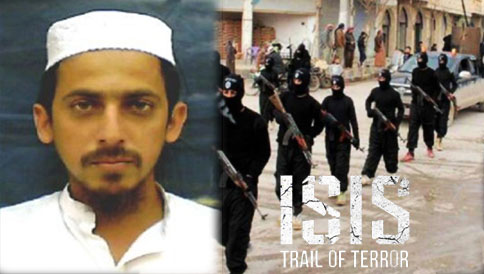
Mohammed Shafi Armar from Bhatkal killed in US airstrike in Syria

April 25, 2016

Bhatkal, Apr 25: Alleged Islamic State (IS) recruiter Mohammed Shafi Armar, hailing from coastal Karnataka's Bhatkal town, is learnt to have been killed in a U.S. air strike on Syria in the last couple of days.

isisA senior intelligence official in New Delhi tracking developments on IS said that they had received the information from their American counterparts on Sunday night. “We are in the process of cross-verifying it on the ground by our men. From initial reports, he is, in all probability, dead,” said the official. Intelligence agencies are also monitoring pro-IS social media handles for confirmation from the IS side.

Armar was recently in the news after the National Investigation Agency and Intelligence Bureau had, in a countrywide crackdown, arrested 14 men, of which six were from Karnataka, on allegations of being in touch with the IS.

It later turned out that all the 14 arrested were in touch with Armar, who headed the Ansar-Ul-Tawhid, an offshoot of IS previously headed by his brother Sultan Armar. However, investigation had then revealed that he was operating under a new banner Janood Al Khalifa Hind, a local terror outfit.

The new terror outfit had an Amir, a military chief and a treasurer, all of whom were busted in the January 2016 operation. While all those arrested were under the scanner for IS leanings, an intervention was necessitated after agencies observed that the gang was working towards a terror strike within India.

“This clearly shows that Shafi Armar had aspirations to be the new Jehadi terror leader in the country filling the place of the Indian Mujahiddeen,” said the senior intelligence official.

In fact, he started his terror career with Indian Mujahiddeen, when he was recruited along with Sultan Armar to it by Riyaz Bhatkal in 2008, sources said. The brothers were holed up in Pakistan since then, agencies said.

However, in 2011-12, they started the Ansar-Ul-Tawhid, which was first operating from North Waziristan in Pakistan from the training camps of Tehrik-e-Taliban.

In fact, IS chief Abu-Bakr-Al-Bhagdadi in a video message had declared Sultan Armar as an Amir (leader) of AuT. He was killed on March 6, 2015 in a similar air strike in Kobane, Syria.

According to NIA, over the last two years, Shafi Armar had emerged as the chief online recruiter of IS in the country.

Those arrested in Ratlam, Madhya Pradesh in April 2015, the four men arrested in New Delhi and Rourkela in January 2016 were also recruited by him, agencies claim. “Of late, he had emerged as the only common link among many IS recruits in the country,” the senior intelligence official said.

NIA officials had said that he followed a three-step recruitment process — first he would scout for vulnerable Muslim youth on social media like Facebook and Twitter, after which he would get in touch with them directly over web-based applications and brainwash them to join the IS. He would later use encrypted applications like Kik, Telegram to send instructions.

Comments

PK
 - 
Monday, 25 Apr 2016

Wow.... Lets FORGET Malegaon TWist and concentrate on this new terrorist... .... any way our indian people still believing such news flash even after exposing the media LIES ... what to do some Animals are used to accept like donkeys whatever is said in the MEDiA.

Viren Kotian
 - 
Monday, 25 Apr 2016

Hahaha. Idu kanri suddi andre.. Great news. need to eliminate these animals one by one across the world.

Add new comment

  • Coastaldigest.com reserves the right to delete or block any comments.
  • Coastaldigset.com is not responsible for its readers’ comments.
  • Comments that are abusive, incendiary or irrelevant are strictly prohibited.
  • Please use a genuine email ID and provide your name to avoid reject.
Muhammad Abdullah Javed
May 20,2020

One of the distinguish features of the Noble Quran is that it presents different sorts of classifications. It is quite evident as one of the names of the Quran is Furqan that is it differentiates between things through its unique style of classification. The Quran openly proclaims the difference between right and wrong, truth and falsehood, literate and illiterate, light and darkness and so on. The system of Quranic taxonomy has a pivotal element with regard to ranking of human beings. It classifies them into two groups, one, who is honorable in the sight of their Creator and the second, disliked by Him.

This Quranic approach of classification is quite genuine, void of all sorts of bias. Since humans have no say in their birth, color or region, therefore the Quran doesn’t recognize these parameters to classify two groups of people.

The crux of Quranic taxonomy rests with the human ability which has been equally distributed among all humans. In terms of abilities to perform, barring those tasks performed with exceptional talents, all humans are equal. This is where Quran draws a line and specify who is most honorable in the sight of their Creator, it says:

 O mankind, We created you from one man and one woman, and then divided you into nations and tribes so that you may recognize one another. Indeed, the most honorable among you in the sight of Allah is he who is the most pious of you. Surely, Allah is All-knowing, All-Wise. (Chapter 49, Verse 13).

Criterion of judgement

To be most righteous in the sight of God, one has to be of pious nature. The Quran uses term Taqwa (a sense of distinguishing between right and wrong, piety) to exemplify the pious nature. It further specifies that the source of pious nature - Taqwa is an inherent quality of human beings. Along with the faculties of hearing, seeing and speaking they have been bestowed with (Taqwa) the criterion of distinguishing between virtues and vices, it has been mentioned in the Quran as:

And by the human self and by Him Who balanced it, then inspired it with its wickedness and piety (Chapter 91, Verses 7 & 8).

Good deeds and human nature

With the advent of human race on earth, the equation has been set in simple terms. Humans have to be obedient to their Creator by means of using their intellect, smart enough to use their ability to judge between right and wrong and spend their lives in performing good deeds. For this very reason God has created life and death:

Who created death and life that He may try you to see which of you is best in deeds, and He is All-Mighty as well as All-Forgiving (Chapter 67, Verse 2)

Since life is all about performing good deeds, the ability to perform any good action has been made as natural as recognizing any color with naked eyes. It is within the reach of a person to identify the difference between colors, so is his criterion of judgement that tells what to perform and what to refrain from?

Good actions have been synchronized with human nature whereas evil deeds are quite detrimental, that’s why there is a universal consensus over the conception of virtues and vices. No one can dare to differ with virtues like truth, justice and honesty etc, and no one appreciates vices like falsehood, violations and corruption. With this inherent ability of humans to identify good and bad, the concept of virtues and vices has been described with the same bent of human intellect, there is no philosophical and ideological kind of description to tell what truth and falsehood are, it is as simple as this:

Prophet Muhammad (peace be upon him) said: Give up what is doubtful to you for that which is not doubtful; for truth is peace of mind and falsehood is doubt (Tirmidhi)

Highway of actions

The Quran presents a highway of actions for everyone who believes in it and intend to be most honorable in the sight of the Creator. For each and every day, there is a definite plan of action to go ahead with it to please the Creator. Again, for every week and month, there are clear specifications with regard to individual and collective actions. So no place for claims and reservations, no place for any excuse either, things have been made clear. For a person to be honored, he has to be man of deeds, that’s it. Every person has fair chances of performing better, as the life has been given, criterion of judgement between right and wrong has been given, and plan of action has been provided with. Now one has to energize himself for everyday action and try to set right the intention.

Difference in human efficiencies

No doubt there are differences in human abilities and efficiencies, one may argue about the quality and magnitude of actions. Those who are of high efficiency may perform well and those who are inefficient may not? True, to convince what Quran emphasizes is, God doesn’t look at the magnitude of an action, rather He sees with what intention in what circumstances it has been performed? If any person keep fast in scorching heat for more than 16 hours a day will get high rewards compare to the one who fast less than 10 hours a day at a cold place. Again, if the intention is to please the God, than every action, no matter how small or big it is in its scale, will fetch rich dividends. A poor’s donation of few rupees will be equal in rewards as compare to what a millionaire gets by donating thousands of rupees from his enormous wealth. The act of charity has demanded sacrifice; both of them have sacrificed in accordance with their capacities. Therefore upon asking whose charity is noble in the sight of God, the Prophet Muhammad (pbuh) said: The charity of poor person who tries hard to get few rupees from his hard earn money to donate in the way of God (NasaiBook of Hadith).

The Quranic taxonomy of human is quite justifiable as every human bear testimony to its genuine and unbiased classification through what we term as actions. Therefore the world has to witness a race between men and women to see who can compete with others in order to please their Creator?

Whosoever acts righteously – whether a man or a woman and embraces belief, We will surely grant him a good life; and will surely grant such persons their reward according to the best of their deeds. (Chapter 16, Verse 97)

God-oriented actions, privilege for the Humanity

It’s very unpleasant to notice that in today’s world the parameters like statuses, resources and wealth have been regarded as privilege and honor for both humans and their societies. No doubt they are, but not at the cost of losing the very essence of human nature and sacrificing its interest. Today’s advancements speak of this dark phase where the height of inventions and discoveries touching the skies while the dignity and honor of humans have gone to the lowest of the low. The ever increasing poverty, hunger, untimely deaths, different forms of corruption in the land, violation of human rights are just to remind a few. The presence of rich and poor, highs and lows in the society speaks of disparity of actions, lack of selfless service and hearts void of God’s love and fear.

The beauty of humanity is to remain in the service of God and always stand on the toes to help those who are in need. This God-oriented action enables every doer to be dear to his God as the classification of good and the bad is purely based on the actions performed for the sake of the Creator:

Everyone is assigned a rank according to his deed. Your Lord is not heedless of what they do (Chapter 6, Verse 132).


Muhammad Abdullah Javed is the Director of AJ Academy for Research & Development. He can be reached at [email protected]

Comments

Add new comment

  • Coastaldigest.com reserves the right to delete or block any comments.
  • Coastaldigset.com is not responsible for its readers’ comments.
  • Comments that are abusive, incendiary or irrelevant are strictly prohibited.
  • Please use a genuine email ID and provide your name to avoid reject.
Wafa Sultana
April 4,2020

Over the last couple of days when the world was occupied with unifying efforts to fight the deadly Covid19 pandemic, sections of Indian media provided viewers a familiar scapegoat – the Indian Muslims – who are often stereotyped as a community being constantly at loggerheads with the citizenry and the State. Biased media channels were quick to resort to blaming the entire Muslim community for the spread of the disease in the country, thanks to an ill-timed Tablighi Jamaat gathering at its international headquarters in Delhi’s Nizamuddin. Unsurprisingly, the opprobrium was also marked by a sudden spike in WhatsApp forwards of videos with people wearing skullcaps licking spoons and performing Sufi breathing rituals, suggesting some sort of wild conspiracy on the part of the community to spread the virus.  Some media channels were quick to formulate, hypothesize and provide loose definitions of a newly discovered form of Jihad i.e. ‘Corona Jihad ’ thereby vilifying the Islamic faith and its followers.

While the investigation on the culpability of the organizers of the Nizamuddin event is still ongoing, there is enough information to suggest that the meeting was held before any lockdown was in force, and the problem began when there was no way of getting people out once the curfew was announced. Be that as it may, there is little doubt that organizing a meet of such a scale when there is a global pandemic smacks of gross misjudgment, and definitely the organizers should be held accountable if laws or public orders were defied. Attendees who attempt to defy quarantine measures must be dealt with strictly. However, what is alarming is that the focus and narrative have now shifted from the unfortunate event at Nizamuddin to the Tablighi Jamaat itself.

For those not familiar with the Tablighi Jamaat, the organization was founded in 1926 in Mewat by scholar Maulana Mohammad Ilyas. The Jamaat’s main objective was to get Muslim youth to learn and practice pristine Islam shorn of external influences. This is achieved through individuals dedicating time for moral and spiritual upliftment secluded from the rest of the world for a brief period of time. There is no formal membership process. More senior and experienced participants typically travel from one mosque to other delivering talks on religious topics, inviting local youth to attend and then volunteer for a spiritual retreat for a fixed number of days to a mosque in a nearby town or village to present the message to their co-religionists. Contrary to ongoing Islamophobic rhetoric, the movement does not actively proselytize. The focus is rather on getting Muslims to learn the teachings and practices of Islam.  This grassroots India-based movement has now grown to almost all countries with substantial Muslim populations. Its annual meets, or ‘ijtemas’ are among the largest Islamic congregations in the world after the annual Haj. One of the reasons for its popularity and wide network in the subcontinent and wordwide is the fact that it has eschewed the need for scholarly intervention, focusing on peer learning of fundamental beliefs and practice rather than high-falutin ideological debates. The Tablighi Jamaat also distinguishes itself from other Islamic movements through its strictly apolitical nature, with a focus on individual self-improvement rather than political mobilization. Hardships and difficulty in the world are expected to be face through ‘sabr’ (patience) and ‘dua’ (supplication),  than through quest for political power or influence. In terms of ideology, it is very much based on mainstream Sunni Islamic principles derived from the Deobandi school.

So, why is all this background important in the current context? While biased media entities have expectedly brought out their Islamophobic paraphernalia out for full display, more neutral commentators have tried to paint the Tablighi Jamaat as a fringe group and have tried to distance it from 'mainstream Muslims'. While the intent is no doubt innocent, this is a trap we must not fall into. This narrative, unfortunately, is also gaining ground due to apathy some Muslims have for the group, accusing it of being “disconnected from the realities of the world”. Unlike other Muslim organizations and movements, the Tablighi Jamat, by virtue of its political indifference, does not boast of high-profile advocates and savvy spokespersons who can defend it in mainstream or social media.  The use of adjectives such as 'outdated' and 'orthodox' by liberal columnists to describe the Jamaat feeds into the malignant attempt to change the narrative from the control of the spread of the pandemic due to the Nizamuddin gathering to 'raison d'etre' of the organization itself.

A large mainstream religious group like the Tablighi Jamaat with nearly a hundred-year history, normally considered to be peaceful, apolitical and minding its own business is now suddenly being villainized owing to unfortunate circumstances. Biased media reactions filled with disgust and hate seem to feed the Indian public conscience with a danngerous misconception - to be a nominal Muslim is okay but being a practicing one is not.  For those committed to the truth and fighting the spread of Islamophobia, the temptation to throw the entire Tablighi Jamaat under the bus must be resisted.

The writer is a lawyer and research scholar at Qatar University. Her research interests include Islamic law and politics.

Comments

zahoorahmed
 - 
Saturday, 4 Apr 2020

great article! provides a great perspective on tableeg jamat

Add new comment

  • Coastaldigest.com reserves the right to delete or block any comments.
  • Coastaldigset.com is not responsible for its readers’ comments.
  • Comments that are abusive, incendiary or irrelevant are strictly prohibited.
  • Please use a genuine email ID and provide your name to avoid reject.
News Network
May 23,2020

Bengaluru, May 23: The Karnataka government on Friday said returnees from six states with high COVID-19 cases will be kept in institutional quarantine for seven days.

The states are - Maharashtra, Gujarat, Delhi, Tamil Nadu, Rajasthan and Madhya Pradesh.

As per the standard operating procedure released by the government, all people to arrive via rain, air road are expected to quarantine.

After they test negative for the disease in pool testing, they will be sent for home quarantine for another seven days, the government said.

Returnees from other low prevalence states will be asked to follow 14 days of home quarantine, according to the standard operating procedure (SOP) for entry of persons from other states to Karnataka issued by the state health department late on Friday night.

However home quarantine is allowed for pregnant ladies, people above 80 years, patients with comorbidities and children below 10 years of age, along with one attendant after they test negative.

In special cases like businessmen coming for urgent work, the quarantine period will be waived if they furnish a report from an ICMR-approved laboratory showing they tested negative for COVID-19, it said.

However, if they don't have reports, they will have to stay in institutional quarantine and can leave once their results test negative.

In case their stay exceeds 5 days, they will be sent to the fever clinic and get a five-day extension if found asymptomatic.

The report should not be more than two days old from the date of travel.

All Karnataka returnees who entered from 4 May will be tested from 5-7 days from the time of their arrival.

If found COVID-19 negative, they will be sent to home quarantine and will have to follow due precautions, the SOP stated.

Comments

Add new comment

  • Coastaldigest.com reserves the right to delete or block any comments.
  • Coastaldigset.com is not responsible for its readers’ comments.
  • Comments that are abusive, incendiary or irrelevant are strictly prohibited.
  • Please use a genuine email ID and provide your name to avoid reject.