Monsoon mayhem triggers deluge in DK, Udupi

[email protected] (CD Network, Photos by Ahmed Anwar, Maunesh Vishwakarma)
August 8, 2012

Bl7Rx_6

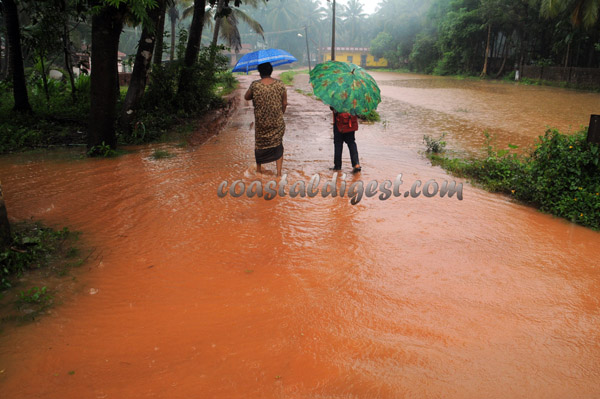
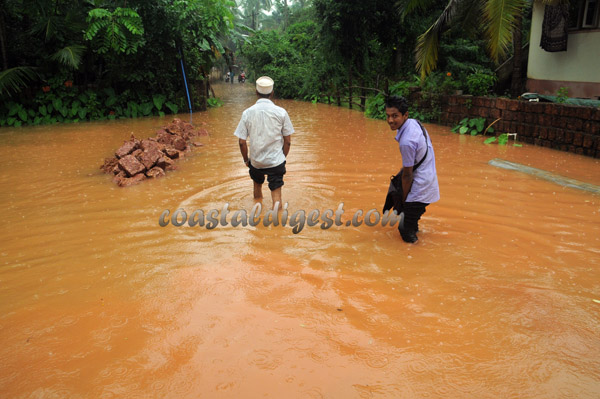
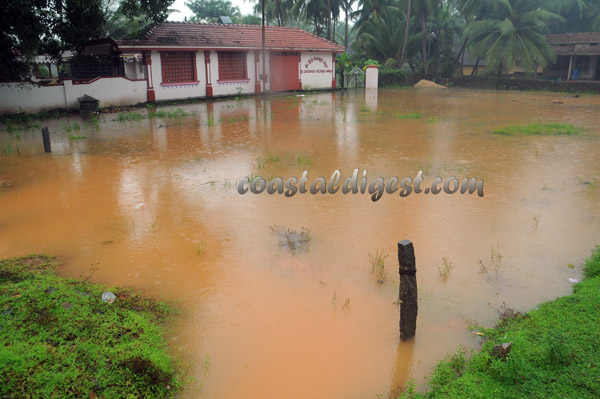
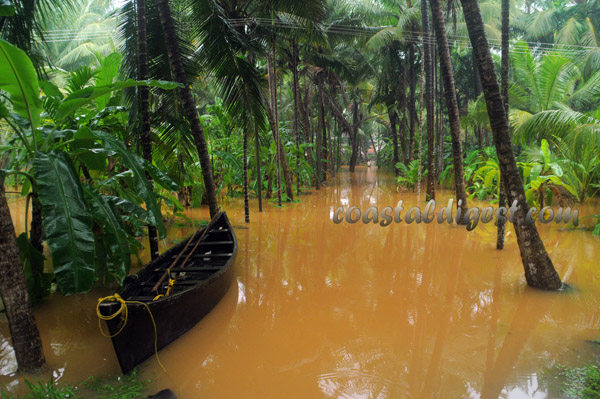
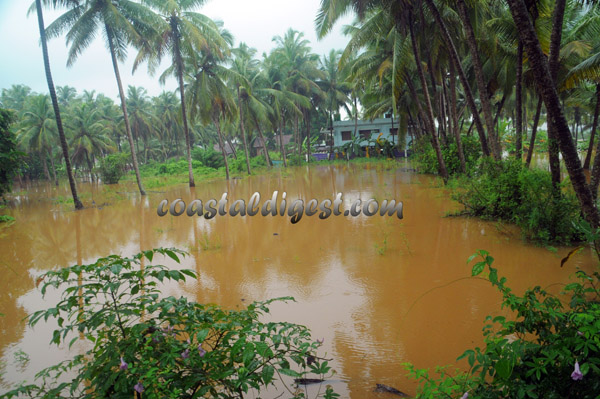
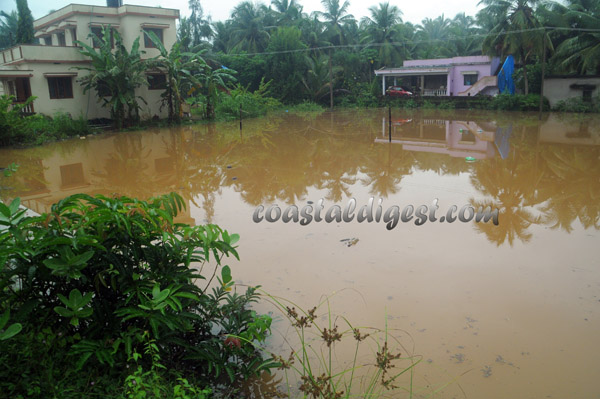
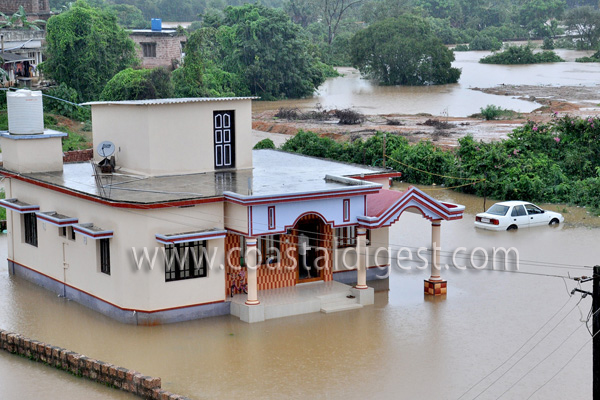
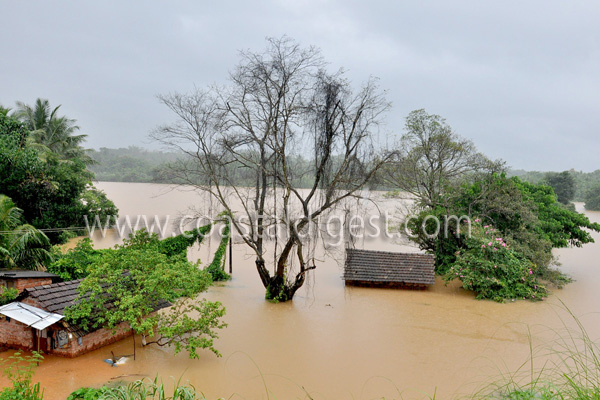
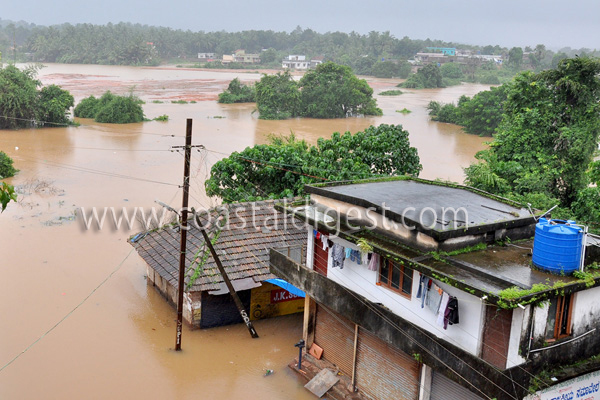
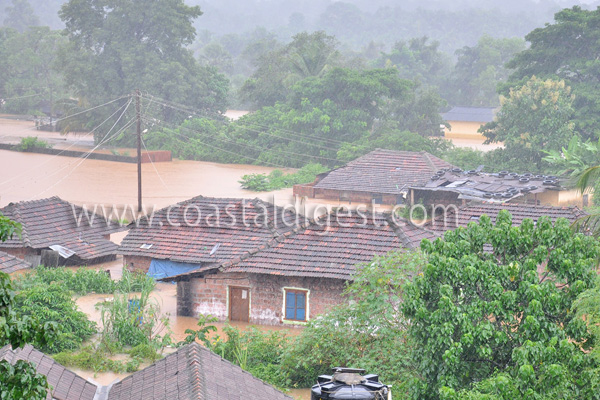
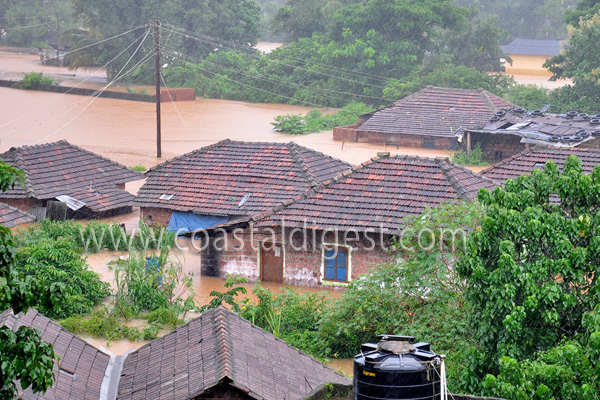
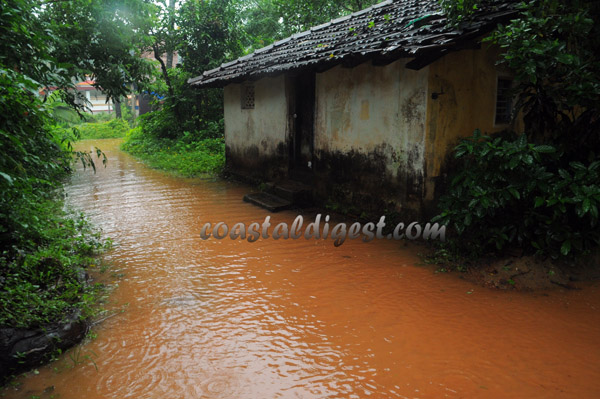
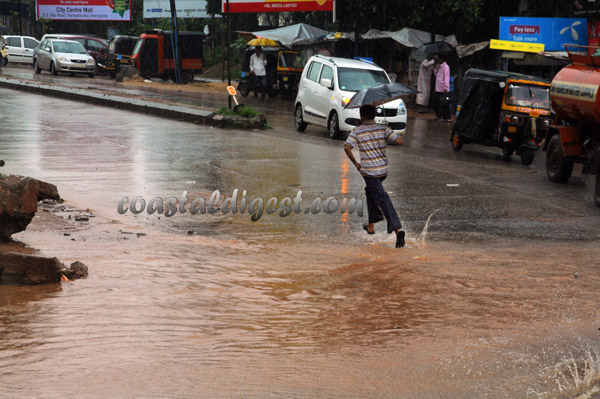
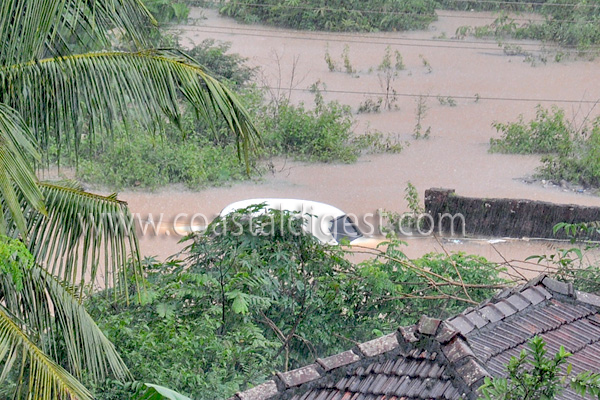
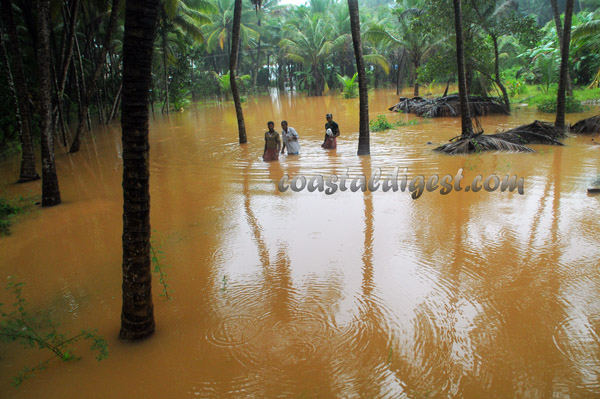
Mangalore / Udupi, August 8: The monsoon mayhem continued across the Coastal districts and some other parts of Karnataka on Wednesday. Low-lying areas were inundated on and crops were destroyed at many places following continuous rains since last few days.

As part of precautionary measures authorities on Tuesday shifted a few families to safe areas after the torrential rains inundated low-lying areas in Uppinangady, Banatwal and Subrahmanya and submerged many bridges across Dakshina Kannada.

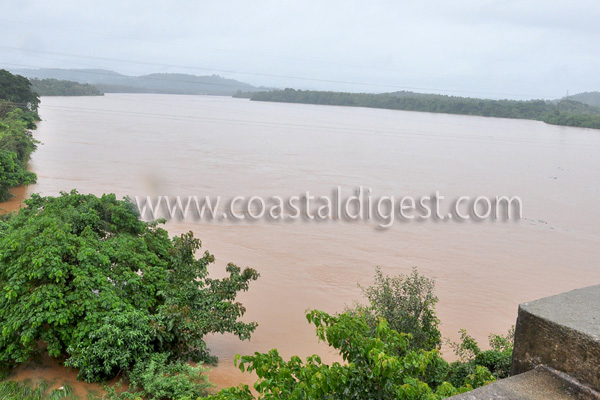
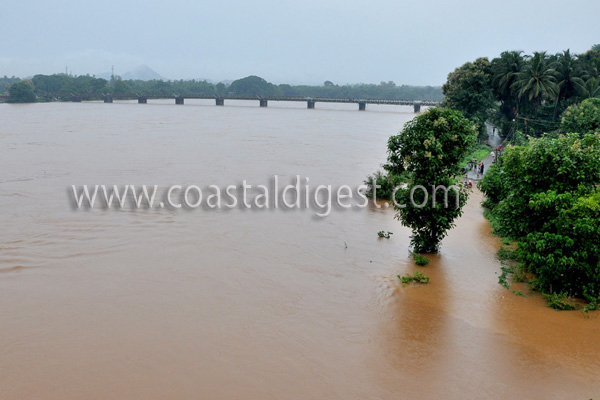
As the Nethravathi river was flowing close to the danger mark in Panemangalore, Kallapu, and Bantwal, the district administration on Tuesday placed boats in strategic locations to rush them in any emergencies while Home Guards were kept on alert.

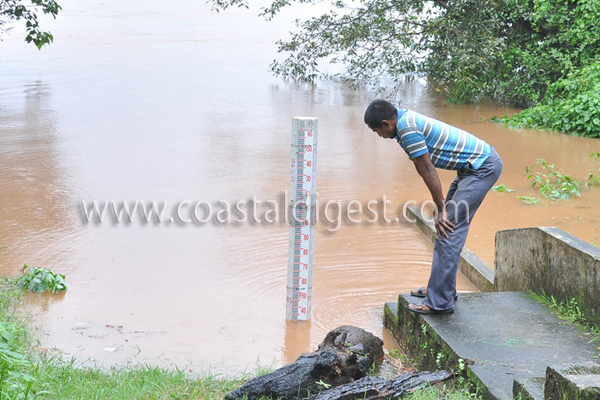
The Nethravathi was flowing at 8.1 metres as against the danger level of 8.5 metres, said Additional Deputy Commissioner K. Dayanand. The police said areas like Bastipadpu, Madaka, Jakribettu, and Bandribettu were inundated. There had been partial damage to seven houses in Bantwal. Mr. Dayanand said a boat has been placed in Bantwal as a precaution. Water continued to flow over the bridge in Hosmat near Kadaba cutting off the road connectivity.

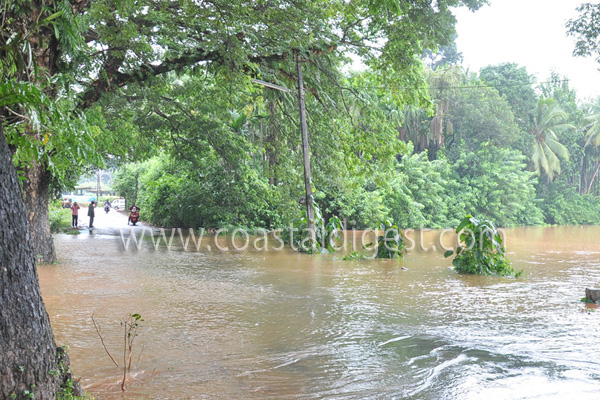
The bridge across Kumaradhara river, connecting Gundya and Subramanya, and the Hosmata bridge, connecting Uppinangady and Subramanya, were under water on Tuesday, affecting vehicular traffic.

While rivers in twin districts are overflowing, rains have flooded both the bridges linking Subramanya and Uppinangady and Subramanya and Gunday, thus cutting off the road link to the temple town. On Tuesday, Kadaba received highest rainfall of 151.3 mm followed by Belthangady—141.6 mm, Puttur—134.9 mm, Sullia—115.4 mm, Bantwal—39.6 mm, Mangalore—12.6 mm.

Mangalore MLA U T Khader has urged the district administration to get ready to face flood situation in the region. Meanwhile, the water-level in almost all the drains were seen reaching the danger level. In fact, owing to the lack of storm water drains, rain water was seen flowing on the road at many places in Mangalore. At the same time, sea erosion too has been intensified in Hosabettu, Chitrapura, Mukka, Sasihithlu, Ullal and Kotepura.

In Udupi

B. Abhijin, Tahsildar of Udupi, said that there were reports of sea erosion at Bada Yermal village endangering a nearby road. After assessing the situation, boulders could be placed to prevent further erosion on Wednesday, he said.

Shankara Shetty (60), a daily wage worker, was washed away at Brahmasthana in Hebri on Monday night, when he tried to cross a road which was flooded by water in River Seetha. The body was found at Nadpalu on Tuesday.

Udupi district received 34.13 mm rainfall on Tuesday. Kundapur taluk has received highest of 51 mm rain followed by Karkala—35.8 mm and Udupi—15.6 mm.

A drain at Kabbinale was washed away in Mudradi near Hebri. With this, road connectivity between Kabbinale and Muniyala was cut off and movement of vehicles were disrupted. Mudradi Gram Panchayat President Chandrashekar Bayari and ZP member Mudradi Manjunath visited the spot and said that the work on repairing the drain will be taken up at the earliest.

Sauparnika, Sumana, Edamavinahole rivers have been overflowing. Flood water had entered Heroor, Badakere, Navunda, Maravanthe, Nada, Hadavu, Senapura, Hakladi villages. At few places, roads were filled with one to four feet water.

The residents of Kelabailu, Salbudam Hadavina Athikone, Movadi, Chikkali, Thoplu were seen depending on boat to reach their destinations. Many had deserted their houses and are taking shelter in their relatives houses in the region. Flood water had entered Sri Durgaparameshwari Temple in Kamalashile in Kundapur. Two boats have been kept ready on the banks of Sauparnika river to shift the people from low lying areas, in case of increase in the water-level in rivers. Kannada kudru, Theru kudru, Kurudweepa have been inundated.

Landslides


There were landslides at five different places in Charmadi Ghat. Mr. Dayanand said steps were taken to clear the road for traffic movement at the earliest.

Due to land slips between Yedekumari and Shrivagilu stations in Mysore division Train No 16518/16517 Kannur –Yesvantpur – Kannur express Via Mangalore Central and Train no.16516 Karwar – Yesvantpur Express via Mangalore Junction is cancelled between Mangalore Junction and yesvantpur on Tuesday and Wednesday.

Rain24x7_1

Rain24x7_2

Rain24x7_3

Rain24x7_4

Rain24x7_5

Rain24x7_6

Rain24x7_8

Rain24x7_9

Rain24x7_10

Rain24x7_11

Rain24x7_12

Bl7Rx_1

Bl7Rx_2

Bl7Rx_3

Bl7Rx_4

Bl7Rx_5

Bl7Rx_9

Bl7Rx_10

Bl7Rx_11

Bl7Rx_12

Bl7Rx_13

Rain24x7_13

Rain24x7_14

Comments

Add new comment

  • Coastaldigest.com reserves the right to delete or block any comments.
  • Coastaldigset.com is not responsible for its readers’ comments.
  • Comments that are abusive, incendiary or irrelevant are strictly prohibited.
  • Please use a genuine email ID and provide your name to avoid reject.
Ram Puniyani
January 14,2020

In the beginning of January 2020 two very disturbing events were reported from Pakistan. One was the attack on Nankana Sahib, the holy shrine where Sant Guru Nanak was born. While one report said that the place has been desecrated, the other stated that it was a fight between two Muslim groups. Prime Minister of Pakistan Imran Khan condemned the incident and the main accused Imran Chisti was arrested. The matter related to abduction and conversion of a Sikh girl Jagjit Kaur, daughter of Pathi (One who reads Holy Guru Granth Sahib in Gurudwara) of the Gurudwara. In another incident one Sikh youth Ravinder Singh, who was out on shopping for his marriage, was shot dead in Peshawar.

While these condemnable attacks took place on the Sikh minority in Pakistan, BJP was quick enough to jump to state that it is events like this which justify the Citizenship Amendment Act (CAA). Incidentally CAA is the Act which is discriminatory and relates to citizenship with Religion, which is not as per the norms of Indian constitution. There are constant debates and propaganda that population of Hindus has come down drastically in Pakistan and Bangla Desh. Amit Shah, the Home minister stated that in Pakistan the population of Hindus has come down from 23% at the time of partition to 3.7% at present. And in Bangla Desh it has come down from 22% to present 8%.

While not denying the fact that the religious minorities are getting a rough deal in both these countries, the figures which are presented are totally off the mark. These figures don’t take into consideration the painful migrations, which took place at the time of partition and formation of Bangla Desh later. Pakistan census figures tell a different tale. Their first census was held in 1951. As per this census the overall percentage of Non Muslim in Pakistan (East and West together) was 14.2%, of this in West Pakistan (Now Pakistan) it was 3.44 and in Eat Pakistan it was 23.2. In the census held in Pakistan 1998 it became 3.72%. As far as Bangla Desh is concerned the share of Non Muslims has gone down from 23.2 (1951) to 9.6% in 2011.

The largest minority of Pakistan is Ahmadis, (https://minorityrights.org/country/pakistan/) who are close to 4 Million and are not recognised as Muslims in Pakistan. In Bangla Desh the major migrations of Hindus from Bangla Desh took place in the backdrop of Pakistan army’s atrocities in the then East Pakistan.

As far as UN data on refugees in India it went up by 17% between 2016-2019 and largest numbers were from Tibet and Sri Lanka.  (https://www.un.org/en/development/desa/population/migration/publication…)

The state of minorities is in a way the index of strength of democracy. Most South Asian Countries have not been able to sustain democratic values properly. In Pakistan, the Republic began with Jinnah’s classic speech where secularism was to be central credo of Pakistan. This 11th August speech was in a way what the state policy should be, as per which people of all faiths are free to practice their religion. Soon enough the logic of ‘Two Nation theory” and formation of Pakistan, a separate state for Muslim took over. Army stepped in and dictatorship was to reign there intermittently. Democratic elements were suppressed and the worst came when Zia Ul Haq Islamized the state in collusion with Maulanas. The army was already a strong presence in Pakistan. The popular formulation for Pakistan was that it is ruled by three A’s, Army, America and Allah (Mullah).

Bangla Desh had a different trajectory. Its very formation was a nail in the coffin of ‘two nation theory’; that religion can be the basis of a state. Bangla Desh did begin as a secular republic but communal forces and secular forces kept struggling for their dominance and in 1988 it also became Islamic republic. At another level Myanmar, in the grip of military dictatorship, with democratic elements trying to retain their presence is also seeing a hard battle. Democracy or not, the army and Sanghas (Buddhist Sang has) are strong, in Myanmar as well. The most visible result is persecution of Rohingya Muslims.

Similar phenomenon is dominating in Sri Lanka also where Budhhist Sanghas and army have strong say in the political affairs, irrespective of which Government is ruling. Muslim and Christian minorities are a big victim there, while Tamils (Hindus, Christians etc.) suffered the biggest damage as ethnic and religious minorities. India had the best prospect of democracy, pluralism and secularism flourishing here. The secular constitution, the outcome of India’s freedom struggle, the leadership of Gandhi and Nehru did ensure the rooting of democracy and secularism in a strong way.

India so far had best democratic credentials amongst all the south Asian countries. Despite that though the population of minorities rose mainly due to poverty and illiteracy, their overall marginalisation was order of the day, it went on worsening with the rise of communal forces, with communal forces resorting to identity issues, and indulging in propaganda against minorities.

While other South Asian countries should had followed India to focus more on infrastructure and political culture of liberalism, today India is following the footsteps of Pakistan. The retrograde march of India is most visible in the issues which have dominated the political space during last few years. Issues like Ram Temple, Ghar Wapasi, Love Jihad, Beef-Cow are now finding their peak in CAA.

India’s reversal towards a polity with religion’s identity dominating the political scene was nicely presented by the late Pakistani poetess Fahmida Riaz in her poem, Tum bhi Hum Jaise Nikle (You also turned out to be like us). While trying to resist communal forces has been an arduous task, it is becoming more difficult by the day. This phenomenon has been variously called, Fundamentalism, Communalism or religious nationalism among others. Surely it has nothing to do with the religion as practiced by the great Saint and Sufi traditions of India; it resorts mainly to political mobilization by using religion as a tool.

Comments

Ashi
 - 
Tuesday, 14 Jan 2020

If Malaysia implement similar NRC/CAA, India and China are the loser.

Add new comment

  • Coastaldigest.com reserves the right to delete or block any comments.
  • Coastaldigset.com is not responsible for its readers’ comments.
  • Comments that are abusive, incendiary or irrelevant are strictly prohibited.
  • Please use a genuine email ID and provide your name to avoid reject.
News Network
March 16,2020

Bengaluru, Mar 16: A 23-year-old mobile app developer was arrested on Saturday for allegedly forging the signature of Infosys Foundation chairperson Sudha Murty to rope in Telugu actor Vijay Devarakonda as an app’s ambassador.

The arrest of Laveti Sai Krishna alias Krishna ML, a resident of Hyderabad, comes a year after the case was registered. Jayanagar police registered a case against Krishna on February 26, 2019 based on a complaint filed by Lt Col (retd) M Ramesh, representative of Infosys Foundation. The complaint was filed after the forged letter didn’t reach Devarakonda and came back to Infosys Foundation instead.

App developer is a B.Pharma holder

“We conducted an investigation and traced the app designer. We caught him and based on information provided by him, we learnt that Krishna was the brain behind the forged signature,” a senior police officer said.

Krishna confessed that he developed a mobile app — ‘Offer nearby’ — and planned to launch it in a big way. He wanted Telugu actor Vijay Devarakonda to be the app’s brand ambassador and tried contacting him. Krishna, however, was unable to meet Vijay.

Krishna then thought he could easily reach the actor if he sent a recommendation letter in the name of Sudha Murty.

“He forged the letterhead of Infosys Foundation and Sudha Murty’s signature. We are verifying his antecedents to know if he committed any other offence earlier,” said Rohini Sepat-Katoch, DCP (south). Rohini said Krishna is a B.Pharma holder and worked with an advertisement firm. Later, he planned to develop an app that provides details of offers for retail customers. He floated Laveti Technologies, and with help from a friend, developed ‘Offer nearby’.

As per the complaint, Krishna created a fake letterhead in the name of Sudha Murty and wrote to Devarakonda, asking him to become the brand ambassador/ partner for his mobile app. Krishna sent it through SpeedPost mentioning the sender’s address as Infosys Foundation. Krishna’s game was up when the letter, which wasn’t delivered to Devarakonda, came back to Infosys Foundation.

Comments

Add new comment

  • Coastaldigest.com reserves the right to delete or block any comments.
  • Coastaldigset.com is not responsible for its readers’ comments.
  • Comments that are abusive, incendiary or irrelevant are strictly prohibited.
  • Please use a genuine email ID and provide your name to avoid reject.
News Network
January 26,2020

Udupi, Jan 26: The late seer of Pejawar Mutt Vishwesha Tirtha Swami has been posthumously honoured with Padma Vibhushan for his contribution to spiritualism.

The seer, who passed away in December last, was known as a Hindu reformist spiritual leader.

He was also among the religious heads to be in the forefront of the Ram Janmabhoomi movement and was a vocal proponent for the construction of a Ram temple at Ayodhya.

Comments

Add new comment

  • Coastaldigest.com reserves the right to delete or block any comments.
  • Coastaldigset.com is not responsible for its readers’ comments.
  • Comments that are abusive, incendiary or irrelevant are strictly prohibited.
  • Please use a genuine email ID and provide your name to avoid reject.