


More lynching incidents happened under previous govts: Shah

Agencies
July 2, 2017

Panaji, Jul 2: BJP president Amit Shah has said that more incidents of lynching had occurred during the previous governments than during the three years of NDA rule, but no one had raised questions then.amitt
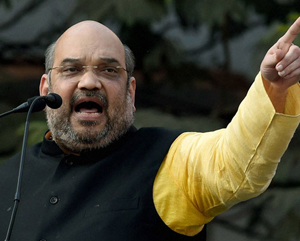
"I do not want to compare and undermine the current incidents of lynching. I am also serious about it. But there have been more lynching incidents in 2011, 2012 and 2013," Shah told a gathering of professionals in Goa last evening.

"There have been more lynchings each year in the past, compared to the total lynching incidents that have happened during our three-year-long tenure," the BJP leader said. The BJP-led government came to power at the Centre in May 2014.

Responding to a question about fears over the lynching incidents, he said there was no apprehension anywhere in the country.

"Do you know of any such incident where arrests have not been made? I do not have any answer to apprehensions. There is no apprehension anywhere in the country," he said.

Maintaining that law and order was a state subject, Shah said when Mohammad Akhlaq died, the Samajwadi Party-led government was in power in Uttar Pradesh, and it was its responsibility.

"But protests are held in Delhi in front of the Narendra Modi government. What is this fashion," he asked.

In September 2015, Akhlaq was dragged out of his house and killed by a mob at Dadri in UP on suspicion of storing and consuming beef.

Following several such lynching incidents, including those in Jharkhand, Haryana and UP, protests were held late last month at several cities across the country.

Comments

Ranjan shetty
 - 
Thursday, 6 Jul 2017

Chutiya bangladeshisare attacking Hindus in WB, where are those SOB's who did rally in the name of #notin my name ?

Umar Ashfaq
 - 
Thursday, 6 Jul 2017

Please qidmat k mauka de guzarish hogi

ABDUL AZIZ
 - 
Thursday, 6 Jul 2017

hang them till death , sharia law

Abdullah
 - 
Sunday, 2 Jul 2017

But who killed them????
You and your goons only.

Rikaz
 - 
Sunday, 2 Jul 2017

do not compare with previous government, it is your job to eliminate all sort of lynching around....take action on all who committed it as of now and make sure that it will not happen again....why it is happening only on muslims....there are people eating beef from other community.... and beef export factories exporting beef everyday basis with no problems...if you have guts stop it....

Thoushi
 - 
Sunday, 2 Jul 2017

True lynching was happening in previous government also and before since Gandhi's assassination , but Mr. Cha most all lynching was carried out by your OWN associated party(BJP) and wings (RSS)

Add new comment

  • Coastaldigest.com reserves the right to delete or block any comments.
  • Coastaldigset.com is not responsible for its readers’ comments.
  • Comments that are abusive, incendiary or irrelevant are strictly prohibited.
  • Please use a genuine email ID and provide your name to avoid reject.
News Network
June 1,2020

New Delhi, Jun 1: The Directorate General of Civil Aviation (DGCA) on Monday asked airlines to allot seats in flights in such a manner that middle seats are kept vacant to the extent possible.

However, if a flyer has been allotted the middle seat due to a high passenger load "then additional protective equipment like the wrap-around gown of the Ministry of Textile approved standards" must be provided to that passenger in addition to three-layered face mask and face shield, said the DGCA order, which has been accessed by news agency.

India resumed its domestic passenger flights from May 25 after a gap of two months due to the coronavirus-triggered lockdown. International commercial passenger flights continue to remain suspended in the country.

Comments

Add new comment

  • Coastaldigest.com reserves the right to delete or block any comments.
  • Coastaldigset.com is not responsible for its readers’ comments.
  • Comments that are abusive, incendiary or irrelevant are strictly prohibited.
  • Please use a genuine email ID and provide your name to avoid reject.
News Network
March 27,2020

New Delhi, Mar 27: Cabinet Secretary Rajiv Gauba has asked states to urgently strengthen the surveillance of international travellers who entered the country before the lockdown as there appeared to be a "gap" between the actual monitoring for COVID-19 and the total arrivals.

In a letter to chief secretaries of all States and Union Territories, Gauba said such a gap in monitoring of international passengers for coronavirus "may seriously jeopardise the efforts to contain the spread of COVID-19", given that many amongst the persons who have tested positive so far in India have history of international travel.

"As you are aware, we initiated screening of international incoming passengers at the airports with effect from January 18, 2020. I have been informed that up to March 23, 2020, cumulatively, Bureau Of Immigration has shared details of more than 15 lakh incoming international passengers with the States/UTs for monitoring for COVID-19.

"However, there appears to be a gap between the number of international passengers who need to be monitored by the States/UTs and the actual number of passengers being monitored," Gauba said in his letter.

The government had started monitoring of all international passengers who have arrived in India in last two months in the wake of the coronavirus outbreak.

Gauba said,"it is important that all international passengers are put under close surveillance to prevent the spread of the epidemic."

He said the Ministry of Health and Family Welfare (MoHFW) has repeatedly emphasised the importance of monitoring, and requested the states and UTs to take immediate steps in this regard.

"I would, therefore, like to request you to ensure that concerted and sustained action is taken urgently to put such passengers under surveillance immediately as per MoHFW guidelines," he said.

The cabinet secretary also urged the chief secretaries to actively involve the district authorities in this effort.The screening of international incoming passengers at airports was done from January 18 in a phased manner.

The Central and state governments have unleashed unprecedented and extraordinary measures to contain the spread of the fast-spreading coronavirus, which has already infected more than 700 people in the country and claimed at least 17 lives.

A nationwide lockdown was also announced by Prime Minister Narendra Modi on Tuesday for 21 days.

Comments

Add new comment

  • Coastaldigest.com reserves the right to delete or block any comments.
  • Coastaldigset.com is not responsible for its readers’ comments.
  • Comments that are abusive, incendiary or irrelevant are strictly prohibited.
  • Please use a genuine email ID and provide your name to avoid reject.
News Network
January 13,2020

Jan 13: India lost more than $1.33 billion to internet restrictions in 2019 as Prime Minister Narendra Modi’s government pushed ahead with his party’s Hindu nationalist agenda, raising tensions and sparking nationwide protests.

The worst shutdown has been in Kashmir, where after intermittent closures in the first half of the year, the internet has been cut off since Aug. 5 following the government’s decision to revoke the special autonomous status of the country’s only Muslim-majority state, a study said. The prologued closure was criticized by India’s highest court, which ruled Friday that the “limitless” internet shutdown enforced by the government for the last five months was illegal and asked that it be reviewed.

India imposed more internet restrictions than any other large democracy, according to the Cost of Internet Shutdowns 2019 report released by Top10VPN, a U.K.-based digital privacy and security research group. The South Asian nation recorded the third-highest losses after Iraq and Sudan, which lost $2.31 billion and $1.86 billion respectively to disruptions. Worldwide internet restrictions caused losses worth $8.05 billion, the report said.

The cost of internet blackouts was calculated using indicators from groups including the World Bank, International Telecommunication Union, and the Delhi-based Software Freedom Law Center. It includes social media shutdowns in its calculations.

India’s ministry of information and technology didn’t respond to an email seeking a response to the report’s findings.

‘Conservative Estimates’

Through 2019, India shut access to the internet for over 4,000 hours. The report added shutdowns in India were often narrowly targeted, down to the level of blocking city districts for a few hours to allow security forces to restore order. Many of these incidents were not included in the report.

“These are conservative estimates,” said Simon Migliano, head of research at U.K.-based Top10VPN. “Internet shutdowns are increasing and it shows a damaging trend.”

India’s other major internet disruptions coincided with two moves by the government that affect India’s Muslim minority. The first disruption took place in November in the states of Uttar Pradesh and Rajasthan after the Supreme Court handed a victory to Hindu groups over Muslim petitioners in a long-simmering dispute over a plot of land.

There were further disruptions in December when protests erupted against the introduction of a religion-based law that allows undocumented migrants of all faiths except Islam from neighbouring countries to seek Indian citizenship. The government enforced shutdowns across Uttar Pradesh and some Northeastern states in order to quell the protests, the report said.

Comments

Add new comment

  • Coastaldigest.com reserves the right to delete or block any comments.
  • Coastaldigset.com is not responsible for its readers’ comments.
  • Comments that are abusive, incendiary or irrelevant are strictly prohibited.
  • Please use a genuine email ID and provide your name to avoid reject.